
Natural · Risk index 6/9 (Quebec) · 4/9 (France)
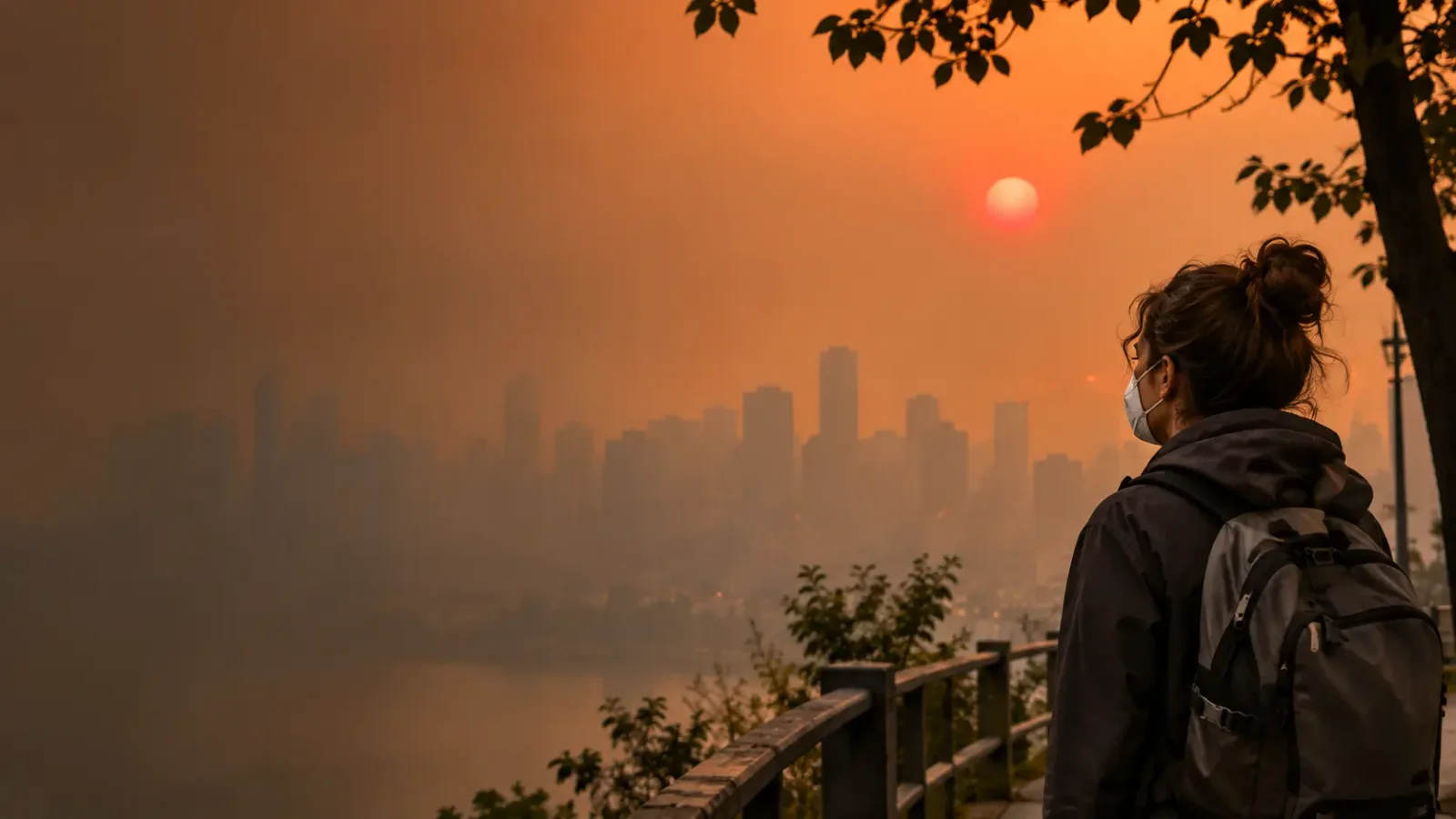
Smoke and poor air quality
Wildfire smoke can travel thousands of kilometres and make the air unbreathable far from the flames. In cities, smog episodes have the same effect. There is no risk-free level.
Quebec / Canada
France
If you only do three things
- 1Follow the Air Quality Health Index or ATMO index
- 2Prepare a cleaner-air room with a purifier
- 3Keep N95 masks for essential outings
Lasting collapse?
Key figures
Air that makes people sick far from the flames.
Understanding the risk
Particles you cannot always see.
Smoke contains fine particles (PM2.5) and gases that penetrate deep into the lungs. Air quality can be poor even if you cannot see or smell smoke.
In Canada, the Air Quality Health Index (AQHI) runs from 1 to 10+, and the WeatherCAN app sends alerts. In Quebec, Info-Smog publishes forecasts. In France, the ATMO index rates air in six classes, from “good” to “extremely poor”.
Severity
Effects range from coughing and eye irritation to asthma attacks, heart problems and, more rarely, strokes. Children, older adults, pregnant people and people with chronic illnesses are most affected.
Smoke often comes with heat waves: you then need protection from both heat and air.
In detail
What to do depending on the level.
| Air quality | What to do | Avoid |
|---|---|---|
| Moderate | Sensitive people reduce outdoor exertion | Ignoring symptoms |
| Poor | Stay indoors, close windows, run the purifier | Exercising outdoors |
| Very poor | Stay in the refuge room, N95 for any outing | Opening windows “to air out” |
| Heat and smoke together | Cool down without letting smoke in, go to an air-conditioned place | Staying in an overheated home |
| Serious symptoms | Get care, call 911 or 15 if breathing is difficult | Waiting it out |
Assess your exposure
Are you more exposed than average?
Tick what applies to your situation.
Get prepared
Your preparedness checklist
Tick items as you go: your progress is saved on this device.
Suggested kits and plans
Before, during, after
The right actions, before, during and after.
Before
- Air quality alerts on
- Purifier ready
- N95 masks in stock
- Medication up to date
- Refuge room chosen
During
- Stay indoors, windows closed
- Run the purifier
- Reduce exertion
- N95 for essential outings
- Watch vulnerable people
After
- Air out when the air is good again
- Change the filters
- Clean dusty surfaces
- Get care if symptoms persist
- Note what was missing
In Quebec, Canada and France
What changes depending on where you live.
Quebec / Canada
Environment and Climate Change Canada publishes the Air Quality Health Index and air quality alerts; in Quebec, Info-Smog forecasts smog episodes. Regional public health may advise staying indoors.
- Emergency
- 911
- Air quality
- AQHI, WeatherCAN, Info-Smog
- Health
- Info-Santé 811
- Smoke
- ECCC FireWork map
France
Approved air quality monitoring associations (Atmo) publish the ATMO index for each commune every day. During a peak, the prefecture can trigger an information or alert procedure with traffic measures.
- Emergency
- 15 or 112
- Air quality
- ATMO index, Atmo France
- Health
- Family doctor, pharmacy
- Alerts
- Prefecture, FR-Alert
Domino effect
This risk often triggers others
Frequently asked questions
Frequently asked questions
Is a surgical mask enough?
No. It filters smoke’s fine particles poorly. A well-fitted N95 is much more effective.
Should I open windows at night?
Not during a smoke episode. Air out only once air quality is good again.
What size purifier?
Choose a unit whose clean air delivery rate (CADR) matches the size of the refuge room.
Is smoke dangerous if I cannot see it?
Yes. Fine particles can be present without odour or visible haze: rely on official indexes.
365 Program
Prepare for this risk, week by week
Data checked on November 23, 2026. Figures come from the organizations cited; consult them for updates.
Sources
Data checked on November 18, 2026. Figures come from the organizations cited; consult them for updates.
- Health Canada, Health effects of wildfire smoke
- Environment and Climate Change Canada, Wildfire smoke and air quality
- Santé publique France, Health impact of air pollution (in French)
- data.gouv.fr, ATMO index (in French)
- CTV News, Montreal has the poorest air quality in the world
This page provides general preparedness information. It does not replace instructions from the authorities: in an emergency, call 911 in Canada or 112 in France.
Start with the basics.
Our free “Be Prepared” guide: 72-hour kit, family plan and your own risk assessment.
Smoke and poor air quality
Index Quebec/Canada 6/9 · France 4/9
If you only do three things
- Follow the Air Quality Health Index or ATMO index
- Prepare a cleaner-air room with a purifier
- Keep N95 masks for essential outings
During
- Stay indoors, windows closed
- Run the purifier
- Reduce exertion
- N95 for essential outings
- Watch vulnerable people
After
- Air out when the air is good again
- Change the filters
- Clean dusty surfaces
- Get care if symptoms persist
- Note what was missing
Emergency numbers: 911 (Canada) · 112 (France)
prepacivile.com/en/risks/smoke-air-quality/