
In this article
- Preparation that carries over from one season to the next
- What the last three seasons show
- Telling fire, smoke and service disruptions apart
- Start with the area around your home
- Choosing the right information channels
- Planning for more protective indoor air
- Don't trade a smoke risk for a heat risk
- Understanding the limits of masks
- Prepare your departure before it becomes urgent
- Documents, insurance and household coordination
- A simple schedule that lasts
- Frequently asked questions
- Sources and updates
- Optional equipment examples
Wildfires don't only threaten cottages deep in the woods: their smoke can reach entire cities, and you may be asked to leave within hours. This guide helps you prepare three things that work together: surroundings that are less exposed to embers, indoor air that offers more protection from smoke, and a departure you can make without delay. It draws on recommendations from SOPFEU (Quebec's forest fire protection agency), the Government of Quebec and Health Canada, and on figures from recent seasons.
At a glance
- In 2025, 87% of fires in Quebec's intensive protection zone were human-caused: prevention starts at home.
- An immediate zone of at least 1.5 metres that is hard to ignite around the house reduces the risk from embers.
- A filtered room or a mask never makes it possible to stay in an area under evacuation: if the authorities ask you to leave, leave.
Preparation that carries over from one season to the next
Wildfires require continued preparation, even when the last summer has been quiet in your area. Natural Resources Canada indicates that climate change is changing fire conditions and that recurrent fires can compromise forest regeneration. This justifies lasting attention, without pretending to foresee the next fire at the address of a home. Effects of climate change on forests.
Tree planting and ecosystem restoration have their place in long-term thinking. They do not replace maintenance around a building, sanitary measures or municipal plans. Comparing burned trees to planted seedlings alone is not enough to measure the forest balance: natural regeneration and the diversity of environments must also be taken into account. A family does not have to wait for these issues to be resolved to improve its preparation.
Your plan must be able to serve several years, with a review before each season and after a significant change: moving, arrival of a child, new mobility limitation, modification of a treatment or new workplace. The goal is to maintain some useful abilities, rather than starting purchases again with each episode of smoke.
What the last three seasons show
Wildfire seasons vary widely from one year to the next. In 2023, lightning started fires of exceptional scale: nearly 1.1 million hectares burned in the intensive protection zone, and more than 3.2 million in the northern zone. In 2025, by contrast, there were many fires, but the area burned stayed small: 1,248 hectares in total.
Quebec's intensive protection zone, 2023 to 2025 seasons
- 2023566
- 2024352
- 2025528
- 10-year average452
Source: SOPFEU, 2023 to 2025 season reviews (10-year average as reported in the 2023 and 2024 reviews), accessed November 10, 2026.
So the number of fires doesn't tell the whole story: a season that is "quiet" in terms of area burned can still see many fires start. And most of the time, those fires are started by people: in 2025, 87% of fires in the intensive zone were human-caused.
Number of fires, intensive protection zone (528 fires in total)
- Campfires not fully put out134
- Debris burning86
- Cigarette butts82
Source: SOPFEU, 2025 season review, accessed November 10, 2026.
For your household, the lesson is twofold: put campfires out completely, check SOPFEU's fire danger rating and bans before any burning, and prepare your home and your departure as if next season could look like 2023.
Telling fire, smoke and service disruptions apart
| Situation | Question to be solved | Useful preparation |
|---|---|---|
| Housing near combustible vegetation | Can embers find fuel against the building? | Maintenance and layout adapted to the recommendations Intelli-feu. |
| Smoke, even far from a fire | Where to spend time in cleaner air and at a safe temperature? | Health monitoring, adaptation of activities and internal solution or alternative place. |
| Departure or access interrupted | How to go with the people and animals involved? | Transportation, destination, essentials and offline sources of information. |
An apartment in the city can be exposed to smoke without being threatened by flames. A cottage can combine limited road access, uncertain mobile coverage and proximity to the forest. Describe your real situation: the same expenses and work will not be prioritized everywhere.
Start with the area around your home
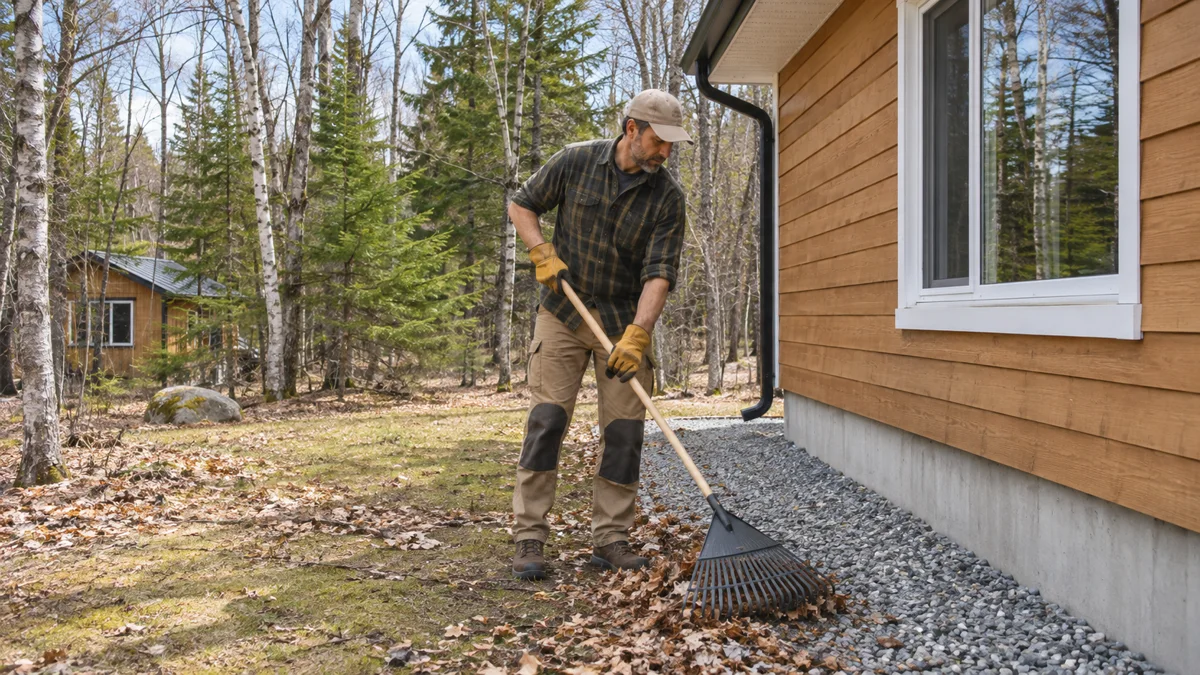
SOPFEU recommends an immediate area that is not flammable at least 1.5 meters around the house and adjoining structures, Like a terrace. Removing leaves, branches and easily flammable materials in this area reduces the possibility of ignition near the building. In particular, the guide prefers pebbles to combustible mulch in this area. SOPFEU advice for the immediate area.
Make an inspection from the ground, with a short list of corrections. Locate accumulated debris, stored wood and maintenance points to be evaluated. SOPFEU also recommends storing combustible materials at more than 10 meters from the building. For the entire layout and the particularities of your land, consult its recommendations and local services; these distances do not guarantee that a house will withstand any fire. Storage of fuels according to SOPFEU.
If you rent, report any visible problems to the landlord or manager and ask what the building provides. Do not perform work at height or slaughter without skill or permission. Maintenance belongs to the upstream preparation; when a departure is requested, it must not delay the evacuation.
Choosing the right information channels
Record your municipality’s information, SOPFEU maps and restrictions, weather alerts and official air quality sources. The Government of Quebec recommends that you register with the citizen alert service of your municipality when it exists and follow local instructions. Don’t wait for a single notification to resolve all situations. Preparing for a forest fire - Quebec.
For smoke, use them. air quality sources brought together by Health Canada : Info-Smog forecasts in Quebec, air health ratings by sector and alerts in effect. Smoke maps help understand plume movements; they do not replace health recommendations or local observations.
Write useful addresses and contact information on an accessible form. Check phone settings, tracking locations, and charging capacity. A radio and pre-arranged contacts complete the phone. For messages received by your entourage, check the source and date before relaying them.
Planning for more protective indoor air
Choose in advance the room where the household could spend more time during an episode of smoke. Examine the openings, existing equipment and how they are used. The public health of Quebec describes the precautions according to the ventilation systems and reminds that a portable device is not necessary for the entire population: the needs differ according to the exposure and the state of health. Quebec Recommendations on Smoke.
If a portable air purifier is relevant, measure the room before choosing the device. Health Canada recommends looking at the clean air flow, or CADR, corresponding to the smoke, the intended area and the conditions of use. A HEPA filter is useful, but the label alone does not replace a suitable capacity. Avoid ozone-producing devices and plan for maintenance and filter availability. Choosing and Using an Air Purifier - Health Canada.
Test the operation before you need it: placement, noise at a usable speed and space around the device. Keep the package leaflet and filter reference. For a central system, check with the manufacturer or a competent person for compatible filters; installing an unsuitable filter is not a reliable improvement.
Don't trade a smoke risk for a heat risk
Closing windows can reduce smoke entry, but overheating housing requires another decision. Health Canada says that during an episode that combines extreme heat and smoke, the priority is to stay cool. If you cannot maintain safe conditions, locate an air-conditioned and filtered air location with your municipality or health authorities. Smoke and Extreme Heat - Health Canada.
Enter this solution in your plan before the summer: address, opening hours to check, transport and possible reception of animals. A connected device is no longer used during a breakdown, so the plan must include an alternative. Our guide to Preparing the house for hot weather Helps to complete this reflection.
Understanding the limits of masks
A well-fitting respirator, such as an appropriate N95, can decrease exposure to fine particles when the outlet is needed. It does not protect against smoke gases. Its effectiveness depends in particular on the adjustment: the figure “95” does not mean that each person will automatically reduce his or her actual exposure by 95%. Reducing output and effort remains an important measure.
The advice is not the same for an adult, a young child or a person with breathing difficulties. In particular, respirators are not suitable for those under two years of age or for people unable to remove them alone. Ask for appropriate advice when a disease or difficulty wearing the mask occurs. Never use a mask as a justification for crossing a dangerous area or ignoring an evacuation notice. These limits are detailed in the Health Canada Fact Sheet.
Prepare your departure before it becomes urgent
Agree on a destination and another possibility, the person who organizes the transport and special needs. Check the possibility of taking the animals. Keep a set of essentials accessible: medicines, documents, clothing, means of communication and personal equipment. The Preparing a family bag You have to take into account what everyone can really wear.
It is useful to study several routes, but their availability will have to be confirmed the same day. Consult Québec 511 and municipal information; respect the closures and the routes imposed. If you are in danger or if the authorities ask you to leave, leave the accommodation. Do not delay departure to protect property. Instructions from Quebec during a forest fire.
Don’t rely on a universal sequence of three alert levels: messages and modalities vary. Read what the authority responsible for your industry is asking for. Provide concrete help for a person who cannot go out alone, with an alternative if the designated loved one is absent. The Guide Evacuation and reduced mobility develop this point.
To put together a bag for each household member, use our Evacuation bag tool, then take stock of your overall preparedness with My preparedness review.
Documents, insurance and household coordination
Gather the details of the insurer, the contract references and an inventory of the goods accompanied by photos. Ask for details about any guarantees, deductibles, exclusions and accommodation charges applicable to your situation; do not assume that a word in the contract covers all costs of an evacuation. Also keep proof of the expenses incurred.
A secure digital copy can complete the paper file. Check that it is accessible offline and that authorized persons know how to find it. Limit health data to what is useful for management. After a change of phone or password, a short access test avoids a bad surprise.
For relatives, plan a news take and a destination communicated in case of departure. Neighbors can help to transmit information or organize a trip, within the limits of their abilities. Aid announced without agreement or alternative solution weakens the plan.
A simple schedule that lasts
- Before the season: Review alerts, test devices, inspect the surroundings, prepare for departure and discuss health needs.
- When a situation deteriorates: follow the instructions, adapt the activities and bring together the essentials useful at the beginning.
- After an episode: replace the consumables used, check expenses and note the difficulties encountered.
- During a change of situation: review transport, destination, contacts and personal equipment.
First, choose a feasible fix: clear the immediate area, call the manager, note a destination or test the hardware already present. An improvement maintained and understood by the household is worth more than an ambitious list left unattended.
Frequently asked questions
What signs should you wait before you evacuate?
Don’t wait to see the flames. Follow the official messages of your sector and leave if you are in danger or if the authorities request it. Levels and formulations are not a universal sequence to rely on.
Is an N95 enough in a heavy smoke?
It can reduce exposure to particles if it is suitable for the person and fits well, but does not protect against gases. It complements other measures and does not replace reduced exposure or evacuation.
How do I assess the risk near my home?
Consult the information of SOPFEU, the restrictions in force and municipal instructions. Distinguish between fire hazards, threats to your industry and air quality: this information answers different questions.
Should I buy a purifier in every room?
First, assess existing equipment, health needs, part used and alternatives. A device must have a suitable capacity and be maintained. Systematic buying for all parts is not a general rule.
Does planting trees immediately protect my home?
An ecological restoration initiative is not a substitute for building protection measures. The layout near the house must follow recommendations adapted to the risk of fire and the local context.
Sources and updates
Documentary verification: November 3, 2026. The official links are with the relevant councils: Natural Resources Canada for the forest context; SOPFEU for housing; Quebec government for preparation and evacuation; Health Canada and Quebec public health for smoke, filtration and heat. The local instructions in force take precedence during an emergency.
Wildfire season statistics: SOPFEU, season reviews, accessed November 10, 2026.
Two items for putting these ideas into practice
Check portable lighting and accessible drinking water for travel or departure.
Affiliate links: as an Amazon Associate, PrépaCivile earns from qualifying purchases. These examples are optional. Check the model, package contents and terms. Use equipment you already own first.
Headlamp for hands-free lighting
Check required batteries and storage; supervise children using the light.
Canada — Amazon.ca
 BLACK DIAMOND Spot 400 Lampe frontale | Luminosité de 400 lumens | Intensité variable | Étanche et durable | Fonctionne avec 3 piles AAA (incluses) | GraphiteView on Amazon.ca
 Black Diamond Unisex Spot 400 Lampe Frontale Graphites One Size
Bottle for carrying drinking water
Listed capacities differ: approximately 946 ml in Canada and 1 L in France. A bottle does not make contaminated water safe.
Canada — Amazon.ca
 Nalgene Bouteille d'eau à large goulot de 946,2 ml, sans BPA, durable et anti-fuite, légère pour randonnée et salle de sport, travail et voyage, bleu céruléenView on Amazon.ca
 Nalgene Gourde 'WH Sustain' Azuré 1 L