

Technological and household · Risk index 8/9 (Quebec) · 5/9 (France)
Prolonged power outage
A few hours without power is an inconvenience. Several days in winter is an emergency: heat, water, food, communications and health are all affected at once.
Quebec / Canada
France
If you only do three things
- 1A safe source of heat and light that works without electricity
- 2Water and no-cook food for at least 72 hours
- 3A battery-powered carbon monoxide alarm
Lasting collapse?
Key figures
Outages that last, affecting millions of people.
Understanding the risk
When everything stops at once.
Most outages last minutes or hours. The ones that matter for preparedness are prolonged outages lasting several days, caused by freezing rain, windstorms, thunderstorms or a major grid failure. They often affect entire regions, which slows restoration and overwhelms services.
In Quebec, where most homes are heated with electricity, a mid-winter outage quickly becomes a survival issue: indoor temperatures can drop below 10 °C (50 °F) within one to two days in a poorly insulated house. In France, heating is more varied, but storms such as Lothar and Martin in 1999 (3.5 million households without power) and Ciarán in 2023 showed that widespread outages remain possible.
Severity
The outage itself is not dangerous; its consequences are: cold, spoiled food, medication no longer refrigerated, medical devices stopped, drinking water cut off for homes on wells, communications down.
The most underestimated danger is carbon monoxide poisoning. During the April 2023 ice storm, Montreal public health recorded 173 cases, including one death. The vast majority came from charcoal barbecues or generators used indoors or too close to the house. Of 64 reports, only 4 homes had a CO alarm, and only one worked.
In detail
How long without power?
| Duration | What happens | Your priority |
|---|---|---|
| 0–6 h | Fridge still cold, phones charged | Keep fridge doors closed, stay informed |
| 6–24 h | Fridge food to watch, house cooling down | Gather the family in one room, layers of clothing |
| 24–72 h | Freezer thawing, batteries dead, well water stopped | Water and food supplies, solar charging, check on vulnerable neighbours |
| Over 72 h | Risk of frozen pipes, health of vulnerable people | Emergency shelter, drain plumbing, stay in touch with the municipality |
Assess your exposure
Are you more exposed than average?
Tick what applies to your situation.
Get prepared
Your preparedness checklist
Tick items as you go: your progress is saved on this device.
Suggested kits and plans
Before, during, after
The right actions, hour by hour.
Before
- Water, food and lighting supplies
- Battery CO alarm
- Batteries and radio ready
- Plan for vulnerable people
- Safe backup heating
During
- Check whether neighbours are also affected, then the utility’s outage site
- Unplug sensitive appliances, leave one lamp on to know when power returns
- Keep fridge and freezer closed
- Gather in one room and close the doors to the others
- Use no fuel-burning appliance indoors
After
- Plug appliances back in gradually
- Check food and discard anything doubtful
- Discard refrigerated medication that was not kept cold
- Boil well water for at least 1 minute until it is confirmed safe
- Restock your supplies
In Quebec, Canada and France
What changes depending on where you live.
Quebec / Canada
Hydro-Québec publishes real-time outage status and estimated restoration times. During prolonged outages, municipalities open warming or shelter centres.
- Outages
- Hydro-Québec Info-pannes website and app
- Emergency
- 911
- Health
- Info-Santé 811
- Shelter
- Your municipality
France
In France, Enedis runs most of the distribution grid and publishes an outage map. People whose lives depend on electrical equipment can be registered as high-risk patients with their supplier.
- Outages
- Enedis app and website (or local distributor)
- Emergency
- 112 or 18
- Warnings
- Météo-France (high winds, snow and ice)
- Alerts
- FR-Alert on mobile phones
Domino effect
This risk often triggers others
Frequently asked questions
Frequently asked questions
Can I use a barbecue or camp stove indoors?
No, never, even near an open window. These appliances produce carbon monoxide. It is the leading cause of poisoning during major outages.
How long does freezer food last?
A full freezer in good condition, kept closed, keeps food frozen for up to 48 hours; a half-full freezer for about half as long.
Can a car battery charge phones?
Yes, with an adapter, running the engine outdoors, never in a closed garage.
Should I turn off the main breaker during an outage?
Unplug sensitive appliances. If your home has flooded or you smell burning, don’t touch the electrical panel and call an electrician.
Sources
Sources
Data checked on November 18, 2026. Figures come from the organizations cited; consult them for updates.
- Government of Quebec, What to do before, during and after a power outage (French)
- Montreal Public Health, Carbon monoxide poisonings during the April 2023 ice storm (French)
- P. Lagadec, The Quebec ice storm, lessons learned (1999, French)
- Narcity, April 2023 ice storm: 1.1 million customers without power (French)
- L’info durable, Ciarán devastated north-western France (French)
- Notre-planète.info, The December 1999 storms in France (French)
This page provides general preparedness information. It does not replace instructions from the authorities: in an emergency, call 911 in Canada or 112 in France.
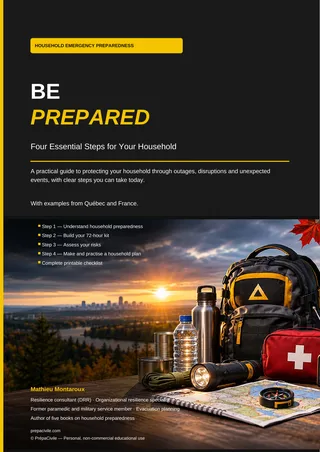
Start with the basics.
Our free “Be Prepared” guide: 72-hour kit, family plan and your own risk assessment.
Prolonged power outage
Index Quebec/Canada 8/9 · France 5/9
If you only do three things
- A safe source of heat and light that works without electricity
- Water and no-cook food for at least 72 hours
- A battery-powered carbon monoxide alarm
During
- Check whether neighbours are also affected, then the utility’s outage site
- Unplug sensitive appliances, leave one lamp on to know when power returns
- Keep fridge and freezer closed
- Gather in one room and close the doors to the others
- Use no fuel-burning appliance indoors
After
- Plug appliances back in gradually
- Check food and discard anything doubtful
- Discard refrigerated medication that was not kept cold
- Boil well water for at least 1 minute until it is confirmed safe
- Restock your supplies
Emergency numbers: 911 (Canada) · 112 (France)
prepacivile.com/en/risks/power-outage/