
Natural · Risk index 8/9 (Quebec) · 8/9 (France)
Flood
France’s leading natural risk, and a recurring risk in Quebec every spring. Water comes in fast, and leaves damage that lasts for months.
Quebec / Canada
France
If you only do three things
- 1Know whether your address is in a flood zone
- 2A backwater valve, and valuables out of the basement
- 3Never cross a flooded road, on foot or by car
Lasting collapse?
Key figures
A risk that keeps coming back, and costs a lot.
Understanding the risk
Three ways water gets into your home.
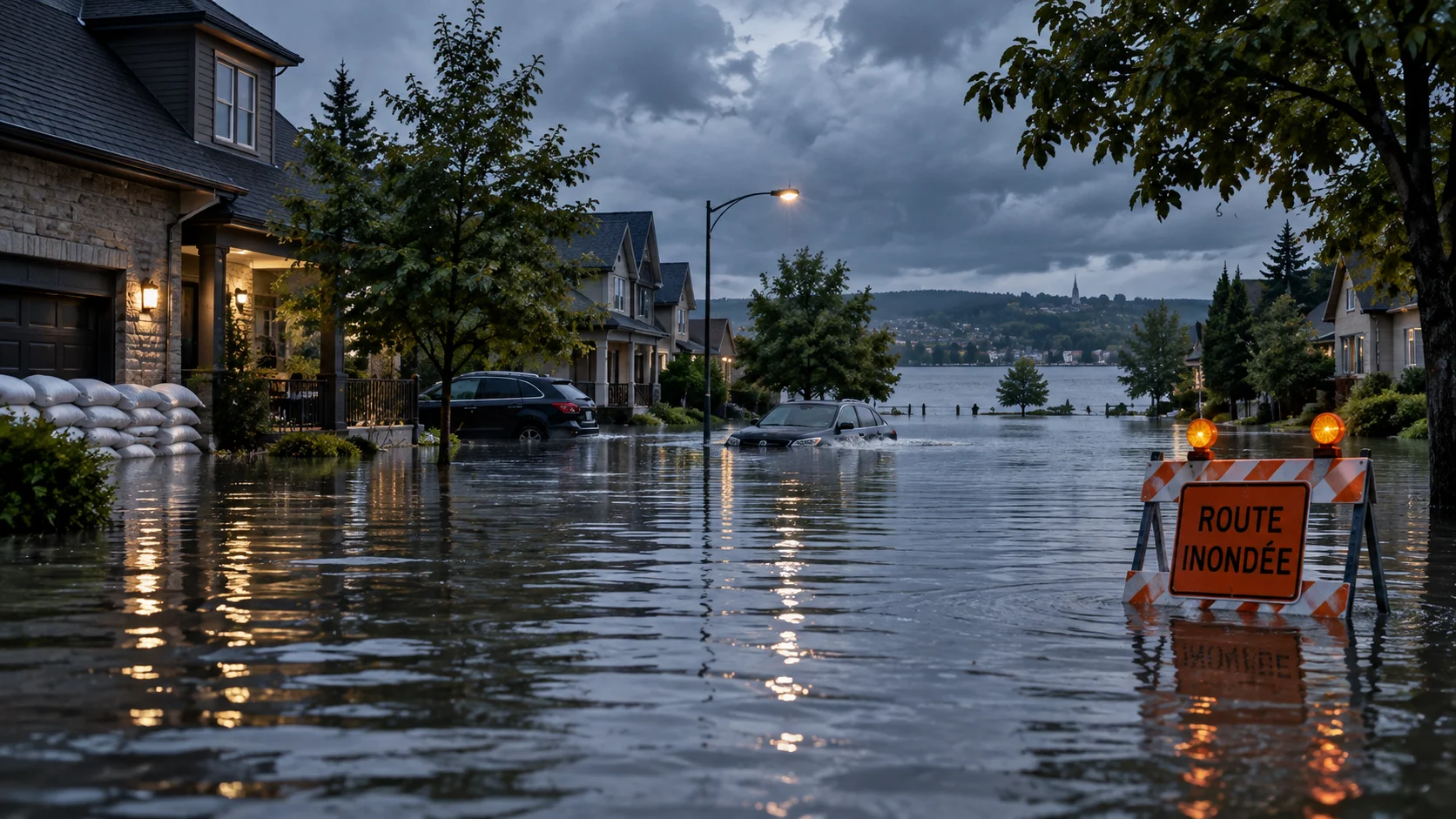
There are several kinds of flooding. Slow river floods, typical of the Quebec spring melt, can be seen coming days ahead. Flash floods and urban runoff after a violent storm happen within hours, sometimes in less than an hour. Sewer backups can flood a basement even far from any river, when the municipal system overflows.
In France, flooding is the leading natural risk by number of people exposed and by damage. Mediterranean rain events can drop the equivalent of several months of rain in a few hours. In Quebec, the 2017 and 2019 floods affected hundreds of municipalities and led to thousands of evacuations.
Severity
Most flood deaths happen on the road: drivers try to cross a submerged roadway and are swept away. The current is almost always stronger than it looks, and the road may have collapsed under the water.
After the flood, the damage lingers: mould, contaminated well water, dangerous electricity, weakened structures. Affected households often face months of paperwork and repairs, and significant stress.
In detail
Which type of flood threatens you?
| Type | Warning time | Where | Key measure |
|---|---|---|---|
| Slow flood (snowmelt, river) | Several days | Riverbanks, floodplains | Monitor water levels, move belongings upstairs |
| Flash flood and runoff | A few hours or less | Narrow valleys, paved urban areas | Receive alerts, stay off the roads |
| Sewer backup | None | Any basement connected to the sewer | Maintained backwater valve, sump pump |
| Dike failure or ice jam | Very short | Behind a dike, near ice jams | Know your evacuation route |
| Coastal flooding | Hours to a day | Low-lying coast | See the coastal flooding page |
Assess your exposure
Are you more exposed than average?
Tick what applies to your situation.
Get prepared
Your preparedness checklist
Tick items as you go: your progress is saved on this device.
Suggested kits and plans
Before, during, after
The right actions, before the water rises.
Before
- Know your risk zone
- Valve and pump maintained
- Valuables upstairs
- Insurance checked
- Alerts on
During
- Follow official instructions and evacuate if told to
- Turn off electricity and gas if water is approaching, only if safe
- Go upstairs, never down into a flooded basement
- Never drive on a flooded road
- Keep your go-bag and medication within reach
After
- Wait for permission before going home
- Have the electrical system checked before turning power back on
- Photograph the damage and notify your insurer quickly
- Wear gloves, boots and a mask to clean up; discard anything soaked in dirty water
- Have well water tested before drinking it
In Quebec, Canada and France
What changes depending on where you live.
Quebec / Canada
In Quebec, municipalities and RCMs map flood zones and the government monitors water levels. A financial assistance program may apply to those affected by major events.
- Emergency
- 911
- Water levels
- Vigilance, Government of Quebec
- Alerts
- Québec En Alerte
- Assistance
- Ministry of Public Security disaster assistance programs
France
In France, Vigicrues publishes flood warnings and Météo-France rain-flood warnings. The natural disaster scheme (CatNat) compensates damage once an official decree is published.
- Emergency
- 112 or 18
- Warnings
- Vigicrues and Météo-France
- Local risks
- georisques.gouv.fr
- Insurance
- Claim within 30 days of the CatNat decree
Domino effect
This risk often triggers others
Frequently asked questions
Frequently asked questions
Does my home insurance cover flooding?
Not necessarily. In Canada, flood and sewer-backup coverage is often optional. In France, damage is covered by the natural-disaster guarantee once a decree is published. Check your policy before the risk season.
What is a backwater valve?
A device installed on the sewer line that stops wastewater from the municipal system from backing up into your basement. It must be accessible and cleaned regularly.
Can I drink tap water after a flood?
Follow your municipality’s advisories. If your well was flooded, don’t drink the water until it has been disinfected and tested.
Should I evacuate if I live upstairs?
If authorities order an evacuation, leave: access, electricity and drinking water may be cut for days, and responders may not be able to reach you.
Go further
Our articles on this hazard
- Flooding and fire: making decisions when hazards combine
- Dams: understanding your exposure and preparing to follow instructions
- Disaster recovery: a comprehensive checklist
- Underwater road tunnels: planning a journey and responding to water ingress
- Preventing water damage: inspections, documents and evacuation
Sources
Sources
Data checked on November 18, 2026. Figures come from the organizations cited; consult them for updates.
- French Ministry for Ecological Transition, Flood risk in France (French)
- Government of Quebec, 2017 floods: assessment and outlook (French)
- MétéoMédia, 2019 floods: more than 10,000 evacuations (French)
- Géorisques, risks in your municipality (French)
This page provides general preparedness information. It does not replace instructions from the authorities: in an emergency, call 911 in Canada or 112 in France.
Start with the basics.
Our free “Be Prepared” guide: 72-hour kit, family plan and your own risk assessment.
Flood
Index Quebec/Canada 8/9 · France 8/9
If you only do three things
- Know whether your address is in a flood zone
- A backwater valve, and valuables out of the basement
- Never cross a flooded road, on foot or by car
During
- Follow official instructions and evacuate if told to
- Turn off electricity and gas if water is approaching, only if safe
- Go upstairs, never down into a flooded basement
- Never drive on a flooded road
- Keep your go-bag and medication within reach
After
- Wait for permission before going home
- Have the electrical system checked before turning power back on
- Photograph the damage and notify your insurer quickly
- Wear gloves, boots and a mask to clean up; discard anything soaked in dirty water
- Have well water tested before drinking it
Emergency numbers: 911 (Canada) · 112 (France)
prepacivile.com/en/risks/flood/