
Natural · Risk index 5/9 (Quebec) · 5/9 (France)
Landslide
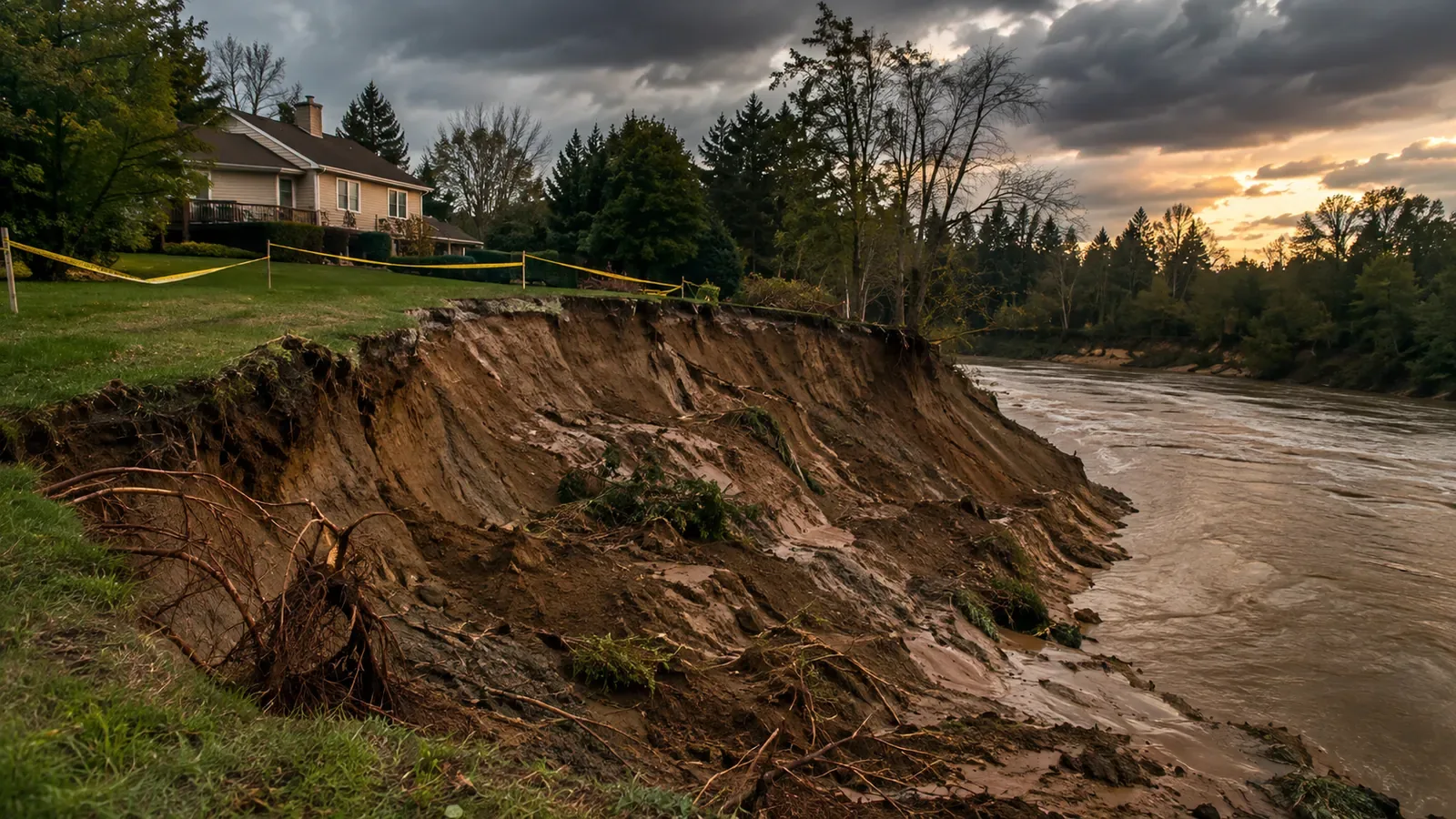
A landslide can sweep away a house in seconds, often after a rapid thaw or heavy rain. In Quebec, the sensitive clays of the St. Lawrence valley make this a very real risk.
Quebec / Canada
France
If you only do three things
- 1Check whether your property is in an exposed zone
- 2Report any crack, bulge or unusual water flow in a slope
- 3Never fill or dig near a slope without your municipality’s advice
Lasting collapse?
Key figures
A quiet risk, but deadly.
Understanding the risk
When the ground gives way.
A landslide is the movement of a mass of soil down a slope. In Quebec, most occur in the sensitive clays of the St. Lawrence valley, from the Outaouais to Quebec City and the Saguenay. These marine clays can suddenly lose their strength and liquefy, which explains large slides like Saint-Jean-Vianney.
The triggers are well known: erosion at the base of a slope by a river, heavy or prolonged rain, rapid snowmelt, and poorly done work (fill, excavation, clearing, water discharged into the slope). Most occur in spring and early summer. In France, ground movements also include mountain rockfalls, cavity collapses and clay shrink-swell, which cracks houses during droughts.
Severity
A large clay landslide can take several homes at once and spread far back from the slope. Victims are often caught at night, as at Saint-Jean-Vianney.
Small slides are much more frequent: they damage land, roads and foundations. Clay shrink-swell doesn’t kill, but it accounts for 36% of natural disaster compensation costs in France.
In detail
Work that increases the risk near a slope.
| Work | Where | Effect |
|---|---|---|
| Fill, storing soil or wood | At the top of the slope | Adds weight on the slope |
| Above-ground pool | At the top of the slope | Heavy load and risk of water leaks |
| Excavation, cutting the toe | At the base | Removes the support holding the slope |
| Discharging water (gutter, drain, emptying) | At the top or into the slope | Saturates the soil and promotes sliding |
| Clearing trees | On the slope | Roots help hold the soil |
Assess your exposure
Are you more exposed than average?
Tick what applies to your situation.
Get prepared
Your preparedness checklist
Tick items as you go: your progress is saved on this device.
Suggested kits and plans
Before, during, after
The right actions, before, during and after.
Before
- Hazard map checked
- Water directed away
- No fill at the top
- Spring inspection
- Go-bag ready
During
- Leave the house if it’s damaged or authorities ask
- Indoors: go to the side away from the slide, shelter under sturdy furniture
- Outdoors: move quickly out of its path
- Stay away from slopes, trees and power lines
- Call 911 or 112
After
- Stay away from the slide area
- Return only with authorities’ approval, in daylight
- Photograph the damage
- Notify your municipality, insurer and lender
- Watch for signs of distress
In Quebec, Canada and France
What changes depending on where you live.
Quebec / Canada
In Quebec, the government maps zones potentially exposed to landslides, and municipalities regulate work in those zones. The Ministry of Transport assesses reports.
- Emergency
- 911
- Report
- Your municipality
- Map
- Landslide-exposed zones
- Support
- Info-Social 811, option 2
France
In France, risk prevention plans (PPR) regulate building in ground movement zones. Géorisques shows the risks around an address, including clay shrink-swell.
- Emergency
- 112 or 18
- Information
- Géorisques
- Regulation
- Risk prevention plan (town hall)
- Compensation
- Natural disaster decree
Domino effect
This risk often triggers others
Frequently asked questions
Frequently asked questions
How do I know if my land is at risk?
In Quebec, check the map of exposed zones and ask your municipality. In France, enter your address on Géorisques.
Is a crack in my yard serious?
Not always, but report it to your municipality, especially near a slope. A specialist can assess stability.
Does insurance cover landslides?
In Quebec, they’re often excluded from home policies; government aid may exist after a disaster. In France, they’re covered if a natural disaster decree is issued. Check your policy.
When is the risk highest?
In spring and early summer, when thaw and rain saturate the ground, and after heavy rain.
Sources
Sources
Data checked on November 18, 2026. Figures come from the organizations cited; consult them for updates.
- Natural Resources Canada, Mapping fatal landslides in Canada (French)
- Government of Quebec, Landslide: what to do (French)
- MétéoMédia, Saint-Jean-Vianney: remembering (French)
- MétéoMédia, Why Quebec is particularly at risk of landslides (French)
- SDES, New clay shrink-swell exposure zoning (French)
This page provides general preparedness information. It does not replace instructions from the authorities: in an emergency, call 911 in Canada or 112 in France. Insurance rules vary by policy and region: check your coverage with your insurer.

Start with the basics.
Our free “Be Prepared” guide: 72-hour kit, family plan and your own risk assessment.
Landslide
Index Quebec/Canada 5/9 · France 5/9
If you only do three things
- Check whether your property is in an exposed zone
- Report any crack, bulge or unusual water flow in a slope
- Never fill or dig near a slope without your municipality’s advice
During
- Leave the house if it’s damaged or authorities ask
- Indoors: go to the side away from the slide, shelter under sturdy furniture
- Outdoors: move quickly out of its path
- Stay away from slopes, trees and power lines
- Call 911 or 112
After
- Stay away from the slide area
- Return only with authorities’ approval, in daylight
- Photograph the damage
- Notify your municipality, insurer and lender
- Watch for signs of distress
Emergency numbers: 911 (Canada) · 112 (France)
prepacivile.com/en/risks/landslide/