
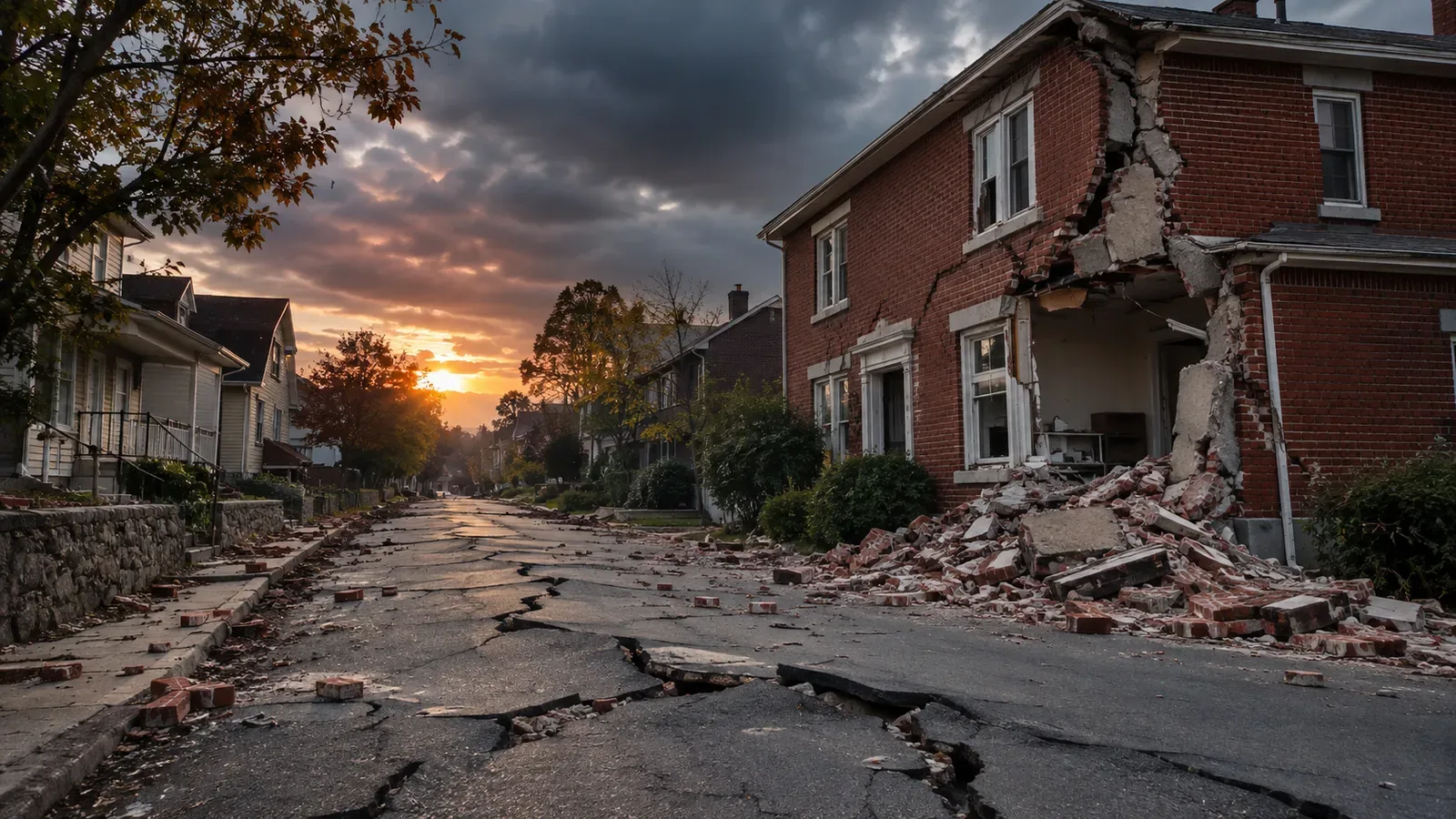
Natural · Risk index 4/9 (Quebec) · 3/9 (France)
Earthquake
It’s easy to forget, but Quebec shakes: Charlevoix records an earthquake every day and a half on average. Most go unfelt, but a magnitude 6 quake can strike without warning. A few simple steps make the difference.
Quebec / Canada
France
If you only do three things
- 1Secure tall furniture and heavy objects to the walls
- 2During shaking: drop, take cover under a sturdy table, hold on
- 3After: shut off gas if you smell it, go out carefully
Lasting collapse?
Key figures
Ground less stable than you think.
Understanding the risk
Rare earthquakes, but possible.
Southeastern Canada has five active seismic zones, two in Quebec: Charlevoix-Kamouraska, which has had at least five magnitude 6 quakes in 350 years, and Western Quebec, which includes Montreal and Ottawa. About three quakes per decade are strong enough to damage buildings. The 1925 La Malbaie quake reached 6.2.
In mainland France, seismicity is moderate, but the 2019 Le Teil earthquake showed that a shallow quake can do a lot of damage. The French Caribbean is in a high-seismicity zone.
Severity
In Eastern Canada, the danger lies less in frequency than in vulnerability: many older buildings, especially unreinforced masonry downtown, predate seismic codes. In 1988, 350 km from the epicentre, the cladding of Montréal-Est’s former city hall was badly damaged.
Injuries mostly come from falling objects, furniture and debris, not from houses collapsing entirely. That’s why securing what can fall matters.
In detail
Where to be during the shaking.
| You are… | What to do | Avoid |
|---|---|---|
| Indoors | Under a sturdy table, or against an interior wall protecting your head | Windows, tall furniture, doorways |
| In bed | Stay lying down, protect your head with a pillow | Getting up in the dark |
| Outdoors | Move away from buildings, poles and lines, crouch down | Staying near building fronts |
| In a car | Stop in an open area and stay inside | Bridges, overpasses, tunnels |
| In a wheelchair | Lock the wheels, bend over and protect your head | Trying to move |
Assess your exposure
Are you more exposed than average?
Tick what applies to your situation.
Get prepared
Your preparedness checklist
Tick items as you go: your progress is saved on this device.
Suggested kits and plans
Before, during, after
The right actions, before, during and after.
Before
- Furniture secured
- Cover spots identified
- Shut-offs known
- Shoes by the bed
- 72 hours of supplies
During
- Drop
- Take cover under sturdy furniture
- Hold on until it stops
- Stay inside during the shaking
- In a car: stop away from bridges
After
- Expect aftershocks
- Shut off gas if you smell it, no flames
- Leave carefully if the building is damaged
- Wear shoes because of glass
- Listen to the radio, avoid calls unless urgent
In Quebec, Canada and France
What changes depending on where you live.
Quebec / Canada
In Canada, Earthquakes Canada (Natural Resources Canada) monitors seismic activity. An earthquake early warning system can send a few seconds of warning to phones in some regions.
- Emergency
- 911
- Monitoring
- Earthquakes Canada
- Gas
- Your gas distributor
- Support
- Info-Social 811, option 2
France
In France, the country is divided into five seismic zones that set building rules. Géorisques shows your town’s zone; the Caribbean is in the high-seismicity zone.
- Emergency
- 112 or 18
- Zoning
- Géorisques
- Alerts
- FR-Alert
- Compensation
- Natural disaster decree
Domino effect
This risk often triggers others
Frequently asked questions
Frequently asked questions
Should I stand in a doorway?
No. In modern homes, doorways are no stronger than the rest, and the door can hurt you. Take cover under a sturdy table.
Should I go outside during the shaking?
No. Most injuries happen while going out, from falling debris and glass. Stay inside until it stops.
Does my insurance cover earthquakes?
In Canada, earthquake coverage is often an add-on. In France, damage is covered if a natural disaster decree is issued. Check your policy.
Are aftershocks dangerous?
Yes: they can bring down structures already weakened. Stay careful for several days after a major quake.
Sources
Sources
Data checked on November 18, 2026. Figures come from the organizations cited; consult them for updates.
- Natural Resources Canada, Earthquakes in southeastern Canada (French)
- Natural Resources Canada, The 1988 magnitude 5.9 Saguenay earthquake
- Public Safety Canada, Earthquakes backgrounder (French)
- MétéoMédia, Why are there earthquakes in Charlevoix? (French)
- CNRS, The Le Teil earthquake provides new insights on seismic risk
This page provides general preparedness information. It does not replace instructions from the authorities: in an emergency, call 911 in Canada or 112 in France. Insurance coverage varies by policy: check with your insurer.

Start with the basics.
Our free “Be Prepared” guide: 72-hour kit, family plan and your own risk assessment.
Earthquake
Index Quebec/Canada 4/9 · France 3/9
If you only do three things
- Secure tall furniture and heavy objects to the walls
- During shaking: drop, take cover under a sturdy table, hold on
- After: shut off gas if you smell it, go out carefully
During
- Drop
- Take cover under sturdy furniture
- Hold on until it stops
- Stay inside during the shaking
- In a car: stop away from bridges
After
- Expect aftershocks
- Shut off gas if you smell it, no flames
- Leave carefully if the building is damaged
- Wear shoes because of glass
- Listen to the radio, avoid calls unless urgent
Emergency numbers: 911 (Canada) · 112 (France)
prepacivile.com/en/risks/earthquake/