
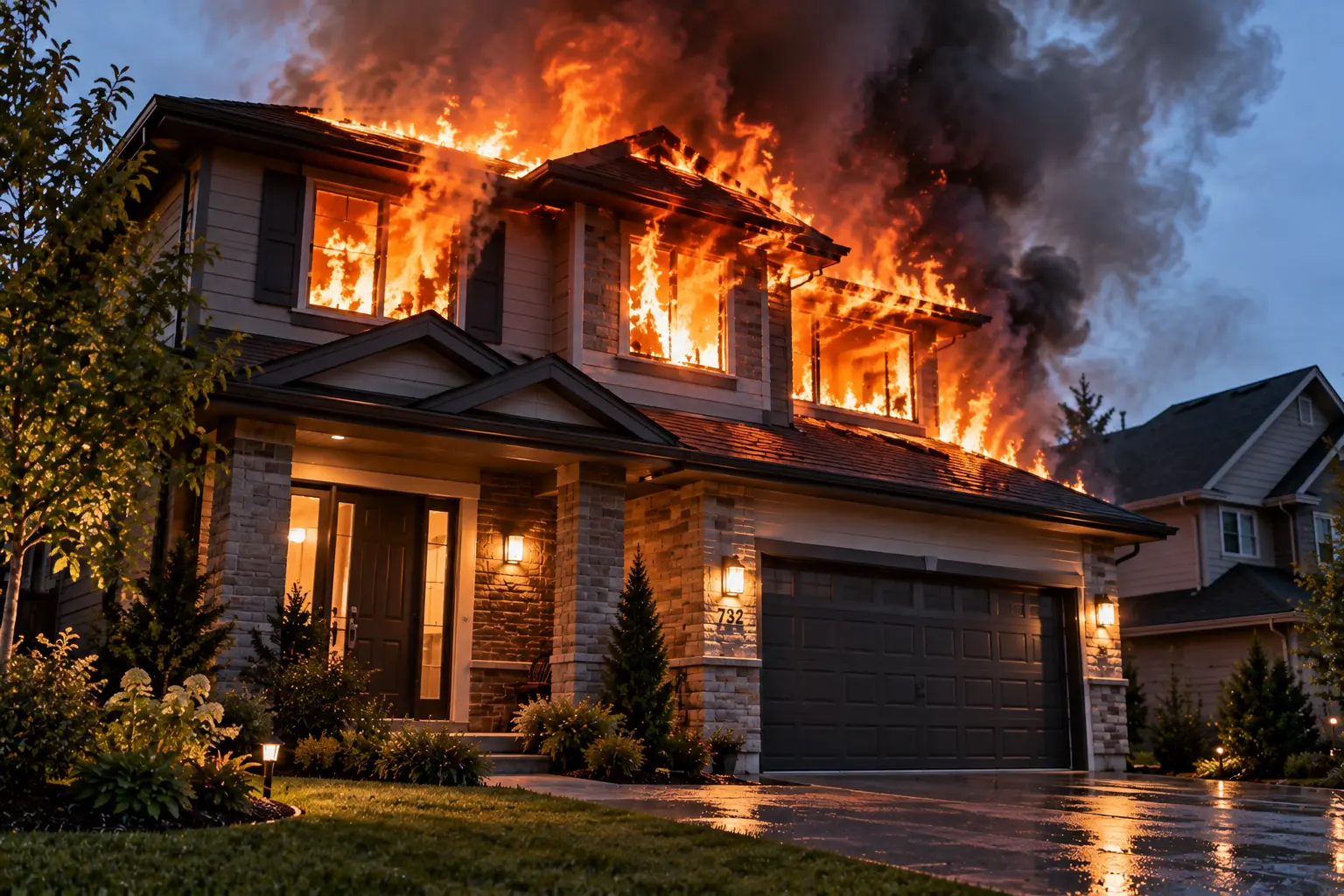
Technological and household · Risk index 9/9 (Quebec) · 9/9 (France)
House fire
The most frequent and deadliest risk for a household. The good news: it is also the one you have the most control over.
Quebec / Canada
France
If you only do three things
- 1A working smoke alarm on every floor, tested monthly
- 2An escape plan with two exits per room and a meeting point outside
- 3Never leave cooking unattended
Lasting collapse?
Key figures
A daily risk, on both sides of the Atlantic.
Understanding the risk
How a kitchen fire becomes a tragedy in five minutes.
A house fire develops much faster than most people imagine. With modern furniture, rich in synthetic materials, a room can be fully engulfed within minutes. Most victims are not burned to death: they are overcome by smoke, often in their sleep, before they even wake up.
In Quebec, nearly half of residential building fires are caused by human error, and the kitchen is where the fire starts in about one case in four. Electrical and mechanical failures come second. In France, the authorities cite electrical appliances, flammable products, candles, cigarettes and holiday decorations among the most frequent causes.
Severity
Severity is maximal: death, serious burns, loss of the home and everything in it — documents, keepsakes, sometimes pets. In Quebec, fires cause an average of 35 deaths and nearly 370 injuries a year (2019–2020). In France, the Ministry for Ecological Transition reports more than 200 deaths and more than 9,000 injuries a year; other, older sources gave higher figures.
Beyond the fire itself, the loss means weeks or months of temporary housing, insurance procedures and often lasting psychological shock, especially in children.
In detail
Causes to watch room by room.
| Room or source | Main risk | Prevention |
|---|---|---|
| Kitchen | Oil catching fire, forgotten cooking | Never leave cooking; keep a lid at hand, never water on oil |
| Living room and bedrooms | Candles, space heaters | Supervise candles; keep heaters 1 m (3 ft) from anything |
| Electrical system | Overloaded extension cords, damaged wires | One cord per outlet; have an old installation inspected |
| Fireplace and wood stove | Creosote, hot ashes | Annual chimney sweep; ashes in a metal container outdoors |
| Garage and workshop | Gasoline, solvents, lithium batteries | Store away from the house; charge batteries under supervision |
| Smokers | Cigarettes not fully put out | Smoke outdoors, deep ashtray, never in bed |
Assess your exposure
Are you more exposed than average?
Tick what applies to your situation.
Get prepared
Your preparedness checklist
Tick items as you go: your progress is saved on this device.
Suggested kits and plans
Before, during, after
The right actions, in the right order.
Before
- Alarms installed and tested
- Escape plan known to everyone
- Extinguisher within reach
- Cooking always supervised
- Documents scanned
During
- Shout “Fire!” and get everyone out immediately
- Crawl low under the smoke
- Touch doors with the back of your hand before opening
- Never go back inside
- Call 911 (Canada) or 18 or 112 (France) once outside
After
- Wait for firefighters’ permission before going back in
- Contact your insurer quickly and photograph the damage
- Ask the Red Cross or your municipality for help with housing
- Discard food and medication exposed to heat or smoke
- Watch children’s stress and sleep in the following weeks
In Quebec, Canada and France
What changes depending on where you live.
Quebec / Canada
In Quebec, smoke alarms are governed by the Safety Code and municipal by-laws, which generally require one alarm per floor. Your municipal fire department may carry out prevention visits.
- Emergency
- 911
- Information
- Your municipal fire department
- Disaster assistance
- Canadian Red Cross and your municipality
- Reference
- Quebec.ca, Fire safety
France
In France, at least one stand-alone smoke detector (DAAF) has been mandatory in every home since 8 March 2015 (law of 9 March 2010). It must carry the CE marking and the NF EN 14604 standard.
- Emergency
- 18 (firefighters) or 112
- Deaf and hard of hearing
- 114 (text or app)
- Information
- Ministry of the Interior and departmental fire services (SDIS)
- Insurance
- Report the loss within 5 working days
Domino effect
This risk often triggers others
Frequently asked questions
Frequently asked questions
How many smoke alarms do I need?
At least one per floor, including the basement, and ideally one near each bedroom. Interconnected alarms all sound at once, which saves precious seconds.
Should I try to put out a fire myself?
Only if it is small, not spreading, you have the right extinguisher and your exit stays clear behind you. When in doubt, get out and call for help.
What if oil catches fire in a pan?
Turn off the heat and cover the pan with a lid or baking sheet. Don’t move it and never throw water on it: burning oil would spray fire across the room.
How long does a smoke alarm last?
About 10 years. Replace it by the date given by the manufacturer, even if it seems to work.
Sources
Sources
Data checked on November 18, 2026. Figures come from the organizations cited; consult them for updates.
- Quebec Ministry of Public Security, Fire statistics 2019–2020, highlights (French)
- French Ministry for Ecological Transition, Home fires: the right reflexes (2022, French)
- French National Federation of Firefighters, Home fires (French)
- Government of Quebec, Fire safety statistics
This page provides general preparedness information. It does not replace instructions from the authorities: in an emergency, call 911 in Canada or 112 in France.
Start with the basics.
Our free “Be Prepared” guide: 72-hour kit, family plan and your own risk assessment.
House fire
Index Quebec/Canada 9/9 · France 9/9
If you only do three things
- A working smoke alarm on every floor, tested monthly
- An escape plan with two exits per room and a meeting point outside
- Never leave cooking unattended
During
- Shout “Fire!” and get everyone out immediately
- Crawl low under the smoke
- Touch doors with the back of your hand before opening
- Never go back inside
- Call 911 (Canada) or 18 or 112 (France) once outside
After
- Wait for firefighters’ permission before going back in
- Contact your insurer quickly and photograph the damage
- Ask the Red Cross or your municipality for help with housing
- Discard food and medication exposed to heat or smoke
- Watch children’s stress and sleep in the following weeks
Emergency numbers: 911 (Canada) · 112 (France)
prepacivile.com/en/risks/house-fire/