
Natural · Risk index 7/9 (Quebec) · 7/9 (France)
Wildfires
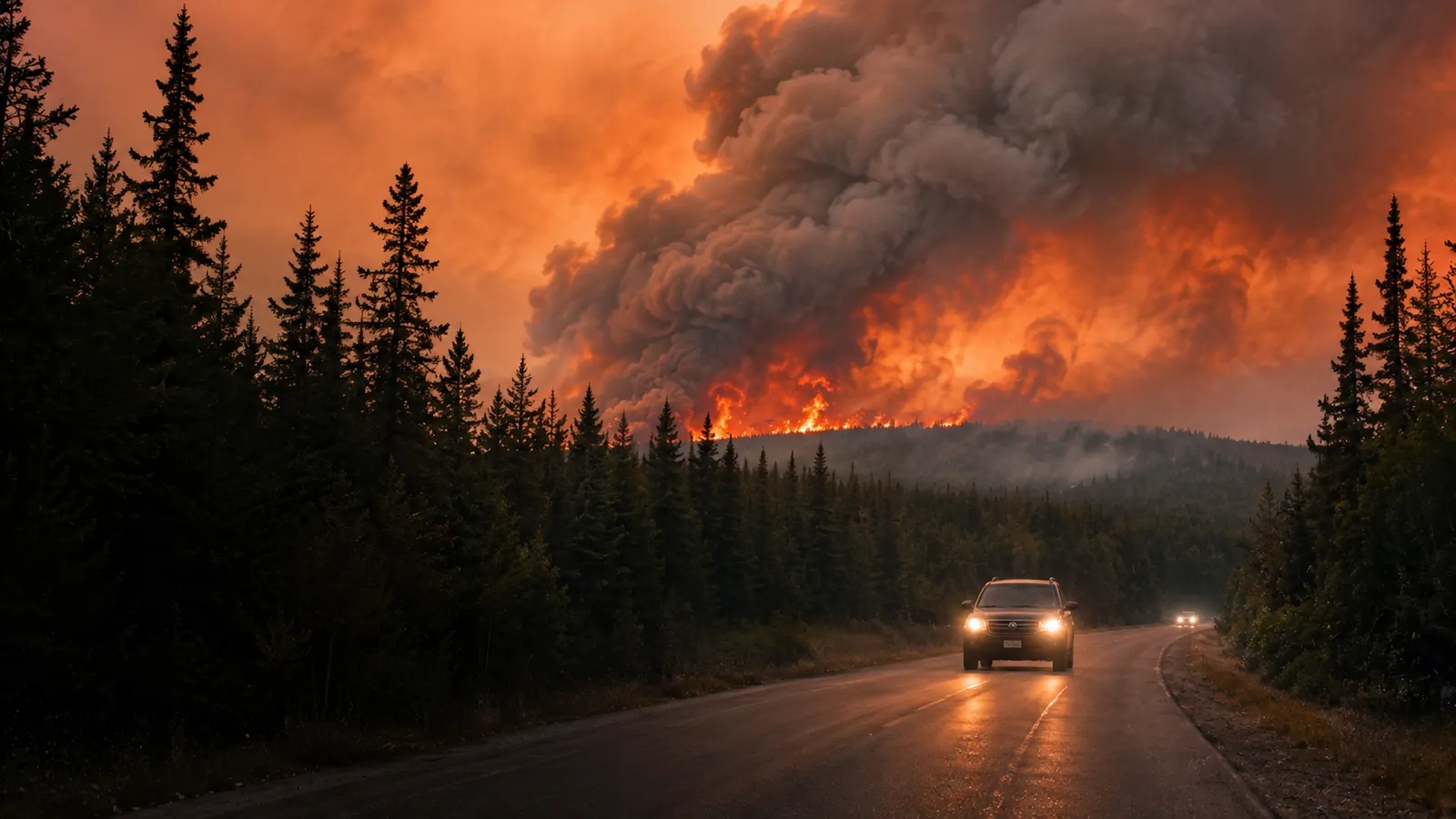
The 2023 season showed that Quebec is not immune to megafires. In France, fire is moving north. The danger: evacuations within hours and smoke that travels hundreds of kilometres.
Quebec / Canada
France
If you only do three things
- 1A go-bag ready and a plan to leave in under 30 minutes
- 2Clear dry vegetation around the house
- 3Protect yourself from smoke: stay indoors, air filter, N95 mask outdoors
Lasting collapse?
Key figures
Fire seasons beyond the norm.
Understanding the risk
How a wildfire reaches homes.
A wildfire spreads according to three factors: how dry the vegetation is, wind and terrain. In strong winds it can advance several kilometres an hour and throw embers more than a kilometre ahead of the front, starting spot fires in gardens and on roofs. Most homes that burn in wildfires are ignited by these embers, not by the flame front.
In Quebec, the 2023 season broke every record: 713 fires, more than 4.3 million hectares burned and nearly 27,000 people evacuated. In Canada, lightning starts about 4,000 wildfires a year. In France, the vast majority of fires are human-caused (carelessness, work, cigarette butts), and the 2022 Gironde fires showed the risk extends beyond the Mediterranean region.
Severity
Wildfires directly threaten lives and homes at the forest edge, and cut roads, power and telecommunications. Evacuations can be ordered with very little notice.
Smoke is a risk in its own right: it can blanket entire regions far from the fire and worsen asthma, heart and lung disease. Fine particles penetrate deep into the lungs.
In detail
Protect your home in three zones.
| Zone | Distance from the house | What to do |
|---|---|---|
| Zone 1: immediate | 0–1.5 m (0–5 ft) | No combustible material: mulch, firewood, leaves. Gutters and roof clear. |
| Zone 2: intermediate | 1.5–10 m (5–30 ft) | Short, watered grass, pruned trees, spacing between shrubs. |
| Zone 3: extended | 10–30 m (30–100 ft) | Thin vegetation, remove dead wood and low branches. |
FireSmart principle, recommended in Canada. In France, mandatory brush clearing (OLD) applies up to 50 m around buildings in exposed areas.
Assess your exposure
Are you more exposed than average?
Tick what applies to your situation.
Get prepared
Your preparedness checklist
Tick items as you go: your progress is saved on this device.
Suggested kits and plans
Before, during, after
The right actions, from the alert to coming home.
Before
- Go-bag ready
- 1.5 m zone cleared
- Two routes known
- N95 masks and HEPA filter
- Alerts on
During
- Follow instructions and leave as soon as evacuation is recommended
- Close doors and windows, turn off outside air intake
- Wear covering cotton or wool clothing, no synthetics
- In the car: headlights on, windows closed, ventilation on recirculate
- If there is smoke but no evacuation: stay indoors in the clean-air room
After
- Wait for the authorities’ permission before returning
- Check for hidden embers on the roof, in gutters and under the deck
- Wear an N95 mask to clean up ash
- Discard food exposed to heat or smoke
- Document the damage for insurance
In Quebec, Canada and France
What changes depending on where you live.
Quebec / Canada
SOPFEU fights fires in the intensive protection zone and publishes the daily fire danger index. Open-fire bans are frequent in summer.
- Emergency
- 911
- Fire danger
- SOPFEU, sopfeu.qc.ca
- Air quality
- Air Quality Health Index, Environment Canada
- Alerts
- Québec En Alerte
France
In France, mandatory brush-clearing obligations (OLD) apply to owners in exposed areas. Météo-France’s forest weather service shows the daily fire danger by department.
- Emergency
- 18 or 112
- Fire danger
- Météo des forêts, Météo-France
- Alerts
- FR-Alert
- Obligations
- Prefecture and town hall (OLD)
Domino effect
This risk often triggers others
Frequently asked questions
Frequently asked questions
When should I evacuate?
As soon as the authorities recommend it, and even earlier if the smoke thickens, flames are visible or you have vulnerable people. Roads can become impassable very quickly.
How do I protect my home from smoke?
Close doors and windows, set ventilation to recirculate, run a HEPA air purifier in one room and avoid activities that add particles (frying, candles).
Do surgical masks protect against smoke?
Not much. Only a well-fitted N95 or FFP2 mask effectively filters the fine particles in smoke.
What if a fire surprises me in my car?
Don’t get out. Park away from vegetation, close windows and vents, turn on the headlights, lie below the windows and cover yourself with a wool blanket; call for help.
Sources
Sources
Data checked on November 18, 2026. Figures come from the organizations cited; consult them for updates.
- SOPFEU, 2023 annual report (French)
- Environment and Climate Change Canada, Lightning in Canada (French version)
- The Connexion, Wildfires in Gironde (July 2022)
- Reporterre, The summer of fires (August 2022, French)
This page provides general preparedness information. It does not replace instructions from the authorities: in an emergency, call 911 in Canada or 112 in France.
Start with the basics.
Our free “Be Prepared” guide: 72-hour kit, family plan and your own risk assessment.
Wildfires
Index Quebec/Canada 7/9 · France 7/9
If you only do three things
- A go-bag ready and a plan to leave in under 30 minutes
- Clear dry vegetation around the house
- Protect yourself from smoke: stay indoors, air filter, N95 mask outdoors
During
- Follow instructions and leave as soon as evacuation is recommended
- Close doors and windows, turn off outside air intake
- Wear covering cotton or wool clothing, no synthetics
- In the car: headlights on, windows closed, ventilation on recirculate
- If there is smoke but no evacuation: stay indoors in the clean-air room
After
- Wait for the authorities’ permission before returning
- Check for hidden embers on the roof, in gutters and under the deck
- Wear an N95 mask to clean up ash
- Discard food exposed to heat or smoke
- Document the damage for insurance
Emergency numbers: 911 (Canada) · 112 (France)
prepacivile.com/en/risks/wildfire/