
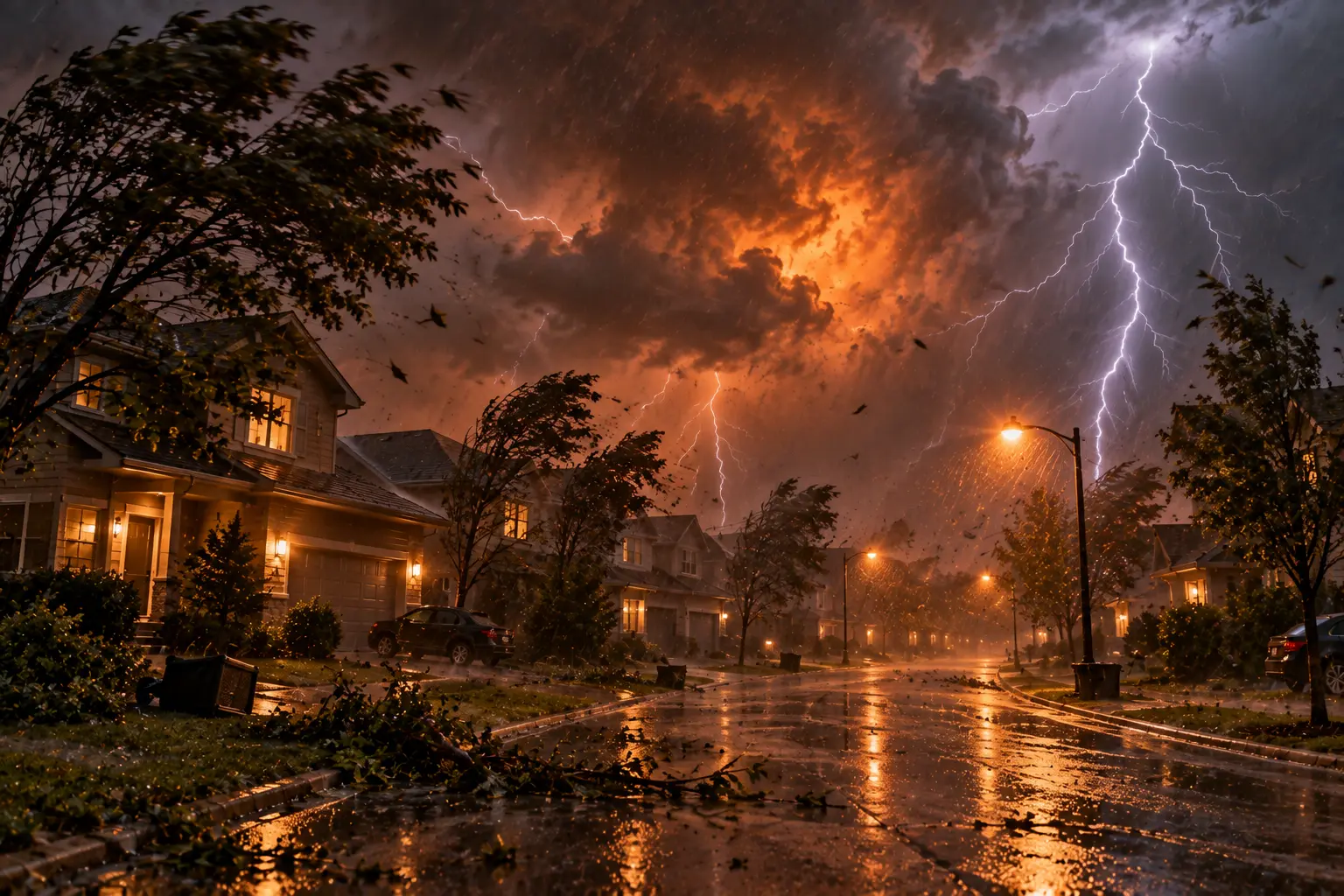
Risk centre · Quebec, Canada and France
Know your risks.
Prepare in the right order.
28 risks ranked by likelihood and severity, so you can put your time and money where they really count.
Where to start
Your 5 priority risks. Start here.
These are the risks that combine the highest likelihood and the highest severity for a typical household. Choose your region: the ranking adjusts.
Flood zone, young child, remote area? Take the preparedness review to get your own priorities.
The 28 risks
Explore each risk. Family by family.
Each fiche explains the severity, how to assess your exposure, how to prepare, and what to do during and after. Click a risk to open its full fiche, with infographics, an interactive preparedness checklist and a printable quick-reference sheet.
Why prioritize
We often prepare for the wrong risk.
A fully stocked go-bag, but no working smoke alarm. A year of supplies, but no plan if the basement floods in spring. A risk assessment puts things back in order.
Identify
The realistic threats where you live, based on historical and scientific data.
Measure
How likely an event is and what it would cost your household: health, home, income.
Act
Start with measures that protect against several risks at once: water, food, lighting, a family plan, alerts.
The full ranking
Compare Quebec and France.
Sort by clicking a column. The same risk doesn’t weigh the same on both sides of the Atlantic: cold and ice storms weigh more in Quebec, heat waves and drought more in France.
| Fiche |
|---|
The matrix
Likelihood × severity, at a glance.
The further up and to the right a risk sits, the more attention it deserves.
The method
Understand, assess, then act.
Each risk gets two scores from 1 to 5, one for likelihood in the region and one for severity for an affected household, rated separately for Quebec/Canada and for France. Their product gives a score from 1 to 25, converted into an index from 1 to 9. All the scales are published: you can check our scores, or redo them for your own situation.
See the likelihood scale
| 5 | Frequent: every year somewhere in the region |
|---|---|
| 4 | Likely: several times a decade |
| 3 | Possible: a few times a century, within a lifetime |
| 2 | Rare: known in recent history, but exceptional |
| 1 | Very unlikely: never observed or hypothetical in the region |
See the severity scale
| 5 | Catastrophic: risk of death, loss of home, lasting effects |
|---|---|
| 4 | Major: possible injuries, evacuation, significant damage |
| 3 | Serious: several days of disruption, notable costs |
| 2 | Moderate: discomfort, limited expenses |
| 1 | Minor: a few hours of disruption |
See the score → index conversion
| Score | 1-2 | 3-4 | 5-6 | 8 | 9-10 | 12 | 15-16 | 20 | 25 |
|---|---|---|---|---|---|---|---|---|---|
| Index | 1 | 2 | 3 | 4 | 5 | 6 | 7 | 8 | 9 |
- 7-9High priorityPrepare now, if you haven’t already.
- 4-6Medium priorityAddress once the priorities are covered, especially if you are exposed.
- 1-3Low priorityGood to know; general preparedness is often enough.
- ±An average index, not a verdictA house in a flood zone, a 15th floor, someone dependent on a medical device or a remote cottage change the priorities. Add one likelihood point if you are directly exposed, one severity point if a household member is vulnerable.
Before everything else
Two foundations: health and finances.
They aren’t in the ranking because they aren’t events. Yet they determine your ability to get through all the others.
Personal health
Good physical condition, well-managed chronic illnesses, prescriptions renewed on time and first-aid skills make every emergency more manageable.
Our health guides →Personal finances
A job loss or unexpected expense affects far more households than a natural disaster. An emergency fund, even a modest one, is a resilience measure in its own right.
Preparing without breaking the bank →Sources and limits
Scores you can check.
Scores are based on historical data and publications from the organizations below. Each detailed fiche cites its own sources and the date of the data.
- Quebec Ministry of Public Security
- Public Safety Canada (Canadian Disaster Database)
- Environment and Climate Change Canada
- Natural Resources Canada (earthquakes, geomagnetism)
- Institut national de santé publique du Québec
- Hydro-Québec
- Géorisques (French Ministry of Ecological Transition)
- Météo-France (warnings)
- Santé publique France
- French nuclear safety and radiation protection authority (ASNR)
- BARPI ARIA database (industrial accidents)
- French national natural risks observatory (ONRN)
Limits. A ranking like this involves some judgment, especially for rare and severe events. The indexes don’t replace official instructions: in an emergency, always follow authorities’ directions (911 in Canada, 112 in France). The ranking covers mainland France; the hurricane, volcano and earthquake fiches include an overseas section.
Frequently asked questions
Your questions about the ranking.
Why does house fire come first?
Because it is both frequent and potentially deadly. Residential fires happen every day, in Quebec and in France, and most deaths are caused by smoke, often at night. It is also a risk you have a lot of control over: smoke alarms, an extinguisher, an escape plan.
Why doesn’t the same risk have the same index in Quebec and France?
Climate, geography, the power grid and history differ. Extreme cold and ice storms weigh much more in Quebec; heat waves, drought and coastal flooding more in France.
Don’t the most severe risks, like a nuclear attack, deserve more attention?
Their severity is maximal, but their likelihood is very low, which gives a low index. Good general preparedness (shelter, supplies, radio, family plan) already covers part of these scenarios.
How often is the ranking updated?
At least once a year, and after any major event or significant new data. The update date is shown at the top of the page and on each fiche.
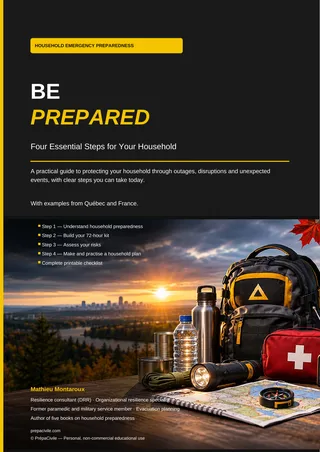
Start with the basics.
Our free guide “Be prepared”: 72-hour kit, family plan and your own risk assessment.