
In this article
- 1. Check security and reception
- 2. Identify health and support needs
- 3. Inform relatives and follow instructions
- 4. Organize a suitable living space
- 5. Provide for hygiene and conservation
- 6. Check water and meals available
- 7. Organize replenishment without arbitrary rationing
- 8. Maintaining security and preparing for the future
- A simple check to redo together
- Frequently asked questions
- Should we follow the eight priorities in this order?
- What if I am alone?
- Does a 72-hour bag guarantee three days of autonomy?
- Sources and benchmarks
An evacuation does not end when you leave the home. Upon arrival, check the security of the place, find the people, report the needs and organize the next hours. These eight priorities are an adaptable checklist, not a stand-alone forest survival procedure.
An immediate danger or medical emergency comes before the order on this list. A planned destination may become unusable: keep the contact information of an alternative and the instructions of your municipality accessible.
1. Check security and reception
On arrival, check that the place remains out of the danger that caused the departure. Respect closed access and security perimeters. Do not make a reconnaissance in a damaged building or in a damaged area to confirm an impression.
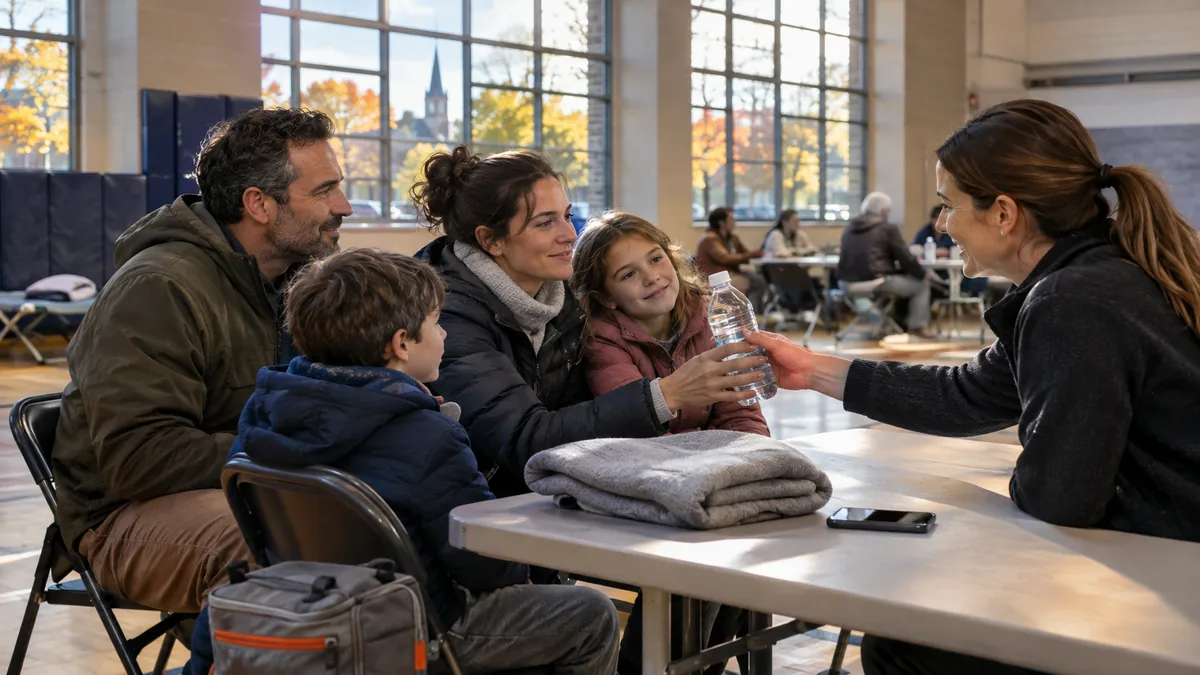
If you are joining a disaster service centre, register with staff. With a loved one, confirm the welcome and practical conditions. Identify exits, toilets, accessible water and who to contact for urgent needs.
The presence of others does not in itself constitute a threat. Identify those responsible for the place, keep the group together and exchange useful information. If the destination is not suitable, ask for an orientation towards a suitable solution rather than improvising an isolated camp.
2. Identify health and support needs
Check to see if someone is missing a call, has an injury or needs immediate help. An absence of reaction, difficulty breathing or severe bleeding requires an urgent response: call 911 and follow the instructions, with the first aid gestures you know how to perform. Don’t start with minor injuries to “liberate” people.
Once emergencies are taken care of, take stock with everyone on treatments, allergies, fatigue, mobility aids and the necessary devices. Maintain the confidentiality of the information and provide stakeholders with what is useful for assistance. Adapting the evacuation to mobility needs →
Emotional reactions can vary and appear at different times. Listen, give simple information and set aside time to rest. Children may need an available adult, a familiar object, and reassuring routines. An activity must remain adapted to their age and the conditions of the place, without dangerous task.
If the response is intense, persistent or does not meet basic needs, seek professional assistance or support services as indicated by the host.
3. Inform relatives and follow instructions
Let your family know where you are, who is there and what you need. Send short and useful information. If the communication fails, use the other means provided in the plan and preserve the battery, without concluding that a loved one is necessarily in danger.
Consult the municipality’s communications and local stations available. A battery-powered or crank radio completes the phone; it does not guarantee reception in all places. Keep important contact information on paper and agree on an upcoming news moment.
4. Organize a suitable living space
Check bedding, dry clothing, weather protection and access to sanitary facilities. Keep the exits clear. Divide tasks according to abilities: installation of equipment, taking news, accompanying children and helping people who need it.
If the stay is in a campsite or other authorized outdoor place, follow the instructions of the manager and the rules of the site. Organized and accessible accommodation is preferred when it is available. An improvised shelter does not automatically replace a safe and suitable place.
Do not light a fire to ensure the facility’s discretion or lighting. Use the appropriate means at the place and in their instructions. Outdoor stoves and appliances should not be used indoors; do not rely on a small flame to make a living space.
5. Provide for hygiene and conservation
Use available sanitary facilities and site instructions for waste. If they are unusable, request the solutions provided by the manager or the municipality. Do not dig a latrine to a generic depth: location, soil, water and local rules change conditions.
Keep food in conditions consistent with its label and protect it from animals. In an outdoor setting, use the site’s devices and instructions for scent products. A suspension technique is not suitable for all species or locations.
6. Check water and meals available
Make an inventory of usable water and meals available for people and animals. Check the water reviews and distribution points. Clear water taken from the wild is not necessarily potable; no single method treats all contamination. Planning for the water supply →
Do not base the stay on collecting plant condensation, an improvised solar distiller or digging a wetland. These techniques do not guarantee sufficient volume or safe water. Look for an identified supply and ask for help before exhausting your reserves.
7. Organize replenishment without arbitrary rationing
Estimate the duration of the products with your actual meals, their portions and their storage conditions. A fixed number of calories presented as sufficient for any active adult is not a method adapted to the needs of each. Do not automatically reduce portions of children or a person with special needs.
Identify early services, accessible businesses or supports to supplement resources. The reserves taken away give time to organize; they do not guarantee a prolonged autonomy and do not exempt from joining an available aid.
8. Maintaining security and preparing for the future
Keep crossings free, contacts accessible and people accompanied. Avoid improvised devices that can trip someone up, confrontations, and surveillance that robs the entire rest group. Report an incident to site officials and call emergency services in case of danger.
Hunting, snares, fish traps and gathering are not an ordinary plan for restocking after an evacuation. Do not rely on their yield and do not eat an unidentified plant or fungus competently. Instead, look for resources and a safe welcome.
Regularly re-evaluate the destination, length of stay, treatments, water and the possibility of rest. Before returning to your home, wait for permission from the authorities and the instructions applicable to the area.
A simple check to redo together
Is the place still safe? Is everyone present? Are urgent needs reported? Does the family contact know the destination? Do you have adequate water, meals and sleeping facilities? What is the next information or help to get? These questions are more useful than a rigid sequence applied regardless of context.
Frequently asked questions
Should we follow the eight priorities in this order?
Nope. An immediate danger or medical emergency comes first. Several tasks can then be divided among the available people. The list helps to identify oversight; it does not replace the instructions of stakeholders.
What if I am alone?
Report your presence and needs to the reception structure, your contact or the services concerned. Reduce non-essential tasks and focus on a place where assistance is available rather than prolonged isolation.
Does a 72-hour bag guarantee three days of autonomy?
Nope. The label does not demonstrate the amount of water, meals, or medical needs covered. Check the actual content, the people involved, the weather and the destination. The bag serves as a support for travel and hospitality, not a promise of independent survival.
Sources and benchmarks
References for Quebec and Canada. Sources consulted on November 2, 2026.