
In this article
- In brief
- Why does the ground start to slide?
- Disasters that marked Québec
- In France: a widespread hazard
- Finding out whether your land is exposed
- What never to do near a slope
- Signs that should raise the alarm
- Preparing if you live at the top or the bottom of a slope
- During and after a landslide
- Your kit if you live near a slope
- Frequently asked questions
- Sources
On the evening of May 10, 2010, in Saint-Jude, in Québec’s Montérégie region, an entire section of the bank of the Salvail River began to move. Within moments, about 520,000 cubic metres of soil slid away, carrying off a house and the four members of the family who lived there. Nothing that evening hinted at a disaster: no storm, no earthquake. Just decades of erosion at the foot of a slope, and a clay that, in Québec, can behave abruptly.
Landslides are a quiet and often overlooked hazard, yet very real in Québec and in France. This guide explains why some ground moves, where the risk areas are, which signs should raise the alarm, what never to do near a slope, and how to prepare if your home sits at the top or the bottom of one.
In brief
In brief. Nearly 100 cases of ground instability and landslides are reported in Québec every year, mostly in spring and early summer. In about 40% of landslides affecting buildings or roads, human activity worsened or triggered the movement. Never load the top of a slope, never dig at its base, never send water toward it, and report any crack or bulge to your municipality right away.
Why does the ground start to slide?
A landslide is the downward movement of a mass of soil under gravity, carrying away all or part of a slope. In Québec’s clay soils, it usually happens suddenly.
The special case of Québec’s clays
Much of the St. Lawrence Valley sits on marine clays laid down by the ancient Champlain Sea at the end of the last ice age. These clays originally contained sea salt. Over thousands of years, fresh water leached the salt out and the soil became more “sensitive”: when disturbed, it can lose much of its strength and behave almost like a liquid. That explains the scale of some landslides, which can cut far back into a plateau within minutes.
These sensitive clays are found mainly in the plains of the St. Lawrence, the Outaouais and Saguenay–Lac-Saint-Jean, where hundreds of mostly small landslides occur every year.
What triggers a landslide
The Government of Québec lists several risk factors:
- erosion at the base of slopes by watercourses;
- earthworks: fill, excavation, drainage, tree cutting;
- the steepness of the slope and soil properties;
- heavy or prolonged rain;
- snowmelt, especially when it is rapid.
Specialists explain that most landslides occur in spring and early summer: snow accumulated over winter, followed by a rainy spring, raises the water table and increases water pressure in the soil. Together with erosion, this is the main cause of landslides.
Disasters that marked Québec
Québec has experienced several deadly or spectacular landslides. Among those that left a mark: Nicolet in 1955, Saint-Jean-Vianney in the Saguenay region on the night of May 4 to 5, 1971, where part of the municipality was swallowed up, and Saint-Jude in 2010. More recently, a landslide occurred in Sainte-Monique on May 20, 2025.
The Québec Ministry of Transportation’s report on Saint-Jude shows what a large landslide in sensitive clay looks like:
- deathsAn entire family whose house was carried away.
- cubic metres of soil movedAbout 680,000 cubic yards.
- wideAbout 900 feet, over about 150 m (490 ft) in length.
- slope heightAbout 72 feet, with an average slope of 12 to 16 degrees.
Source: Québec Ministry of Transportation, report MT11-01 (2011)
According to that report, the trigger was entirely natural: bank erosion, active since at least 1950 and intensified over the previous fifteen years, gradually weakened the slope. Very high water pressure at the foot of the slope made things worse. The type of movement, a lateral spread in Champlain Sea clays, is still being studied because its mechanisms are so complex.
In France: a widespread hazard
In France, ground movements take many forms: landslides, rockfalls, sinkholes and cavity collapses, mudflows. According to the statistical service of the Ministry for Ecological Transition, more than 14,300 municipalities, or 41% of French municipalities, are exposed to ground movements (excluding clay shrink-swell). Collapses and landslides account for two-thirds of the movements recorded between 1900 and 2022.
On top of these comes clay shrink-swell, caused by the alternation of droughts and rain. It is France’s second natural hazard in terms of insured cost:
- of mainland territorymoderately or highly exposed.
- detached houses exposed54% of houses, including 4.6 million built after 1976.
- in insured costcumulative between 1995 and 2019, about €480 million a year.
- per damaged houseon average, between 1990 and 2015.
Source: SDES, Key figures on natural hazards, 2023 edition
This phenomenon does not usually endanger lives, but it cracks houses, warps door and window frames, and can make a home uninhabitable.
Finding out whether your land is exposed
The first step is to know the risk at your address:
- In Québec, the government maps zones potentially exposed to landslides (ZPEGT). These maps are built into municipal bylaws, which regulate construction and work in those zones. Ask your municipality’s or regional county municipality’s (MRC) planning department.
- In France, the Géorisques website shows the known hazards at an address, including ground movements and exposure to clay shrink-swell. When a property is sold or rented, a risk statement must also be given to the buyer or tenant.
PrépaCivile’s My risk radar tool also includes, for Québec, zones potentially exposed to landslides: just enter your address.
What never to do near a slope
Nearly four out of ten landslides affecting buildings or roads in Québec were worsened or triggered by human activity, sometimes minor. Prevention brochures from regional county municipalities list the mistakes to avoid:
- Overloading the crestFill, imported soil, waste, storage, snow piled at the top of the slope.
- Digging at the footExcavation or landscaping that removes soil from the base of the slope.
- Sending water toward the slopeUnconnected downspouts, drains, pool draining, a septic field too close to the crest.
- Clearing without approvalCutting trees or changing vegetation without checking municipal rules.
Source: MRC de Manicouagan, Land-use precautions (in French)
Before any earthworks, construction or tree cutting near a slope, check with your municipality. Stabilisation work requires the advice of a geotechnical engineer.
Signs that should raise the alarm
A landslide is often preceded by subtle signs. In Québec, the authorities ask people to report to their municipality:
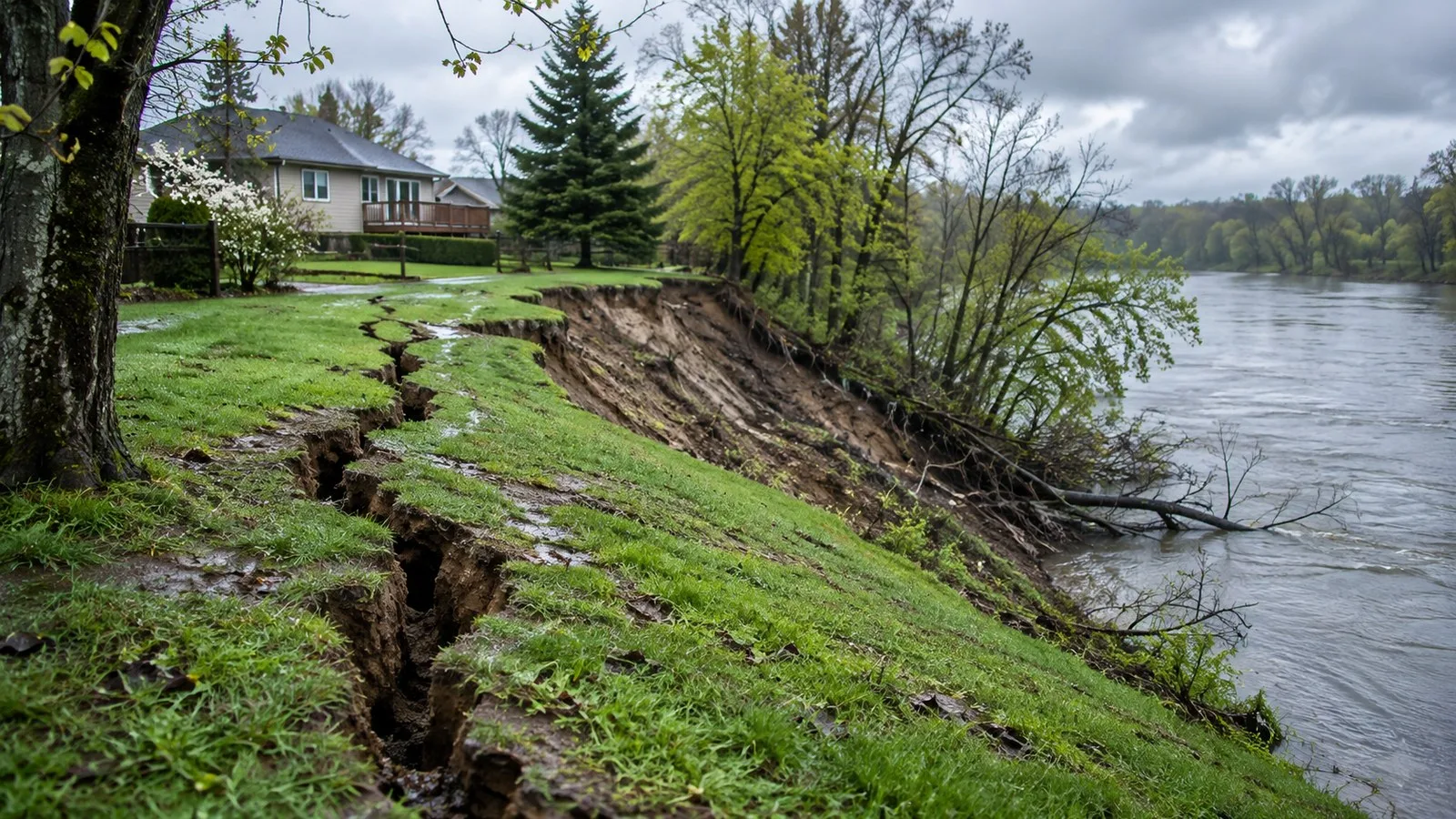
- a crack in the ground, especially on sloping land or at the top of a slope;
- a collapse, even a small one;
- a bulge in the slope;
- an unusual flow of water from the slope.
Other clues can also be worrying: trees or poles starting to lean, doors and windows that suddenly stick, new cracks in foundations or walls, ground that sinks. According to specialists, cracks at the top of a slope indicate that a landslide could occur, and the area is then evacuated.
If you see any of these signs, do not try to fix them yourself. Move away from the slope, notify your municipality, and call 911 if the ground is moving or people are in danger.
Preparing if you live at the top or the bottom of a slope
A landslide poses two very different threats: being hit by debris if the house is at the foot of the slope, or being carried away if it is at the top. In both cases, preparation rests on three pillars.
A fast evacuation plan
- Identify at least two routes leading away from the slope, and a meeting point on stable ground.
- Keep a go-bag ready with your medication, copies of important documents and the essentials for 72 hours.
- Plan how you will evacuate your pets.
Getting the alert
- Sign up for your municipality’s alerts and turn on emergency alerts on your phone.
- Keep a battery-powered or hand-crank radio to follow instructions if the network goes down.
- During snowmelt and heavy rain, pay closer attention to warning signs.
Insurance and documents
- Check what your home insurance covers: in Québec, landslides are often excluded or limited; in France, they can be compensated under the natural disaster scheme when an official decree is published.
- Photograph the condition of your house and land, and keep the photos outside your home (cloud, waterproof USB key).
- Note the appearance of new cracks with the date: it is valuable for experts and insurers alike.
During and after a landslide
During: move away from the slope immediately, sideways if you are in the path of the movement. Do not go back for belongings. If you are inside and cannot get out, take cover under sturdy furniture, away from windows.
After:
- Do not return to the area until the authorities allow it: further movement can follow.
- Beware of damaged gas lines, electrical wires and water pipes.
- Have the land and building inspected by a professional before moving back in.
- Contact your insurer and document the damage with photos.
Your kit if you live near a slope
Frequently asked questions
When are landslides most frequent?
In Québec, mostly in spring and early summer, when snowmelt and rain raise the water in the soil. Heavy rain can, however, trigger a landslide at any time of year.
How do I know if my house is in a risk zone?
In Québec, ask your municipality or regional county municipality, which build the maps of potentially exposed zones into their bylaws. In France, check Géorisques using your address.
There is a crack at the top of my slope. What should I do?
Do not fill it or intervene yourself. Move away from the slope, notify your municipality, and call 911 if the ground is moving or people are threatened.
Can my gutters really cause a landslide?
They can contribute. Downspouts that dump water at the top of a slope saturate the soil exactly where it is most sensitive. Water should be piped to the foot of the slope or to the storm sewer.
Disclaimer. This article is meant for public information and preparedness. It does not replace the advice of a geotechnical engineer or your municipality’s bylaws. In immediate danger, call 911 (Canada) or 112 (France).
Sources
- MétéoMédia, Why Québec is particularly at risk of landslides (in French)
- Québec Ministry of Transportation, Report on the Saint-Jude landslide (in French)
- MRC de Manicouagan, Land-use precautions (in French)
- SDES, Natural hazards in France: 2023 overview (in French)
- SDES, Clay shrink-swell (in French)
Go further: the Landslide hazard guide, My risk radar to check your address and the emergency kit builder to put together your go-bag.