
Technological and household · Risk index 6/9 (Quebec) · 6/9 (France)
Industrial accident and hazardous materials
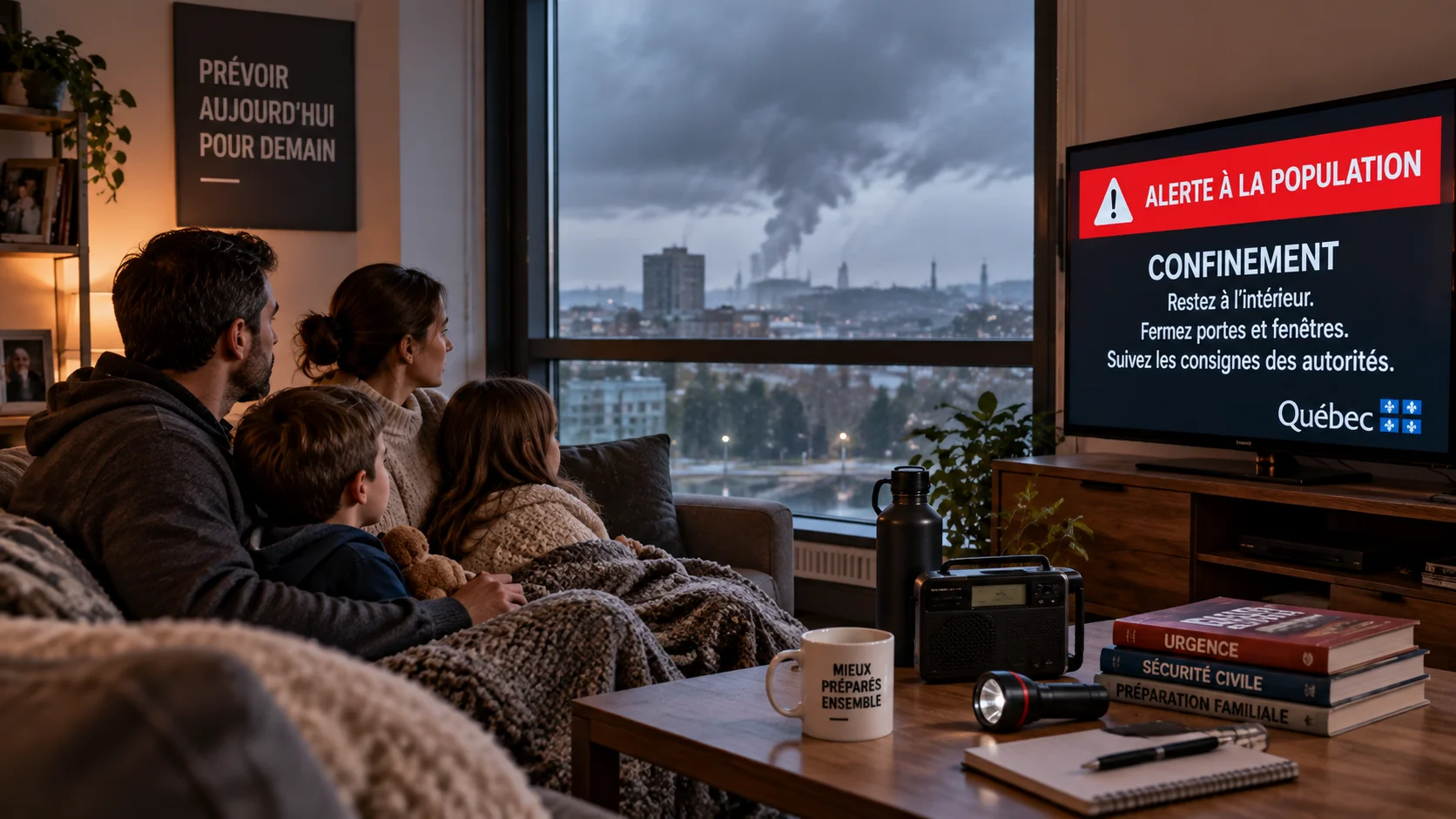
Chemical plants, oil trains, tanker trucks, fertilizer warehouses: hazardous materials move and are stored close to home. If an accident happens, you need to know within minutes whether to shelter or leave.
Quebec / Canada
France
If you only do three things
- 1Know whether you live near a risky site or route
- 2Know the shelter-in-place routine: close up, shut ventilation, seal
- 3Don’t go get the kids from school: they are taken care of
Lasting collapse?
Key figures
Rare accidents, but devastating.
Understanding the risk
Fire, explosion, toxic cloud.
An industrial or hazardous materials transport accident can take three forms, often combined: fire, explosion (blast, broken windows) and a leak of toxic product into the air, water or soil.
The risk isn’t limited to people living next to plants. Hazardous materials travel daily by rail, road, pipeline and ship. In Quebec, Lac-Mégantic showed that a train can run through a town centre. In France, the Lubrizol fire in Rouen on September 26, 2019, worried an entire city under its smoke plume.
Severity
Effects depend on the product, distance and wind. Near the source, an explosion or fire can kill and destroy buildings. Further away, the main danger is breathing a toxic gas or smoke.
Some products are invisible and odourless. That is why you must follow instructions even if you smell or see nothing, and wait for the official all-clear before going out.
In detail
Shelter or evacuate: who decides and how.
| Situation | Usual instruction | Why |
|---|---|---|
| Toxic cloud passing over | Shelter indoors | A closed building filters the air while the cloud disperses |
| Risk of explosion or spreading fire | Ordered evacuation | Move out of the danger zone |
| You’re outside, near the accident | Move away crosswind, then shelter | Get out of the plume quickly |
| You’re in a car | Get to a building; otherwise close windows and ventilation | A car protects poorly against gas |
| All-clear | Air out, restart ventilation | Only authorities can lift the order |
Assess your exposure
Are you more exposed than average?
Tick what applies to your situation.
Get prepared
Your preparedness checklist
Tick items as you go: your progress is saved on this device.
Suggested kits and plans
Before, during, after
The right actions, before, during and after.
Before
- Know risky sites
- Alerts on
- Shelter kit
- Shelter room chosen
- Go-bag ready
During
- Move away from the accident and call 911 or 112
- Shelter in the nearest building
- Shut ventilation and air exchanger, seal openings
- Don’t smoke, don’t make unnecessary calls
- Listen to the radio and follow instructions
After
- Wait for the official all-clear
- Air out your home
- Clean or replace ventilation filters
- Follow instructions on water and food
- See a doctor if you have symptoms
In Quebec, Canada and France
What changes depending on where you live.
Quebec / Canada
In Quebec, municipalities inform residents about local industrial risks and issue alerts. Some industrial areas have sirens. Québec En Alerte sends serious alerts to phones.
- Emergency
- 911
- Health
- Info-Santé 811
- Alerts
- Québec En Alerte, municipal alerts
- Poisoning
- Quebec Poison Control Centre
France
In France, upper-tier Seveso sites have a specific intervention plan (PPI). Residents receive information on what to do, and alert sirens are tested on the first Wednesday of every month.
- Emergency
- 112 or 18
- Alerts
- Sirens, FR-Alert
- Information
- Géorisques
- Poisoning
- Poison control centre
Domino effect
This risk often triggers others
Frequently asked questions
Frequently asked questions
Why not flee by car?
A car lets outside air in, and roads may cross the cloud or be jammed. Unless ordered to evacuate, a closed building protects better.
How long does sheltering last?
Usually a few hours, while the cloud disperses. Stay inside until authorities give the all-clear.
How do I know if I live near a risky site?
In Quebec, ask your municipality. In France, the Géorisques website shows facilities and risks around your address.
Can I drink tap water after the accident?
Follow authorities’ instructions: they may restrict water or certain foods while tests are run.
Sources
Sources
Data checked on November 18, 2026. Figures come from the organizations cited; consult them for updates.
- Government of Quebec, Hazardous materials accident (French)
- Government of Quebec, Shelter in place (French)
- The Canadian Encyclopedia, Railway accidents (French)
- Hérodote.net, Industrial disasters (French)
- Futura-Sciences, France remains poorly prepared for industrial risks (French)
This page provides general preparedness information. It does not replace instructions from the authorities: in an emergency, call 911 in Canada or 112 in France.
Start with the basics.
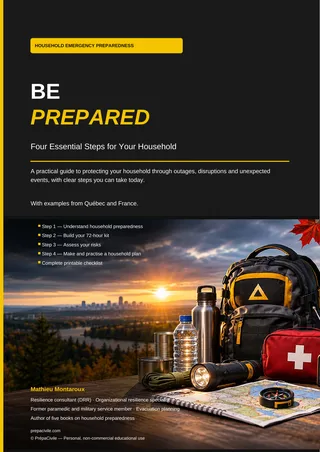
Our free “Be Prepared” guide: 72-hour kit, family plan and your own risk assessment.
Industrial accident and hazardous materials
Index Quebec/Canada 6/9 · France 6/9
If you only do three things
- Know whether you live near a risky site or route
- Know the shelter-in-place routine: close up, shut ventilation, seal
- Don’t go get the kids from school: they are taken care of
During
- Move away from the accident and call 911 or 112
- Shelter in the nearest building
- Shut ventilation and air exchanger, seal openings
- Don’t smoke, don’t make unnecessary calls
- Listen to the radio and follow instructions
After
- Wait for the official all-clear
- Air out your home
- Clean or replace ventilation filters
- Follow instructions on water and food
- See a doctor if you have symptoms
Emergency numbers: 911 (Canada) · 112 (France)
prepacivile.com/en/risks/industrial-accident/