

In this article
The 2013 Lac-Mégantic rail disaster was a stark reminder that an emergency evacuation can affect any community, urban or rural, with very little notice. This article examines situations that may make evacuation appropriate, risk factors in different settings, and the elements to consider when preparing thoughtfully.
On July 6, 2013, a runaway train derailed in Lac-Mégantic. The crude-oil spill caused fires, explosions, 47 deaths and environmental contamination. Transportation Safety Board report R13D0054 details the circumstances and safety factors. Describing the disaster simply as a release of toxic vapours overlooks its other hazards. The investigation addresses transportation safety; it does not determine civil or criminal liability.
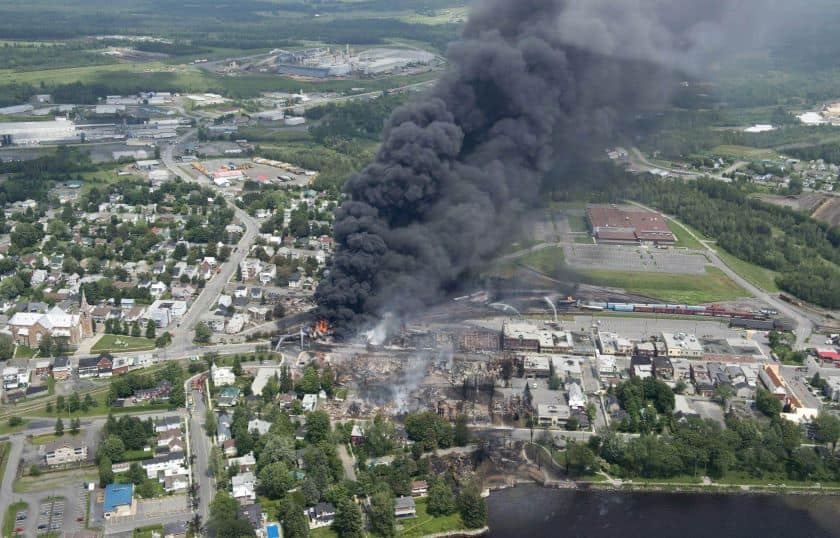
An event of this kind shows how a transportation corridor can expose inhabited areas, sometimes leaving little time to act. This article does not provide a calculation establishing the overall statistical frequency of such accidents. Knowing local risks and instructions addresses a practical need without suggesting that a comparable accident is imminent or assuming that one distance provides protection against every substance.
Rethinking evacuation: one option among several
Remaining in a safe place may be appropriate in some emergencies, while others require leaving a building or following an evacuation. This article does not establish that staying at home is preferable in most cases. Staying home and temporarily sealing openings against a chemical plume are also different measures. The hazard, individual needs and official instructions should guide action; there is no universal rule to remain in place.
Evacuation is not an automatic response to every deteriorating situation. It becomes an appropriate option when staying exposes people to greater danger than moving would.
Wildfires, industrial accidents and certain security operations may require people to leave temporarily. The source also mentioned movements during the pandemic in Paris and London and during the invasion of Ukraine; these are not equivalent situations. A change of residence during a public-health crisis is not necessarily a civil-protection evacuation. Displacement during armed conflict involves other hazards and protections. Placing each example in context avoids treating them as a single departure scenario.
Such situations can create transportation, information and accommodation needs without proving that those affected had failed to plan ahead. Some people had a plan but lost access to a road, housing or treatment. Preparing options may help, but cannot guarantee that nobody will be caught by surprise or that every consequence can be controlled. Services and assistance remain necessary, including for households with supplies and equipment.
Both urban and rural settings present a range of risk factors to consider.
Risk factors in urban and densely populated areas
A common assumption portrays cities as inherently dangerous during a crisis. That is an oversimplification. Urban areas also have substantial resources: more emergency services, better-equipped response organizations, medical facilities and an institutional presence. These resources have a real bearing on the management of local emergencies.
Urban density nevertheless creates particular conditions that are worth considering in advance.
Pressure on resources
Some stores and service stations may face high demand or close during a disruption. This may lead to queues and supply difficulties, without automatically producing social tension or a shortage within a fixed period. Organizing everyday needs and identifying an alternative source is more useful than assuming that any densely populated area will experience conflict over supplies.
Civil unrest and other disruptions
Demonstrations, major strikes, states of emergency or curfews may temporarily make some areas difficult to access or best avoided. These situations do not necessarily call for an evacuation, but deserve advance consideration.
Crime and local safety
A marked deterioration in neighbourhood safety may, in some circumstances, lead residents to consider relocating temporarily. This factor varies considerably between neighbourhoods and cities.
Risk factors in rural and sparsely populated areas
Industrial facilities, dams and transportation corridors may also be near rural or suburban communities; they are not absent from cities either. Consequences depend on the site and substance involved, rather than population density alone. Looking for appropriate public information, planning zones and instructions helps clarify the risk without generalizing about where facilities are located.
Local alert systems operated by municipal, regional or federal authorities are a useful starting point for staying informed. Neighbourhood associations and community networks can complement these formal arrangements, particularly by sharing timely information about local conditions.
Nuclear power plants
Gentilly-2 stopped generating electricity in 2012. Shutting down a plant does not mean that all radioactive material has been removed. For an operating facility or one being decommissioned, consult the applicable public information and protective measures. Planning zones are not universal danger radii, and not every operational detail is necessarily public. Instructions issued during an actual event take precedence over a map prepared beforehand.
Chemical and biological facilities
A chemical or biological facility may present risks specific to its activities and safeguards. A release may have short-lived or lasting effects. This article does not establish that every facility could cause decades of consequences or that such events systematically receive less media coverage. Site information, public plans and local authorities are the starting points for identifying suitable measures without treating all substances or agents alike.
Dams and mining infrastructure
The failure of mining dams in Brumadinho, Brazil, on January 25, 2019, caused an official toll of 272 victims, including two unborn children according to the state of Minas Gerais, as well as severe environmental impacts. A topographic map may help explain the terrain, but cannot by itself define a dam-failure or flood-propagation zone. For a dam near your home, seek information and instructions from its operator and the authorities rather than drawing your own perimeter from that map alone.
Correctional facilities
Knowing that a detention facility is nearby may be part of understanding an area. Its presence alone does not establish that the risk would be negligible or heightened during widespread disorder. People in custody must not be collectively portrayed as a threat. Follow official instructions during a reported incident, without organizing patrols or private surveillance or spreading rumours about alleged escapees.
Crime in rural areas
In rural areas, lower population density and longer distances between incidents and response services may affect the nature of crime-related risks. These factors call for an assessment specific to the area concerned.
Railways and busy roads
Proximity to a route carrying dangerous goods can be considered in preparedness planning. Not all information is publicly available in real time. Transport Canada provides, among other things, for information to be shared with municipal officials and for certain public reports from carriers. The TSB publishes investigation reports, not a public register tracking every train. Ask about local instructions and do not approach a train to identify its cargo yourself.
What evacuation means in practice
Evacuating does not necessarily mean heading into the woods. Options may include staying with relatives, going to a facility opened by the authorities or using available accommodation. The following examples are not a statistical ranking of the most common destinations. Confirming agreement, access conditions and specific needs helps avoid leaving for somewhere that cannot accommodate your household after all:
- spending a few nights at a hotel an hour away by road;
- staying temporarily with a relative or friend elsewhere in the city or in another municipality;
- leaving an affected area until conditions stabilize.
You can begin by discussing contacts and options without making any purchases. However, accessible transportation, treatment, accommodation for an animal or somewhere to stay may require significant funding or support. Do not promise that leaving will be simple or inexpensive for everyone. Arranging necessary assistance is part of practical preparation, just as gathering documents and packing a bag are.
A plan prepared in advance
Identify possible destinations, alternative routes and trusted contacts before an emergency occurs. A plan considered calmly in advance is more reliable than a decision made under pressure. Learn more: Explore the resources.
Keeping informed about local conditions
Following developments in your area, including local alerts and signs of deteriorating conditions, helps you plan ahead instead of responding only once an emergency is underway. Municipal alert systems and neighbourhood networks are useful, complementary resources.
Essentials ready to take with you
Important documents, medicines, a few personal belongings and basic supplies organized where they can be reached make it easier to leave promptly when necessary. See also: Explore the resources.
Bringing the plan together
Evacuation belongs in a preparedness plan and should not be presented as invariably rare or secondary. The actual hazard and official instructions guide the decision, rather than an assumption that staying is almost always preferable. Identifying a place to stay, routes and assistance does not oblige you to leave; it provides options if a departure is ordered or your home no longer offers protection.
A balanced approach involves mapping the risks specific to your immediate surroundings, whether urban or rural, and having a basic plan. If it has not been physically practised, at least walk through it mentally. This work is especially useful because it can be done calmly and thoughtfully, before there is an emergency.
Consider this question: have you identified the environmental hazards in your neighbourhood or local area, including industrial facilities, transportation corridors and sensitive infrastructure? Do you have a basic plan for responding to them, including leaving temporarily?
If not, the following articles can help structure that planning:
- Developing a PACE plan
- 15 actions to prepare for a prompt evacuation
- Managing in an urban environment after a disaster
- Your first response to an emergency
- Outdoor skills to practise
- Life during the invasion of Ukraine
Frequently asked questions
How can I find out about industrial risks in my area?
Start with the civil-protection pages provided by your municipality, regional county municipality and government, then ask which public information applies to your area. A fire-safety cover plan does not replace an assessment of all industrial risks. Railway information is not held in a comprehensive public TSB register. Information-sharing responsibilities involve carriers and Transport Canada, among others, with defined recipients and access arrangements.
Does evacuation require a woodland refuge or a self-sufficient shelter?
No. Staying with relatives or using accommodation officially opened to receive people may meet the need, in a city or elsewhere, if access and conditions are confirmed. A hotel an hour away is not necessarily available or outside the danger zone. Planning for treatment, mobility, animals and contact with your chosen destination is more practical than preparing a woodland refuge without water, permission or support.
How do I know whether to evacuate or shelter in place?
Follow evacuation or shelter-in-place instructions and take an immediate danger seriously. A chemical plume may require temporary sheltering rather than travelling through the affected area. Report any need for assistance and seek official clarification if instructions are uncertain. Personal observations may reveal a fire or deteriorating conditions, but cannot by themselves assess an invisible gas hazard or replace a safety perimeter.
What is the difference between a family evacuation plan and a “bug-out plan”?
The term “bug-out” often refers to a rapid emergency departure to a predetermined location. A family evacuation plan can cover that scenario as well as more common situations, such as temporarily relocating. Both approaches share the same foundations: identified destinations, known routes, and essential documents and equipment ready to take along.