
In this article
A generator is often the biggest purchase a household makes to prepare for prolonged outages. Well chosen, it keeps the fridge and freezer cold, runs a sump pump and a gas or oil furnace, recharges phones and lights the house. Poorly chosen or misused, it becomes a source of serious hazards: carbon monoxide poisoning, electrocution, fire, or simply a machine that runs dry at the worst moment.
This guide addresses the most common questions: should you choose propane, diesel or gasoline? A conventional or inverter generator? How much fuel should you plan? How do you connect it to the house safely? And does it need to be grounded?
In brief
In brief. Propane keeps almost indefinitely and burns cleanly, making it an excellent choice for occasional outages; diesel is more economical and rugged, but heavier and noisier; gasoline is convenient but degrades quickly. Calculate consumption from the real load, not maximum output. A generator is always used outdoors, at least 6 m (20 ft) from openings, and is connected to the house only through a transfer switch or interlock installed by an electrician. Grounding depends on the model and connection: follow the manual and the electrical code.
Propane, diesel or gasoline: comparing fuels
| Criterion | Propane | Diesel | Gasoline |
|---|---|---|---|
| Storage life | Practically unlimited in a sealed tank | About 1 year, longer with stabilizer and good conditions | 3 to 6 months without stabilizer |
| Efficiency | Lower: about 10 to 20% less output than on gasoline | Best | Good |
| Cold starting | Good, but pressure drops in a small, very cold tank | May need winter fuel or preheating | Good |
| Emissions and maintenance | Clean burning, less engine fouling | Rugged, long engine life | Carburetor sensitive to old fuel |
| Availability in a crisis | Cylinder exchange often possible | Gas stations, but pumps need power | Gas stations, but pumps need power |
| Weight and noise | Comparable to gasoline | Heavier and often noisier | Medium |
Why consider propane?
Propane’s main strength is storage life. Unlike gasoline, which oxidizes and gums up the carburetor within months, propane remains usable as long as the cylinder is sealed. For a household that runs its generator a few times a year, that is a major advantage: no fuel to stabilize, drain or rotate. It also burns more cleanly, which reduces engine maintenance. Dual-fuel models (gasoline and propane) offer welcome flexibility: you use what you have.
Its limits: slightly less output than gasoline for the same engine, and a pressure drop when the tank is small, nearly empty and very cold. In Canada, 20 lb (about 9 kg) cylinders must be requalified or replaced ten years after the manufacture date stamped on the collar.
Diesel: rugged and economical
Diesel generators use less fuel for the same energy produced, and their engines last a long time. They suit high demand or long outages, especially in rural areas. On the other hand, they are heavier, often noisier and more expensive to buy. Diesel keeps better than gasoline, but it can gel in severe cold unless it is a winter blend, and it is sensitive to water and microbial contamination during long storage.
Gasoline: convenient but demanding
Gasoline is the most common and easiest to find in normal times. In a crisis, however, gas stations need electricity to pump, and lines form quickly. Stored fuel also has to be stabilized and rotated. See storing fuel safely.
Conventional or inverter generator?
| Conventional | Inverter | |
|---|---|---|
| Power quality | Fine for simple appliances | Stable power, suited to electronics |
| Engine speed | Constant | Adjusts to load, more economical |
| Noise | Louder | Much quieter |
| Available output | Powerful models more affordable | Often limited, but parallel-capable models exist |
| Typical use | Powering several large household appliances | Electronics, fridge, camping, cottage |
An inverter generator produces very stable power, which protects computers, phones, TVs and appliances with circuit boards, such as some furnaces. It also uses less fuel at low load, which extends runtime. A conventional generator offers more output for the same budget, useful if you want to power a well, a sump pump and several large appliances.
How much output do you need?
Start by listing what you really want to power during an outage, then distinguish running watts (continuous) from the higher starting watts of motor-driven appliances: fridge, freezer, pump, furnace. Add up the running watts of everything used at the same time, then add the single largest starting surge. The generator power calculator does this for you.
| Appliance | Running (approx.) | Starting (approx.) |
|---|---|---|
| Refrigerator | 150 to 800 W | Up to 2,000 W |
| Freezer | 100 to 500 W | Up to 1,500 W |
| Sump pump (1/2 hp) | About 1,000 W | About 2,000 W |
| Furnace blower | 300 to 800 W | Up to 1,500 W |
| LED lighting (several rooms) | 50 to 150 W | None |
| Charging phones and a laptop | 50 to 150 W | None |
These values are rough guides: check your appliances’ rating plates. Avoid electric heaters and ranges, which are very power-hungry and quickly use up fuel.
How much fuel should you plan?
Consumption depends above all on the real load, meaning what you plug in, not the generator’s maximum output. A 7,500 W generator powering 2,500 W uses far less than at full load. Manufacturers publish runtime charts at 25%, 50% and 100% load: they are the most reliable source.
A simple method for propane
Without a chart, you can estimate consumption from the typical efficiency of a small generator. In practice, each kilowatt-hour produced requires roughly 0.7 to 1 L of propane (about 0.2 to 0.25 gal). The method:
- estimate the average load in kilowatts (for example 2.5 kW);
- multiply by unit consumption (for example 0.8 L per kWh): 2.5 × 0.8 = 2 L/h (about 0.5 gal/h);
- multiply by the hours of operation per day, then by the number of days.
| Example | Value |
|---|---|
| Average load | 2.5 kW |
| Estimated consumption | About 2 L/h (0.5 gal/h) |
| Running in periods | 10 h per day |
| Daily need | About 20 L (5.3 gal) |
| 20 lb cylinder (about 18 L or 4.7 gal of propane) | A little less than a day |
| For 3 days | About 60 L (16 gal), or 3 to 4 cylinders of 20 lb |
Cylinders or tank?
20 lb cylinders are easy to fill, exchange and carry, but they empty quickly under heavy load and lose pressure in severe cold. For a stationary generator or frequent outages, a larger tank (100 lb or more), installed by an authorized company, provides much more runtime. Several cylinders joined by a manifold are a middle ground.
Reducing consumption
The most effective strategy is to run the generator in periods: a few hours in the morning and evening are enough to keep the fridge and freezer cold, as long as they stay closed in between. Group charging and tasks during those periods, and turn off anything non-essential.
Connecting the generator to the house
This is the most dangerous aspect when done wrong. Plugging a generator into a wall outlet or the dryer outlet with a “male-to-male” cord sends power back into the grid: it can electrocute a line worker restoring service, damage your appliances and start a fire when the power returns. It is dangerous and prohibited.
Two options are safe:
- Extension cords of the right gauge, rated for outdoor use, plugged directly into the generator and run to a few appliances.
- A transfer switch or an interlock device on the electrical panel, installed by a qualified electrician (in Quebec, a master electrician), which isolates the house from the grid and lets you power selected circuits. Also check your electricity distributor’s requirements.
Does a portable generator need to be grounded?
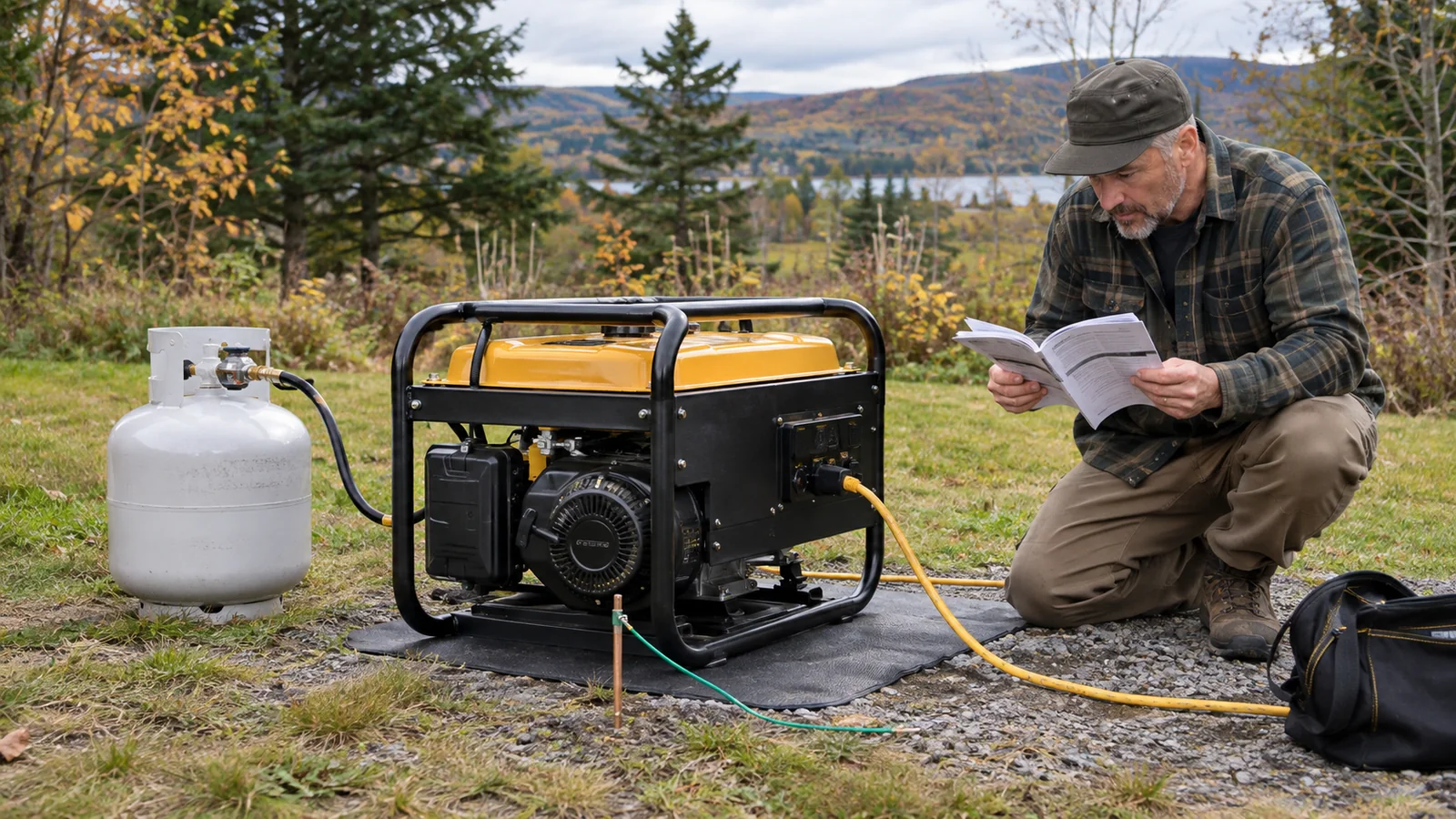
Grounding protects against electric shock by providing a safe path for current in case of a fault. Depending on the model and use, it may or may not be required. The answer is in the manufacturer’s manual and the applicable electrical code.
- Generator used on its own with extension cords: many recent models have a neutral bonded to the frame and do not require a ground rod when appliances are plugged directly into the generator. The manual says so.
- Generator connected to the house through a transfer switch: it generally uses the building’s grounding system; the neutral configuration depends on the type of switch, hence the importance of an electrician.
- Generator powering a separate installation (job site, trailer, detached building): a ground rod may be required.
If a rod is needed, it is usually a copper rod driven into the ground and connected to the generator’s grounding terminal with copper wire. Before digging, have underground lines located (in Quebec, through Info-Excavation). If in doubt, consult an electrician: poorly done grounding gives a false sense of security.
Safety first
- Always outdoorsNever in the house, garage or a shed, even if open.
- Away from openingsAt least 6 m (20 ft) from doors, windows and air intakes.
- CO detectorsBattery-powered, on every floor and near bedrooms.
- Safe connectionProper extension cords or an installed transfer switch.
- Refuel coldTurn off and let cool before refuelling.
Carbon monoxide from a generator can kill within minutes in an enclosed space. Protect the unit from rain and snow without enclosing it, on a dry surface. See running a generator in the rain and, for the neighbours, reducing noise without compromising safety.
Points to check before buying
- size it for your real needs, with a reasonable margin for starting surges;
- check the noise level, especially in urban areas or condos;
- favour electric start with a manual backup starter;
- check that parts and service are available near you;
- plan regular maintenance: oil change, air filter, spark plug, a monthly run of a few minutes under load;
- check municipal regulations (noise, fuel storage) and your insurer’s conditions.
To put the generator in context, see organizing during a prolonged outage and take the preparedness review.
Frequently asked questions
Is propane a good choice for an emergency generator?
Yes, especially for occasional use: it keeps almost indefinitely, burns cleanly and reduces maintenance. It provides slightly less output than gasoline for the same engine, which should be factored into choosing the model.
How long does a 20 lb cylinder last?
It depends on the load. With an average load of 2 to 3 kW, expect roughly 8 to 12 hours. The manufacturer’s runtime charts give more precise values by load percentage.
Can you plug a generator into the dryer outlet?
No. It is dangerous for line workers, for you and for your appliances. Use extension cords plugged directly into the generator or a transfer switch installed by an electrician.
Does my generator need to be grounded?
It depends on the model and how it is used. The manufacturer’s manual specifies it. Generators used on their own with extension cords often do not need it; a separate installation may require it. If in doubt, consult an electrician.
How far from the house should the generator be?
Outdoors, at least 6 m (20 ft) from doors, windows and air intakes, with the exhaust pointed away from the building, and with carbon monoxide detectors in the house.