
In this article
- Can I operate a generator in the rain?
- The dangers of operating a generator in the rain
- 3 tips for operating a generator safely
- Can I operate my generator in the rain if it is covered?
- DIY shelter: a video does not validate functional safety or performance.
- Conclusion
- References and compatibility
- Equipment to compare for your needs
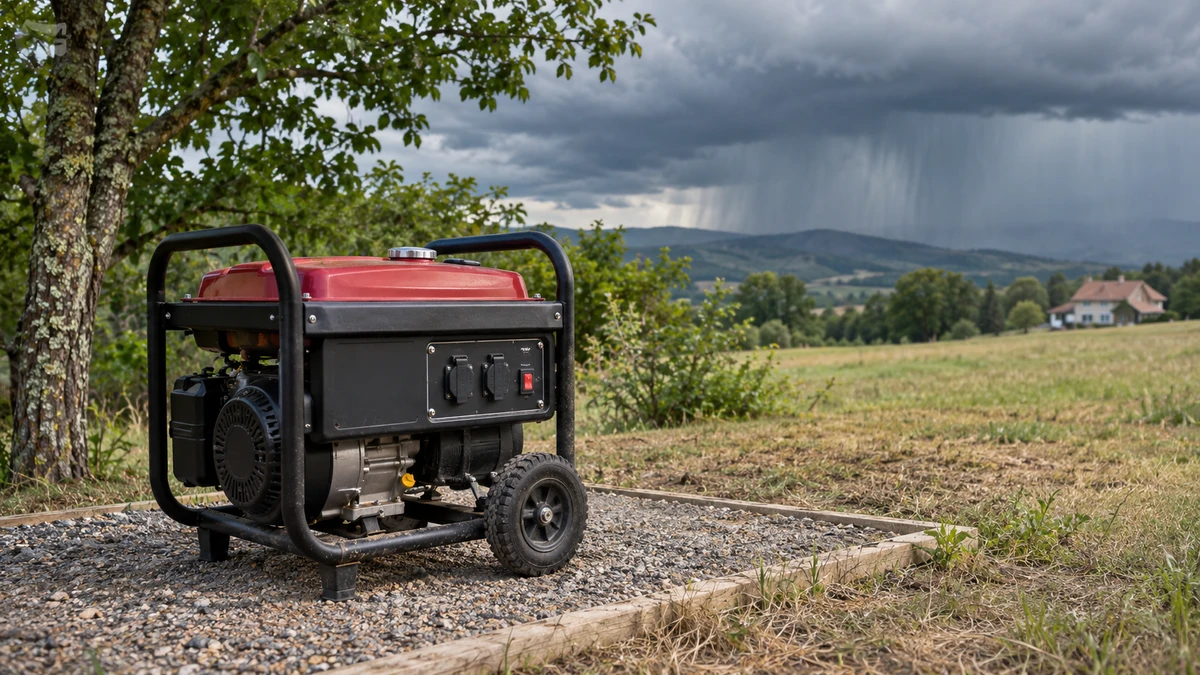
Natural disasters are often accompanied by high winds, flooding, and rain. If you rely on a portable generator for backup power, it is important to be aware of the safety implications of using your generator in wet weather.
Here, we will review the following:
- Should I operate a generator in the rain?
- What are the dangers?
- How to operate a generator safely.
- Can I operate a generator in the rain if it is covered?
- How to build a generator cover.
Can I operate a generator in the rain?
Do not operate a generator that is exposed to water, and do not handle it while wet. A so-called "operating tent" is only a viable option if it is explicitly compatible with the specific model and its intended use, and if the instruction manuals and safety guidelines permit such an installation. A storage cover must be removed before operation unless it is specifically designed for that purpose. Neither the price nor a claim of high quality is sufficient to authorize use in the rain.
The dangers of operating a generator in the rain
Protection against rain must be kept separate from any enclosure surrounding the engine. A garage, shed, or partially enclosed shelter can accumulate carbon monoxide, even if it has openings. Furthermore, there are risks related to electricity, heat, and fuel; never attempt to operate a generator indoors just to keep it dry.
#1 Electrocution
This can occur during or after a storm; touching a wet, running generator can be fatal.
Grounding and ground-fault protection are two different things. A GFCI (ground-fault circuit interrupter) is not the same as a proper grounding system, nor is it a universal solution for every setup. Follow the manufacturer’s instructions and have the connection verified by a qualified professional; do not attempt to modify neutral connections or add a grounding rod based on a general rule of thumb.
Cables, outlets, and powered devices can also pose a danger if they are wet or damaged. Never stand in water or work on equipment that is wet; the presence of a protective device does not make such a situation safe. Ensure the circuit is made safe and have the equipment inspected before putting it back into service—and never attempt to check for the presence of electricity by touching the equipment.
Always install the generator in a dry, secure outdoor location that provides the required clearances and distances. A standard awning, covered porch, or gazebo is not automatically a suitable location. If no appropriate, dry outdoor space is available during a storm, seek an alternative power source or relocate to a different shelter—do not move the generator closer to buildings or openings.
#2 Generator Malfunction
Water ingress can damage a generator and make restarting it dangerous. Have the unit inspected according to the manufacturer’s instructions before reuse; the fact that it appears dry does not mean it is free of defects. There is no specified minimum replacement cost or requirement to choose a dual-fuel model; needs, power output, and compatibility must be evaluated on a case-by-case basis.
#3 Fire Hazards
A cover can interfere with cooling, come into contact with hot surfaces, or be exposed to exhaust. Openings and clearances must comply with the engine and accessory manufacturer’s guidelines. Simply cutting a few vents into a box does not make it a safe or approved enclosure for operation. Do not assume that a drop in performance will serve as a warning sign before a fire or carbon monoxide poisoning occurs.
Keep combustible materials away, do not overload the unit, and use appropriate cables. Stop the engine and allow it to cool before refueling, as per the manufacturer’s instructions; a tent flap does not make it safe to refuel while the unit is running. A suitable fire extinguisher—kept in an accessible location away from the hazard—is a useful preventive measure, though it does not guarantee that a fire can be brought under control. In the event of a fire, move to a safe distance and alert others.
Even when not in use, follow proper storage guidelines: ensure the unit has cooled down, use appropriate protective covers, and store it in a suitable location. Never assume that a generator can be left out in the rain simply because it is not running. A storage cover and an operating tent (or canopy) are two different things; using the right one for the situation prevents the risk of powering up equipment that has been exposed to water ingress.
3 tips for operating a generator safely
Generators use fuel to produce high-voltage electricity, making them potentially dangerous machines—especially when there is a lot of water nearby. To protect both your generator and yourself, keep the following safety tips in mind:
#1 Do not operate your generator in the rain or near water
Water and moisture increase electrical hazards, depending on the specific conditions and substances present. There is no reason to test the conductivity of a puddle; keep your equipment dry and avoid handling any components that are wet.
Touching any of the electrical components of your generator with wet hands could result in a nasty electric shock. Imagine how much worse it would be if your generator were sitting in a puddle while rain poured down on both you and the unit.
#2 Keep your generator outdoors and away from your home
When storm clouds gather overhead, it can be tempting to move your generator indoors. The problem is that operating a generator—even in the best-ventilated area—is extremely dangerous.
Even those of us most concerned about safety can unknowingly put ourselves at risk simply by placing our generators too close to, or inside, our homes.
Combustion produces, among other things, carbon monoxide—a toxic, invisible, and odorless gas. Exposure can lead to serious symptoms and even death. Do not wait until you smell fumes or lose consciousness; if you suspect exposure, move to an open-air environment (without putting yourself in further danger) and seek appropriate emergency assistance. The engine must never be operated in an enclosed or partially enclosed space.
Health Canada recommends keeping the generator at least six meters away from the house—including its doors, windows, and vents—while following the manufacturer’s instructions and site-specific guidelines. Point the exhaust away from any openings. The presence of indoor carbon monoxide (CO) detectors does not justify moving the engine closer or testing a dangerous location. Ensure these detectors are maintained, regardless of whether or not a generator is being used.
#3 Never plug your generator into a wall outlet.
Never attempt to power a building’s electrical system by plugging the generator’s output into a wall outlet. This applies to any situation, even when powering a small appliance; convenience does not eliminate the risk of backfeeding (power flowing back into the grid). Always use a proper, compliant connection method designed for your specific setup.
Backfeeding can endanger both the building’s occupants and utility workers. To power a building’s electrical circuits, a transfer switch—installed by a qualified professional in accordance with all applicable regulations—is required. For devices connected directly to the generator, ensure compliance with specifications regarding outlets, power ratings, extension cords, and protective measures. Never use improvised cords with two male plugs.
Can I operate my generator in the rain if it is covered?
Distinguish between a storage cover and a protective cover specifically designed for use while the unit is running. Price alone is not a reliable indicator. Always check for exact compatibility, exclusions, and the user manual before purchasing or using any such product.
The least expensive options are designed solely to protect a generator from the elements when it is not in operation.
A protective cover intended for use during operation may cost more than a standard storage cover, but a higher price does not guarantee suitability. Pay close attention to the frame, dimensions, exhaust outlet, cooling system, and the intended installation method for your generator. An incompatible product cannot be made safe through improvised mounting.
Commercial claims do not constitute an independent test conducted by PrépaCivile. Verify the specific model before making comparisons; no product should be presented as the "best" or as a "universal" solution without clear criteria and proper verification.
GenTent 10k: verify the specific model reference.
Shape, attachment points, and exhaust placement matter. Consult the GenTent model guide and its list of exclusions rather than relying on a "universal cover" label.
Check prices on Amazon.
Check the documentation for the specific product, including the units of measurement and the timeframes:
- Rain: check units, exposure duration and operating limits in the exact product manual. A commercial figure in isolation does not define safe operating conditions.
- Snow: 18 inches is cited as a load or accumulation limit; thickness, density, and measurement conditions are not interchangeable.
A cover may protect certain components if it is correctly selected and installed. It does not guarantee engine performance or safety during a hurricane. The GenTent guide includes exclusions and wind limits; do not remain outside to monitor an installation when conditions pose a danger to people.
Specifications must be matched to the specific model reference and generation; this does not guarantee a specific service life. Check the condition, attachments, and instructions before use; the fact that the fabric appears intact does not rule out an exhaust-related incompatibility.
There is no guarantee of a price point around one hundred dollars or a multi-year lifespan. Compare the cost of the specific product—including any necessary accessories—against your intended use to determine if it meets your needs. An unsuitable cover can actually create a hazard; do not frame the purchase as a guaranteed cost-saving measure.
IGAN: protective covers for certain frame-mounted generators
The brand offers protective covers designed for specific generator configurations. References to "weatherproofing" or "water resistance" apply to the product under standard operating conditions; they do not imply that every part of the generator is shielded from all hazards, nor that the installation is safe under extreme conditions. Always verify which areas are covered and which must remain unobstructed.
Check prices on Amazon.
Some IGAN covers for tubular or square-frame generators are rated for a power range of 3,500 to 12,000 W; however, this does not mean they are compatible with every generator within that range. Carefully check the dimensions and mounting points, then verify the specific accessory part number. Do not attempt to improvise a fit if a hot component or the exhaust system is positioned in a way that conflicts with the cover.
While a frame may support the cover, its structural integrity depends on the assembly, anchoring, and environmental conditions. There is no guarantee that the structure will not collapse under heavy rain, snow accumulation, or high-velocity wind gusts. Follow all instructions, and do not operate the generator if the setup cannot be maintained in a compliant, secure state.
IGAN: specialized protective covers for certain small inverter generators
For models in the 1,000 to 2,300 W range, you must verify compatibility based on the specific part number and dimensions. Compatibility is not universal across all models, and the cover does not guarantee safe operation in all weather conditions; consult the list of exclusions and the generator’s user manual.
Check prices on Amazon.
In any actual installation, proper cooling and exhaust venting must be maintained. Claims regarding "natural air circulation" do not guarantee that the unit will not overheat or pose a risk of carbon monoxide poisoning. Check the required clearances and ensure that exhaust gases are vented away from people and buildings; do not add any walls or barriers for the purpose of noise reduction.
Featuring a heavy-duty tarp cover reinforced by a sturdy metal frame and fiberglass support rods, it is designed to withstand the elements.
Verify compatibility separately for an enclosed inverter generator and an open-frame model. Accessories from one brand can target different machines. A favourable review does not validate a personal adaptation or prove that cooling and required clearances are maintained.
Price and warranty terms vary based on the specific model, country, retailer, and date of purchase. Always verify the actual terms—do not automatically assume a three-year warranty applies to every tent from the brand. Purchasing a product does not negate the need for a safe location and adherence to safety guidelines; furthermore, it is not a substitute for an alternative power solution if the unit cannot be operated safely.
DIY shelter: a video does not validate functional safety or performance.
A DIY solution might seem less expensive, but it offers no guarantee of safety or durability. Heat management, exhaust venting, and electrical protection must be handled in accordance with the specific generator model and relevant regulations. This guide does not provide a validated design for an operational enclosure. Do not attempt to convert a storage cover or a wooden box into an enclosure for a running generator based solely on a video.
A permanent shelter must maintain proper clearance from buildings and must not allow for the accumulation of gases or create hazardous access points. Knowing the prevailing wind patterns does not guarantee the wind’s direction during a storm. Adding an acoustic barrier or an extra wall can interfere with cooling and exhaust systems. Have your project evaluated by qualified professionals and ensure compliance with the manufacturer’s exclusions.
A demonstration video does not constitute testing for temperature, carbon monoxide (CO) levels, wind load, or electrical safety. We include such links for reference purposes only; this does not imply that the shelter shown in the video is an option endorsed by PrépaCivile.
A sturdy appearance is not proof of resistance to wind, rain, or storms. No "hurricane-rated" standard applies to homemade structures. Furthermore, severe weather conditions can make accessing the equipment dangerous, even if the shelter itself remains structurally intact.
Materials like plastic and plywood carry specific risks—such as heat damage, fire, or deformation—depending on how they are used. Using thicker material does not automatically make a design safe or easy to build. Adhering to required clearances, exhaust specifications, and the manufacturer’s manual takes precedence over the mere availability of wood or tools.
Efforts to reduce noise must not result in the trapping of exhaust gases or the obstruction of cooling systems. An acoustic enclosure is not necessarily a validated operating enclosure. Perceived quietness and the absence of odors do not constitute a check for carbon monoxide (CO); maintain required clearances and do not make any unapproved modifications.
When constructing an enclosure for a generator, keep the following requirements in mind:
Airflow – without sufficient airflow, a generator will struggle to operate and may even overheat, creating a fire hazard.
Exhaust – do not assume that a few vents are enough to make an enclosure safe. CO must be kept away from people and building openings, in accordance with a compliant installation; never operate a generator in an enclosed or partially enclosed space.
Heat – maintain required clearances and use only approved materials; an improvised heat shield is not a substitute for proper clearances or a validated design.
Access – ensure that any maintenance or intervention is performed safely, only when the engine is stopped and has cooled down, as per the manufacturer’s instructions. An opening that provides access to the fuel tank does not authorize refueling while the unit is running. Never attempt to access moving parts or work on wet components while it is raining.
Conclusion
During a power outage or severe weather, starting a generator should not automatically be the first course of action. Assess your needs, the current conditions, and whether a safe location is available; consider alternative solutions for critical functions. If a compliant installation cannot be achieved, do not use the generator, as doing so risks carbon monoxide poisoning or electric shock.
A suitable protective cover may be part of the solution, but it does not eliminate all risks related to water exposure, exhaust fumes, or electrical connections. Read both instruction manuals, check the placement, and plan for maintenance. An accessory should not be purchased or constructed under the assumption that it provides blanket authorization for operation during any type of severe weather.
The performance standards of certain commercial tents do not necessarily apply to low-cost, DIY assemblies made from plywood sheets. A do-it-yourself solution does not guarantee cost savings, nor does it offer equivalent resistance. Opting for a verifiable, professional-grade installation—or another method to address this essential need—is preferable to a promise of savings that compromises safety.
References and compatibility
Equipment to compare for your needs
Some links below are affiliate links: we may receive a commission at no additional cost to you. Products are examples by function, to choose according to your needs; buying the entire selection is unnecessary.