
In this article
- Unboxing and First Impressions
- Historical specifications provided by the source — not re-measured here.
- Controls described in the review — not a guide for returning the item to service.
- Form factor
- Charging Process
- Beam Pattern / Beamshots
- Mode (Output) Spacing
- Tint and CRI
- Water Resistance
- Lockout Capability
- Historical comparison with the Olight M2R Warrior — historical test data
- Scale comparison (ruler)
- Final thoughts
- Equipment to compare for your needs
Historical review: observations concern the model and sample examined at the time. Check the exact model manual, safety notices, accessories and sales terms before purchase or use.
Safety Recall — historical document. The M2R Pro is among the flashlights subject to a Canadian recall issued on May 24, 2022, due to the risk of accidental activation and overheating while in a pocket or holster. Health Canada advises that you stop using the product immediately and contact Olight. The observations, photographs, and order information below are retained to document this past review; they do not constitute a recommendation to purchase or resume using the product.
This historical review presents observations and specifications for the model as they existed at the time it was written. The observations describe this specific unit and that particular period; they do not represent a review of a current model. This historical assessment is separate from the recall measures; any previously perceived quality does not negate the need to follow the recall instructions.
Unboxing and First Impressions
The source photographs show how the flashlight was presented in its packaging at the time of the review; they do not reflect the condition or compliance of any product offered for sale today.
- The shrink-wrapped packaging, featuring a magnetic opening flap, appears to be of superior quality—a level of detail not commonly found on flashlight boxes.
- The threads and the O-ring have been lightly lubricated. The threads were smooth and clean (with no gritty or sandy feel).
- The review described a tail switch that requires firm pressure. This observation does not imply that accidental activations are prevented; it must be considered in light of the product recall, which takes precedence over the initial assessment.
- The side switch was also noted to be quite firm during testing. This observation does not constitute a validation of safe carry; nothing described here should be used to disregard or bypass a recall notice.
- The included two-way clip is reversible, allowing for deep-pocket carry (bezel-down) when flipped.
- The clip was observed to hold securely onto fabric under the conditions tested. This does not guarantee secure attachment to all types of material, nor does it prevent the light from falling in every instance. Real-world stress and wear may vary.
- The magnetic tail cap can support the weight of the flashlight when attached vertically (upside down) to a flat, ferrous metal surface. The weight of the flashlight prevents it from being attached horizontally.
- It is also compatible with Olight’s magnetic remote pressure switch.
- The anodization on the light is uniform and free of any defects, consistent with the standards expected from Olight.
- The included strap comes with a thin piece of metal, which is very useful for making it easier to insert into the hole.
- The lanyard was deemed capable of supporting the flashlight during the original test. No long-term durability was measured, and this does not constitute a guarantee of strength.
- The holster was included and appeared suitable for everyday use in the original account. An expectation of durability is not a substitute for actual measurement and does not address the safety issue identified later.
- The holster comes with a quick-release button for faster access to the flashlight, similar to the one used for the Olight Seeker 2 Pro.
- The MCC3 magnetic charging cable was rated for charging at up to 2A. Do not assume compatibility with all batteries based solely on their size or claims of backward compatibility. For questions regarding older equipment, refer to the manufacturer’s information and follow appropriate safety protocols.
- The test referenced a custom Olight ORB-217C50 battery. The 21700 format does not mean all such batteries are interchangeable; the chemistry, contact points, protection circuitry, and charging specifications must all match an authorized model.
- The earlier suggestion that another 21700 battery might fit into the compartment does not constitute electrical validation. Do not attempt to use a battery based solely on its dimensions, and do not modify its contact points. This document is not a repair procedure.
- Scanning the QR code found on the bottom of the box with your phone or tablet will take you to the product page for the Olight M2R Pro Warrior.
Notes:
- The original manual mentioned the removal of a shipping insulator before first use. This reference is included for historical documentation purposes only; it should not be interpreted as an instruction to prepare a unit for use if that unit is subject to a safety-related recall or notice.
- The photos below show the flashlight body after the shrink-wrap film has been removed.


Historical specifications provided by the source — not re-measured here.
- Body material: HAIII aluminum
- Body color options:
- Black
- Camouflage (limited edition)
- LED: The original test identified a neutral-white Cree XHP35 HI. This technical identification is based on the earlier test and has not been verified through disassembly or current manufacturer documentation.
- Battery type: 1 x 21700 only
- Output and runtime (with included Olight 21700 3.6V / 5000mAh battery):
- Moonlight (1 lumen / 50 days)
- Low (15 lumens / 5 days 10h)
- Mid 2 (60 lumens / 1 day 16h)
- Mid 1 (250 lumens / 10h)
- High (750 lumens / 2h 40min) → (250 lumens / 40min) – Gradual reduction based on temperature
- Turbo (1800 lumens / 4min 30sec) → (750 lumens / 2h 25min) → (250 lumens / 45min) – Step-down based on temperature
- Maximum beam distance: 300m
- Beam intensity: 22,400 cd
- Stated protection: IPX8, under the manufacturer's specified conditions. This does not imply a universal depth rating or resistance to all types of immersion.
- Stated drop resistance: 1.5m under specific test conditions; this is not a guarantee against every possible impact or internal damage.
- Dimensions: 136.5mm (length) x 29.5mm (diameter)
- Weight: 179g (batteries included)
- Battery reverse polarity protection
- Included accessories:
- 1 * Olight 21700 3.6V / 5000mAh battery (Olight ORB-217C50)
- 1 * Magnetic USB charging cable (MCC3)
- 1 * Pocket clip
- 1 * Holster
- Historical price listed: approximately $150 CAD. This is neither a current price nor a commercial offer.

Controls described in the review — not a guide for returning the item to service.
The review highlighted access to multiple levels via two switches. The following descriptions retain this technical detail, without verifying the controls on a current unit. Do not handle a recalled flashlight to replicate these sequences; safety remains the priority.
The historical review described turning the light on and off using either the side or tail switch, and a momentary mode via the tail switch. The original text repeatedly used the term "side"; the two locations are distinguished here for the sake of clarity in the archive.
Note:
- Configuration 1 for the electronic tail switch is the factory default mode.
- The tail switch was described as a two-stage pressure mechanism, compared in the text to a camera shutter button. This is an explanation of the tactile feel, not a measurement of force or a testing specification.
- The report mentioned a strobe mode and the absence of an SOS mode. A flashing light mode is not a distress signal, and there is no guarantee that such a signal will be seen or recognized.
Normal operation – side switch
From OFF:
- 1 click – Activates the last used brightness level (all modes are memorized, except for TURBO and STROBE).
- 2 clicks – Direct access to TURBO; click once to turn off, or press and hold to change modes.
- 3 clicks (or more) – Direct access to STROBE; click once to turn off, or press and hold to change modes.
- HOLD (~ 1 sec) – Direct access to "MOONLIGHT" mode.
From the ON state — description of the test procedure
- 1 click – Turns the light off.
- 2 clicks – Direct access to TURBO; click once to turn off, or press and hold to change modes.
- 3 clicks (or more) – Direct access to STROBE; click once to turn off, or press and hold to change modes.
- HOLD – Mode switching (the light cycles only through LOW, MID 2, MID 1, and HIGH; MOONLIGHT and TURBO are not included in the sequence).
Notes:
- If the memorized mode is HIGH, and you double-click to enter TURBO mode, a subsequent double-click will return the light to MID 1 instead of the previous mode (HIGH).
- Momentary access through the tail switch differs from the side control. Assess the interface for your tasks and the risk of accidental activation. The commercial term “tactical” does not demonstrate defensive capability or a particular household need.
Normal Operation – Tail Switch (Configuration 1 – MID 1 and TURBO)
From OFF:
- Half-press – Direct access to MID 1.
- Full press – Direct access to TURBO.
- HOLD (half-press) – Direct access to MOMENTARY MID 1; HOLD (full press) – Access to MOMENTARY TURBO.
- HOLD (full press) – Direct access to MOMENTARY TURBO.
From (MID 1):
- Half-press – The light turns off.
- Full press – Switches to TURBO mode.
- HOLD (full press) – Direct access to MOMENTARY TURBO.
- Full press (SIDE switch) – The light turns off.
- HOLD (side switch) – Mode switching (the light cycles only through LOW, MID 2, MID 1, and HIGH; MOONLIGHT and TURBO are not part of the sequence).
From ON (TURBO):
- Half-press OR full press – The light will turn off.
- Full press (SIDE switch) – The light will turn off.
- HOLD (side switch) – Mode switching (the light cycles only through LOW, MID 2, MID 1, and HIGH; MOONLIGHT and TURBO are not part of the sequence).
Normal operation – Tail switch (Configuration 2 – MOMENTARY TURBO AND STROBE)
From OFF:
- Half-press – Direct access to MOMENTARY TURBO.
- Full press – Direct access to MOMENTARY STROBE.
- The historical test mentioned momentary access to HIGH here, while a half-press was described as accessing TURBO just above. This inconsistency is not resolved by inventing a sequence; it remains noted in the report. Do not attempt both variations to determine the behavior of a flashlight subject to the recall.
- HOLD (full press) – Direct access to MOMENTARY STROBE.
From the ON state — archive
- Not applicable – Configuration 2 consists exclusively of MOMENTARY modes.
Switching configurations (Configuration 1 ⇔ Configuration 2)
The sequence for changing configurations is not fully explained in the remaining paragraphs. The result indicators provided below do not constitute a complete procedure to follow. Do not complete the steps based on assumptions.
- HOLD (1 press) on the tail switch, and 1 press (on the side switch).
- If MOMENTARY TURBO is visible, Configuration 1 has been activated.
- If MOMENTARY STROBE is visible, Configuration 2 has been activated.
- Release the tail switch to exit the configuration mode selection.
Power Indicator
There is only one type of power indicator for this flashlight.
When turned ON (in any mode except "MOONLIGHT"), the LED indicator on the side switch will glow in one of the following colors:
- GREEN – Power is > 75%.
- ORANGE – Power is between 30% and 75%.
- RED – Power is < 30%; recharge or replace the batteries.
- FLASHING RED – Power is < 10%; recharge or replace the batteries immediately.
Electronic lockout
From OFF:
- HOLD (until MOONLIGHT mode is activated and then deactivated) – LOCKOUT mode is enabled; HOLD (until MOONLIGHT mode is activated) – LOCKOUT mode is disabled.
When electronic lockout mode is active, pressing any button causes the RED LED on the switch to light up for approximately 2 seconds.
Form factor
For an everyday carry (EDC) flashlight, factors such as weight, volume, ergonomics (how it feels in the hand), and accessibility of the controls are important considerations. The observations made during this review reflect the specific unit at the time of testing; they do not constitute a recommendation for its inclusion in a current-day carry kit.
This light is remarkably well-balanced in an average-sized hand—it is neither head-heavy nor tail-heavy. Its form factor makes it easy to switch between an overhand (tactical/pronated) grip and an underhand (ice-pick/supinated) grip.
The knurling provides good grip, as noted in previous evaluations. While it offers a solid hold—even when wearing certain types of gloves or with wet hands—this does not guarantee a secure grip under all conditions; such assessments remain subjective.
Although the tail switch protrudes, the three crenellated-style prongs around the tail cap allow the flashlight to stand upright perfectly, without any wobbling, while still providing quick and easy access to the switch.
By reversing the two-way pocket clip and inserting it into the slot on the tail section, you can enable a deep-carry configuration.
This flashlight is not recommended for use as a weapon or a glass-breaking tool. The presence of a crenellated bezel does not guarantee an ability to break vehicle windshields or windows, particularly those made of laminated glass. A visual comparison to the previous M2R model does not constitute a test of its effectiveness for vehicle emergency egress.




Charging Process
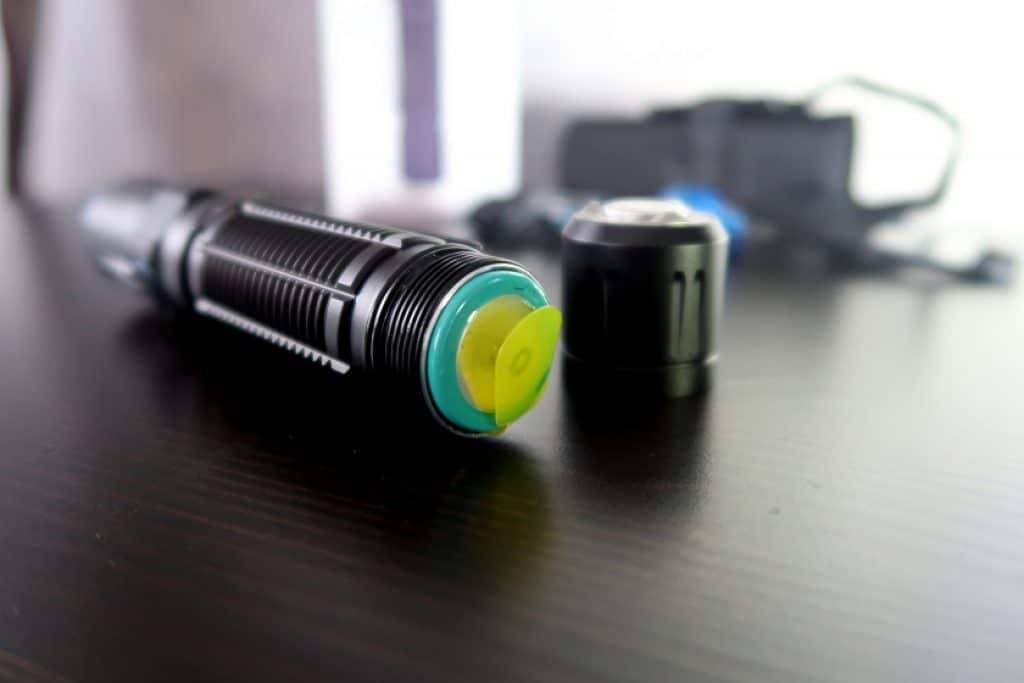
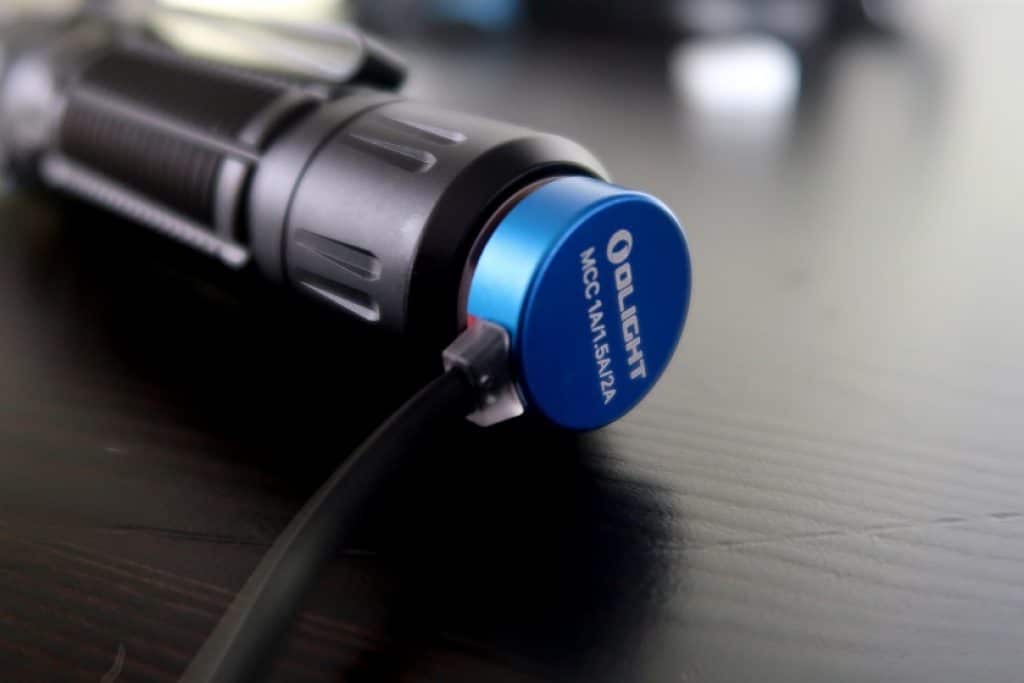
Previous testing indicated a charging current of approximately 1.95 A when using the MCC3. This measurement has not been replicated and cannot be used to verify the current condition of any specific cable, charger, or battery currently in use.
The report mentioned the possibility of operating the light while it is charging. This should not be interpreted as a recommendation for how to handle or charge the device; furthermore, the "Moonlight" or "Low" modes should not be presented as a solution to any safety concerns.
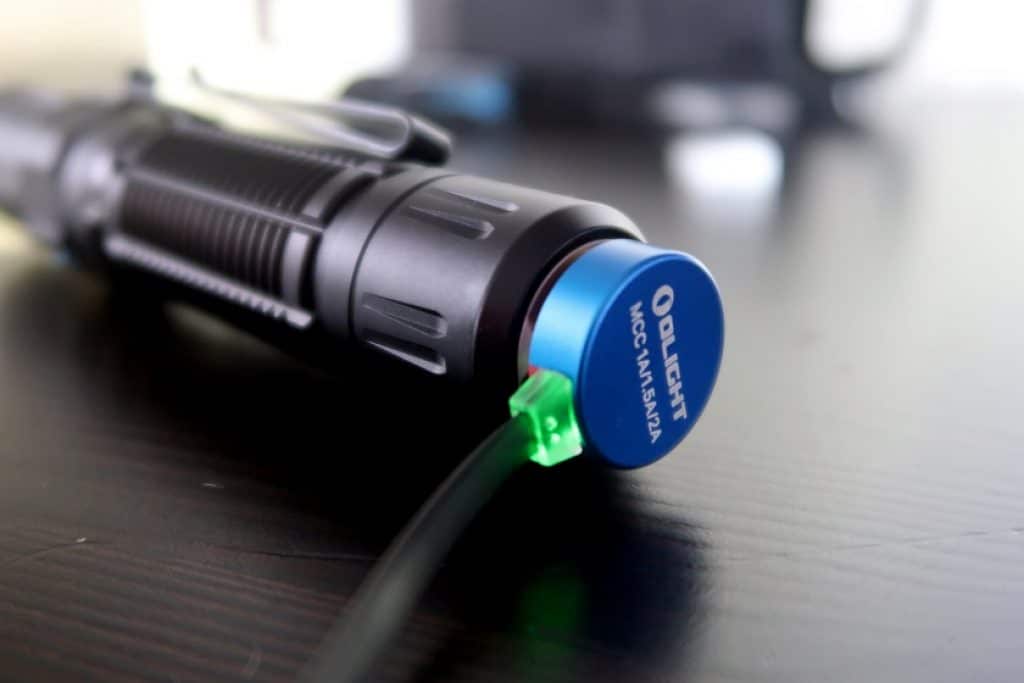
A solid red indicator on the tail-end component of the MCC3 charger signifies that charging is in progress. A solid green indicator on the same component signifies that charging is complete.
Note: The MCC3 requires a power source with a minimum output of 5V 2A (or greater than 2A) to operate at its optimal charging speed.


Beam Pattern / Beamshots
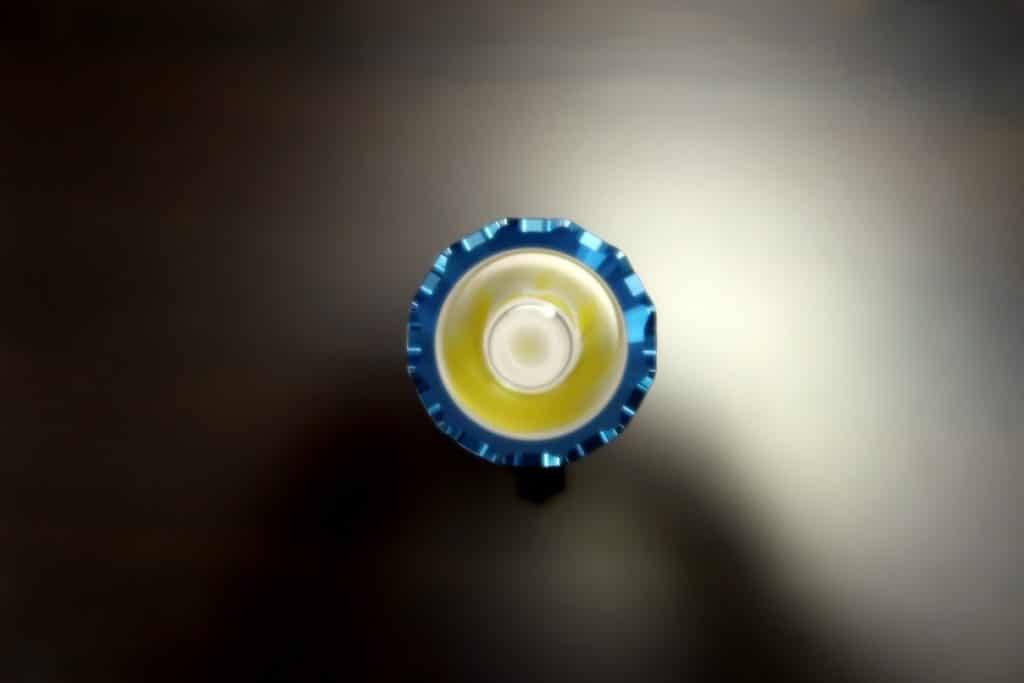
For this flashlight, the spill, corona, and hotspot are relatively predictable due to the use of a TIR (Total Internal Reflection) optic. The LED is entirely covered by a clear TIR optic (featuring a slight frosting at the center). Consequently, the beam features both a "throw" component and a soft diffusion, allowing for the recognition of objects at near-to-medium distances.
The beam diagram and photographs are representations derived from previous testing. While illuminating a wall allows for certain visual comparisons, it does not measure effective range or color rendering in real-world environments.
The beam consists of a large, circular "hotspot" with a faint corona and a wide "spill" (the majority of the light output is concentrated within the hotspot). Although beam artifacts may appear when shining the light against a white wall, they are not noticeable during real-world use.
Note: The crenellated bezel is visible within the spill area of the beam, though it is less apparent under actual operating conditions.

Mode (Output) Spacing
In previous testing, the output levels were considered sufficiently spaced to be clearly distinguishable. Perceived brightness alone is not a reliable indicator of remaining battery life; factors such as battery state, regulation, and temperature also play a role. These values should be viewed as historical benchmarks rather than a guarantee of current runtime performance.
The low "MOONLIGHT" mode was valued for nighttime use, providing illumination without excessive brightness. While the concept of a low-output mode remains useful—and may help in selecting an appropriate alternative flashlight—it does not justify the continued use of the recalled model.
The "MID 1" level of 250 lumens was presented as a compromise between brightness and runtime. This is an assessment from the review—not a formal ranking among current models, nor a guarantee regarding thermal management.
Tint and CRI
The original review estimated the color temperature to be around 5,000 K and the Color Rendering Index (CRI) to be around 75; these figures were not based on instrumental measurements. They are estimates, not confirmed manufacturer specifications.
The report noted a slight variation in tint between the center, the corona, and the periphery of the beam. Whether such an effect is visible depends on specific conditions and individual perception; it cannot be claimed that it would be impossible to notice during actual use.
Water Resistance
The archived records describe the device being submerged in hot and cold water, as well as being held under a running tap while in "TURBO" mode. This does not constitute an IPX8 certification protocol, and the test has not been repeated. Do not attempt to replicate these actions, as they could damage the device or create safety hazards—especially given the current product recall.
The text did not report any visible water ingress during this test. The fact that no water was observed does not rule out internal damage, nor does it guarantee performance under different conditions (such as varying durations, temperatures, or across other individual units).
Lockout Capability
The report described two methods for locking the device. The existence of these features does not imply that the device is safe, nor does it override instructions to cease use of the product.
The quarter-turn of the cap was presented as a mechanical disconnection. This reference is for documentation purposes only and should not be proposed as a corrective measure for a recall or as evidence of isolation for transport.
The electronic locking mechanism refers to the description archived above; it does not replace the safety procedures established with the manufacturer.
Historical comparison with the Olight M2R Warrior — historical test data
| Description | Olight M2R Pro Warrior | Olight M2R Warrior |
|---|---|---|
| LED used | Cree XHP35 HI | Cree XHP35 HD |
| LED tint | Neutral White (NW) | Cool White (CW) |
| TURBO mode output | 1800 lumens | 1500 lumens |
| Beam distance | 300 meters | 208 meters |
| Beam intensity | 22,400 cd | 10,880 cd |
| Weight (battery included) | 179 grams | 155 grams |
| Flashlight length | 136.5 mm | 130 mm |
| Flashlight width | 29.5 mm | 25.4 mm |
| Battery included | 21700 (5000mAh) | 18650 (3500mAh) |
| Magnetic USB charging | Yes, MCC3 (charges up to 2A) | Yes, MCC2 (charges up to 1A) |
| Knurled body | New, more pronounced knurling | Less pronounced knurling |
| Crenellated bezel | More aggressive crenellation | Less aggressive crenellation |
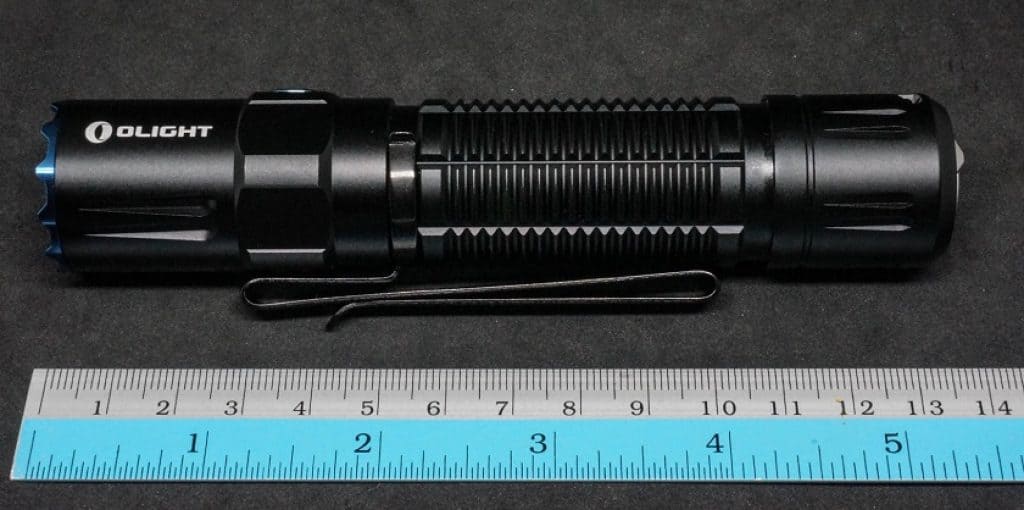
Scale comparison (ruler)
Final thoughts
The original conclusion recommended purchasing the product. This is no longer a current recommendation: an assessment made prior to a product recall is not sufficient to justify the use or resale of an affected model. The technical details and impressions remain available for reference to understand the review, but no affiliate offer is provided for this flashlight.
Aspects highlighted in the review included the direct and tail-switch controls, configuration options, the quiet operation of the button, the MCC3 cable, the stated capacity, and the knurling. These points reflect what the reviewer found interesting; they do not constitute an endorsement of safety. The compatibility of a remote accessory also requires model validation and has not been re-evaluated for this new test.
The historical suggestion regarding a less aggressive bezel relates to desired ergonomics. It is neither a modification to be performed by the user nor a means of bringing the product into compliance with safety standards.
Simple user interface with direct access to MOONLIGHT, TURBO, or STROBE
Points noted favorably in the previous test — not a purchasing recommendation
- Simple user interface with direct access to MOONLIGHT
- TURBO or STROBE from OFF; simple 2-mode interface via the TAIL switch.
- Option to use either the SIDE or TAIL switch; configurable TAIL switch.
- Nearly silent electronic tail switch; easy access to the tail switch; uses the new Magnetic Charging Cable 3 (MCC3); faster charging capability (up to 2A); higher-capacity 21700 battery.
Limitations identified during testing, in addition to a subsequent product recall.
- No SOS mode.
Safety reference:Health Canada recall RA-64179.For an affected unit, follow the official instructions and those provided by the manufacturer. Previous descriptions, photographs, or assessments do not supersede this procedure.
Equipment to compare for your needs
Some links below are affiliate links: we may receive a commission at no additional cost to you. Products are examples by function, to choose according to your needs; buying the entire selection is unnecessary.