
In this article
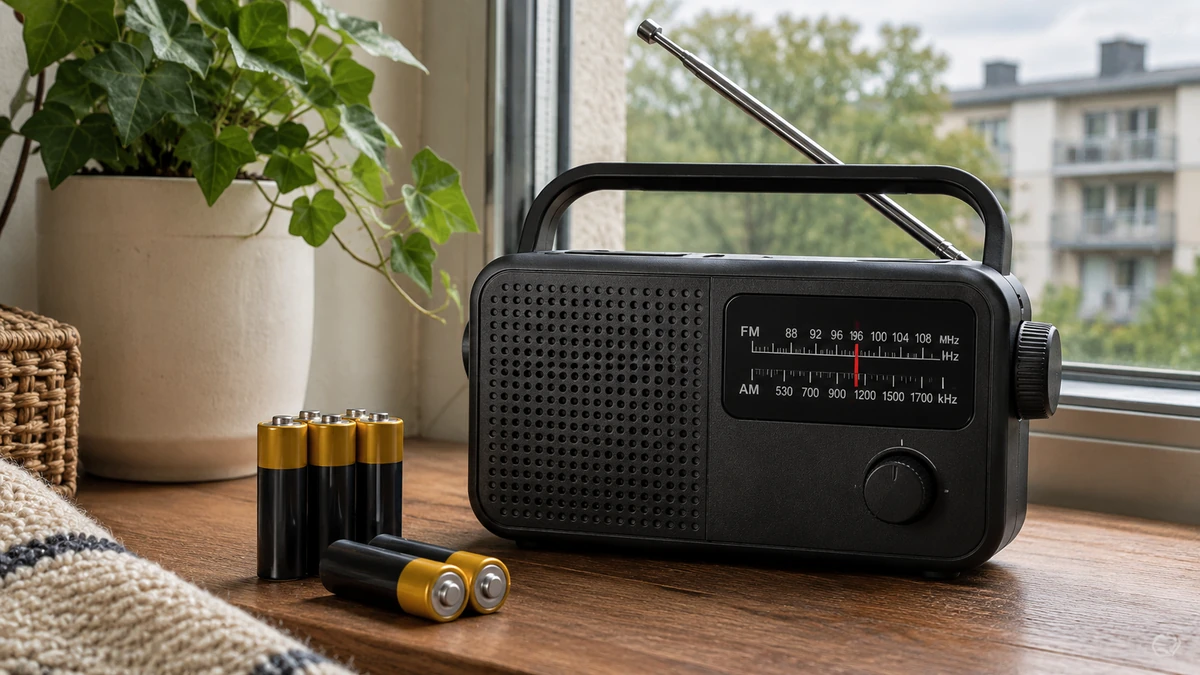
When electricity, the internet or the cellular network are disrupted, a portable radio remains one of the simplest ways to receive bulletins and instructions from the authorities. It only picks up stations whose transmitters are working and whose signal reaches you, though: it is a complement, not a guarantee. Here are the criteria for choosing one in Canada since the closure of Weatheradio, and how to test it before you need it.
At a glance
- Prioritize good AM/FM reception and a simple power supply: standard batteries, with tested spares.
- Since March 16, 2026, Weatheradio Canada no longer broadcasts: a weather band or SAME decoder does not replace that service.
- Test the radio at home, find your local stations and measure its real battery life before an outage.
Dozens of models are on the market at very different prices. They are not all equal for emergency preparedness: a few clear criteria help avoid an unsuitable purchase.
Why Include an Emergency Radio in Your Kit?
An AM/FM radio allows you to listen to bulletins and alerts broadcast by accessible stations. "Alert Ready" (En Alerte) is the brand for the national public alerting system; authorized officials issue messages according to established criteria and channels. Not all weather advisories are broadcast with the same level of priority. A consumer-grade radio does not need to feature a special logo to pick up an alert integrated into a station’s regular programming.
Cellular networks may experience outages or overloads, though they do not necessarily fail completely within the first few hours. A battery-operated radio provides an alternative, but its functionality depends on having sufficient power, good reception, and an operational broadcaster. It is best to rely on multiple sources of information, rather than assuming that any single one will remain immune to all potential failures.
Real-world utility: The best emergency radios offer more than just the ability to receive alerts. Some models can charge other devices (such as phones or flashlights), provide lighting for the immediate area, and maintain a basic connection to national and international broadcasters. These secondary features prove truly valuable during extended periods of waiting.
Understanding "Alert Ready" and the end of Weatheradio Canada
Distinguishing between standard AM/FM broadcasting and the specialized Weatheradio service helps ensure you don’t purchase the wrong equipment. Weatheradio Canada and its French-language counterpart, *Bonjour Météo*, ceased operations on March 16, 2026. Having a 162 MHz weather band or a SAME decoder will not restore these transmissions. The "Alert Ready" system continues to rely on broadcasters and compatible wireless devices—these are entirely different systems.
National Alerting Infrastructure
Pelmorex operates the central infrastructure that aggregates messages from authorities and distributes them to participating outlets. Individual stations then broadcast the alerts according to their specific operational protocols. The historical figure of 719 transmitters should not be considered an accurate, current inventory. This infrastructure is not a specific radio band to be tuned into on a receiver, nor does it mean that every station and site will continue to broadcast in the event of a local outage.
Alert Ready
"Alert Ready" is the public-facing name for the national system, developed and operated in collaboration with emergency management authorities, broadcasters, wireless service providers, and other partners. On the radio, the listener hears the message as broadcast by the station. This does not turn an ordinary, switched-off radio into a device that wakes up automatically, nor does it transform a receiver into a transmitter capable of calling for emergency assistance.

AM and FM broadcasters participate in transmitting alerts; however, one should not assume that every frequency broadcasts every message simultaneously, or that coverage is uniform. Reception depends on the transmitter, signal propagation, the building, and radio interference. Identify several stations that can be reliably received at home, and plan an alternative solution for locations where no stations can be picked up.
Key selection criteria
1. AM and FM reception
Receiving both AM and FM gives you more choice of stations and useful redundancy: AM often carries farther, while FM usually sounds better locally. Neither guarantees full coverage if a transmitter fails. Test local stations where you will listen, with the antenna and batteries you will actually use. A simple radio can be perfectly suitable if its limits are known.
2. A realistic power supply, with backups
Power deserves as much attention as the bands received. A simple battery radio, with spare batteries stored and tested, is often the most reliable solution. A hand crank, solar panel and USB charging add options, but their presence proves neither quality nor durability. Check which sources the model actually accepts: not every radio combines all the options.
| Power source | Advantages | Limitations |
|---|---|---|
| Standard AA or AAA batteries | Easy to find and store, shared with other equipment | Spares to plan and renew; check for leaks |
| Hand crank (dynamo) | Backup when everything else is depleted | Output and durability to test; physical effort |
| Built-in solar panel | Top-up charging without fuel | Highly dependent on light; weak in winter |
| USB port | Charging from a power bank or portable panel | Requires another charged power source |
Power use: a basic AM/FM radio uses little energy. Every added feature (flashlight, USB charger, Bluetooth) increases consumption. Check battery life in receive-only mode: that is the main use.
3. Understand SAME and weather bands before buying
SAME (Specific Area Message Encoding) is a code that lets some weather receivers filter messages by area, when the corresponding broadcast service is operating. It filters neither ordinary AM/FM programming nor phone alerts. Since Weatheradio Canada closed, do not buy this feature as a guarantee of local alerts in Canada. In the United States, NOAA Weather Radio availability should be checked where you will use it; cross-border reception is neither automatic nor complete.
Marketing claims to read with caution
- Alert Ready logo: it is not a quality certification. For AM/FM, no logo is needed to hear an alert broadcast by a station.
- The Weather Network or Pelmorex mention: on its own, it does not guarantee the device's capabilities.
- SAME or NOAA mentions: they describe specific features or services, and do not prove that a closed Canadian weather network is still available.
Useful bands depending on context
- AM/FM: alerts broadcast by stations, local information and national programming, depending on reception.
- Shortwave (SW): long-distance reception is possible depending on what is actually broadcast, the time, language, antenna and propagation. Big names from the past do not guarantee a service in Canada today.
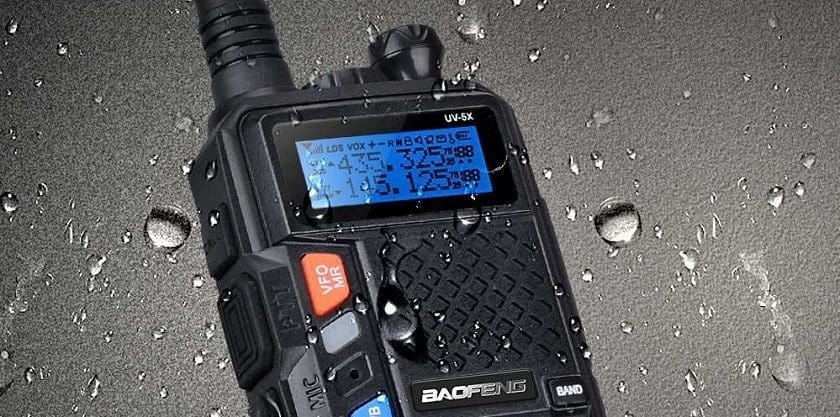
- Two-way radios: a different function from receiving information. In Canada, choose certified FRS/GMRS devices; European PMR446 rules do not apply here.
4. Water resistance
Choose protection based on intended use. IPX ratings are not interchangeable: IPX4 protects against splashes, IPX6 against powerful jets and IPX7 against temporary immersion under the specified test conditions. So IPX6 does not mean "partial immersion". Check the specification sheet and the conditions for covers and ports. A case protects the radio when travelling, but does not make it usable in a dangerous flooded area.
Optional features based on needs
These features do not replace the main role, reception. They can be useful if their capacity matches your need, but they use up available power and sometimes complicate the controls. Check how they work and the battery life rather than assuming a benefit.
Features with real added value
- USB output port: charge a phone or flashlight from the radio's internal battery.
- Built-in flashlight: emergency lighting without extra equipment.
- Rechargeable internal battery: confirm in the manual whether it works with standard batteries or instead of them; capacities do not simply add up.
- SOS function: a local sound or light signal on some models. It sends no location and no call to an emergency centre; avoid tests that could cause a false alarm.
- Rugged housing: shock-resistant for field use.
Features depending on how you use it
- Speaker or earphones: a speaker lets the family listen together; power use depends on volume and active features.
- Preset stations: save your local broadcasters before a crisis.
- Bluetooth: handy day to day, but uses more power.
- Shortwave: useful for international reception if local networks are down.
Selection principle: match features to real use. A radio mainly meant to follow bulletins during a winter outage does not need the same specifications as one for a multi-day evacuation bag. Power use and durability matter more than comfort features.
Test your radio before you need it
Find your stations: note the frequencies of AM and FM stations in your area that broadcast local information, and preset them.
Test reception where you will listen during an outage (basement, central room), with the antenna extended.
Measure battery life: with fresh batteries, note how many hours the radio runs in receive-only mode at normal volume. Then work out the spares needed for 72 hours, with a margin.
Try the crank or solar panel according to the manual, and note what they really provide.
Store the radio with its spare batteries in your emergency kit, and repeat the test at each time change.
Review all your sources of information with your preparedness review, and test your other means of communication too: see week 38: testing backup communications.
Frequently asked questions
Does an emergency radio replace a ham radio or walkie-talkie?
No. An AM/FM radio is for listening; a two-way radio is for exchanging messages with people who are equipped and within range. Amateur radio requires a qualification and authorization. In Canada, FRS/GMRS walkie-talkies follow a different framework from European PMR446. The two uses complement each other, and a household does not need every type of radio: first decide who to reach, why, and by what legal means.
Do I need a licence to use an emergency radio?
Not for a receive-only radio. Buying a device gives you no right to transmit with any other functions it may have, though. In Canada, FRS/GMRS devices must be certified under the Innovation, Science and Economic Development Canada (ISED) framework to be licence-exempt, and amateur radio requires a certificate. A PMR446 device sold in Europe should not be used in Canada just because it says "licence-free".
Is the hand crank really useful, or just a gimmick?
It can help when other sources are depleted. The ratio between cranking time and listening time depends on the model and the battery's condition: test it according to the manual to get a realistic result. A good battery radio with a suitable reserve remains a good choice without a crank, and a crank does not guarantee you can usefully charge a phone.
How many spare batteries should I keep with the radio?
Start from your device's measured battery life and how much you plan to listen, then add a margin. Listening continuously for 72 hours uses far more than catching a few bulletins a day. Keep the right size, and check dates and leaks. For lithium batteries, often advertised for long life and cold weather, confirm compatibility in the radio's manual.
What is the difference between a weather radio and an emergency radio?
A weather radio receives a specific service on the bands designed for it; a multifunction emergency radio adds AM/FM, lighting or charging, depending on the model. In Canada, Weatheradio and Hello Weather ended their services on March 16, 2026: the 162 MHz band and SAME can no longer be presented as guaranteed local reception. Coast Guard marine forecasts fall under another framework and do not replace that service for a household. Choose truly useful features rather than the largest number of bands.
Read next
Week 4: preparing your communications
The basics of a family communication plan before a crisis.
UV-5R type radios
Comparing versions and checking what you are allowed to transmit.
Community Resilience Citizen Network
Organizing neighbourhood mutual aid, including FRS/GMRS radios.
Sources and verification references
- Environment and Climate Change Canada: Weatheradio closure notice
- CRTC: National Public Alerting System
- Alert Ready
- ISED: licence-exempt radiocommunication devices
- Canadian Coast Guard: radio aids to marine navigation
Equipment to compare for your needs
Some links below are affiliate links: we may receive a commission at no additional cost to you. Products are examples by function, to choose according to your needs; buying the entire selection is unnecessary.