
In this article
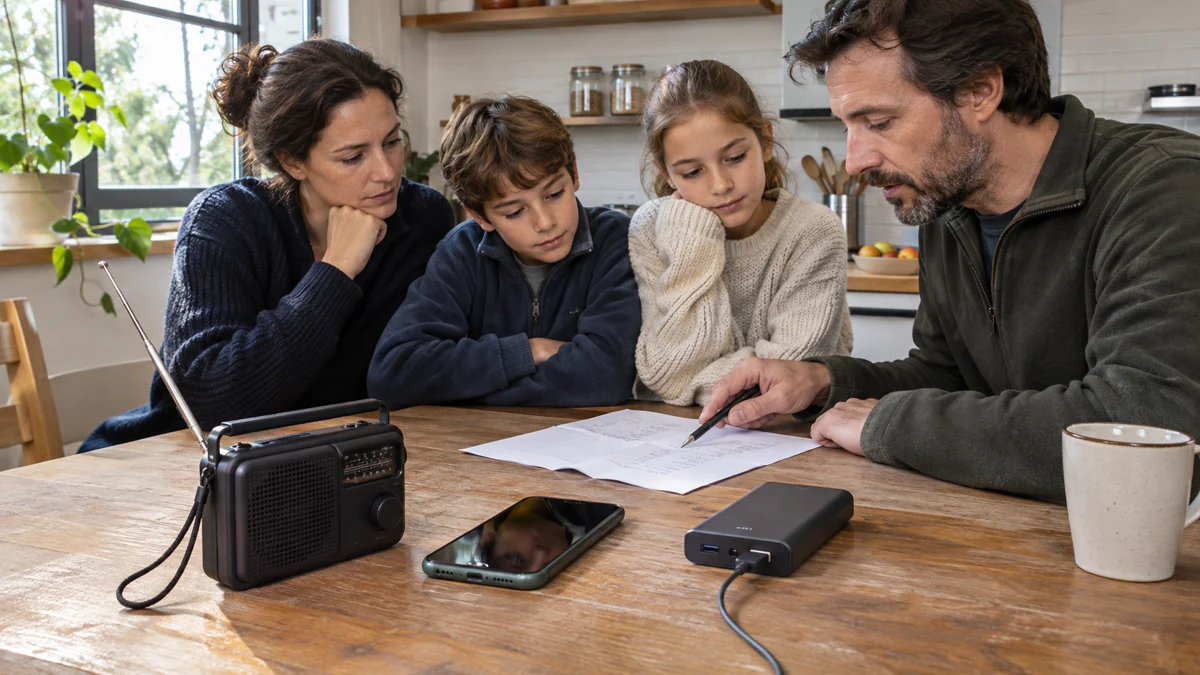
This week, prepare a way to receive instructions and a way to find your loved ones if communication becomes difficult. A power outage can affect power, networks, or their capacity. The plan should work even when your phone is no longer enough.
Separate Three Needs
Receiving an alert, sending a message and asking for help are different functions. A broadcast radio makes it possible to listen to information; it generally does not allow to talk to a loved one. An external battery extends the use of a compatible phone, but it does not restore an interrupted network. A more specialized device requires specific choice and learning.
Start by recording your official channels: municipality, provincial or national authorities, weather service and local station received at home. Make a real acceptance test. Not all functions and tapes advertised on an imported radio are usable in your territory.
Prepare a short message and an appointment
Choose a contact person outside the sector, with their agreement. Agree on a simple message: “I’m safe, I’m at..., next contact at...”. If the network is working but seems congested, opt for short messages and limit unnecessary calls. No method guarantees transmission: check receipt when possible.
Plan two gathering points: one near the home and another outside the neighborhood. Define who can pick up the children and how to reach the school or daycare. A written plan avoids depending on a conversation at the time of the disaster.
Make contacts available without a screen
Prepare a small paper list with useful numbers, gathering addresses and people authorized to help. Adapt it to children without unnecessarily exposing sensitive data. Keep one copy in the bags and another at home.
Identity, insurance and health documents are to be organized separately, in a protected storage. A notebook transported every day does not need to contain all your banking credentials or detailed family medical information.
Check the power supply of the devices
Recharge the external battery and try it with the phone and cable actually used. Identify the holds and keep the records. For radio, test batteries or charging. The crank can be an extra function; evaluate the operation of the device without assuming that it will ensure all your needs.
An amateur radio, CB device or satellite device may meet a particular need, but requires checking the country’s rules, skills, coverage and possible subscriptions. Do not choose a device only on an advertised commercial scope. Week 38 will allow us to deepen this choice.
Actions of the week
- Record the official channels and test the reception of a local station.
- Obtain the agreement of the out-of-sector contact and send him the plan.
- Write the two meeting places and the instructions for the children.
- Test radio, telephone, cable and emergency power supply.
- Do a short message family exercise, without calling emergency numbers for a try.
Your expected result: Each person knows where to find the instructions, who to reach and where to end up if the communications fail.
Useful references
- Communicating in an emergency - Gouvernement du Québec.
- Preparing an Emergency Plan - Public Safety Canada.
Put this reading into practice
Perform the action as you wish and then check the result. Your follow-up remains specific to this route.
52 weeks to strengthen your preparation; Week 4
Preparing communications
Your action: Choose your alert sources, an outside contact and a solution if the mobile network is disrupted.
To check: The coordinates are on paper; each person knows the message to be transmitted.
To do