
In this article
This third week is used to prepare first aid and continuity of home treatments. The objective is concrete: quickly find the useful material, know who to call and have a plan for special needs. A tidy kit helps to intervene; training allows it to be used correctly.
Start with people
Take a look at the needs with the members of the household. Is there an infant, a known allergy, daily treatment, medical device or mobility difficulty? Write down the necessary information in a confidential form, accessible to people who could help you. A copy of the list of drugs, with their dosage and pharmacy contact information, is more useful than a randomly chosen assortment.
Talk to the pharmacist about treatment continuity, renewal and storage conditions. The amount to be expected depends on the prescription and the situation. If a product needs to stay cold or a device depends on power, ask for a suitable plan before the breakdown. A bag in a car subjected to frost and heat is not a universal place of conservation.
Create a simple and identifiable basis
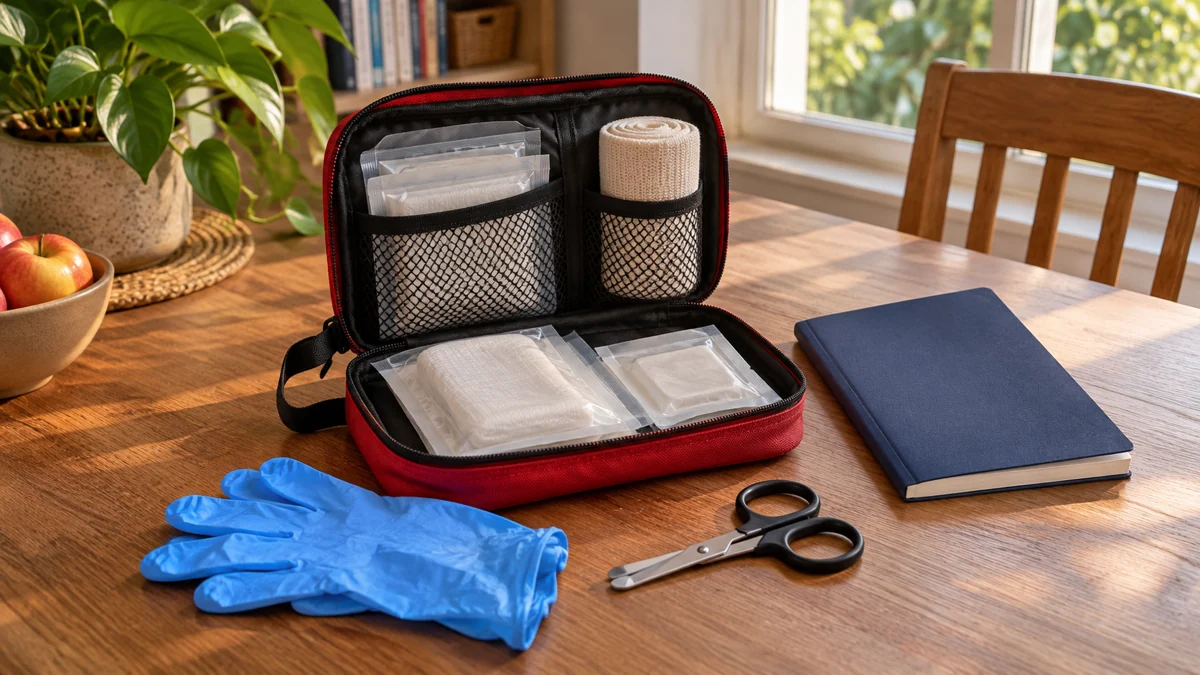
Start by checking what you have. Gather dressings of several sizes, sterile compresses, medical tape, bandages, latex-free disposable gloves, scissors and a small lamp. Add a current first aid guide and useful contacts. Keep packaging and package inserts; a sterile item with a damaged envelope must be replaced.
Classify content by use: protection, dressings, small instruments and documentation. Avoid multiplying accessories that no one knows how to use. A purchased kit may offer a starting point, but its number of parts does not demonstrate its suitability for the home.
Distinguishing equipment and treatments
The need for medication is not inferred from a general list. Painkillers, digestive products or rehydration solutions should be chosen with a professional when necessary, depending on age, contraindications and ongoing treatments. Do not buy antibiotics or advanced treatments to use without medical indication.
Also plan daily items whose absence would complicate care: glasses, technical aids, prescribed equipment, infant products and contact information for professionals. Week 9 will return to documentation and customization; this week lays the groundwork.
Associate the kit with training
Choose a recognized training in first aid and resuscitation adapted to your context. A tutorial or manual serves as a reminder, but does not replace supervised practice. Do a spotting exercise: a person tells you where the gloves, compresses and useful numbers are. Do not open sterile supplies to simulate care.
In the presence of an emergency, secure the premises and contact the emergency services. In Canada, call 911; in France, 15 or 112. Follow the instructions received. Domestic preparation should not delay the necessary care.
Actions of the week
- Inventory the kit and replace used, damaged or expired items.
- Prepare the list of treatments and contacts, protecting personal data.
- Ask the pharmacist for a plan for needs that depend on renewal, cold or electricity.
- Choose a training and make known the location of the equipment.
- Set a semi-annual audit and a replacement after each use.
Your expected result: an accessible kit, adapted to the home, accompanied by contacts and a next stage of training.
Useful references
- Contents and maintenance of a kit - Canadian Red Cross.
- First Aid Training - Société de rescuing du Québec.
Put this reading into practice
Perform the action as you wish and then check the result. Your follow-up remains specific to this route.
52 weeks to strengthen your preparation; Week 3
Organizing First Aid
Your action: Inventory the kit, check the dates and identify a recognized training adapted to the people in the home.
To check: The kit is accessible; the help numbers and limitations of the known actions are clear.
To do