
In this article
Week 3 laid the foundation for the first aid kit. This week, customize it and prepare reliable references that can be used without a connection. The expected progress is not a bigger bag: it’s a package better suited to people and what you know how to do.
Examine the special needs
Take a look at the list of treatments, allergies, glasses, technical aids and children’s needs. Check with the people concerned what should be available at home, during a trip and during an evacuation. For each treatment, keep the leaflet and personal instructions up to date.
Ask the pharmacist how to organize the renewals and respect the storage conditions. If a medical device depends on electricity, plan with the healthcare team a solution of continuity and a place of withdrawal. A battery chosen without checking compatibility and battery life is not enough to validate this plan.
Choose a guide adapted to your training
Prefer a current first aid manual from a recognized organization, in a language understood by users. Go through it before the emergency and find the sections corresponding to your training. If you are using an app, check what remains accessible offline and keep a helpful paper backup.
A book intended for a doctor, a surgeon or a specialized practice does not turn the reader into a professional. Avoid accumulating conflicting or outdated protocols. Advanced actions and prescribed treatments require the right skills and guidance.
Completing the Really Missing Material
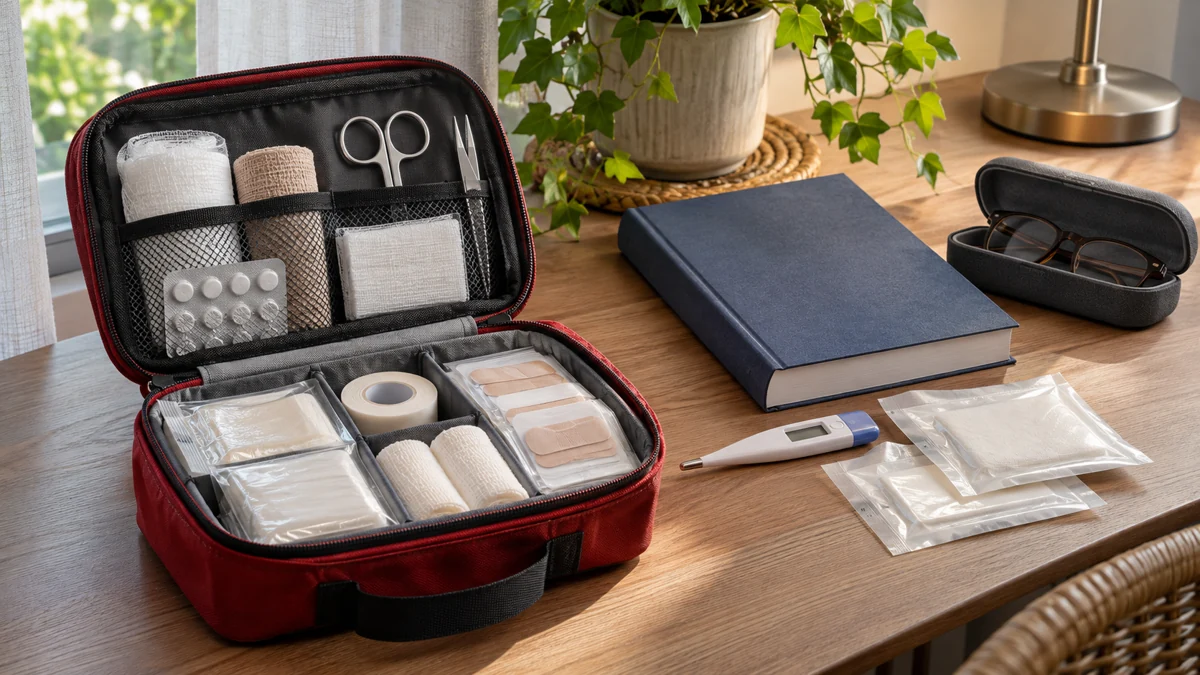
Open the kit to compare its inventory to the uses of the household. Check dressing formats, compresses, bandages, latex-free gloves, scissors and thermometer. Check the condition of the packaging and replace the items used. Protective elements and small instruments should be easy to find.
Add specific products only if their use is understood and appropriate. Lentil care, for example, requires the products intended for the eyes and their compliant storage; a household disinfectant is not a substitute. Ask for advice for products against allergies, sun or insects depending on age and situation.
Preparing contacts and intervention limits
In Canada, a vital emergency is 911; in France, 15 or 112. Also prepare the contact details of the pharmacy and the professionals who follow the home. In case of poisoning, contact the poison control center immediately or help according to the severity. Do not throw up the person and do not give them coal or other products without professional instruction.
Ipeca syrup and intoxication treatments are not a general home shopping list. Similarly, do not systematically use alcohol or peroxide on a wound: follow the first aid recommendations and the indications of the product actually intended for this use.
Actions of the week
- Update specific needs and treatment plan.
- Choose a current guide adapted to the training followed.
- Prepare contacts that are readable and usable offline.
- Complete the specific gaps without buying unmastered equipment.
- Repeat a spotting exercise, then set a verification date.
Your expected result: a personalized kit, an accessible reference and a clear plan to ask for help.
Useful references
- Content and maintenance - Canadian Red Cross.
- First aid in case of poisoning - Centre antipoison du Québec.
Put this reading into practice
Perform the action as you wish and then check the result. Your follow-up remains specific to this route.
52 weeks to strengthen your preparation; Week 9
Complete the care plan
Your action: Reassess health needs with those affected and the pharmacist, including barriers to treatment.
To check: Useful orders and contacts are accessible to authorized persons.
To do