
In this article
A power outage can happen at any time: an ice storm, ageing equipment, an accident that hits a line or a grid overload at peak times. Even a few hours without electricity can disrupt a household. Putting together a "black box", a kit dedicated to power outages, is one of the simplest and most cost-effective preparedness steps. Here is what to put in it, how to go beyond 24 hours and where to start.
At a glance
- Gather in one place, known to everyone, what you need for 24 hours without power: light, charging, radio, contacts, can opener.
- Prefer battery lights to candles, and only use appliances designed for indoor use inside.
- Check the box twice a year, for example when the clocks change.
Power and carbon monoxide: a fuel-powered generator runs outdoors only, at least 6 m (20 ft) from buildings and their openings, exhaust pointed away, respecting the manufacturer's clearances. Never in the house, a garage or a partly enclosed shelter. Barbecues and camp stoves stay outside. Install working carbon monoxide alarms; any connection to the building requires a transfer switch installed by a licensed electrical contractor.
Why the power grid remains vulnerable
The grid is a complex system, and many of its components were put into service decades ago. Very different causes can trigger outages, sometimes in cascade:
- severe weather: ice, high winds, lightning, winter storms;
- animals touching lines or equipment;
- normal wear and infrastructure failures;
- traffic or construction accidents that hit lines;
- overloads during heat waves or extreme cold;
- cyberattacks on grid management systems;
- geomagnetic storms (strong solar storms).
How long an outage will last is rarely predictable when it starts. Preparing for 24 hours is a realistic starting point; going further lets you handle longer outages without panic or improvisation. To learn more, read our article on preparing before the lights go out.
The black box: principle and purpose
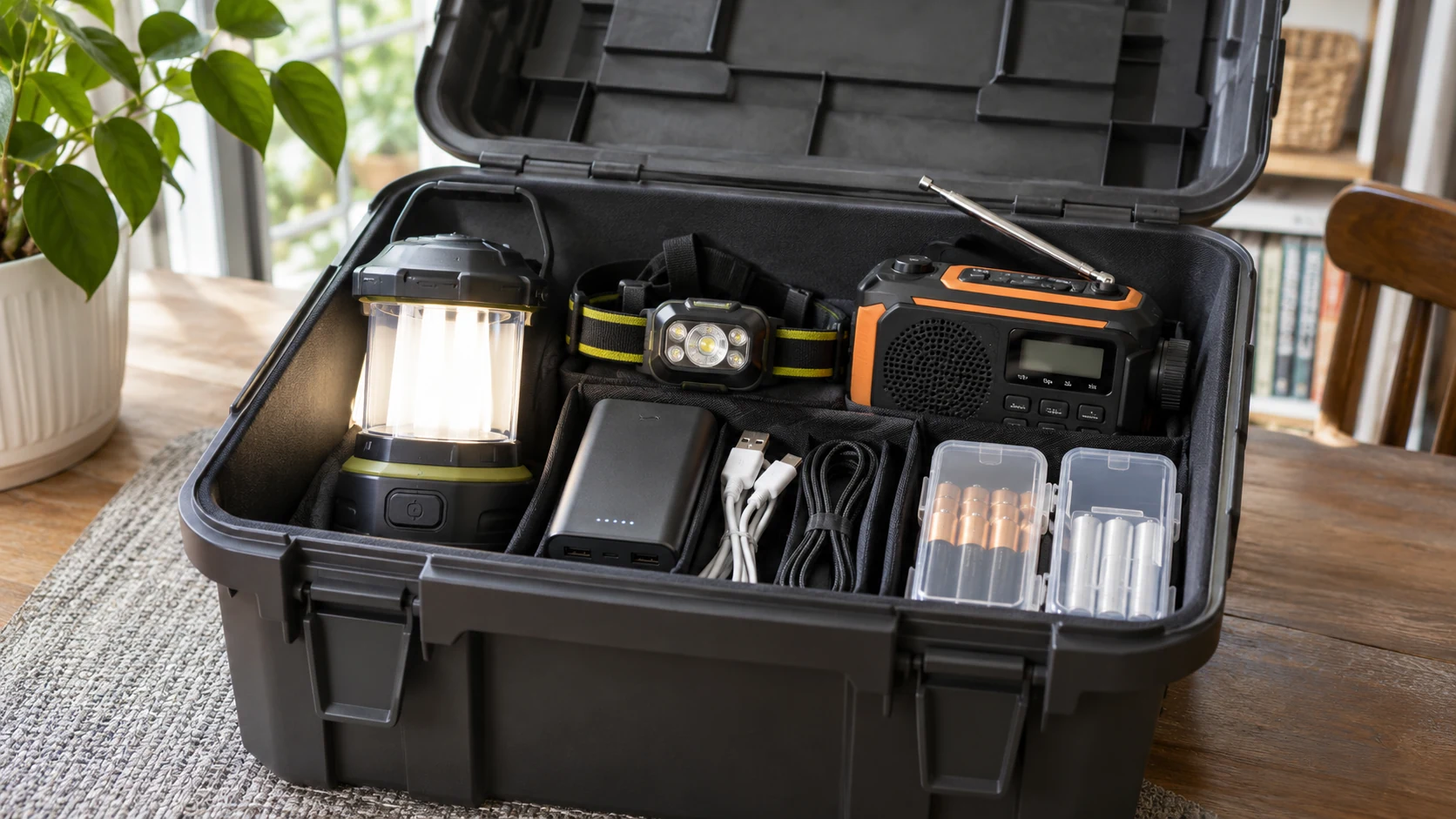
The principle is simple: gather in one place, known to every member of the household, the gear needed to get through an outage without fumbling in the dark. The main goal is to cover the first 24 hours; a second level of preparation lets you plan for longer outages.
Black box: a kit dedicated to power outages, stored somewhere accessible, known to all and kept in working order. The name refers to the darkness, not to anything secret or military.
What goes in the black box
These items make a good base for the first 24 hours, in any season.
Lighting
- Flashlights or headlamps: at least one per adult, plus a spare.
- Battery or rechargeable lanterns, to light common rooms.
- Chemical light sticks: reliable, battery-free, limited duration.
- Candles and stable holders, as a last resort only: never unattended, away from curtains and out of reach of children and pets.
- Lighters and matches, preferably waterproof.
Candles: they cause fires every year during outages. Battery lights are always preferable. If you use candles or a fuel-burning appliance, keep an extinguisher within reach and check your smoke alarms.
Backup power
- A high-capacity power bank, to keep phones and essential devices charged.
- Spare batteries in various sizes (AA, AAA, 9 V) for the devices in the box.
- A folding solar panel compatible with the power bank, useful during long outages in clear weather.
Communication and information
- A hand-crank or battery radio that receives AM and FM: stations relay Alert Ready alerts and official instructions.
- A printed list of emergency numbers and close contacts, in case your phone dies.
Correction: an earlier version recommended a radio receiving "weather alerts on a dedicated band". Weatheradio Canada stopped broadcasting on March 16, 2026: in Canada, the weather band no longer replaces AM/FM. See our guide to choosing an emergency radio.
Cooking and food
- A manual can opener: essential if your supplies are canned.
- Foods that can be eaten without cooking: see our list of 100 foods that need no refrigeration.
- Light dishes, utensils, long matches.
- A safe way to cook: indoors, only an appliance expressly designed for indoor use, according to its instructions (for example a gel-fuel chafing-dish warmer made for the table); propane or butane camp stoves stay outside.
Correction: an earlier version described alcohol or solid-fuel stoves as "usable indoors with adequate ventilation". Only appliances designed and labelled for indoor use may be used inside, according to their instructions; any other fuel-burning appliance stays outdoors because of the risk of carbon monoxide poisoning and fire.
Comfort and seasons
- Emergency blankets (Mylar): light, compact and effective at retaining body heat.
- Disposable or reusable hand warmers, especially in winter.
- A battery fan with mister, for outages during intense heat.
- For a Quebec winter: warm clothing, sleeping bags and one room to gather in. A fuel-burning space heater should only be considered if it is expressly certified for indoor use, used according to its instructions, with a working carbon monoxide alarm; when in doubt, do without.
Home documentation
- A diagram or photo of the electrical panel, with circuits labelled.
- Restart instructions for key appliances: water heater, sump pump, heating system.
Entertainment
- Board games, playing cards, books.
- Colouring books or activities for children.
This last point may seem secondary. In practice, managing children's boredom and your own anxiety during a long outage helps the household stay together and make calm decisions.
Beyond 24 hours: more lasting self-sufficiency
The black box covers everyday situations. Outages lasting several days call for more permanent solutions. Here are options to consider depending on your situation, resources and region.
Electricity
- Gasoline or propane generator, with safely stored fuel and suitable extension cords
- Permanent solar system, with or without batteries
Heating
- A working, code-compliant wood stove or fireplace, especially relevant in Quebec
- Enough dry firewood for the expected duration
Water
- A hand pump if you have a well: the electric pump stops in an outage
- A supply of drinking water: at least 4 L per person per day
Food storage
- A cold room or naturally cool cellar, to depend less on the fridge
- A good-quality cooler and ice packs for perishables
Cooking without power
- Propane or butane stove, outdoors only
- Wood gasifier: an advanced solution that produces fuel gas from biomass, for experienced users only and outdoors, because of the carbon monoxide risk
Hand tools
- Hand tools for common tasks: sawing, screwing, nailing
- The ability to make small repairs without power tools
The principle: each level of self-sufficiency reduces pressure on shared resources and helps you get through a long crisis without an immediate emergency. The goal is not total self-sufficiency, but to buy time and keep the ability to decide calmly. To estimate your supplies, use our tools.
Where to start
Assemble the basic box: lighting, power bank, radio, can opener, printed contacts. This first level costs little and covers most everyday situations.
Document your installation: electrical panel, essential circuits, appliances that depend on electricity. This step costs nothing and is often overlooked.
Adapt the box to the season: in Quebec, January's risks are not July's.
Consider medium-term solutions: generator, solar panels, wood stove, depending on your resources, home and region.
Points to watch
Batteries: they discharge over time. Check batteries and the power bank twice a year, for example when the clocks change.
Fuels: store candles and fuels safely, out of children's reach and away from heat sources.
Generator: never indoors, even partly (garage, basement, enclosed space). Carbon monoxide is odourless and deadly.
Location: every member of the household, including children old enough to understand, must know where the box is. A forgotten box, or one you cannot reach in the dark, is useless.
Special needs: electric medical devices, infants, older adults or people with reduced mobility. For a medical device, talk to your care provider.
Frequently asked questions
What is the difference between a black box and an emergency kit?
An emergency kit covers several situations (evacuation, flooding, storms). The black box is designed for power outages: lighting, backup power, off-grid communication and managing heat or cold. The two complement each other; see our emergency kit for the first days.
Do I absolutely need a generator?
No. It is useful for long outages and more powerful appliances, but not necessary to get through 24 to 48 hours. A high-capacity power bank, good lighting and no-cook foods are enough in most cases. A generator becomes relevant depending on your level of preparedness and situation (rural area, medical dependence, sump pump).
What about the fridge and freezer?
Keep the doors closed. A closed fridge keeps food cold for about 4 hours; a full freezer for about 48 hours, and a half-full one for about 24 hours. Moving the most perishable foods to a cooler with ice packs extends their life. These times vary with the appliance and room temperature: see our article on fridge food after an outage.
Where should I store the black box?
Somewhere you can reach in the dark and that everyone knows: a main hallway closet, a cabinet near the entrance or a designated piece of furniture on the ground floor. Avoid the back of a poorly lit basement. Accessibility comes before discretion, and a flashlight by each bed helps you get there.
In summary: the black box is one of the simplest kits to put together and one of the most useful in Quebec. It requires no technical skills, a small budget is enough for an effective first level, and it can gradually grow toward more self-sufficiency. Take stock with your preparedness review.
Sources and verification references
- Hydro-Québec: backup power, installation and use rules (in French)
- Health Canada: backyard and outdoor safety (fuel-powered generators)
- Environment and Climate Change Canada: Weatheradio closure
- CDC (United States): using a generator safely
Equipment to compare for your needs
Some links below are affiliate links: we may receive a commission at no additional cost to you. Products are examples by function, to choose according to your needs; buying the entire selection is unnecessary.