
In this article
- Start with consumption, not with the solar panels.
- The basic system: components and estimated costs
- Understanding batteries: actual capacity and state-of-charge management
- Choosing the right inverter
- A Gradual Upgrade Plan
- Important considerations and limitations
- Summary
- Frequently Asked Questions
- Sources and References
- Related resources
- Equipment to compare for your needs
- Manufacturer documentation
An independent solar system can be built in stages around a few priority loads. Its budget depends on components, protection, batteries and installation work. The table amounts are an unupdated budgeting example, not a quote or a promise of a complete system below $900.
The goal of this article is not to convince you to go completely off-grid, but rather to help you understand how to build an independent energy reserve—useful during a prolonged power outage, a period of temporary isolation, or simply to reduce your immediate reliance on the electrical grid.
Start with consumption, not with the solar panels.
A common mistake is to size a solar system based on the available panels. The reverse approach is more effective: start by identifying what you wish to power, then calculate the necessary capacity.
Certain appliances are difficult to support with a small, independent system: central heating, air conditioning, electric water heaters, and stoves account for the vast majority of a household's energy consumption. Alternatives do exist—such as wood-burning stoves, propane ranges, or passive solar water heaters—and are often already considered by those pursuing greater self-sufficiency.
For everyday needs (lighting, charging devices, fans, television, a small refrigerator), daily consumption typically ranges between 500 and 2,000 Wh, depending on your habits. Here is how to estimate it:
Basic calculation: Appliance power rating (watts) × hours of use per day = Wh/day. A "Kill-a-Watt" style meter can be used to measure an appliance’s actual consumption, including during intermittent cycles (such as a refrigerator operating over a 24-hour period).
Some useful benchmarks:
- A 13W compact fluorescent lamp (CFL) is equivalent to a 60W incandescent bulb.
- A 10W LED bulb produces the same amount of light while using even less power.
- Although a microwave oven is energy-intensive, it cooks food in just a few minutes—its impact on the battery bank remains moderate compared to an electric stovetop.
- A high-efficiency chest freezer, located in a cool area of the home, consumes significantly less energy than a standard refrigerator-freezer unit.
Creating a list of your priority appliances, along with their estimated daily energy consumption (in Wh/day), is the first step to take before making any purchases.
The basic system: components and estimated costs
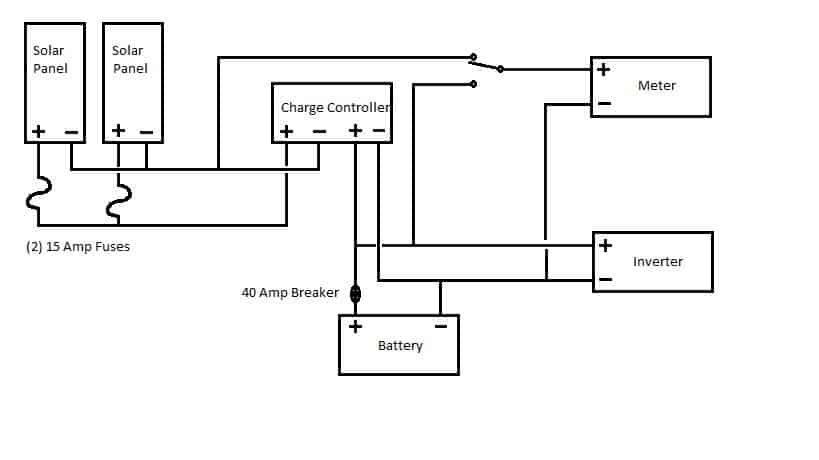
The system presented here is designed to be autonomous from the outset—it is not connected to the home’s existing electrical wiring, which simplifies installation and avoids the need to modify the electrical panel. Extension cords and power strips are used to distribute electricity wherever it is needed.
Note: The prices provided are estimates based on the Canadian market at the time of writing. Prices may fluctuate, and product availability may vary. It is recommended to compare several sources before making a purchase.
| Component | Source | Estimated cost |
|---|---|---|
| 100 W solar panel | Amazon.ca | $178 |
| 12 V / 100 Ah deep-cycle battery | Amazon.ca | $338 |
| Battery box | Amazon.ca | $15 |
| 30 A PWM charge controller | Amazon.ca | $44 |
| 300 W pure sine wave inverter | Amazon.ca | $208 |
| Battery switch | Amazon.ca | $31 |
| 40 A circuit breaker | Amazon.ca | $14 |
| Wires, connectors, fuses, miscellaneous hardware | Various sources | $30 |
| Estimated total cost of the starter system | $858 |
This starter system can provide approximately 450 Wh per day, given a day with sufficient sunlight. This is sufficient to cover priority uses: charging mobile devices, LED lighting, a table fan, a television, and a set-top box.
Adding panels requires checking every controller limit: cold-weather open-circuit voltage, current, PV power, battery voltage and series or parallel configuration. A “30 A” label alone does not establish compatibility with four 100 W panels. Consult the exact manual before expansion.
Wiring: size conductors and protection for current, round-trip length, voltage drop, temperature and installation. Fuses and breakers must suit DC operation, system voltage and the battery’s prospective short-circuit current. Sizes of 6–7 AWG and 15–40 A are not universal specifications. Fixed-system protection and grounding require the exact manuals, applicable rules and qualified professionals.
Understanding batteries: actual capacity and state-of-charge management
A 12 V / 100 Ah battery has a theoretical capacity of 1,200 Wh. In practice, two factors significantly reduce this figure:
- Recommended depth of discharge: a deep-cycle (lead-acid) battery should not be discharged beyond 50% of its capacity, as doing so will shorten its lifespan. This reduces the usable capacity to 600 Wh.
- Efficiency losses: actual performance is lower than the manufacturer’s stated values, especially at high discharge rates. An 80% correction factor is reasonable: the effective usable capacity is approximately 480 Wh.
Resting voltage can give an approximate state of charge for some lead-acid batteries, but depends on model, temperature, rest and surface charge. A correctly configured monitor can help. The table only illustrates a lead-acid battery; it does not apply to LFP batteries or replace the manufacturer’s chart.
| Resting voltage | Approximate SOC | Observation |
|---|---|---|
| 12.8 V or higher | Indeterminate | Battery currently charging (surface charge) |
| 12.6 – 12.7 V | ~100% | Fully charged |
| 12.4 V | ~75% | |
| 12.1 V | ~50% | Threshold that should not be exceeded for routine use |
Measurements should be taken at night, when the solar panels are not generating current. Temperature also affects voltage; the values above are for reference only and may vary depending on the battery model.
Alternative to a voltmeter: If you are not yet comfortable reading voltage, you can estimate the State of Charge (SOC) by calculating total consumption: add up the power (W) of each device multiplied by its hours of use. When the total approaches 450 Wh (the estimated usable capacity of a 100 Ah battery), it is wise to stop drawing power.
6 V batteries in series: an option to consider
6 V batteries, designed for golf carts and industrial equipment, typically offer a capacity of 200 to 215 Ah. When connected in series in pairs (two 6 V batteries → 12 V / 215 Ah), they often provide a better cost-to-capacity ratio than standard 12 V batteries. For the same pair:
- Theoretical capacity: 12 V × 215 Ah = 2,580 Wh
- 50% usable: 1,290 Wh
- After losses (×80%): ~1,032 Wh
This allows, for example, powering a 43 W load continuously for 24 hours, or a 100 W load for about ten hours.
For flooded lead-acid batteries, follow the manufacturer’s maintenance, ventilation and protective-equipment instructions. Never put bicarbonate into cells or onto an exposed person. Plan containment and a suitable spill procedure; skin or eye splashes require immediate flushing and appropriate care.
Choosing the right inverter
An inverter converts the direct current (DC) from the battery into alternating current (AC) that can be used by household appliances. Two technologies are available on the market:
Pure Sine Wave (PSW)
Pure sine-wave output is generally preferable for versatile use, but compatibility also depends on voltage, frequency, continuous and surge power, and appliance requirements. It does not make a small inverter suitable for every load.
Modified Sine Wave (MSW)
Less expensive, but can damage certain sensitive devices, cause humming in audio equipment, and result in motors running at the wrong speed or overheating. Should be avoided for versatile, general-purpose use.
The basic system described here includes a 300 W inverter—sufficient for common appliances. If your requirements grow to include more demanding devices (such as a microwave oven, vacuum cleaner, or toaster), a more powerful inverter (1,000 to 1,500 W) will be necessary. It is advisable to carefully read reviews before investing in a high-end model, as there are significant variations in quality within this category.
A Gradual Upgrade Plan
One of the advantages of a modular architecture is the ability to increase capacity without having to start from scratch. Here is a typical initial upgrade that doubles the capacity of the basic system:
| Component | Estimated cost |
|---|---|
| Additional 100 W solar panel | $236 |
| Additional 12 V / 100 Ah battery | $338 |
| Additional battery enclosure | $15 |
| Miscellaneous wires, connectors, and fuses | $20 |
| Estimated cost of the upgrade | $609 |
Following this upgrade, the capacity increases to approximately 900 Wh available after a full day of sunshine. On partially cloudy days, the impact is proportionally smaller.
To estimate the output of a solar panel array:
Basic formula: Number of panels × power rating per panel (W) × effective hours of sunlight per day = Wh produced. Example: 2 panels × 100 W × 5 hours = 1,000 Wh/day (an optimistic estimate). Cloudy conditions and partial shading will reduce this figure.
In practice, it is advisable to aim for a storage capacity (battery bank) slightly greater than the daily output of the solar panels. This helps preserve the batteries by avoiding deep-discharge cycles and provides a buffer for periods with low sunlight.
Panel orientation and maintenance
To optimize production, the panels must be kept clean and oriented at an angle appropriate for the local latitude. In Quebec, as well as in most regions of France and Belgium, adjusting the tilt twice a year (for winter and summer) can significantly improve winter yield—a period when short days pose the primary challenge for such a system.
Important considerations and limitations
A few realities should be clearly understood before getting started:
- Winters in Quebec are demanding. Short days and extensive cloud cover from November to February significantly limit energy production. A system sized for summer use may prove insufficient during the winter. The solution involves either increasing production capacity or reducing energy consumption.
- Quality comes at a justified cost. Opting for cheaper components to lower the initial investment can lead to the need for premature replacements. Batteries, in particular, should be chosen with great care.
- This system is not connected to the electrical panel. It cannot power a home’s fixed electrical circuits without modifications made by a qualified electrician. It is a portable, independent system.
- Performance will vary. The figures provided here are representative estimates. Actual results are influenced by factors such as temperature, battery condition, the quality of connections, and local sunlight levels.
Summary
An off-grid solar system built in stages offers several tangible benefits: it is functional from the very first investment, it can be upgraded without disruption, it remains useful for daily electricity bill savings, and it serves as an independent energy reserve in the event of a prolonged grid outage.
The key to such a project lies less in the initial budget than in the approach: start by identifying your actual needs, choose reasonably high-quality components, understand how batteries work so you can preserve their lifespan, and progress at a pace that suits your financial means.
A question that often guides initial decisions is: which electrical uses would be truly problematic if they were unavailable during a power outage lasting several days? The answer to this question defines the minimum scope for a useful system.
See also: 5 essentials for achieving gradual energy autonomy.
Frequently Asked Questions
Is it possible to start with just one solar panel and one battery?
Yes. A 100 W panel paired with a 100 Ah battery constitutes a basic, functional system capable of powering lights and charging mobile devices. A 30 A charge controller allows for the addition of more panels later on, without needing to replace existing equipment.
Can this type of system power a refrigerator?
For a refrigerator, measure energy used over 24 hours and check starting current, inverter capability, required autonomy and winter solar output. Two panels and two batteries are not a universal minimum: their capacities and operating conditions determine the result.
Is a permit or certification required to install this type of system?
Being off grid does not automatically exempt an installation from construction or electrical rules. Distinguish a portable appliance used as directed from a fixed installation. In Quebec, confirm required contractor licences and work; in France, check requirements for power, mounting and connection. Consult the competent authorities before installation.
What is the lifespan of a deep-cycle battery?
A well-maintained lead-acid deep-cycle battery (discharged to a maximum of 50%, with regular recharging) can last between 3 and 7 years, depending on usage and the specific model. Lithium iron phosphate (LFP) batteries, while more expensive to purchase, offer a significantly longer lifespan (10 years or more) and can withstand deeper discharges.
Sources and References
Local guidelines and product manuals take precedence for your specific situation. References consulted for this update include:
- CDC — Using a generator outdoors, away from openings
Related resources
Equipment to compare for your needs
Some links below are affiliate links: we may receive a commission at no additional cost to you. Products are examples by function, to choose according to your needs; buying the entire selection is unnecessary.