
In this article
- What is an N95 mask?
- N95, surgical mask, dust mask: what are the differences?
- Certifications: how to read a filtering mask’s label
- What an N95 mask filters, and what it doesn’t
- N95 masks and chemical vapours and agents
- Fit: a non-negotiable condition
- Adding a filtering mask to a preparedness kit
- FAQ: N95 masks and preparedness
- Further reading
Among the items often missing from preparedness kits, respiratory protection remains one of the most neglected. Yet several common scenarios, a wildfire, an industrial cloud, a respiratory epidemic, an accidental chemical release, can make the air immediately dangerous. Understanding what an N95 mask really does, what it doesn’t, and how to choose the right equipment for the situation is a basic preparedness skill.
What is an N95 mask?
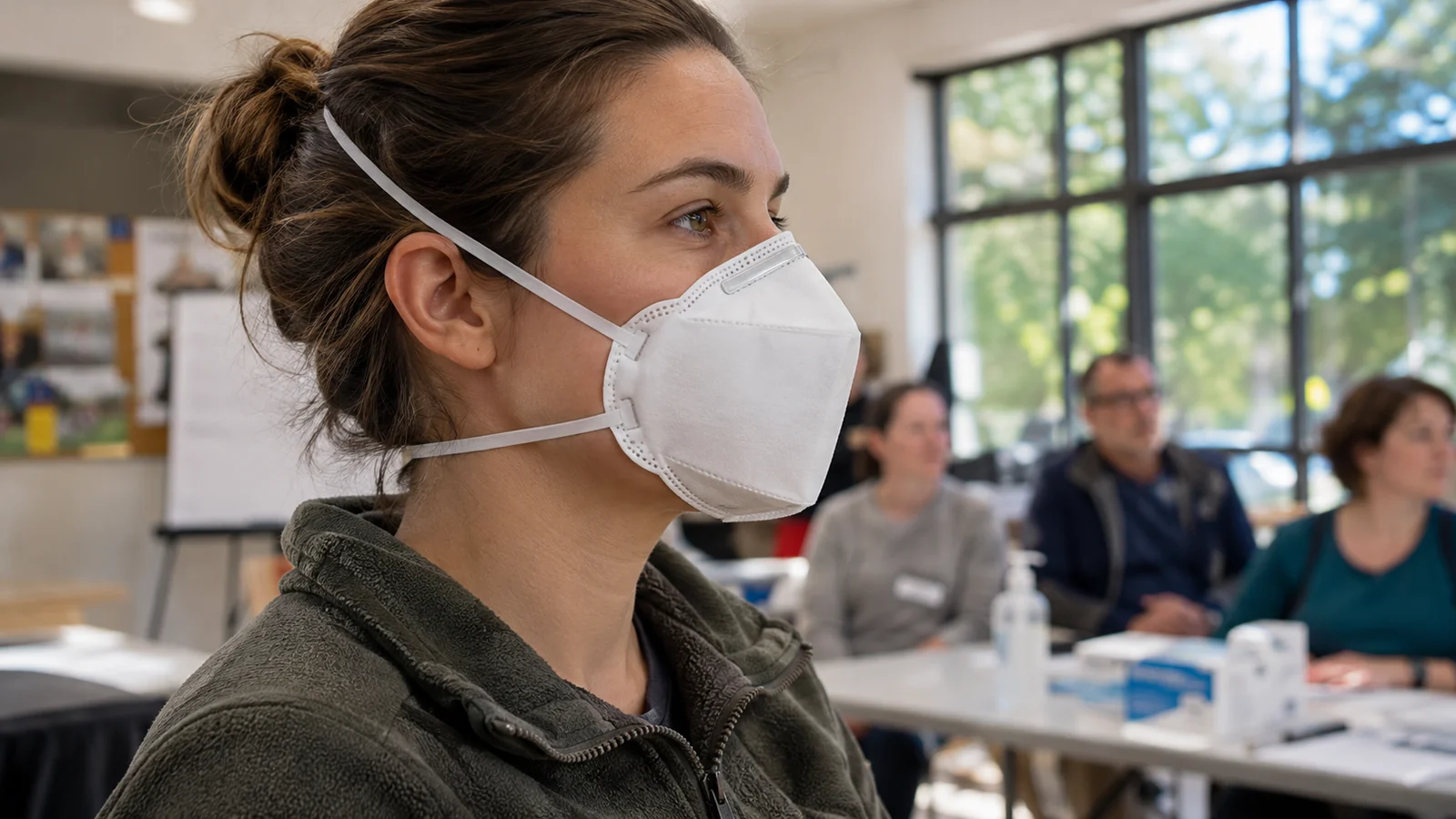
An N95 mask is a filtering respirator designed to cover the nose and mouth and to block at least 95% of airborne particles 0.3 micron or larger. The letter “N” means it is not oil-resistant. The number “95” is the minimum certified filtration efficiency.
It is not a simple face covering: it is personal protective equipment subject to rigorous certification standards.
N95, surgical mask, dust mask: what are the differences?
These three types of masks look alike but offer very different levels of protection. Confusing them can create a false sense of security.
Surgical mask
Designed to protect others from the wearer’s spray (spit, droplets). Does not effectively filter fine particles from the environment. Not suitable for respiratory protection in a contamination situation.
N95 mask
Filters particles from the surrounding air in both directions. Protects the wearer against outside agents: fine dust, spores, smoke, some bacteria. NIOSH-certified. Guaranteed minimum efficiency of 95%.
Dust mask (hardware store)
Offers partial protection against large particles. Not NIOSH-certified. Not designed to filter vapours, gases or fine particles. Suited to ordinary mechanical work, not emergencies.
There are also surgical N95 masks, which combine both functions: filtering the surrounding air and protecting others. These models carry both NIOSH approval and FDA clearance. They are common in medical settings.
Certifications: how to read a filtering mask’s label
Certification is the most important thing to check before buying. A mask without recognized certification offers a level of protection that is impossible to assess. The two most common reference systems in North America and Europe are NIOSH and the European standard EN 149.
NIOSH certifications (North America)
NIOSH ratings are based on two parameters: oil resistance and filtration efficiency.
Not oil-resistant (N)
- N95: filters ≥ 95% of particles
- N99: filters ≥ 99% of particles
- N100: filters ≥ 99.7% of particles
Somewhat oil-resistant (R)
- R95: filters ≥ 95% of particles
Strongly oil-resistant (P)
- P95: filters ≥ 95% of particles
- P99: filters ≥ 99% of particles
- P100: filters ≥ 99.7% of particles
EN 149 certifications (Europe)
The European standard EN 149 classifies filtering masks into three protection levels:
- FFP1 (P1): filters at least 80% of particles
- FFP2 (P2): filters at least 94% of particles (roughly equivalent to N95)
- FFP3 (P3): filters at least 99.5% of particles
Certification is normally printed directly on the mask, along with the manufacturer’s name, the model and the lot number. A mask without this visible information should not be used for serious protection.
Uncertified masks: a real risk
Comparisons by specialized bodies, including NIOSH and the CDC, have documented large gaps between certified masks and cheap unregulated ones. Some of the latter offered negligible protection, others intermediate protection that is impossible to quantify precisely.
Without NIOSH or EN 149 certification, there is no way to know a mask’s actual filtration level. In preparedness, that uncertainty is unacceptable. Always choose a certified mask, even at a slightly higher cost.
What an N95 mask filters, and what it doesn’t
An N95 mask is effective against particles of 0.3 micron and larger. This limit matters: some dangerous agents are smaller than this threshold and will not be stopped by a standard N95 mask.
Practical benchmark: 1 inch equals 25,400 microns. Particles visible to the naked eye are generally larger than 50 microns. The most dangerous agents are often invisible.
The following table gives a few particles and their size in microns as a guide. Note: some of these particles are smaller than 0.3 micron and will not be retained by an N95 mask. This table is provided for information, to give orders of magnitude.
| Particle | Size (microns) |
|---|---|
| Anthrax | 1 – 5 |
| Asbestos | 0.7 – 90 |
| Atmospheric dust | 0.001 – 40 |
| Vehicle emissions | 1 – 150 |
| Bacteria | 0.3 – 60 |
| Bromine | 0.1 – 0.7 |
| Combustion smoke (wood) | 0.2 – 3 |
| Coal dust | 1 – 100 |
| Toner (photocopier) | 0.5 – 15 |
| Household dust | 0.05 – 100 |
| Droplets (sneeze) | 10 – 100 |
| Insecticide dust | 0.5 – 10 |
| Lead dust | 0.1 – 0.7 |
| Mould spores | 10 – 30 |
| Oil smoke | 0.03 – 1 |
| Pesticides and herbicides | 0.001 |
| Pollen | 10 – 1,000 |
| Radioactive fallout | 0.1 – 10 |
| Tobacco smoke | 0.01 – 4 |
| Viruses | 0.005 – 0.3 |
| Yeast cells | 1 – 50 |
Source: Engineering Toolbox, engineeringtoolbox.com
On viruses: N95 masks have been shown to reduce exposure to viruses under some conditions, even though viruses are often smaller than 0.3 micron. That is because viruses rarely travel alone in the air: they are generally carried by droplets or larger particles. An N95 mask therefore works indirectly. During an epidemic, it is one useful measure among others, but not absolute protection.
N95 masks and chemical vapours and agents
A standard N95 mask is designed to filter suspended solid and liquid particles. It is not designed to filter vapours, gases or chemical agents in gaseous form. In situations involving complex industrial fumes, solvents or chemical warfare agents, an N95 mask alone is not enough.
More specialized solutions exist for these scenarios. The FAST-ACT VapourKlenz face mask is one example of a mask combining particle filtration with chemical vapour neutralization. It uses metal oxides, rather than zeolites or conventional activated carbon, to neutralize a broad spectrum of chemical agents, including some compounds found in fire smoke.
For protection against chemical vapours, look for a mask or respirator that explicitly states it filters organic vapours or gases. The mere mention “N95” does not guarantee that capability.
Fit: a non-negotiable condition
A poorly fitted certified mask offers far less protection than its specifications. Fit is as important as certification itself.
Points to watch for a good fit
- Beards and heavy facial hair: incompatible with an airtight seal. Even a few days’ stubble can significantly reduce the mask’s effectiveness.
- Children: adult N95 masks don’t fit children. Models specifically sized for young users exist.
- Nose bridge fit: choose a model with an adjustable metal nose clip to ensure an airtight seal in this critical area.
- Straps: make sure the straps hold firmly without excessive discomfort. A mask that is too loose lets unfiltered air in.
Fit test to do before an emergency
- Place both hands over the mask and breathe in deeply. The mask should pull slightly against your face without letting air in at the sides.
- Breathe out and try to feel air leaking at the edges. If the mask has an exhalation valve, cover it temporarily for this test.
- If you feel a leak, adjust the nose clip or tighten the straps. If the leak persists, try another model or size.
Never try a mask for the first time in a real emergency. Check the fit in advance, in calm conditions, before putting the equipment in your kit.
Adding a filtering mask to a preparedness kit
A certified N95 mask is compact, light and relatively inexpensive. Its effectiveness for its size makes it a justified item in any basic preparedness kit.
Scenarios where an N95 mask can be useful
- Wildfires or urban fires (particulate smoke)
- Accidental industrial spill (as an initial measure, while evacuating)
- Respiratory epidemic (reducing exposure to droplets)
- Post-disaster cleanup (dust, insulation, debris)
- Volcanic eruption or ash cloud (in the regions concerned)
Practical recommendations
- Store masks in sealed packaging away from moisture and excessive heat.
- Check the expiry date: filter materials can degrade over time.
- Plan at least one mask per person in the household, including models suited to children.
- For specific chemical scenarios, consider a mask with interchangeable filter cartridges or a mask designed to neutralize vapours.
- Include the mask in preparedness drills so every household member is familiar with using and fitting it.
Filtering masks don’t replace evacuation when it is possible. They are a temporary protective measure to buy time or move through a degraded environment, not a solution for prolonged sheltering without first assessing the situation.
FAQ: N95 masks and preparedness
Is an N95 mask enough against all chemical hazards?
No. An N95 mask is designed to filter solid and liquid particles suspended in the air. It is not designed to block vapours or chemical gases in pure gaseous form. For protection against organic vapours or chemical agents, you need respirators fitted with specific filter cartridges or masks that combine particle filtration and chemical neutralization.
How long does a stored N95 mask last?
Shelf life varies by manufacturer and storage conditions. In general, masks kept in their original packaging, away from heat, moisture and direct light, can keep their filtering properties for several years. Some manufacturers state a shelf life of 3 to 5 years. Check the date on the packaging and test the mask before putting it in a kit.
Is a European FFP2 mask equivalent to an N95?
The two certifications are close but not strictly identical. FFP2 (EN 149) filters at least 94% of particles, compared with 95% for N95 (NIOSH). Test methods differ slightly, but in practice both levels are considered comparable for most preparedness uses.
Can you reuse an N95 mask?
Most N95 masks are designed for limited or single use. Reuse is possible in some conditions (no biological contamination, mask not deformed, seal still airtight), but effectiveness may decrease with use. Where there is a biological or chemical risk, use a new mask. Manufacturer and health authority recommendations on this point may change: check current guidance before use.
Further reading
For protection against gases and vapours, see the gas mask and CBRN respirator guide. For wildfire smoke and epidemics, see preparing for outbreaks and activated charcoal: uses and limits.