
In this article
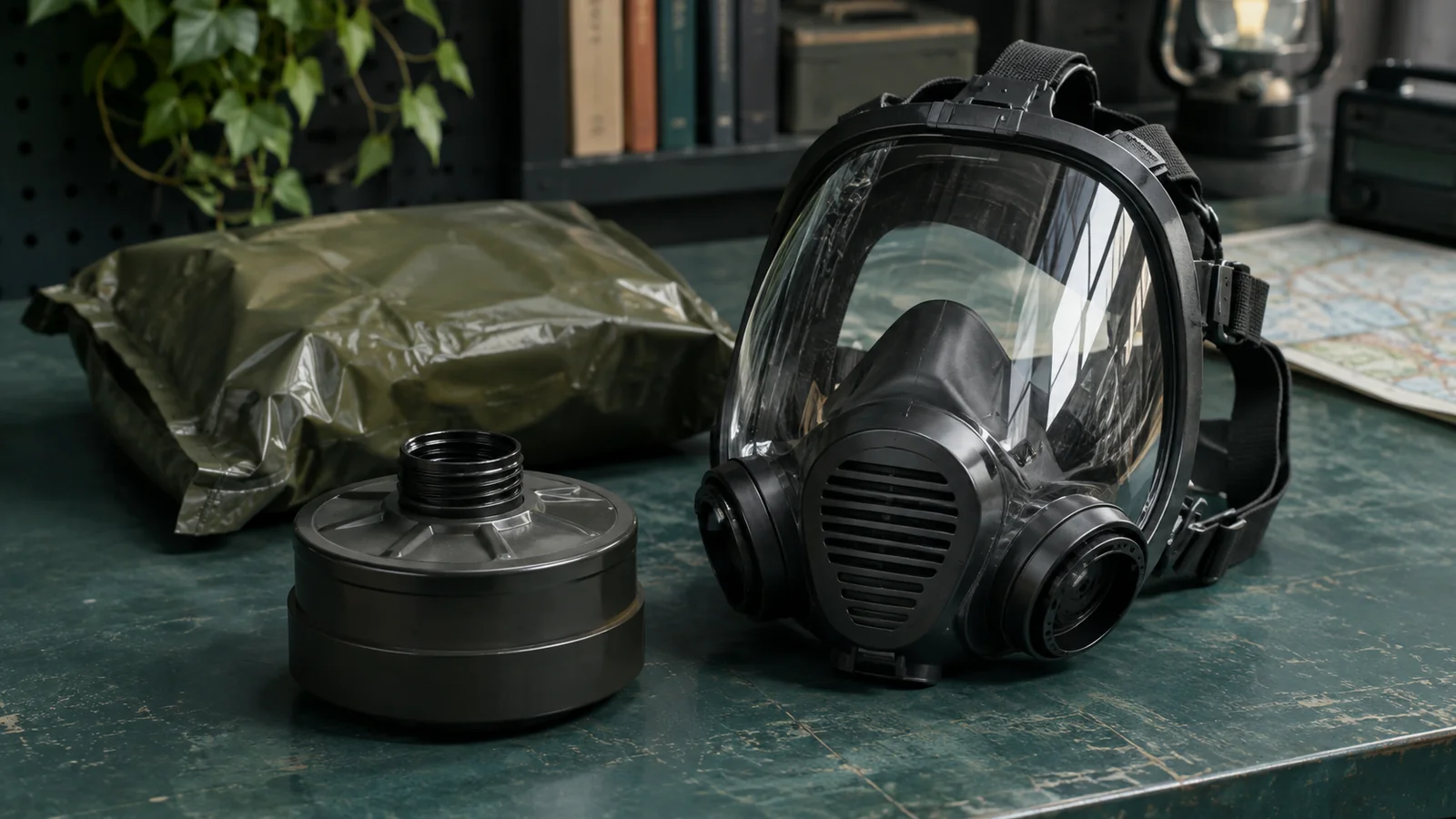
A gas mask or CBRN respirator is not just for war or global pandemic scenarios. Situations that call for respiratory protection include urban unrest involving tear gas, industrial chemical incidents, fires giving off toxic smoke, or situations where air quality temporarily becomes unbreathable. This guide covers the options available for household preparedness, their respective limits and practical selection criteria.
Why a mask in preparedness
The rule of three minutes, the maximum time without breathable air in a survival situation, takes on a different meaning when the available air is itself contaminated. The threat is not the absence of air, but the presence in the air of an agent that makes every breath dangerous: tear gas, dense smoke, chemical particles or airborne biological agents.
Scenarios that justify respiratory protection in realistic preparedness are varied:
- Civil unrest and crowd control: tear gas (CS or CN) is used by police in many countries to disperse crowds. Exposure, even brief and without a mask, causes intense irritation of the eyes, airways and skin.
- Industrial and chemical incidents: derailments of trains carrying dangerous goods, chemical warehouse fires, leaks at industrial facilities. These events occur regularly in urban and suburban areas.
- Major fires: urban fire smoke (synthetic building materials, furniture, vehicles) gives off toxic compounds that can be lethal at low concentrations.
- Biological or radiological contamination: less likely scenarios, but documented in emergency management plans.
In the field
Real-world exposure to tear gas is significantly more intense than the description suggests. The symptoms, intense burning of the eyes and airways, heavy tearing, uncontrollable coughing, set in within seconds and make any coordinated action difficult. The window to put a mask on properly before exposure is very short. That is why practising with the mask matters as much as the mask itself: equipment you haven’t mastered doesn’t protect you.
The three categories of masks available
The civilian market offers three main categories of CBRN masks, each with its advantages and limits.
Military surplus
Surplus military CBRN masks are designed to counter the nuclear, biological and chemical threats soldiers may face in operations. They include features that basic civilian masks lack: a drinking tube for a standard military canteen, a built-in voicemitter for speech, panoramic or binocular vision depending on the model.
These masks are available online and in military surplus stores, used or sometimes new. Two points to watch: check the condition of the seals (which deteriorate over time even without use) and make sure the filter cartridges screw on rather than clip inside; some older models use an internal mounting system that limits replacement options.
In the field
A seal test for a military CBRN mask consists of blocking the air inlets and breathing in: if the mask pulls against your face without letting air in, the seal is good. In military settings, this test is supplemented by a chemical test with a detectable substance (isoamyl acetate, which smells of banana) to confirm there are no leaks. Test kits are available online and let you check a used mask before trusting it in a real situation.
Israeli civilian mask
The Israeli civilian mask is the most affordable option on the market, sold with a sealed filter. It was designed for mass distribution to the civilian population in case of an imminent chemical threat, and offers full CBRN protection with its original sealed filter.
The main question with this mask is the reliability of the seals on older or long-stored models. The built-in sealed filter is in good condition if it has never been opened, but the body of the mask (silicone or rubber seals) may have degraded over time. A seal test before any used purchase is essential. At its price, however, it can be an accessible way to equip several members of a household or group, alongside a better-quality main mask.
Commercial-grade civilian masks
Several manufacturers offer civilian CBRN masks that incorporate the ergonomic improvements of recent military models: a panoramic visor, right or left side filter mounting, compatibility with NATO-standard filters.
Some specialized manufacturers offer preparedness masks compatible with their own CBRN filters and with NATO-standard filters available elsewhere on the market, with a warranty and replacement parts.
This category is recommended for households that want a reliable, durable main solution, with a commercial warranty and documented availability of spare parts.
Understanding filters
A mask without a compatible filter in good condition protects against nothing. Choosing the filter is as critical as choosing the mask itself.
Types of filters
CBRN / NBC: full protection
Protection against chemical, biological, radiological and nuclear agents (particles). This is the level of protection to aim for in the most serious scenarios. Look for CBRN or NBC certification on the packaging.
P100 / P3: high-efficiency particle protection
Filters 99.97% of airborne particles (P100 under the NIOSH standard, P3 under European standard EN 143). Effective against fire smoke, biological particles and dust. Does not protect against chemical gases and vapours without an additional absorbent layer.
ABEK: protection against gases and vapours
Activated carbon filter against organic gases (A), inorganic gases (B), sulphur oxides (E) and ammonia (K). Combine with a P3 filter for full protection. European standard EN 14387.
N95 / FFP2: basic particle protection
They filter 95% of airborne particles. Useful in light smoke or moderate particulate contamination. Ineffective against gases, chemical vapours or very small airborne biological agents. An accessible entry point, but of limited use.
Filter lifespan
An often-overlooked critical point
An unopened sealed CBRN filter has a shelf life of 10 to 20 years depending on the manufacturer. Once opened and exposed to ambient air, its absorption capacity gradually decreases; most activated carbon filters have an effective service life of 8 to 24 hours in a contaminated atmosphere, depending on agent concentration. You must know the lifespan of every filter in stock and plan replacements accordingly. A mask with a spent filter is a mask without protection.
Compatibility and thread standard
The NATO standard connection (40 mm, RD40 thread) is the most widespread format for military and quality civilian masks. Compatibility between mask and filter must be checked before buying. Some older masks use proprietary connections that limit replacement options on the civilian market. Choosing masks compatible with NATO-standard filters ensures replacements remain available over the long term.
Practical selection criteria
Communication
A mask worn in an emergency is often worn in a group. Being able to speak without removing the mask is an important functional criterion. Military surplus masks generally include a voice diaphragm; recent civilian models often offer this as an accessory or as standard.
Hydration
During prolonged wear in a hot environment, hydration becomes a constraint. Older military masks have a drinking tube compatible with standard-issue canteens. For civilian masks without this option, planning the maximum wearing time without drinking is part of preparedness.
Visibility
Modern masks offer a panoramic visor that significantly improves the field of view compared with older binocular models. The filter position (right, left or centre) also affects peripheral vision. Users who expect to handle equipment or move quickly benefit from a panoramic mask with a side-mounted filter.
Fit and seal
A poorly fitted mask doesn’t protect, whatever the quality of its filter. Beards and heavy facial hair systematically compromise the facial seal. Fit must be checked on each user individually, and children need masks specifically sized for them: adult masks cannot be used on children.
Building a filter stock
Spare filters should be bought and stored at the same time as the mask. In a real emergency, resupply of specific filters is not guaranteed. Work out the number of filters needed based on the number of users, the lifespan per filter and the target self-sufficiency period.
Legal framework in Canada
Carrying and possession in Canada
Possessing a gas mask or CBRN respirator is legal for civilians in Canada. There is no federal restriction on buying or owning this equipment for preparedness or personal protection. Some provinces or municipalities may have bylaws on wearing masks in specific contexts (demonstrations, public spaces), but these concern wearing them in public, not possession. Refer to the local bylaws in force for any specific question.
Comparative summary
Budget: Israeli civilian mask
Sold with a filter. Full CBRN protection if the seals are in good condition. Ideal for equipping several household members at low cost. Check the seal before use.
Intermediate: military surplus CBRN
Varies by model and condition. Advanced features (drinking tube, voicemitter). Check filter compatibility and seal condition. A good option if the model is recent and in good condition.
Premium: commercial-grade civilian mask
More expensive. Commercial warranty, NATO filter compatibility, panoramic visor. Recommended main solution for serious long-term preparedness.
Frequently asked questions
Does an N95 mask protect against tear gas?
No. An N95 mask filters airborne particles but does not absorb chemical gases and vapours. Tear gas (CS or CN) is an aerosol whose active compounds are both particulate and gaseous. An N95 mask partially reduces exposure to solid particles but does not protect against irritating vapours. Effective protection against tear gas requires a half-face or full-face mask with an ABEK activated carbon filter or a combined CBRN filter.
How do you check that a used mask still seals?
Two complementary tests: the positive test (block the filter connection and breathe out; if air escapes evenly through the face seal, the mask is sealed; if it escapes at specific points, there is a leak) and the negative test (block the inlets and breathe in; if the mask pulls against the face without letting air in, the seal is good). A chemical test with an isoamyl acetate kit (banana smell) is the most reliable: if no smell is detected with the mask on, the seal is confirmed.
Can you use the same adult mask for children?
No. A gas mask’s seal depends on contact between the face seal and the skin. An adult mask on a child’s face cannot seal properly; the difference in shape is too great. Masks specifically designed for children exist but are harder to find in CBRN versions. For families with young children, this constraint must be planned for explicitly: an ill-fitting mask doesn’t protect.
How long does an unopened CBRN filter last in storage?
Most quality CBRN filter manufacturers state a shelf life of 10 to 20 years for an unopened filter, kept in its sealed packaging away from moisture and extreme temperatures. The manufacturing date is usually printed on the filter. Once the packaging is opened and the filter exposed to ambient air, its absorption capacity starts to decrease, even without active use. In a contaminated atmosphere, a CBRN filter’s effective life ranges from 8 to 24 hours depending on agent concentration and filter type.
Is a gas mask useful in a major fire?
Partially. A CBRN mask with a P3 or CBRN filter effectively protects against particles suspended in fire smoke. It does not protect against carbon monoxide (CO), an odourless gas produced in large quantities by fires, which requires specific cartridges or a self-contained breathing apparatus. In a fire, the priority remains rapid evacuation rather than staying in a smoke-filled space with a mask. The mask can, however, help you cross a smoky area to reach an exit in otherwise impassable conditions.
Further reading
For protection against fine particles, see the N95 mask guide. To understand the role of carbon in cartridges, see activated charcoal: uses and limits. In a chemical incident, the authorities’ first instruction remains sheltering in place or evacuating: follow official alerts and see the first hour of a crisis.