
In this article
- What makes a plastic safe or unsafe for food?
- Resin identification codes (aka recycling numbers)
- BPA and plastic packaging: understanding the risks
- List of food-safe plastics
- Plastics that are not food-safe
- Food-grade buckets for storing food
- Plastic water storage containers
- Good storage and use practices
- Frequently asked questions
- Conclusion: informed choices for your health
Disclaimer: this content is published for information only. It does not replace the advice of a health professional or the official recommendations of Health Canada or your municipality regarding drinking water.
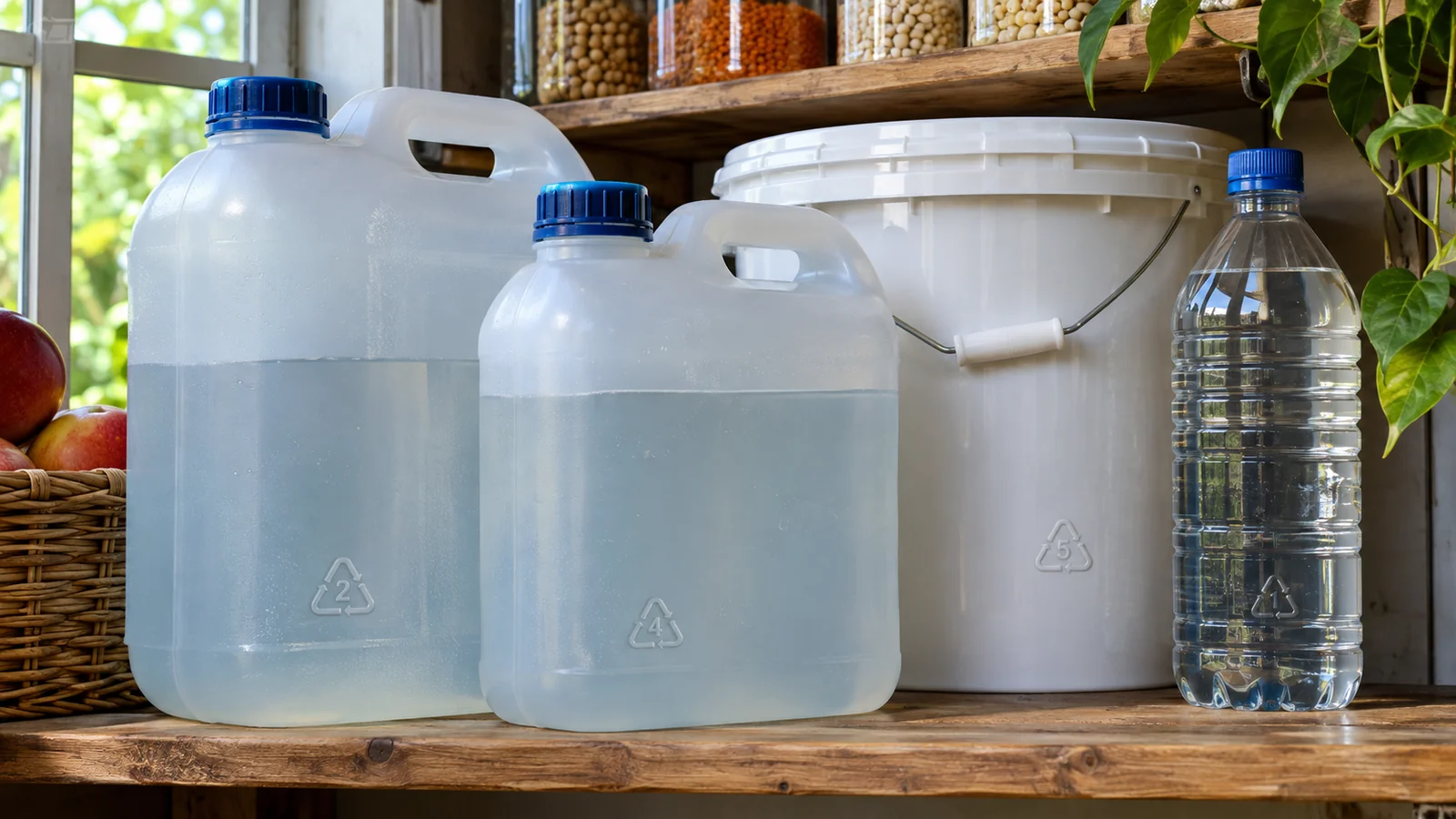
Whether you want to keep last night’s leftovers or store food and water for an emergency, it is important to use containers that are safe for food. Plastic containers that aren’t food-safe can leach chemicals into your food, which could cause health problems later.
Here is what you need to know about food-grade plastics for storing food and water, including food-grade buckets and water tanks. This guide demystifies recycling codes, explains the real risks and helps you make informed choices to protect your health and your family’s.
The fundamental food safety principle
The safety of food containers rests on a simple but crucial principle: no harmful substance should migrate from the container into the food or water it holds. This migration increases with contact time, temperature and the composition of the food (fatty, acidic). Understanding these factors lets you make informed decisions.
What makes a plastic safe or unsafe for food?
In Canada, food packaging materials are governed by the Food and Drugs Act and its regulations (Division 23): they must not transfer any harmful substance to food. Health Canada assesses many materials before they go on the market on a voluntary basis, and then issues a “letter of no objection”. The European Union, the United States and most industrialized countries have comparable frameworks.
In Europe, materials intended for food contact often carry the “glass and fork” symbol. This symbol isn’t mandatory in Canada, where you will instead see wording such as “food grade”, “food safe”, “qualité alimentaire” or “FDA compliant”.
The limits of the current regulatory system
Assessments rely largely on data supplied by manufacturers, and many substances found in plastics (additives, impurities, breakdown products) have never undergone complete toxicological studies.
A reality to know
More than 12,000 individual chemical substances can be used in making food-contact materials. Most have never undergone complete toxicological studies. Regulations evolve constantly as new research reveals previously unknown risks.
Chemical migration
Migration refers to chemical substances moving from the container into the food or drink. This natural phenomenon occurs with all plastics, but its intensity depends on several factors:
- Contact time: the longer the contact, the greater the migration
- Temperature: heat considerably speeds up chemical migration
- Type of food: fatty or acidic foods draw more substances out of the plastic
- Condition of the container: degraded, cracked or aged plastic releases more substances
- Type of plastic: some polymers are much more stable than others
Canadian, European and French regulations
In Europe, Regulation (EU) No 10/2011 strictly governs plastic materials intended for food contact. It sets positive lists of authorized substances and specific migration limits. France has often been a pioneer with stricter restrictions, notably on bisphenol A.
In Canada
- Ban on polycarbonate baby bottles containing BPA (2010) — Canada was the first country to act on this
- BPA added to the list of toxic substances under the Canadian Environmental Protection Act (2010)
- Food packaging governed by the Food and Drugs Act (Division 23 of the regulations)
- Health Canada letters of no objection for many packaging materials
In Europe
- Regulation (EU) No 10/2011 for plastics
- Ban on BPA in baby bottles (2011)
- Strictly controlled migration limits
- Positive lists of authorized substances
In France
- Suspension of BPA in all food containers (2015)
- Often more protective regulations
- Regular checks by ANSES
- BPA identified as an endocrine disruptor (2017)
Resin identification codes (aka recycling numbers)
The resin identification code (RIC) is the small number inside a triangle that you will see on most plastic packaging. This number tells you what type of plastic the container is made of.
Watch out: a common misconception
Many people wrongly believe that the RIC number tells you whether a plastic is food-safe or not. It doesn’t. For example, many food containers are made from #2 plastic (HDPE). But many containers that aren’t food grade (such as buckets or gas cans) are also made from #2 plastic.
Understanding the coding system
The recycling code only identifies the type of polymer used, not its food grade status or safety. Two containers with the same code can have very different chemical compositions depending on the additives, colourants and processing agents used.
#1 – PET/PETE
Polyethylene terephthalate. Used for beverage bottles and takeout containers. Recycling: Yes
#2 – HDPE
High-density polyethylene. Milk jugs, buckets, jerry cans. One of the safest for food. Recycling: Yes
#3 – PVC
Polyvinyl chloride. Plastic film, pipes. Contains phthalates. Recycling: Rarely
#4 – LDPE
Low-density polyethylene. Bags, cling film. Safe but flexible. Recycling: Sometimes
#5 – PP
Polypropylene. Resists heat and acids. Excellent for food. Recycling: Yes
#6 – PS
Polystyrene (Styrofoam). Releases styrene. Avoid. Recycling: Rarely
#7–19 – Other
Polycarbonate, bioplastics, multilayer. Polycarbonate can contain BPA. Use caution. Recycling: Variable
Important point: the recycling code does NOT automatically mean a plastic is food grade. Always look for an explicit food-grade statement (or the glass-and-fork symbol on European products) in addition to the recycling code.
BPA and plastic packaging: understanding the risks
When it comes to chemicals in plastic packaging, bisphenol A — or BPA — gets the most attention. Many studies have shown that BPA can migrate into food or water, and have linked it to health effects such as endocrine disorders, heart disease, obesity, type 2 diabetes, fetal development problems and cancers.
What is BPA?
Bisphenol A is a chemical compound used since the 1960s to make polycarbonate-type plastics (70% of BPA produced) and epoxy resins (30%). It is found in a multitude of everyday products: reusable bottles, storage containers, the inner linings of food cans, thermal cash register receipts.
A major regulatory shift
In April 2023, the European Food Safety Authority (EFSA) drastically reduced the tolerable daily intake of BPA, from 4 μg/kg of body weight per day to 0.0002 μg/kg — a 20,000-fold reduction. This drastic revision reflects new scientific evidence on the effects of BPA even at very low doses.
Documented effects of BPA
Scientific research has identified several categories of concerning effects:
Reproductive effects
- Reduced sperm production in men
- Higher miscarriage rates
- Fetal development problems
- Early puberty
Metabolic and other effects
- Increased risk of type 2 diabetes
- Obesity and metabolic disorders
- Cardiovascular disease
- Behavioural problems in children
- Increased risk of certain cancers
The problem with “BPA-free” alternatives
In the United States, the FDA still considers current dietary exposure to BPA safe, although it banned its use in baby bottles and sippy cups in 2012. Health Canada also considers dietary exposure for the general population to be low, while recommending that it be reduced for infants. However, because BPA is associated with many health risks, plastics containing BPA won’t appear on most lists of food-safe plastics.
Just because a plastic doesn’t contain BPA doesn’t mean it is necessarily safe. The chemicals used in BPA-free containers, such as BPS and BPF, may be just as harmful. And that doesn’t even account for the many other chemicals in plastic that could leach into your food or water.
So what is the reality?
No plastic is completely inert in contact with food and water. Choose glass containers whenever possible. When you have to use plastic containers (it’s hard to avoid plastic!), choose ones that:
- Are labelled food-safe
- Contain no harmful chemicals (at least none that we know of now)
- Are the least likely to leach chemicals
Vulnerable populations
Infants, young children, and pregnant and breastfeeding women are particularly sensitive to the effects of BPA and other endocrine disruptors. For these groups, maximum caution is called for:
- Always favour glass for baby bottles and food containers
- Avoid heating food and liquids in plastic containers
- Never reuse single-use plastic bottles
- Choose products explicitly labelled “free of BPA, BPS and BPF”
List of food-safe plastics
Polyethylene terephthalate (PET or PETE)
Recycling code: #1
Contains BPA: No
Used for: soda bottles, takeout containers, salad dressing bottles, peanut butter jars…
PETE is one of the most common food plastics and is generally considered safe. However, cases of chemicals leaching from PETE water bottles have been reported, particularly when they are exposed to high temperatures. At around 21 °C (70 °F), chemical levels appear safe. But as temperatures rise, harmful chemicals begin to leach into the contents at a faster rate.
Precautions for use
If you live somewhere very hot, PET plastics may not be a wise choice for food storage. As a rule, PET isn’t recommended for long-term storage of home-filled water either, because thin bottles become brittle with age and reuse, which can lead to leaks.
Recommended use: short-term single use only (a few months at most) for refilled bottles, never for long-term emergency storage; avoid exposure to heat and sun.
High-density polyethylene (HDPE)
Recycling code: #2
Contains BPA: No
Used for: milk jugs, motor oil containers, buckets, shampoo bottles, toys, pipes…
HDPE is generally considered the best food plastic. It is very strong and durable, which is why it is used for items such as milk jugs and buckets.
Compared with other food-safe plastics, HDPE is the least likely to leach chemicals into its contents. Its dense, stable molecular structure considerably limits the risk of chemical substances migrating into food, even at moderate temperatures. However, thin HDPE containers eventually break down, which can be a problem if you want to store water in reused milk jugs.
Note: HDPE is often used for non-food items such as motor oil or cleaning products. It is NEVER safe to put food in an HDPE container that previously held non-food items.
Advantages of HDPE:
- Excellent moisture barrier
- Resistant to impact and cracking
- Can be opaque, protecting contents from light
- Recyclable and relatively eco-friendly
- Available in large sizes for bulk storage
Low-density polyethylene (LDPE)
Recycling code: #4
Contains BPA: No
Used for: cling film, sandwich bags, squeeze bottles, plastic bags…
LDPE plastics are very flexible and are therefore often used for items such as six-pack rings or squeeze bottles. This type of plastic is considered of low concern and unlikely to release chemicals.
However, because it is so flexible, it isn’t generally used for storing food or water in bulk. Its relatively simple molecular structure and the absence of harmful additives in its base composition explain its reputation as a safe material for food contact.
Best use: food wraps, freezer bags, flexible packaging for dry foods, temporary protection.
Polypropylene (PP)
Recycling code: #5
Contains BPA: No
Used for: medicine bottles, baby bottles, lunch boxes, straws, plastic bottle caps, yogurt containers, packing tape…
Compared with other types of plastic, polypropylene better withstands heat and exposure to acids or fats. That makes it less likely to leach chemicals. If you need to store foods like tomato sauce (acidic) or vegetable oil (fatty), PP containers may be the best choice.
PP plastics are generally considered microwave- and dishwasher-safe. No major health problem is currently associated with food-grade PP, although, like any plastic, it can release microplastics and additives when heated. This thermal stability comes with excellent chemical inertness, sharply limiting interactions with food, whether acidic, fatty or watery.
Outstanding properties:
- High melting point (about 160 °C / 320 °F) — withstands hot liquids
- Resistance to fats and acids
- Durability allowing repeated use over several years
- Lightness combined with strength
- Ideal for quality reusable containers
Recommendation for preparedness
For emergency storage that may need heating, or for storing fatty or acidic foods, favour polypropylene (#5) containers. They offer the best safety/durability/versatility balance among food plastics.
Plastics that are not food-safe
Polyvinyl chloride (PVC)
Recycling code: #3
Harmful chemicals: phthalates
Used for: plastic film, squeeze bottles, pipes, shrink-wrap packaging…
Even if PVC plastics are labelled “food-safe”, it is best to avoid this type of plastic. It contains phthalates, a group of chemicals that can affect sex hormones. They are also associated with obesity, asthma and birth defects.
Phthalates: proven endocrine disruptors
Phthalates are plasticizers added to PVC to make it more flexible. These substances migrate easily into food, especially fatty food. Classified as endocrine disruptors, they interfere with the hormonal system and are of particular concern for children and pregnant women.
Polystyrene (PS)
Recycling code: #6
Harmful chemicals: styrene
Used for: disposable cups, meat trays, Styrofoam boxes and containers
Better known as Styrofoam, polystyrene plastics are known to leach a chemical called styrene. The chemical is terrible for the environment and is also associated with many health problems. It should be avoided and never heated.
Styrene risks:
- Classified as probably carcinogenic (Group 2A) by IARC since 2018
- Neurotoxic at high doses
- Migration accelerated by heat and fats
- Catastrophic environmental impact (not biodegradable)
- Accumulation in the marine food chain
Other (polycarbonate and polylactide)
Recycling code: #7 to #19
Harmful chemicals: BPA
Used for: plastic lids, baby bottles, wires, car parts…
Plastic codes #7–19 are used for various plastics, including polycarbonate (PC) and polylactide containers. Although some of these plastics may be food-safe, the problem is that you can’t be sure what is in them. Many of them may contain BPA or other harmful chemicals that could leach into your food or water.
The precautionary principle
Given the uncertainty around categories #7–19, apply the precautionary principle: avoid these plastics for food contact, especially for vulnerable populations and long-term storage. Always favour the categories clearly identified as safe (#2, #4, #5).
Summary table
| Code | Plastic | Food contact | Long-term emergency storage | Heat |
|---|---|---|---|---|
| #1 | PET | Yes, single use | Sealed commercial water only | Avoid |
| #2 | HDPE | Yes, if food grade | Excellent (buckets, barrels, jerry cans) | Moderate |
| #3 | PVC | Avoid | No | No |
| #4 | LDPE | Yes | Bags and liners for dry foods | Low |
| #5 | PP | Yes | Very good (reusable containers) | Best of the common plastics |
| #6 | PS | Avoid | No | Never |
| #7 | Other (PC, PLA…) | Uncertain | Not recommended | Avoid |
Food-grade buckets for storing food
Buckets are an excellent way to store large quantities of food. Just be aware that not all buckets are food grade, even if they are made from #2 HDPE plastic.
The problem with release agents
The problem is that some manufacturers use “release agents” to help get the buckets out of the mould. These chemicals can remain on the buckets and leach into your food. Food-grade buckets use release agents that are also food-safe, or compressed air to pop the bucket out of the mould.
FOOD-GRADE buckets
- ✅ Made from virgin #2 HDPE
- ✅ Food-grade release agents
- ✅ Explicit “food grade” marking
- ✅ Often white or natural colour
- ✅ Slightly higher price
NON-FOOD buckets
- ❌ May contain recycled HDPE
- ❌ Industrial chemical agents
- ❌ No food marking
- ❌ Various colours (orange, grey, black)
- ❌ Cheap but risky
Where to find food-grade buckets
When buying buckets for food storage, make sure they specifically say they are food grade. You will also want to make sure any lids you get are food grade too.
You can often get free buckets from local retailers, especially bakeries. Just make sure you know with 100% certainty what was in the bucket. You never want to store food in buckets that may have held cleaning products, motor oil or other chemicals.
Recommended sources
- Home-brewing supply stores: often sell new food-grade buckets at a reasonable price
- Food wholesalers: direct access to professional suppliers
- Local bakeries: buckets that held icing or fillings (check previous contents)
- Specialized hardware stores: food storage section
- Specialized preparedness retailers: full ranges with certifications
Essential checks before buying
- Visible food-grade statement (or glass-and-fork symbol)
- “HDPE” or “2” clearly marked
- “Food grade”, “food safe” or “qualité alimentaire” wording
- Lid also certified food grade
- Gasket in good condition
- No residual chemical smell
Recommended sizes and uses
2 to 5 litre buckets (½ to 1⅓ US gallons)
Ideal for: flour, sugar, rice, family portions. Easy to handle, quick rotation.
10 to 15 litre buckets (2½ to 4 US gallons)
Ideal for: legumes, pasta, grains. A balance of capacity and handling.
20 to 25 litre buckets (5 to 6½ US gallons)
Ideal for: long-term storage, bulk foods. Needs space and strength to handle.
Plastic water storage containers
Thin single-use containers — milk jugs, beverage bottles — aren’t designed to last. Even though plastic takes centuries to disappear in the environment, these containers become brittle and can develop tiny cracks long before that.
The problem of plastic degradation
These cracks are a major problem if you want to store water in plastic containers: reused milk jugs in particular can start leaking within 6 to 18 months, and milk residue encourages bacterial growth. For this reason, storing water in reused containers of this kind is NOT recommended.
Realistic shelf life of water in plastic
- Commercial bottled water (PET, sealed): until the date given by the manufacturer, often 1 to 2 years; store in a cool, dark place
- Food-grade jugs and jerry cans filled at home: replace about every 6 months, as Canadian authorities recommend
- Opaque food-grade barrels with a preservative: up to 1 year depending on the product used
- Reused milk jugs: NOT recommended (rapid degradation, leaks)
Recommended containers for water storage
Instead, invest in sturdier containers designed for water storage. These should also be labelled food-safe and never have held anything other than food or water.
Opaque HDPE barrels
Capacity: 20 to 200 litres (5 to 55 US gallons). Opaque blue to block light. Sturdy, with a screw-in bung. Ideal for long-term storage.
Pros: exceptional durability, light protection, various capacities
Cons: bulky, hard to move when full
Food-grade jerry cans
Capacity: 5 to 25 litres (1 to 6½ US gallons). Built-in handle, optional spigot. Easy to carry and handle.
Pros: portability, easy dispensing, stackable
Cons: limited volume, more expensive per litre
Rain collection tanks
Capacity: 200 to more than 1,000 litres (55 to more than 265 US gallons). For rainwater. Requires filtration and disinfection to make it drinkable.
Pros: very large capacity, self-reliance, economical
Cons: fixed installation, treatment required
WaterBrick
Capacity: about 13 to 15 litres (3½ to 4 US gallons). Stackable, modular design. Handy for evacuation.
Pros: versatility, portability, efficient stacking
Cons: high price, medium capacity
See our detailed review of WaterBrick containers.
Treating and preserving stored water
To maximize the shelf life of water in plastic containers:
- Treated municipal water: no additive needed for 6 months of storage in a clean, food-grade container
- Untreated water (well, spring): 2 drops of unscented household bleach (5 to 6% sodium hypochlorite) per litre, 4 drops if the water is cloudy or cold; mix and wait 30 minutes
- Micropur or equivalent: silver-ion products for up to 6 months of storage without a chlorine taste
- Chlorinated tap water: residual chlorine fades over time; rotating about every 6 months remains best practice
- Regular rotation: use and replace every 6 to 12 months
Good storage and use practices
Optimal storage conditions
Temperature
Store at a stable temperature, ideally 15 to 20 °C (59 to 68 °F). Avoid damp basements, uninsulated garages and overheated attics. Temperature swings speed up degradation.
Light
Maximum protection from sunlight and UV. Use opaque containers or store in the dark (cupboard, boxes). Light degrades both the plastic and its contents.
Humidity
A dry environment is essential. Humidity encourages mould on the outside and can get in if seals fail. Check tightness regularly.
Ventilation
Moderate air circulation is desirable to avoid condensation and odours. Avoid completely confined spaces with no airflow.
Golden rules for reusing plastics
NEVER reuse if
- The container held chemicals, fuels or motor oil
- The container held dairy products (persistent bacteria)
- The container held sugary juices (sugars in the plastic = bacterial growth)
- The plastic is cracked, warped, discoloured or smelly
- You don’t know the previous contents with absolute certainty
- The container isn’t explicitly marked “food grade”
Avoid heat with plastics
Heat is the main enemy of plastic food containers:
- Microwave: only plastics explicitly marked “microwave-safe” (usually PP). Even then, avoid very fatty foods, which get hotter
- Dishwasher: top rack only if clearly marked. Hand-washing in lukewarm water is preferable
- Hot liquids: never pour boiling liquid into plastic. Let it cool below 60 °C (140 °F)
- Storage near heat sources: keep away from radiators, ovens, sunny spots and engines
- Vehicles in summer: never leave plastic containers in a car parked in the sun (temperatures above 60 °C / 140 °F are possible)
Inspection and rotation
Set up a regular inspection routine:
Monthly inspection
- Check for cracks or warping
- Test the tightness of seals and lids
- Look for unusual discolouration or clouding
- Detect unusual odours
- Note storage dates
Twice-yearly rotation
- Use up and replace stored water
- Check the condition of dry foods
- Clean empty containers
- Replace degraded containers
- Update the inventory
Cleaning and maintenance
To maximize the lifespan and safety of plastic food containers:
- First use: wash in warm soapy water + rinse thoroughly + light disinfection (bleach solution diluted 1:100) + complete final rinse
- Daily use: wash after each use, dry completely before storing, no standing water in closed containers
- Long-term storage: deep clean before filling, check there is no soap residue (taste), dry perfectly
- Replacement: every 2 to 5 years depending on use and type of plastic, or at the first signs of degradation
Frequently asked questions
Can you reuse disposable water bottles?
Reusing single-use PET (#1) bottles carries several significant risks and isn’t recommended:
- Accelerated degradation: these bottles are designed for single use. Each wash and refill degrades the plastic
- Bacterial contamination: tiny cracks and microscopic scratches harbour bacteria that are hard to remove
- Increasing chemical migration: plastic degradation increases the release of chemicals into the water
- Impossible to clean properly: the narrow neck prevents effective cleaning
Solution: invest in a reusable bottle made of stainless steel, glass or food-grade HDPE/PP plastic designed for repeated use.
How can you tell if a container contains BPA?
Identifying BPA takes several checks:
- Recycling code: BPA is mainly found in #7 plastics (polycarbonate), but not all #7 plastics contain it
- Explicit marking: look for “BPA-free”, “sans BPA” or “0% BPA”. The absence of marking is no guarantee
- Manufacturing date: products made before 2010–2015 are likely to contain BPA
- Type of product: old baby bottles, rigid clear reusable bottles, inner linings of food cans
- Visual test: very rigid, clear and shiny plastic = possible polycarbonate (but not always)
Important: “BPA-free” doesn’t mean “bisphenol-free”. The substitutes BPS and BPF carry similar risks. Favour HDPE, LDPE or PP plastics.
How long does water keep in a plastic container?
Shelf life depends on several critical factors:
Commercial bottled water (sealed PET):
- Until the date given by the manufacturer, in good conditions (cool, dark, stable temperature)
- The best-before date reflects the container, not the water
- Once opened: drink within 48 to 72 hours (bacterial contamination)
Tap water in HDPE jerry cans:
- 6 to 12 months with a preservative treatment (chlorine or silver ions)
- Rotation recommended every 6 months for best quality
- Conditions: complete darkness, 15 to 20 °C (59 to 68 °F), airtight
Limiting factors:
- Weakening of thin reused containers (possible leaks within 6 to 18 months)
- Gradual migration of substances from the plastic into the water
- Loss of residual chlorine (3 to 6 months)
- Algae growth if exposed to light
Recommendation: for long-term emergency storage (more than 1 year), favour dedicated opaque HDPE barrels or invest in glass or stainless steel containers.
Can you reheat food in plastic in the microwave?
Microwaving in plastic carries risks even with “microwave-safe” plastics:
Plastics explicitly approved for microwave use (mainly PP):
- Safe for moderate reheating (not boiling)
- Avoid very fatty foods (oils, creamy sauces), which can reach more than 100 °C (212 °F)
- Always remove lids that aren’t microwave-safe
- Use medium power, in short intervals
- Leave room for steam to expand
Risks even with approved plastics:
- Local hot spots can exceed a safe temperature
- Aging or damaged plastic → increased migration
- Some additives migrate more at high temperature
Recommended alternative: transfer food to a glass or ceramic container before reheating. If you use plastic, use only PP marked microwave-safe, at moderate temperature, for a short time, and avoid fatty foods.
Are bioplastics safer for food?
“Biodegradable” or “compostable” doesn’t automatically mean “safer for health”:
Common bioplastics (PLA — polylactic acid):
- Generally considered safe for cold food contact
- Low softening point (about 60 °C / 140 °F) — don’t use with hot liquids
- Begin to degrade at moderate temperatures
- Breakdown products not always better characterized than conventional plastics
Important considerations:
- Additives needed to make bioplastics functional can migrate
- Faster degradation = potentially more migration
- Fewer long-term studies on health safety
- Industrial composting often required (no natural breakdown)
Conclusion: bioplastics are better for the environment, but not necessarily safer for health. For food contact, well-characterized conventional plastics (HDPE, PP) remain the safest choice for now. Use bioplastics for short-term service and cold foods.
What should I do if I stored food in a non-food-grade container?
Immediate action:
- Transfer immediately to certified food-grade containers
- Inspect the food visually: discolouration, odour, abnormal texture
- If in doubt about safety: throw out the food concerned
Risk assessment:
- Contact time: longer = higher risk of chemical migration
- Type of food: fatty or acidic foods will have drawn out more substances
- Previous contents of the container: chemicals or fuels = major danger
- Condition of the container: visible residue or odours = certain contamination
For the future:
- Invest in containers clearly identified as food grade
- Only buy new containers, or ones whose history you know perfectly
- Remember: the initial savings aren’t worth the long-term health risks
Precautionary principle: if in doubt about food safety, throw it out. Health is priceless.
Conclusion: informed choices for your health
The safety of plastic food containers isn’t a matter of paranoia, but of informed choices based on solid scientific data. By understanding the different types of plastic, their properties and their limitations, you can effectively protect your health and your family’s.
Key principles to remember
- Favour glass when possible, especially for long-term storage and acidic or fatty foods
- For plastic, choose HDPE (#2), LDPE (#4) or PP (#5) with food-grade certification
- Absolutely avoid PVC (#3), PS (#6) and uncertain categories (#7–19)
- Never reuse containers that held non-food products
- Protect your containers from heat, light and degradation
- Rotate regularly stored water and food
A prepared citizen doesn’t just store enough food and water. They make sure those supplies stay wholesome and safe for their family. Choosing appropriate containers is an investment in long-term health, not an unnecessary expense.
Regulations evolve constantly as science uncovers new risks. Stay informed, use discernment, and don’t hesitate to invest in higher-quality containers when your health is at stake.
Real resilience isn’t just about surviving a crisis, but about maintaining your health and quality of life during and after it. Your food container choices today shape your well-being tomorrow.