
In this article
- In brief
- The first question: what water will you have to treat?
- Filters and purifiers: two different functions
- Boiling remains the microbiological benchmark
- Why microns are not enough to compare
- Which contaminants do you need to treat?
- Floodwater: maximum caution
- Chemical contaminants, the most misunderstood topic
- A multi-barrier strategy
- The main types of systems
- Criteria to check before buying
- Freezing, a major risk in Quebec
- Sawyer Mini or LifeStraw: the detailed comparison
- Cleaning and caring for your filter
- The different ways to use a squeeze filter
- A selection of systems by scenario
- The quick pick
- There is no “best filter overall”
- For a go bag: redundancy
- Watch out for cross-contamination
- Prefilter cloudy water
- What about pool water?
- A water reserve still beats a filter
- The 6-question selection method
- Choose the risk before the filter
- Frequently asked questions
The best survival water filter is not necessarily the one that removes the most contaminants. It is the one that matches the water you will actually have to treat, the number of people you need to supply and the context in which you will use it: backcountry hiking, a go bag, a prolonged outage, a boil-water advisory, travel or a family camp.
Bacteria, protozoa, viruses, sediment and chemical contaminants are not handled by the same technologies. Before buying, you need to understand what a device can do and, above all, what it cannot. This guide explains the difference between filters and purifiers, the main types of systems, buying criteria, the special case of freezing in Quebec, compares the Sawyer Mini and the LifeStraw straw in detail, and offers a selection by scenario.
In brief
In brief. No portable filter turns “any water” into drinking water. A 0.1-micron membrane filter stops bacteria and protozoa but not viruses; a purifier adds virus protection; activated carbon reduces some chemicals but not all of them. Water suspected of containing fuel or toxic products is not treated: you change sources. Choose the risk first and the filter second, protect membranes from freezing, and always keep a backup method and a water reserve.
The first question: what water will you have to treat?
The right question is not “which filter should I buy?” but “what water might I really have to treat?”. Someone hiking in remote parts of Quebec does not need the same system as a family that wants to treat water after an urban flood.
| Scenario | Main risk | Approach |
|---|---|---|
| Backcountry lake or river | Protozoa, bacteria, sediment | Suitable microbiological filtration |
| Boil-water advisory at home | Possible microbiological contamination | Boiling or a treatment validated for that risk |
| Floodwater | Microorganisms and unknown contamination | Use another source |
| Country with uncertain sanitation | Bacteria, protozoa and possibly viruses | Microbiological purifier |
| Water suspected of fuel or chemicals | Chemical contamination | Change sources |
Filters and purifiers: two different functions
The two words are often used interchangeably, but the distinction is useful.
The water filter
A portable membrane filter physically stops certain contaminants by preventing them from passing through extremely small pores. Outdoor models are designed to retain bacteria, protozoa and their cysts, sediment and, depending on the model, microplastics. A Sawyer MINI, for example, uses a hollow-fibre membrane rated at 0.1 micron absolute; it targets bacteria, protozoa and microplastics, but does not claim to remove viruses.
The purifier
In outdoor manufacturers’ vocabulary, a purifier adds the ability to treat viruses. That can come from ultrafiltration, ultraviolet light, chemical treatment (tablets, drops), electroadsorption or specific media. A UV device inactivates microorganisms without filtering, and tablets disinfect chemically.
A technology that kills or inactivates microorganisms does not necessarily remove sediment. Conversely, an excellent sediment and bacteria filter may let viruses through. The two approaches are often combined.
Boiling remains the microbiological benchmark
When water is suspected of microbiological contamination and no safer source is available, boiling remains the reference home method of health authorities. Bring clear water to a rolling boil for 1 minute, or 3 minutes above about 2,000 m (6,500 ft). Cloudy water should first be left to settle, then prefiltered through a clean cloth or coffee filter before boiling.
Boiling does not remove sediment or chemical contaminants, however, and it uses fuel. For chlorine disinfection, see purifying water with household bleach and alternatives to bleach; for an overview, the drinking water treatment cheat sheet.
Why microns are not enough to compare
Pore size is an indicator, not a guarantee. Two filters with the same rating can perform very differently depending on membrane construction, seal integrity, test protocols and maintenance. Serious spec sheets express effectiveness as log reduction: 99.9999% of bacteria and 99.9% of protozoan cysts, for example.
To compare two systems, look first at which contaminants removal or reduction is claimed and documented for, then at the test standards used. The micron figure comes after.
Absolute or nominal micron
A nominal rating describes an average or statistical performance: some particles of that size may pass. An absolute rating describes a much stricter limit. For a microbiological filter, an absolute rating is clearly preferable.
Which contaminants do you need to treat?
| Contaminant | Examples | Relative size | What works |
|---|---|---|---|
| Protozoa | Giardia, Cryptosporidium | Large (a few microns) | 0.1 to 0.2 micron filter, boiling, UV; chlorine works poorly on Cryptosporidium |
| Bacteria | E. coli, Salmonella | Medium (about 0.2 to 2 microns) | 0.1 to 0.2 micron filter, boiling, chlorine, UV |
| Viruses | Norovirus, hepatitis A | Very small (0.02 to 0.3 micron) | Purifier, boiling, chlorine, UV |
| Sediment | Silt, mud | Variable | Settling, prefilter, membrane |
| Chemicals | Fuels, pesticides, metals | Molecular | Change sources; activated carbon only for some compounds |
Protozoa and parasites
Giardia and Cryptosporidium are classic surface water contaminants. Relatively large, they are very well retained by hollow-fibre filters designed for the outdoors, such as Sawyer models at 0.1 micron absolute.
Bacteria
E. coli, Salmonella and other bacteria are found in water contaminated by human or animal feces. Clear water in the wild is therefore not automatically safe: a beaver or moose upstream is enough.
Viruses
Much smaller, viruses are what separate a simple filter from a purifier. In much of the North American backcountry, they are considered a lower risk than bacteria and protozoa. The picture changes in a region with poor sanitation, near sewage contamination, in a degraded urban environment after a disaster, when travelling, or whenever human fecal contamination is plausible. LifeStraw, for example, clearly distinguishes its classic filters, which treat bacteria and parasites, from its purifiers, which also treat viruses.
Floodwater: maximum caution
A purifier that handles viruses is not a solution for drinking water from a flooded city. Floodwater can contain sewage, fuels, oils, pesticides, industrial products, metals and debris all at once. Health authorities advise against trying to make drinkable water that is known or suspected to be contaminated with fuel or toxic chemicals: neither boiling nor disinfection solves that problem.
In a flood, a drinking water reserve or an alternative source remains the priority. See calculating an emergency water supply and understanding drinking water advisories.
Chemical contaminants, the most misunderstood topic
Claims such as “removes chemicals” are often misleading. A filter may reduce chlorine, some pesticides or some organic compounds and do nothing for others, such as nitrates, salts or certain metals. Performance depends on the contaminant, its concentration, contact time and cartridge wear. A general claim without a precise list of tested contaminants is worth little. For PFAS, see checking your source and choosing a response.
Activated carbon: adsorption, not absorption
Activated carbon works by adsorption: certain molecules stick to its very large internal surface. It can improve taste and odour and reduce chlorine, some organic compounds and, depending on the formulation, some metals. But as available sites fill up, its effectiveness drops, and unlike many membranes it does not regain capacity through backflushing. That is why a carbon cartridge has a defined lifespan and must be replaced.
A multi-barrier strategy
The best approach is often a treatment chain:
- Safest sourceRunning water, upstream, away from roads, fields and campsites.
- Settle and prefilterLet it stand, pass it through a clean cloth or coffee filter.
- FilterMembrane for bacteria, protozoa and sediment.
- Purify if neededBoiling, chlorine or UV if a viral risk is plausible.
- Store cleanlyA closed, labelled container reserved for treated water.
Each step protects the next. Very muddy water that is settled and passed through a cloth before reaching an expensive cartridge noticeably improves flow and extends the filter’s life. To find the best sources in the wild, see outdoor water sources and safety.
The main types of systems
1. Straw filters
Popularized by LifeStraw, straws let you drink directly from the source. They are very compact, simple, light and often inexpensive. On the other hand, they are impractical for producing several litres, do not always let you fill a clean container, and are poorly suited to cooking and groups.
2. Squeeze filters
The Sawyer family is a good example of this category. You fill a pouch with raw water, screw on the filter, squeeze the water through the membrane and collect it in a clean container. With no pump or battery, these filters can also be used inline on a hydration bladder, as a straw or as a gravity system.
3. Purifier bottles
The GRAYL GeoPress is a good example: you fill the outer part with the water to be treated, then press the cartridge through the water, which stays in the clean part. It is much more practical than a straw for drinking, filling another container, cooking, adding electrolytes or quickly treating a small amount.
4. Pump filters
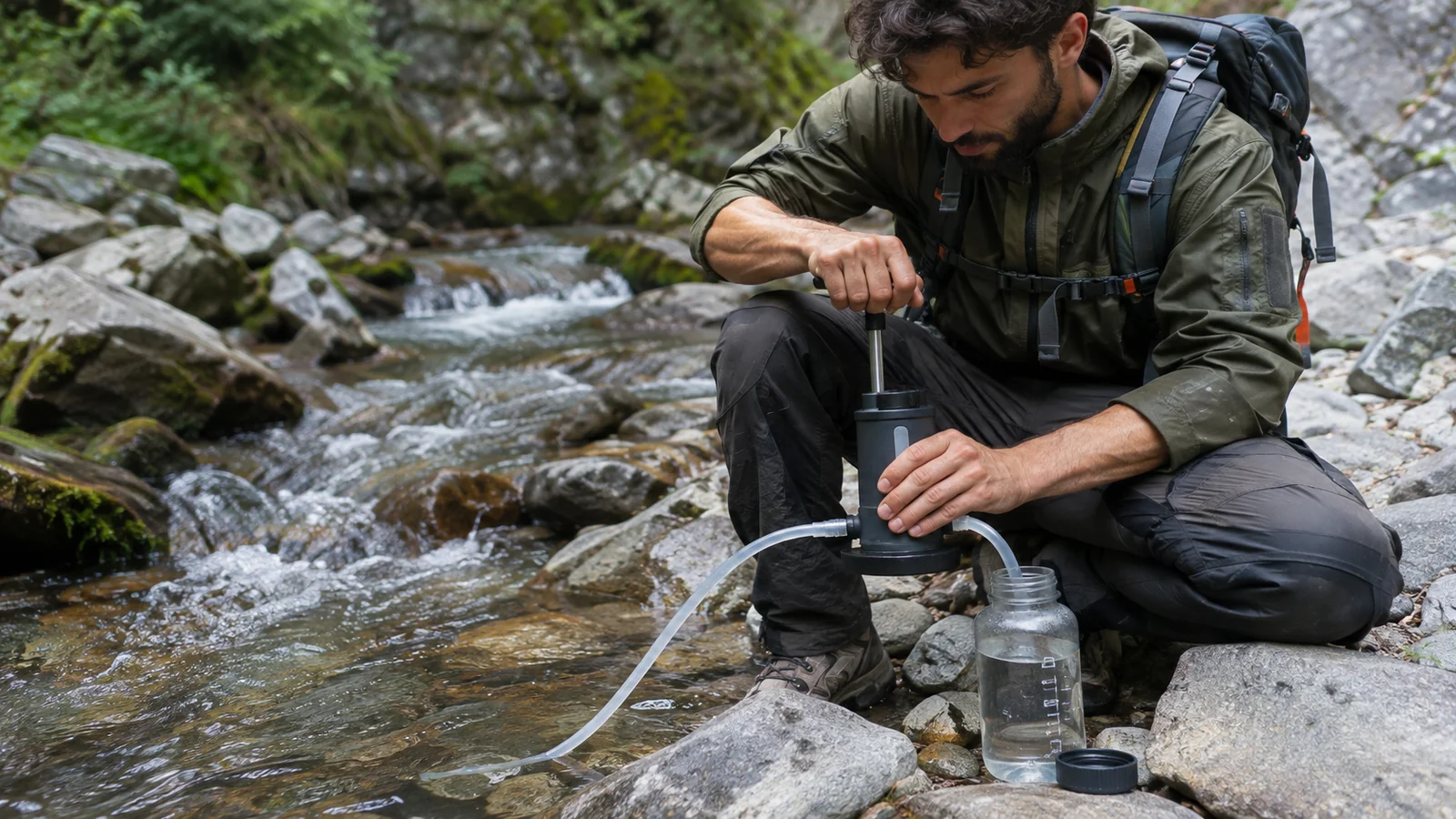
Pumps are useful when the source is shallow, when it is hard to fill a pouch, when you need to produce water quickly or when the system must be rugged. The trade-off is weight and extra mechanics to maintain.
5. Gravity systems
For several people, this is often the best design: you fill a raw-water reservoir and gravity does the work. They suit family camps, groups, temporary home use and repeated production of several litres, without squeezing or pumping every litre.
| Need | Suitable type |
|---|---|
| Ultralight solo hiking | Squeeze or compact filter |
| Go bag | Squeeze or purifier bottle depending on the risk |
| International travel | Purifier with virus treatment |
| Family camp | Gravity |
| Large group | Gravity or high-capacity purifier |
| Very shallow water | Pump or an intermediate collection container |
| Boil-water advisory at home | Boiling or a system validated for the specific risk |
Criteria to check before buying
Contaminants treated
This is the first criterion. Don’t settle for words like “purifies”, “ultrafiltration”, “advanced technology” or “clean water”. Check precisely: bacteria? protozoa? viruses? microplastics? which chemicals? which metals?
Results and test protocols
The best spec sheets give reduction rates, tested contaminants, protocols and reference laboratories or standards (for example NSF/ANSI standards). Independent certification is worth more than a marketing promise.
Flow rate
It becomes crucial when several people depend on the same system. A device that is comfortable for one person can become very frustrating for a family of five.
Lifespan
Distinguish the lifespan of the membrane, of the complete cartridge, the capacity of the activated carbon and ageing after first use.
Maintenance
Some filters can be backflushed, others need a new cartridge. A preparedness system should come with its cleaning gear, spare seals where relevant, at least one replacement cartridge if its capacity is limited, and its instructions.
Freezing, a major risk in Quebec
A wet hollow-fibre membrane contains water. If that water freezes, its expansion can crack the fibres, and the damage is not necessarily visible: the filter seems to work while its microbiological integrity is compromised. A wet filter that has frozen should be treated as suspect unless the manufacturer guarantees its integrity after freezing.
As soon as temperatures drop below zero, keep the membrane close to your body: an inside pocket by day, your sleeping bag at night, an insulated case, or another method recommended by the manufacturer. Never leave a wet filter in the outer pocket of your pack at -20 °C (-4 °F). In winter, protecting the filter can matter as much as carrying it. See also cold-weather survival.
Sawyer Mini or LifeStraw: the detailed comparison
These are two of the most widespread affordable hiking filters, and often the first ones people slip into an evacuation kit. They share a basic function, microbiological filtration of bacteria and protozoa, but differ clearly in use.
First impressions
The Sawyer Mini lives up to its name: it is very small and comes with a 16 oz (about 500 mL) squeeze pouch, a straw and a backflush syringe. The LifeStraw is almost twice as long and comes with a lanyard and no other accessories.
Specifications
| Feature | Sawyer Mini | LifeStraw Personal |
|---|---|---|
| Rated capacity | Up to 100,000 gal (about 378,000 L), with maintenance | About 1,000 gal (about 4,000 L) |
| Bacteria | 99.99999% | 99.9999% |
| Protozoa | 99.9999% | 99.9% |
| Viruses | No | No |
| Pore size | 0.1 micron absolute | 0.2 micron |
| Versatility | Straw, squeeze, bottle-mounted, inline, gravity | Straw only |
| Size | About 13 cm (5 in) | About 23 cm (9 in) |
| Weight | About 57 g (2 oz) | About 57 g (2 oz) |
| BPA-free | Yes | Yes |
The figures above are those announced by the manufacturers and may change from one model to the next: check the product sheet when you buy.
Ease of use
The Sawyer Mini can be used as a straw to drink immediately, but also attaches to the supplied pouch: you squeeze to push water into a clean container. It screws onto disposable bottles with a standard 28 mm thread and installs inline on a hydration bladder. That versatility makes it easy to use in almost any situation.
The LifeStraw is used only by sucking, either directly from the source or from a container of unfiltered water. There is no simple way to filter water and store it, and it cannot be installed inline.
Speed
Water passes through the Sawyer Mini faster, whether you squeeze the pouch or use it with gravity. The LifeStraw has some suction resistance, which makes drinking slower.
Weight and size
Both weigh about the same and have the same diameter. About 10 cm (4 in) shorter, the Sawyer Mini packs more easily with the rest of your gear.
The verdict
For a go bag or a hike, the Sawyer Mini wins: more accessories, much higher rated capacity, a finer membrane, more compact, faster and far more versatile. The LifeStraw remains an excellent, ultra-simple backup filter to slip into a car kit or a child’s bag. Neither treats viruses or chemical contaminants.
If you can accept a few extra grams, the Sawyer Squeeze, with the same 0.1-micron absolute membrane, offers more comfortable filtering and also converts into a gravity system: for frequent use, it is worth considering.
Cleaning and caring for your filter
Cleaning
A clean filter keeps a steady flow. After use, backflush the Sawyer Mini with the syringe: push clean water several times from the outlet side to the inlet side. For the LifeStraw, blow air through the straw after each use to clear the water and prevent clogging.
Storage
Let both filters dry before storing them, and protect them from freezing. After long storage, rehydrate them before use: backflush the Sawyer several times with the syringe; for the LifeStraw, remove both caps, soak the straw in water for about 10 seconds, then take a few small sips to prime the filter.
The different ways to use a squeeze filter
As a gravity filter
Attach a cord to the bottom corners of the raw-water pouch (some models have grommets; otherwise use a purpose-made gravity bag), screw on the filter, hang the pouch above a clean bottle, remove the cap from the outlet and squeeze lightly to start the flow. Gravity then takes over. Flexible tubing can guide the filtered water into the bottle. Keep dirty and clean water containers well separated.
Screwed onto a bottle
The filter screws onto a soft bottle with a standard thread. You carry raw water and squeeze the bottle to filter into a clean container.
As a straw
You can drink directly from the source in a pinch.
Inline on a hydration bladder
Installed on the tube, the filter lets you drink while walking instead of stopping to filter. If you put unfiltered water in the reservoir, label it “dirty” and always use it with the filter.
Taste and electrolytes
Because filtered water can be collected in another container, you can add flavour packets or electrolytes to it, never to the raw-water pouch or before the filter.
Useful accessories
- Extra squeeze pouches in different sizes, or a compatible soft bottle.
- Fast-fill adapter to fill a hydration bladder without taking it out of your pack.
- Cleaning coupling to backflush from a bottle of clean water rather than with the syringe.
- Large pouch or gravity bag to produce several litres at camp.
A selection of systems by scenario
The following specifications are those announced by manufacturers for current models; they may change, so check before buying.
Rugged pump purifier: MSR Guardian
The Guardian is a pump designed for true microbiological treatment including viruses, able to work in difficult environments. Its strengths: fast pumping, virus treatment, automatic cleaning during pumping, very rugged construction and good capacity for a group. Its limits: high price, more weight than ultralight filters, and an essentially microbiological function: it should not be presented as a solution to chemical pollution. Ideal for expeditions, demanding travel, groups and scenarios where viral risk is real.
Evacuation or travel: GRAYL GeoPress
The GeoPress combines protection against viruses, bacteria and protozoa, sediment and microplastics with reduction of many chemicals and some heavy metals, and improved taste. The current model holds 710 mL (24 oz), weighs about 450 g (16 oz) and treats a fill in about 8 seconds, a theoretical flow of about 5 L (1.3 gal) per minute. The cartridge is rated for about 350 cycles, or 250 L (66 gal), and is replaced when pressing becomes very slow or about three years after first use.
Pros: very simple, fast, broad microbiological protection, carries purified water. Cons: consumable cartridge, higher cost per litre than a long-life membrane, limited volume per press, and no solution for a source obviously contaminated with fuel or toxics. Ideal for a go bag, travel and anyone who wants broader protection than a backcountry filter.
Budget and ultralight: Sawyer MINI
A 0.1-micron absolute membrane; the manufacturer claims 99.99999% of bacteria, 99.9999% of protozoa, 100% of microplastics and a very high theoretical capacity when properly maintained. Pros: very light, very small, affordable, backflushable, compatible with many bottles and pouches. Cons: no virus or chemical treatment, lower flow than some larger models, freeze protection required. Excellent in the right scenario: the problem is never the product, but asking it to treat water it was never designed for.
For a group with viral risk: LifeStraw Peak Series Gravity Purifier
This gravity system has an 8 L (2.1 gal) reservoir, treats viruses, bacteria and parasites, filters sediment and microplastics, is rated at about 30 L (8 gal) per hour and about 18,000 L (4,750 gal) of capacity for the ultrafilter. It gives a family a system with true virus protection, with no pumping or electricity. Ideal for a family, a group, a fixed camp and home preparedness.
Group outdoors: Platypus GravityWorks 4 L
Its two-bag design of 4 L (1 gal) each clearly separates raw water from filtered water, limiting cross-contamination. Its membrane targets bacteria and protozoa. Pros: very simple for several people, no pumping, good flow, separate clean reservoir, easy backflushing. Cons: no virus treatment with the standard filter, no complete chemical treatment, less suited to one person moving fast. Ideal for family camping.
Countertop gravity systems, Berkey-style
Large stainless steel countertop filters are popular for the home. Berkey’s situation has changed, however: the original Black Berkey elements are no longer normally available, and the brand offers other filter elements for some units. Before buying this type of system, rely on independent certifications for the elements actually available (the NSF database lets you check which standards are covered, for example Standard 42 for chlorine, taste and odour), not on a reputation built on elements that are no longer produced.
Bucket ultrafiltration: Sawyer Point Zero Two
This very fine ultrafiltration adds virus protection and can be mounted on a bucket for gravity use: an excellent principle for a home, a group or a temporary fixed setup. Check availability, parts and instructions with the manufacturer before building a system around it. As with other purifiers, treating viruses does not mean treating chemicals.
In general, a spectacular product that is hard to document is less valuable than a simpler one whose performance, consumables and procedures are clearly established.
The quick pick
| Context | First choice to look at | Why |
|---|---|---|
| Solo hiking | Sawyer Squeeze or MINI | Light, simple, bacteria and protozoa |
| Go bag | GRAYL GeoPress | Very simple, broader microbiological protection |
| International travel | GRAYL or another documented virus purifier | Viruses covered |
| Family camp | Platypus GravityWorks | Easy production of several litres |
| Family and viral risk | LifeStraw Peak Gravity Purifier | 8 L and virus treatment |
| Demanding expedition | MSR Guardian | Rugged pump, microbiological purification |
| Ultra-simple backup | LifeStraw Personal | No parts, nothing to lose |
| Unknown chemical contamination | None | Change sources |
There is no “best filter overall”
The best system changes with the scenario. A Sawyer MINI is excellent for walking alone for several days in the backcountry when weight matters. A GRAYL makes more sense for crossing varied environments during an evacuation or a trip. A gravity purifier is far more efficient when a whole family needs several litres every day.
For a go bag: redundancy
A single device is a single point of failure. A sensible setup combines:
- a main filter;
- a few purification tablets suited to the scenario;
- a metal container for boiling water;
- a clean container reserved for treated water;
- a simple prefilter (bandana, coffee filter).
Several independent methods are often worth more than one very sophisticated device. See the grab bag for quick evacuation.
Watch out for cross-contamination
An excellent filter can be made useless by careless handling. Clearly distinguish the raw-water container, the clean-water container, the filter inlet and its clean outlet. Don’t let the clean outlet drop into the source and don’t fill your clean bottle with raw water “just to carry it”. Physically marking containers “dirty” and “clean” is an excellent habit, and wash your hands before handling treated water.
Prefilter cloudy water
Mud does not necessarily prevent microbiological treatment, but it greatly increases the load on the system. Let it settle, prefilter through a clean cloth or coffee filter, then treat. Manufacturers themselves recommend choosing the clearest water possible to extend cartridge life.
What about pool water?
Pool water can contain concentrated chlorine, stabilizers, algaecides, maintenance products, biological contaminants and other additives. Health authorities consider it a resource for hygiene and cleaning (flushing, washing), not a drinking water source, even filtered.
A water reserve still beats a filter
A filter is often presented as unlimited self-sufficiency, but it always depends on an available source. After a grid failure, chemical contamination or an evacuation, that source may be out of reach. Treating and storing water are two complementary capabilities: the reserve buys you time, the filter extends your autonomy when a suitable source remains accessible. The water storage calculator works out your needs.
At home: think in litres per day
One person can put up with squeezing a pouch to produce a litre. A family that needs water for drinking, cooking, medication, pets and minimal hygiene quickly needs a more productive system: a gravity system then becomes far more rational than an individual bottle.
During an evacuation: think mobility
The logic flips: weight, volume, speed, simplicity, number of parts and the ability to treat several kinds of sources become the criteria. That is why a GRAYL and a Sawyer can both be excellent, for different strategies.
The 6-question selection method
- Which source am I likely to use?
- Which contaminants are plausible in that source?
- How many people do I need to supply?
- How many litres do I need to produce each day?
- Do weight and bulk matter?
- What backup method do I have if the main system fails?
If you can answer these six questions, the choice becomes much simpler.
Choose the risk before the filter
The market for filters and purifiers has grown a lot, which is good news, but more choice also means more marketing and more confusion. A small, affordable filter can be excellent for a Quebec hike; a more expensive purifier is more relevant on an expedition or in an environment with viral risk; a gravity system is unbeatable for a family. And none of them is an answer to water containing fuel or toxic products. The goal is not to own “the best filter”, but to be able to produce enough drinking water from the sources actually available, with technology suited to the plausible contaminants and a backup solution.
Frequently asked questions
Does a Sawyer MINI remove viruses?
No. It is designed to filter bacteria, protozoa and microplastics with a 0.1-micron absolute membrane. For a viral risk, add a purification step: boiling, chlorine or UV.
Can you drink floodwater after filtering it?
It is not a strategy to rely on. Floodwater can contain sewage, fuels and chemicals. If toxic contamination is known or suspected, use another source.
Which filter for hiking in Quebec?
For backcountry surface water with no suspicion of chemical pollution or significant human fecal contamination, a membrane filter designed for bacteria and protozoa is generally suitable.
Which system for a go bag?
A light squeeze filter works if the sources resemble backcountry water; a purifier bottle offers broader protection if the environment varies. Always add a secondary method.
Does activated carbon remove all chemicals?
No. It reduces some compounds depending on the contaminant, its concentration, the formulation and contact time. Water suspected of containing fuel or toxic substances does not become safe thanks to activated carbon.
Why protect some filters from freezing?
Water trapped in the hollow fibres can freeze, expand and crack the membrane with no visible damage. The filter seems to work while its microbiological protection is compromised.
Is it better to store water or buy a filter?
Both. A reserve works immediately and depends on no source; a filter extends autonomy when a suitable source remains accessible.
Sawyer Mini or LifeStraw for an evacuation kit?
The Sawyer Mini is more versatile, faster and more compact, and lets you fill a clean container. The LifeStraw is an excellent ultra-simple backup. Neither treats viruses.