
In this article
- Context: Water quality
- Understanding water contaminants
- Purification methods: documented efficacy
- Combined approaches and multi-barrier strategy
- Contexts for application
- Water storage: an essential supplement
- Common mistakes and misconceptions
- Limitations and acknowledgment of uncertainty
- Examples of equipment to be selected based on specific needs
- Conclusion: proportionate preparedness
- Frequently Asked Questions
- Additional Resources
- Going Further
- Primary verification references
- Equipment to compare for your needs
Access to potable water is a resource that most people enjoy daily without a second thought. Municipal water treatment systems generally operate reliably, subject to rigorous quality controls. However, there are situations—such as prolonged power outages, floods, water main breaks, accidental contamination, or activities in natural environments—where treated water may become temporarily unavailable, or where one might need to rely on untreated sources.
This guide outlines various methods—boiling, chlorine disinfection, purification tablets, filtration, and UV treatment—along with how to combine them and store water. The best approach depends on the water source, the specific contaminants present, the people involved, and the equipment available. General quality rankings cannot replace information provided by your local water utility; effective preparation should be based on specific guidelines and needs—avoiding both constant fear and blind, absolute reliance on any single portable treatment method.
Important clarification regarding context
Always follow the information provided by your local water utility and any advisories specific to your location. A "boil water" advisory, a "do not consume" notice, and a "do not use" notice each require different actions. Water from a private well, cistern, or natural spring must be evaluated based on its own specific circumstances. This article is not a substitute for official directives or for a properly designed and monitored domestic water treatment system; some challenges may persist for longer than just a few days.
Context: Water quality
Municipal systems: General performance
In Quebec, regulatory requirements are primarily governed by the *Regulation respecting the quality of drinking water* (provincial level). While Health Canada’s recommendations serve as a national reference, they do not, in themselves, constitute the official Quebec regulatory framework. Responsibilities and requirements also vary depending on the type and size of the facility; check the applicable regulatory framework and any notices issued by your local water utility.
Performance indicators:
- A percentage without a clearly defined indicator does not serve as a current measure of water safety or the reliability of a tap water supply.
- Systems typically include filtration, disinfection (chlorination or ozonation), and regular quality monitoring.
- The appropriate response and communication depend on the specific issue; not every exceedance can be resolved by a "boil water" advisory. In the case of chemical contamination, an alternative water source or a different type of usage may be required.
- Do not rely on unreferenced international rankings to draw conclusions about the quality of a specific facility. Consult local data and check the dates to ensure they are current.
Boil water advisories: frequency and context
An advisory may be issued as a preventive measure or following actual contamination, and its duration can vary. Do not assume it will be lifted quickly; keep track of the date, the affected area, and the specific conditions until an official notice confirms that the advisory has ended.
Typical causes for boil water advisories:
- Water main breaks (which may allow contaminants to enter the system during repairs)
- Power outages affecting treatment pumps
- Weather events (flooding, heavy rainfall) increasing turbidity
- Planned work on the network
- Detection of coliforms during routine testing
Duration: the lifting of an advisory depends on follow-up checks and the responsible authority. A timeframe of 24 to 72 hours is not a guaranteed standard for most networks.
An advisory may reflect a monitoring and protective measure; however, its specific content and cause must be examined. It should neither be trivialized nor interpreted as evidence of a total system collapse. Residents must follow the specific instructions provided, even if a filtration system is already installed in their home.
Notable exceptions: underserved communities
There are significant exceptions to this general level of performance, particularly in certain First Nations communities where access to potable water remains a chronic issue.
Data (Indigenous Services Canada):
- Dozens of Indigenous communities have been subject to long-term (multi-year) boil-water advisories.
- Aging, underfunded, or inadequate infrastructure
- Geographical challenges related to access and maintenance
Long-standing advisories affecting certain First Nations communities require structural solutions and reliable water supply methods. As of October 21, 2026, the report from Indigenous Services Canada—covering water systems on reserves—indicated 39 long-term advisories across 37 communities. This scope does not encompass all Indigenous peoples or every type of facility. Portable, hiker-style water filters should not be presented as an adequate solution, nor should the responsibility for ensuring safe water be shifted to the individual; collective access to safe water remains essential.
Understanding water contaminants
Types of contaminants and their sources
To choose an appropriate purification method, one must understand what is being removed from the water.
Biological (microbiological) contaminants:
- Bacteria: examples include *E. coli*, *Salmonella*, and *Campylobacter*. Sizes vary; a typical dimension is no guarantee that a filter will capture all such organisms.
- Viruses: examples include norovirus, hepatitis A, and rotavirus. These can be smaller than bacteria; verify a device’s performance specifically against viruses, rather than relying solely on a pore-size rating.
- Protozoa: *Giardia* and *Cryptosporidium* come in various shapes and sizes; their cysts or oocysts do not all exhibit the same level of resistance to treatment.
Chemical contaminants:
- Heavy metals (lead, mercury, arsenic)
- Nitrates and nitrites (from agriculture, runoff)
- Pesticides and herbicides
- Hydrocarbons (gasoline, oils)
- Pharmaceuticals (trace amounts)
- Disinfection by-products (trihalomethanes)
Physical contaminants:
- Sediments, turbidity (suspended matter)
- Organic debris
Fundamental principle
No single method can universally address all contaminants. Filtration performance depends on the specific medium, design, and testing; disinfection targets organisms under certain conditions but does not remove all dissolved substances. Clarity and taste are not proof of potability. If water is known or suspected to be contaminated with toxic substances, an alternative source should be sought, even if microbiological treatment is available.
Health risks by contaminant type
Biological contaminants:
Pathogens can cause digestive symptoms or other health issues, with incubation periods varying depending on the specific organism and the individual. A one-to-three-day incubation period is not universal. The absence of immediate symptoms does not necessarily mean the water consumed was safe. Factors such as age (including childhood), pregnancy, immune status, and underlying illness can alter individual needs; seek professional advice if exposure or a concerning health condition is suspected.
Chemical contaminants:
Chemical risk depends on the substance, its concentration, and the level of exposure. Some effects may be acute, while others may be long-lasting; a single exposure does not automatically imply low risk. The absence of taste or odor is not a reliable indicator. Do not decide to drink water of questionable quality simply because the emergency period is expected to be short.
Risk prioritization:
Microbiological risk requires preventive measures, though it is not always the most significant concern. Following a spill or a "do not consume" advisory, chemical contamination may take immediate precedence. Select your water source and handling methods based on information provided by the relevant authorities, rather than assuming that a low dosage or short duration of exposure makes any given substance acceptable.
Purification methods: documented efficacy
1. Boiling
Principle: Heat destroys cellular structures and denatures the proteins of microorganisms.
Procedure: Follow local guidance. To address microbiological risks, Quebec requires at least one minute of a rolling boil; altitude may necessitate different requirements, depending on the competent authority.
- Bring the water to a vigorous (rolling) boil.
- Maintain the boil for 1 minute at sea level.
- At higher altitudes, follow the specific guidelines for that location. For instance, the CDC recommends three minutes for elevations above approximately 2,000 m; do not automatically apply this rule to all Canadian guidelines.
- Allow to cool before consumption
Effectiveness:
- ✅ Bacteria: effectively eliminated
- ✅ Viruses: effectively eliminated
- ✅ Protozoa: cysts destroyed
- ❌ Chemical contaminants: not removed (may even become more concentrated due to evaporation)
- ❌ Sediments/turbidity: not removed
Advantages:
- Reliable method with a strong scientific basis
- Requires no specialized equipment (only a heat source and a container)
- No chemicals required
- Effective against almost all biological pathogens
Limitations:
- Consumes fuel (a significant factor in prolonged situations)
- Time required for heating and cooling
- May alter the taste (water becomes “flat” due to the loss of dissolved gases)
- Requires a heat-resistant container
When handling cooled water, use clean containers and minimize contact. Transferring the water—for instance, to improve its taste—must not lead to recontamination. Letting water sit does not make chemically contaminated water safe if boiling has not removed those chemicals; taste is not a reliable indicator of safety.
2. Chlorination (bleach)
Principle: Chlorine is an oxidizing agent that destroys the cellular structures of microorganisms.
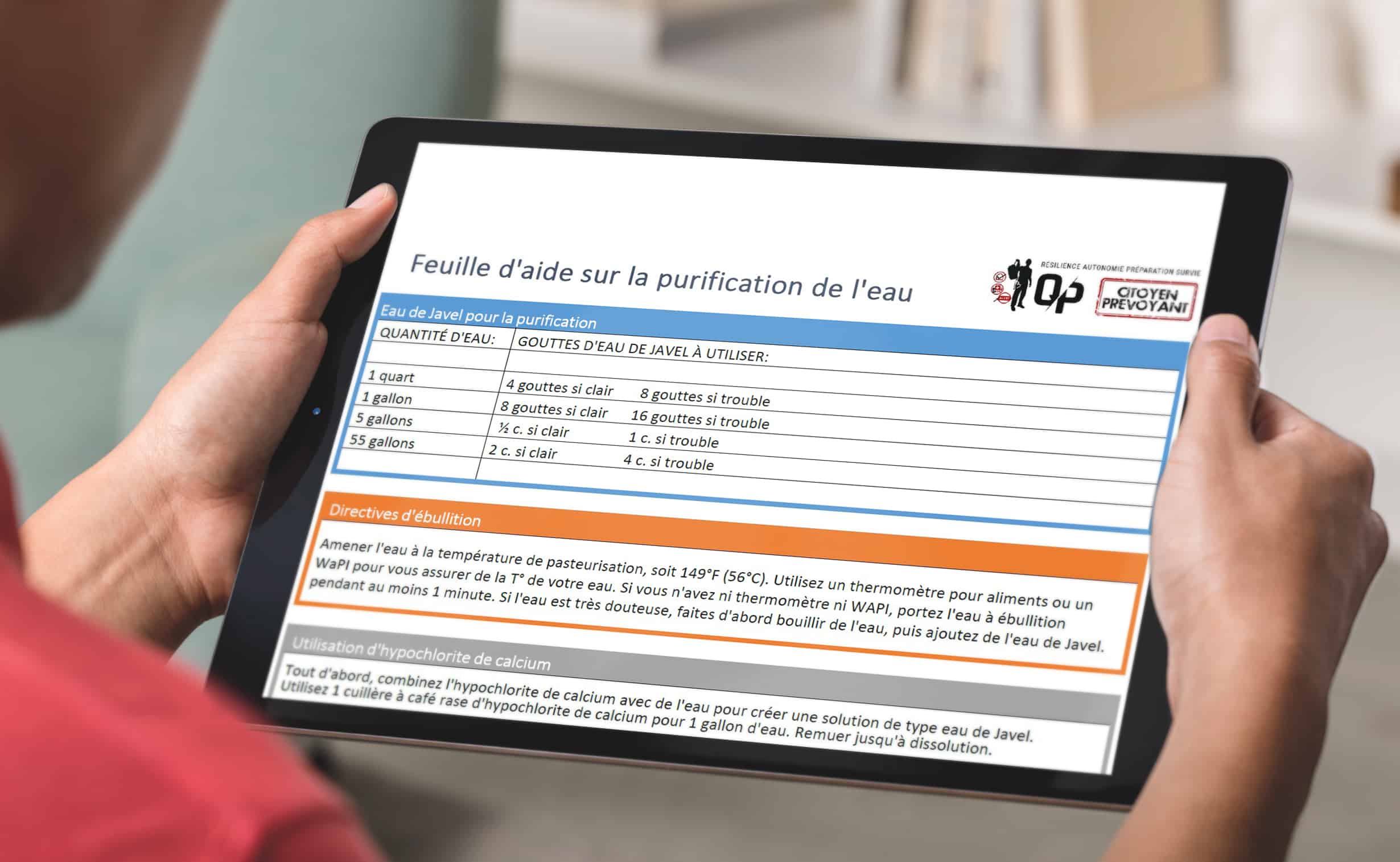
Chlorination: A protocol specific to the product and the risk; there is no universal formula.
- Identify a formulation that is explicitly appropriate for the intended use, along with its specified concentration. Fragrances, gels, and additives can render a product unsuitable for treating drinking water. Bleach intended for other purposes cannot simply be adapted for this use through basic mathematical proportioning.
- Official tables link dosage to concentration, water quality, and specific units of measurement; a "drop" is not a standardized volume across different dispensing devices. Follow the table applicable to the specific product being used; do not apply dosage guidelines intended for surface disinfection to water treatment.
- Turbid (cloudy) water may require settling and pre-filtration prior to disinfection, as well as other specific adjustments. Arbitrarily doubling a dose does not guarantee that water will become potable, especially if chemical contaminants are present.
- Adhere strictly to the prescribed mixing instructions, temperature, and contact time. A thirty-minute contact time does not guarantee the elimination of all pathogens in all types of water. If the protocol does not adequately address the specific risk, use a different method or source.
- A faint smell of chlorine is not proof of adequate disinfection. Odor, taste, and clarity are not reliable indicators of effectiveness or the absence of residual contaminants; do not taste the water to test whether the dosage is correct.
Effectiveness:
- Effectiveness against certain bacteria depends on specific conditions and the protocol used; no single method or checklist can guarantee safety for every real-world water source.
- ✅ Viruses: effective (sometimes requires a longer contact time)
- ⚠️ Protozoa: *Giardia* is vulnerable, but *Cryptosporidium* is highly resistant to chlorine
- ❌ Chemical contaminants: not removed
- ❌ Sediments: not removed
Advantages:
- Lightweight and compact (a few milliliters can treat liters of water)
- Shelf life varies by product and instructions; the concentration may decrease over time—long-term storage (months or years) is not guaranteed for every bottle.
- Inexpensive
- Does not require an energy source
Limitations:
- Chlorine taste and odor (unpleasant for some)
- Reduced effectiveness against *Cryptosporidium*
- Protocol wait time; this varies depending on the agent, the water, the temperature, and the specific product.
- Adhere to the manufacturer’s expiration date and storage guidelines; replacing the product annually does not compensate for improper storage or an unknown concentration.
- May create disinfection by-products if organic matter is present.
3. Purification tablets
Principle: Tablets containing disinfecting agents (chlorine, iodine, or chlorine dioxide).
Main types:
- Chlorine tablets: Similar to household bleach, with comparable effectiveness.
- Iodine tablets: Effective but have a strong taste; not recommended for pregnant women or individuals with thyroid conditions.
- Certain chlorine dioxide formulations can treat *Cryptosporidium* under specified conditions; taste and required wait times vary between different types of tablets.
Follow the specific product guidelines regarding dosage, water volume, and required wait time. Instructions such as "one tablet per liter" or wait times ranging from thirty minutes to four hours are examples of specific directions, not a universal standard. Do not split a tablet or alter the water volume without proper instructions.
Advantages:
- Pre-measured doses can simplify use, though they do not eliminate the risk of errors related to water volume, product selection, temperature, or wait time.
- Very compact and lightweight
- Long shelf life if packaging remains intact
- Chlorine dioxide is effective against *Cryptosporidium*
Limitations:
- Higher cost per liter compared to household bleach
- Requires a waiting period
- Does not remove chemical or physical contaminants
- Expiration date must be monitored
4. Mechanical filtration
Principle: Water passes through a filter medium with controlled pore sizes, which trap particles based on their dimensions.
Types of filters based on pore size:
- Microfiltration: Performance depends on the filter medium and the absolute pore size rating. A range of 0.1 to 10 microns does not guarantee the same level of reduction for bacteria and parasites; check the test results and the specific targets (pathogens).
- Ultrafiltration: A label or a specific pore size range is not, by itself, proof of sufficient viral reduction. Verify the performance of the specific system, its integrity, and the conditions for its use.
- Nanofiltration and reverse osmosis: Distinct technologies, each with its own capabilities and requirements regarding pressure and maintenance. A rating of 0.001 microns does not guarantee the removal of virtually everything; check which contaminants are addressed and look for relevant certification.
Filter formats:
Straw-style filters (e.g., LifeStraw):
- Some straw-style filters target bacteria and parasites but do not reduce viruses; The brand includes several product families. Identify the specific model rather than attributing a particular size or performance level to an entire product line.
- Capacity varies based on the cartridge, the water source, and operating conditions; the range of 1,000 to 4,000 liters does not apply to every product.
- Maintenance and replacement requirements vary by model: some components are replaceable, while others are not. Do not assume that no maintenance is required.
Pump-style filters:
- Allow for filtration into a container for later use.
- Flow rate depends on the model and the water source; pump-style filters are not inherently superior to straw-style filters.
- Cartridges are often replaceable.
- Tend to be bulkier and more expensive.
Gravity-fed filters:
- Intended for household use or stationary campsites.
- No pumping required—water is filtered via gravity.
- Slow flow rate, but capable of processing large volumes without physical effort.
- May be suitable for some households depending on flow rate, volume, types of contaminants, maintenance needs, and accessibility; not a universal solution for all families.
Effectiveness:
- Bacteria: Verify the validated reduction rate for the specific system; a pore size of ≤ 0.2 microns alone is not sufficient to draw conclusions about effectiveness.
- ✅ Protozoa: Highly effective (cysts are relatively large).
- Viruses: Require specific performance data and the conditions under which it was tested; terms like "ultrafiltration" or a stated pore size do not serve as a general guarantee of effectiveness.
- Chemical substances: certain media or systems reduce specific contaminants, sometimes including lead or other metals. Activated carbon does not remove everything, and the name alone is not sufficient to confirm or rule out any particular performance capability.
- Particulates and turbidity: reduction depends on the medium and its condition; there is no guarantee of complete removal, nor is it proof of potability.
Advantages:
- Immediate improvement in clarity and taste
- No added chemicals
- Some models can process large volumes
Limitations:
- Higher initial cost
- Requires cartridge replacement
- Can become clogged if the water is very turbid (pre-filtration recommended)
- Some models do not remove viruses
- Performance degrades with use—capacity is limited per filter
Important: read the specifications
Check the model, the specific contaminants targeted, the testing performed, and the applicable certification. The term "ultrafiltration" is not equivalent to a verified claim of virus reduction. If a specific risk is not covered, choose an additional, truly appropriate treatment method or a different water source; do not assume that combining any two devices will automatically provide sufficient protection. A leak or a damaged cartridge will also alter the outcome.
5. UV Disinfection
UV light can inactivate organisms by affecting their genetic material, provided the dosage and water quality are appropriate. Wavelengths and design vary by device; 254 nm is not a universal standard for all commercial systems.
Operation:
- Portable devices powered by disposable or rechargeable batteries
- Duration, volume, immersion depth, and movement requirements vary according to the model's instructions—do not assume a standard 60-to-90-second treatment time applies to all water types and devices.
- An indicator confirms certain cycle conditions; it does not perform an analysis of all contaminants and does not guarantee the absence of recontamination.
Effectiveness:
- ✅ Bacteria: highly effective
- ✅ Viruses: highly effective
- ✅ Protozoa: effective (including chlorine-resistant *Cryptosporidium*)
- ❌ Chemical contaminants: not removed
- ❌ Sediments: not removed (and turbidity reduces UV effectiveness—pre-filtration is necessary)
Advantages:
- Cycle time varies by model, volume, and condition; there is no universal duration.
- No chemicals used; no change in taste
- Effective against a broad spectrum of contaminants, including *Cryptosporidium*
- Compact and lightweight
Limitations:
- Dependent on electricity (requires maintenance of batteries or power cells)
- Requires relatively clear water (turbidity blocks UV light)
- Higher purchase cost
- Limited lifespan for the UV lamp (based on usage cycles)
- No residual protection (water can become recontaminated after treatment)
Combined approaches and multi-barrier strategy
Principle of redundancy
The logic behind a multi-barrier approach is to address identified risks using compatible treatment stages. Simply adding products at random is, by definition, not the best approach. A municipal water system incorporates controls that are absent in an improvised, home-built setup. Do not assume that validation for one system automatically applies to a simple combination of a filter and a purification tablet.
Examples to be verified based on the specific components and the water source
Filtration + chemical disinfection:
- The filter must provide the required performance against the targeted organisms or particles; its mere presence is not sufficient to guarantee this.
- The disinfection method must be appropriate for the remaining contaminants and the specific conditions; residual protection does not last indefinitely.
- Combining methods may reduce certain risks, but it cannot remediate chemical contamination, nor does it guarantee that the system has been assembled correctly.
Pre-filtration + boiling:
- Remove sediments first (this improves the efficiency of boiling and reduces the fouling of containers).
- Boiling eliminates biological pathogens.
- This requires a container, an energy source, and safe heating practices; even a well-known method cannot make chemically contaminated water safe for use.
Filtration + UV:
- Filtration removes turbidity (which is necessary for UV to be effective).
- UV provides rapid disinfection.
- Compatibility, water clarity, and proper operating cycles must be ensured; the mere availability of electricity does not validate the entire system.
Pre-filtration: an often-overlooked step
Removing certain particles can facilitate subsequent treatment, but it does not necessarily make all water treatable. Very murky or stagnant water can also present risks that cannot be resolved using a piece of fabric. Identify the source, and do not proceed if toxic contamination is known or suspected.
Pre-filtration techniques:
- Sedimentation: Let the water sit for several hours—heavy particles will settle to the bottom; carefully draw off the clear water from the top.
- Coarse filtration: Use a clean cloth, bandana, or coffee filter—this removes debris and visible particles.
- Coagulation-flocculation: This process requires specific agents, precise dosing, proper mixing, and a separation step. Do not add alum (aluminum sulfate) at home in an arbitrary manner. An approved kit must be used strictly according to its instructions; visual clarity does not guarantee that the water is disinfected or free of chemical residues.
Contexts for application
Municipal boil-water advisory
A local advisory should be reviewed with attention to its date and the affected area. Such advisories may be issued as a precautionary measure or in response to test results; there is no single, standard classification that applies to all situations experienced by residents of Quebec. The presence of an existing water treatment device does not automatically exempt one from the advisory.
Health Canada recommendation: Boil water (for 1 minute) if it is to be used for consumption, food preparation, making ice cubes, or brushing teeth.
Practical approach:
- Boil the water needed for the day each morning, and store it in clean, sealed containers.
- For hygiene and household tasks, follow the specific instructions provided in the advisory, along with any necessary personal precautions. A boil-water advisory does not grant permission to use water that is otherwise subject to a "do not consume" or "do not use" order. Take steps to prevent accidental ingestion, especially by young children.
- Duration: until the official notice is lifted; do not assume a timeframe of 24 to 72 hours, or anything less than a week.
Boiling is a reliable method for addressing microbiological concerns, but not everyone has access to a heat source, a suitable container, or the physical ability to perform this task. Plan for an alternative water supply and seek assistance if needed; a gravity-fed filtration device is not a substitute for the required boiling process.
Prolonged power outage
If a power outage affects municipal pumping or treatment stations.
Considerations:
- A power outage does not automatically make water unsafe after a fixed 24- to 72-hour reservoir period. Water systems and the impacts of outages vary. Follow your water utility’s instructions instead of calculating your own deadline.
- Official notices issued — follow municipal instructions.
- The safe use of gas-powered appliances depends on proper installation and adequate venting; do not use them if essential ventilation systems are not functioning. Never use camping stoves or barbecues in an enclosed space to boil water.
- If boiling is not possible, use an alternative safe water source or solutions specifically approved by the authorities for the situation at hand. Not all filters or purification tablets are suitable substitutes.
- Pre-existing water reserves become highly valuable.
Outdoor activities (camping, hiking).
Situations requiring the treatment of water from natural sources (lakes, rivers, streams).
- Moving water does not guarantee a safer source; assess potential activities and contaminants—do not rely on appearance alone.
- Being upstream may reduce exposure to certain pollutants, but it does not guarantee the absence of animals, contamination, or dissolved substances.
- Avoid areas near livestock, dwellings, or roads.
- Even crystal-clear water may contain *Giardia* or bacteria—always treat it.
Preferred methods:
- Portable filters (straw-style or pump)—fast and convenient.
- Purification tablets—a lightweight backup.
- Boiling (if a campfire is available)—though this consumes fuel.
- Filters and tablets do not provide absolute, universal safety; verify the specific pathogens they target, compatibility, required treatment time, and chemical limitations.
Emergency evacuation.
Situations requiring a rapid departure from home with limited gear.
Priorities for an evacuation (go-bag):
- Lightweight and compact: straw-style filters + purification tablets.
- Consider energy needs and the possibility of equipment failure. A UV purification device may be suitable as part of a well-thought-out plan, but it should not be the sole resource unless it offers sufficient independent operational capacity.
- Ease of use under stress
- Adjusting reserves and access to supplies: 72 hours is not a guaranteed standard timeframe before the arrival of aid or distribution efforts.
Water storage: an essential supplement
Recommended quantities
The PrépaCivile planning scenario allocates two liters per person per day for drinking, plus an additional two liters for food preparation and basic hygiene. Official guidelines may list these uses separately. Adjust these amounts based on the individuals involved, physical exertion levels, and heat—consult a professional if necessary. This is not a medical prescription, nor does it account for all household water needs.
Realistic planning for a family of four:
- Three days for four people, based on the 4-liter-per-person scenario: 48 liters, weighing approximately 48 kg (excluding the weight of the containers).
- Seven days for four people: 112 liters, based on the same scenario—though this does not guarantee comfort, and requirements may vary from one household to another.
- Fourteen days for four people: 224 liters; consider factors such as available space, weight limits, accessibility, and the need for water replenishment.
These volumes do not cover showers, laundry, or all other potential uses. Wet wipes and hand sanitizer cannot fully replace water or standard washing practices. Account separately for medical needs, infants, and pets; also consider potential external aid or public distribution points if your storage capacity is limited.
Storage methods
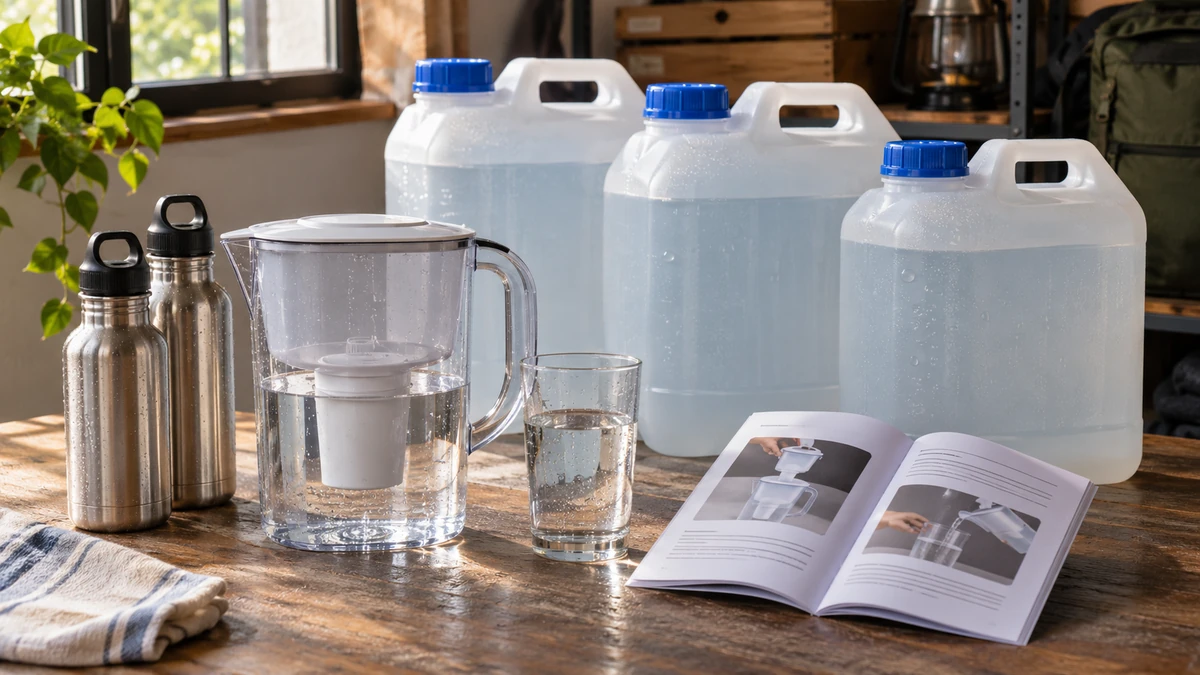
Commercial containers:
- Food-grade containers (5–20 liters) specifically designed for drinking water.
- Verify that the material is food-safe; check the seal, storage conditions, and weight capacity—not all containers are stackable or suitable for every type of use.
- Moderate cost; available at hardware stores and camping supply shops.
Reusing containers:
- Only reuse containers intended for food; never use containers that held chemicals. The design and cleanliness of a container must be suitable for storage—do not assume that just any beverage bottle can be safely reused for long-term storage.
- Clean and rinse thoroughly before filling.
- Avoid containers that previously held milk or non-food products.
- Free, but each container has limited capacity.
Large-capacity tanks:
- Large tanks (100–200L+) for long-term storage.
- Check temperature, floor load capacity, watertightness, cleanliness, and accessibility; a garage or basement is not automatically a suitable location.
- Requires a larger investment, but offers substantial capacity.
Rotation and maintenance
Shelf life:
For water filled at home, follow proper cleaning and replacement procedures. The CDC, for instance, recommends replacing stored water every six months. A timeframe of six months to a year is not a universal guarantee; the date, the type of container, and how it has been handled all matter. Furthermore, the absence of a noticeable chlorine smell is not a reliable indicator of safety.
Rotation practices:
- Label containers with the date they were filled.
- Plan for replacement according to your chosen schedule, and inspect the containers if they have been damaged or exposed to unusual conditions. Do not substitute an annual cycle for a shorter recommended interval.
- Incorporate into your routine: use stored water for tasks like watering plants or household cleaning, then refill the container.
- Check the condition and cleanliness of containers during routine inspections and after any incident; water may appear clear yet still be contaminated, even in the absence of visible cracks or other signs.
Treating water stored for long periods:
Do not rely on adding a drop or two of bleach per liter as a universal preservative to extend storage beyond one year without rotating the supply. This approach has not been validated in terms of concentration, water quality, or storage conditions. The presence of a chlorine odor does not guarantee microbiological stability. Instead, ensure the water is replaced periodically, or use a product specifically designed for this purpose—following the manufacturer’s instructions—rather than attempting to arbitrarily extend the shelf life.
Common mistakes and misconceptions
Mistake #1: “Clear water is safe”
Visual clarity does not indicate the absence of biological contaminants. Bacteria, viruses, and even certain parasites are invisible to the naked eye. Crystal-clear river water, for instance, may contain *Giardia*.
Principle: Always treat water from natural sources, even if it appears pure.
Mistake #2: “More disinfectant means safer water”
Overdosing can be harmful, not just unpleasant. Furthermore, increasing the dosage will not make an unsuitable product or protocol safe. Do not adjust the amount based on smell or taste, and never mix different disinfectants in an attempt to enhance their effectiveness.
Principle: Follow recommended dosages. Safety is achieved through the correct dose AND sufficient contact time—not by using an excessive amount.
Mistake #3: “My filter removes everything.”
Many portable filters (such as LifeStraw-style devices) remove bacteria and protozoa, but NOT viruses (which are too small). If contamination by human sewage is possible, filtration alone is insufficient.
Principle: Know the precise specifications of your equipment. Combine methods if necessary.
Mistake #4: “Boiling destroys everything.”
Boiling eliminates biological pathogens, but it does not remove chemical contaminants (such as heavy metals, pesticides, or nitrates). In some cases, evaporation can even concentrate chemical contaminants.
If chemical contamination is suspected, follow official guidance and seek an alternative, safe water source. Activated carbon is not a universal remedy for metals, nitrates, pesticides, or fuels. Addressing specific contaminants may require laboratory analysis and specialized equipment; do not rely on an unsuitable filter—find another source instead.
Mistake #5: “I don’t need purification; I’ll just buy bottled water.”
Retailers may run out of water or become inaccessible—and water is often one of the first items to disappear from shelves. Maintaining a reserve supply and knowing where to source water helps reduce dependence on last-minute purchases. If you lack the means to do this, your preparedness plan should include arrangements for receiving aid or accessing water distribution services.
Principle: Pre-existing stockpiles + the ability to treat available water = greater resilience than relying solely on commercial supply.
Limitations and acknowledgment of uncertainty
What this article does not cover
- Complex chemical contamination: Scenarios involving major industrial contamination require specialized expertise—the citizen-level methods described here are insufficient.
- Radiological contamination: Requires specialized equipment and protocols beyond the reach of individual citizens.
- Brackish or saline water: Desalination requires sophisticated equipment (high-pressure reverse osmosis)—outside the scope of this article.
- Specific medical needs: Dialysis, preparation of infant formula in a medical context—consult healthcare professionals.
When citizen-level methods are insufficient
Certain situations exceed the purification capabilities available to individuals:
- Known contamination by concentrated industrial chemicals.
- Oil or hydrocarbon spills.
- Industrial disaster zones (Chernobyl, Fukushima, major chemical spills).
- Water with a pronounced chemical taste or odor (indicating potentially dangerous contamination).
Unsafe water does not automatically mean the entire area must be evacuated. Authorities may advise using an alternative source or impose usage restrictions; follow these instructions and report your needs. Do not attempt to treat water contaminated with fuel using microbiological purification methods, and do not embark on a dangerous journey simply because the tap water is under a warning notice.
Honesty Regarding Uncertainty
Even with the best methods and equipment, a residual level of uncertainty always remains when individuals purify their own water. Professional municipal systems benefit from laboratories, regular testing, and multiple quality controls. In contrast, an individual treating water often does so "blindly," without any analytical confirmation.
This uncertainty is not necessarily acceptable, even for a short period—a single contaminant can pose an immediate risk. Long-term, private water treatment setups can also be safe, provided they include proper analysis, treatment, and monitoring. The key criterion is that risks are managed and verified; it is not merely a matter of duration, nor is it a simple conflict between the individual and the municipal system. Seek professional advice if the water source or your available equipment makes it impossible to follow safety guidelines.
Examples of equipment to be selected based on specific needs
Below is a selection of equipment designed for various usage scenarios—ranging from lightweight, portable options for outdoor activities to household systems for families.
🥤 LifeStraw — Filter straw
LifeStraw offers a variety of filters and purifiers. For a personal straw, verify the specific model, the target organisms, and its effectiveness against viruses; do not assume that a 4,000-liter capacity applies to the entire product line. Follow all instructions regarding maintenance, storage, and checks following freezing or potential damage—do not assume that "no maintenance required" applies universally. Microbiological claims do not extend to all dissolved substances.
💧 Purification Tablets
While purification tablets can simplify transport and dosing, they are not foolproof. You must strictly adhere to the specified water volume, temperature, contact time, and target pathogens. Individuals sensitive to iodine should avoid iodine-based products; do not assume that contact times or shelf-life specifications apply across all types of tablets. If a product does not address a specific risk, ensure you have an alternative solution available.
🔦 SteriPen UV Purifier
SteriPen encompasses a range of UV devices, each with its own specific volume capacity, treatment cycle, and power requirements. Always check the specific model and user manual—do not assume a standard 60-to-90-second treatment time for every device. Water clarity, device integrity, and completion of the full treatment cycle are essential; UV light does not remove chemicals or particulate matter. A fully charged battery does not negate the need to follow all other operational requirements.
🚰 Gravity-Fed Water Filter
A gravity-fed system can process an appropriate volume of water, provided it is rated for the specific water source and the contaminants present. A 10-to-20-liter reservoir does not guarantee a sufficient flow rate, nor does it necessarily satisfy the requirements of a "boil water" advisory. Some filter cartridges are designed only to improve taste or target specific contaminants. Verify replacement, cleaning, and performance requirements; do not assume that any given household filter is an ideal solution for a family.
Note on product recommendations
Distinguish between a standard, a test protocol, a model certification, and a commercial claim. NSF/ANSI 53 targets specific contaminant reductions; it does not guarantee complete microbiological purification. NSF P231 is a protocol for microbiological purifiers, not an EPA certification for the entire product line. Always check the specific model’s data sheet to see which contaminants are actually covered, as well as any limitations on use.
Conclusion: proportionate preparedness
In Quebec and Canada, drinking water is generally of very high quality and safe. Situations requiring individual water purification are the exception, not the rule. However, such exceptions do occur—boil-water advisories, utility outages, outdoor activities, or, more rarely, emergency situations.
Reasonable preparedness in this area involves:
- Knowledge: Understanding the basic principles of purification and the limitations of each method.
- Reserves: Based on a scenario of 4 liters per person per day, a three-to-seven-day supply for four people would amount to 48–112 liters—though this is an estimate and does not guarantee it will meet all needs.
- Means: The ability to safely heat water (if possible), or access to alternative water sources and external assistance. Not all kitchens can boil water during a power outage, and a simple filter is not a universal solution.
- Complementary solutions tailored to specific risks and available resources; there is no requirement to stock multiple devices for every single function.
Initial steps may be modest, but water, containers, storage, and treatment methods all come with real constraints regarding cost and accessibility. A household or an individual may require assistance. Do not suggest that proper preparation requires neither space nor investment; instead, determine priorities and the type of support needed based on the specific household.
The goal may be to meet certain needs during a service disruption, with the possibility of replenishment or external aid. A sustainable private water supply also requires appropriate monitoring and treatment: simply having a well or a rainwater collection system does not guarantee self-sufficiency or potability. Health and hygiene should not rely on a single technique or an assumed duration for an outage.
The best preparation combines practical knowledge with appropriate, essential equipment, while maintaining a realistic perspective on what can be managed at the individual level versus what requires professional or institutional resources.
Have you ever had to treat your water—for example, during a "boil water" advisory or while camping? What method did you use? What challenges did you encounter? Practical experience helps identify what actually works within one’s own specific context.
Frequently Asked Questions
Q: How long can one survive without water?
There is no universal, safe time limit for going without water. Figures such as three, five, or seven days—or twenty-four to forty-eight hours—vary depending on the individual and the conditions; they should not be used to determine how long one can wait. Factors such as fatigue, heat, physical exertion, illness, and certain medical treatments alter hydration needs. Prioritizing adequate fluid intake, ensuring a supply of safe water, and seeking assistance before one’s condition deteriorates are far more important than tracking a countdown. If you are under medical restrictions regarding fluid intake, consult a professional; furthermore, concerning symptoms should never be managed simply by calculating the percentage of body weight lost.
Q: Can I drink water directly from a lake or river while camping?
Never consume water from a natural source without first assessing the risks and applying appropriate treatment. Clear water, a spring emerging from rock, or a location that appears pristine are not guarantees of safety. Animals and human activity upstream are not the only potential sources of contamination. Filtration, disinfection, and boiling are not equally effective against all types of contaminants; if a toxic substance is known or suspected to be present, seek an alternative water source. Plan your water supply points before heading out, and always account for the possibility that they may be unavailable—do not assume that a lack of past illness is proof that a source is safe.
Q: Is household bleach truly safe for purifying water?
Certain emergency guidelines specify the use of a particular type of bleach for specific water sources and risk levels. This does not mean that just any bottle of bleach is safe to use—nor that adding two drops per liter is a universal solution. The product’s concentration, its specific formulation, the precise dosage, the quality of the water, the temperature, and the contact time must all align with the established protocol. The theoretical amount of chlorine added is not necessarily the same as the measured residual free chlorine; some is consumed by the water itself and by any matter present. Do not assume that a calculated figure—such as "five ppm"—guarantees safety or the absence of toxicological risk. The presence of an odor is not proof that disinfection has occurred, and products that are scented, thickened, or intended for other purposes should never be used as substitutes.
Q: My portable filter claims to "remove 99.9% of bacteria"—are the remaining 0.1% dangerous?
A 99.9% reduction mathematically represents a factor of one thousand; for example, one million organisms would be reduced to one thousand, assuming that exact reduction rate applies under the given conditions. This does not mean the survivors are harmless; the infectious dose varies significantly depending on the specific pathogen and the individual. Some infections can occur even with a small number of organisms, and having a healthy immune system is no guarantee of safety. Testing protocols are based on specific pathogens and conditions. The NSF/ANSI 53 standard does not, by itself, cover all bacteria and viruses; P231 is a different protocol. Always check the certified performance specifications for your specific model, and do not assume the risk is acceptable based solely on a percentage used for marketing purposes.
Q: How long does boiled water remain safe to drink?
Storing water after it has been boiled can lead to recontamination. There is no universal rule—such as a three-to-seven-day window at room temperature—that guarantees safety. Use a clean, suitable, and sealed container, avoid contamination through contact, and follow local storage guidelines (refrigeration is recommended whenever possible). Prepare only a reasonable amount at a time and note the date. The absence of odor, cloudiness, or a surface film does not mean the water is safe; contamination can often be invisible.
Q: What is the best purification system for a family?
A gravity filter combined with boiling is not automatically suitable for most emergency situations, particularly chemical contamination. Straw filters, pumps and UV devices each have limitations; compare identified models rather than formats alone. A family kit is not guaranteed to cost $100 to $300. Read the manuals, practise safely and plan for assistance to establish what you can actually use. Keep another safe water supply available if the treatment method is unsuitable.
Additional Resources
Official Canadian Organizations
- Health Canada — Guidelines for Canadian Drinking Water Quality: canada.ca/drinking-water
- Public Safety Canada — Get Prepared (water section): getprepared.gc.ca
- Institut national de santé publique du Québec (National Institute of Public Health of Quebec) — Water Quality
- Canadian Red Cross — Emergency Preparedness Resources
Equipment Standards and Certifications
- NSF: Standards and protocols for specific models—such as NSF/ANSI 53 and NSF P231—which address particular performance claims; note that these should not be broadly attributed to the EPA.
- EPA (United States) — Guide to Drinking Water Treatment Technologies
- WHO — Guidelines for Drinking Water Quality
Further Reading
- Health Canada, “Emergency Preparedness Guide for Households” (free official guide)
- CDC, “A Guide to Water Filters” (technical yet accessible)
- WHO, “Household Water Treatment and Safe Storage” (international context)
Final Note
This overview is intended to support concrete decision-making: reading official advisories, identifying risks, verifying treatment processes, and ensuring a safe water supply. Trusting public utility networks does not negate the need for proactive preparedness, yet the existence of a real risk does not justify generalized fear. Those facing long-term challenges also require collective, professional solutions. Effective preparedness acknowledges the limitations of equipment and available resources, without implying that water is safe to drink simply based on its appearance, taste, or the application of basic treatment methods.
Going Further
The provided resources and links allow for a deeper exploration of criteria, official advisories, and original technical documentation. Tables, checklists, or maintenance guides are only included as downloadable files if the original source is verified and available. No PDF files are recreated to replace broken links, and older resources remain dated to reflect their inherent limitations.
This section does not function as a submission form. To suggest a resource or ask a question, please use the “Contribute to this article” option; all submissions are reviewed before being integrated.
Primary verification references
Equipment to compare for your needs
Some links below are affiliate links: we may receive a commission at no additional cost to you. Products are examples by function, to choose according to your needs; buying the entire selection is unnecessary.