
In this article
Summers in Quebec can be hot—very hot—and when the heat sets in, there is nothing more satisfying than a tall glass of cold water.
Adding a manual pump to a well can provide emergency access, provided the setup is compatible. This account does not represent an actual installation performed or a test verified by PrépaCivile. While a pump may be a practical solution in certain configurations, factors such as the specific model, water quality, freezing conditions, the physical effort required, and ongoing maintenance must be carefully considered before making a purchase.
It is important to distinguish between the total depth of the borehole and the vertical distance to the water level—both when the water is at rest and while pumping is underway. A surface-mounted suction pump has a limited suction lift, typically rated at around 20 to 25 feet, depending on the configuration. If the water level is at 250 feet, a different system is required, involving a cylinder placed down inside the well.
Ease of assembly cannot be judged solely by the number of parts. You must verify dimensions, existing piping, sanitary sealing, and lifting capacity, while also ensuring compliance with local requirements. The linked installation guide helps clarify these issues, but it is not a substitute for the manufacturer’s manual or the professional expertise required to work on a well. Consult the verification guide before installing a hand-operated pump on a well.
This ranking is neither an independent comparative test nor an exhaustive, up-to-date analysis of all products currently on the market. Some entries do not refer to a specific, exact model; They must be evaluated before making a purchase. Reviews and videos are not sufficient to establish performance, durability, or compliance with drinking water standards.
Options mentioned: compare after identifying the specific model.
Hand-operated pump for shallow wells.
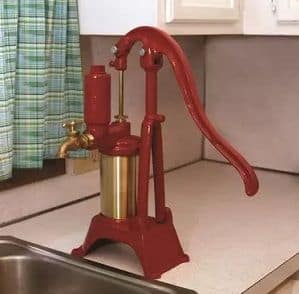
Pressurized sealed water pump.
The pressurized sealed water pump mentioned claimed a suction depth of up to twenty feet. This is not a guaranteed limit for every product bearing this name. Actual lift, system losses, dynamic water level, and the instruction manual must be verified.
The material alone does not guarantee potability or longevity. Identify the specific product and its capacity (in gallons) before making a comparison.
Check on Lehmans.
Deep-well hand pump.
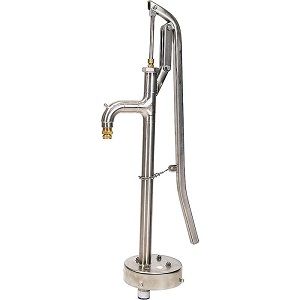
Stainless steel deep-well pump.
These two values should not be assumed to occur simultaneously. For the current "Bison Standard" model, the manufacturer distinguishes between head (lift) options and water-level conditions; you should request the specific configuration and flow rate for your well, rather than relying on a general maximum figure.
Check on Lehmans.
Pressurized, sealed water pump: specific model to be identified.
Brass and cast iron are mentioned as materials, but there is no evidence that they offer twice the lifespan of standard iron in every installation. Factors such as corrosion, water chemistry, seals, and maintenance will affect the outcome. Aesthetic appeal is not an indicator of sanitary quality. Treat this option as a specific reference point rather than a universally superior choice.
Check pricing at Lehmans.
A pitcher pump may require a specific priming procedure unique to the model. The fact that the design is traditional does not validate a specific modern product, nor does it guarantee an easy installation. Read the instructions and ensure you have a safe source of priming water if required; never introduce questionable water into a well used for drinking.
The 1¼-inch connection and the 20-foot lift height must be verified for the specific pump model. The physical effort required and the resulting flow rate depend on the total lift, system losses, and the pumping pace; 15 feet is not a universal threshold for "high effort." Also, consider the physical capabilities of the person who will actually be operating the pump, and whether they might require assistance.
Do not assume that these characteristics apply to all models in this category; furthermore, the existence of a warranty does not imply that the unit is maintenance-free or that replacement parts will always be available.
Check on Lehmans.
Cincinnati Gem Chain Pump: a chain-driven pump, distinct from a suction pump.
A chain pump uses elements driven through a tube to lift water. This operates on a different principle than a suction pump; historical usage alone does not validate a modern-day installation. Water quality, sanitary protection, and installation conditions must still be verified.
Check pricing at Lehmans.
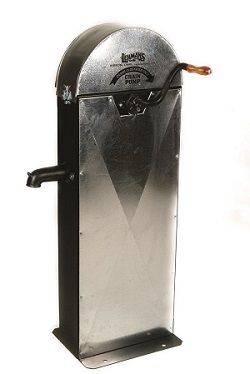
Lehman offers the Cincinnati Gem for vertical lifts of up to thirty feet, utilizing a specialized chain and corresponding elements. The stated flow rate depends on the specific configuration and the effort applied; a commercial claim regarding the ability to fill a bucket does not guarantee the well’s actual yield or the water’s suitability for drinking. Always verify the assembly, dimensions, and materials before making comparisons.
The product documentation specifies that the chain, chain elements, and downpipe are not all included. Therefore, the total cost—covering all components, shipping, and maintenance—must be evaluated for the complete installation. No price ranking relative to other pumps can be guaranteed without current, comparable offers.
Check on Lehmans.
TBVECHI: verify the specific model and actual suction lift height.
A marketed depth for a TBVECHI suction pump is not a guaranteed practical suction lift. Atmospheric pressure, altitude and losses impose limits. Identify the model and obtain its curve or manual; distinguish well depth from actual lift.
Check prices on Amazon.
Do not preemptively replace a screw (or any other part) based solely on a reported defect, without first conducting a proper, verified test. Fasteners and materials are factors in both safety and warranty coverage. In the event of an issue, consult the manufacturer and use the specified parts; do not modify a pump without first identifying the model and the function of each fastener.
Verify the component, whether priming is required, and the availability of consumables. A lower price does not necessarily imply a higher maintenance frequency or a lack of suitability for potable water; such criteria must be documented.
Without an exact model, an instruction manual, and verified operating data, an option cannot be deemed effective as a backup, nor can its overall quality be assessed. Including it in a comparison helps clarify what information must be obtained prior to purchase: actual lift height, flow rate, available parts, regulatory compliance, and return policy.
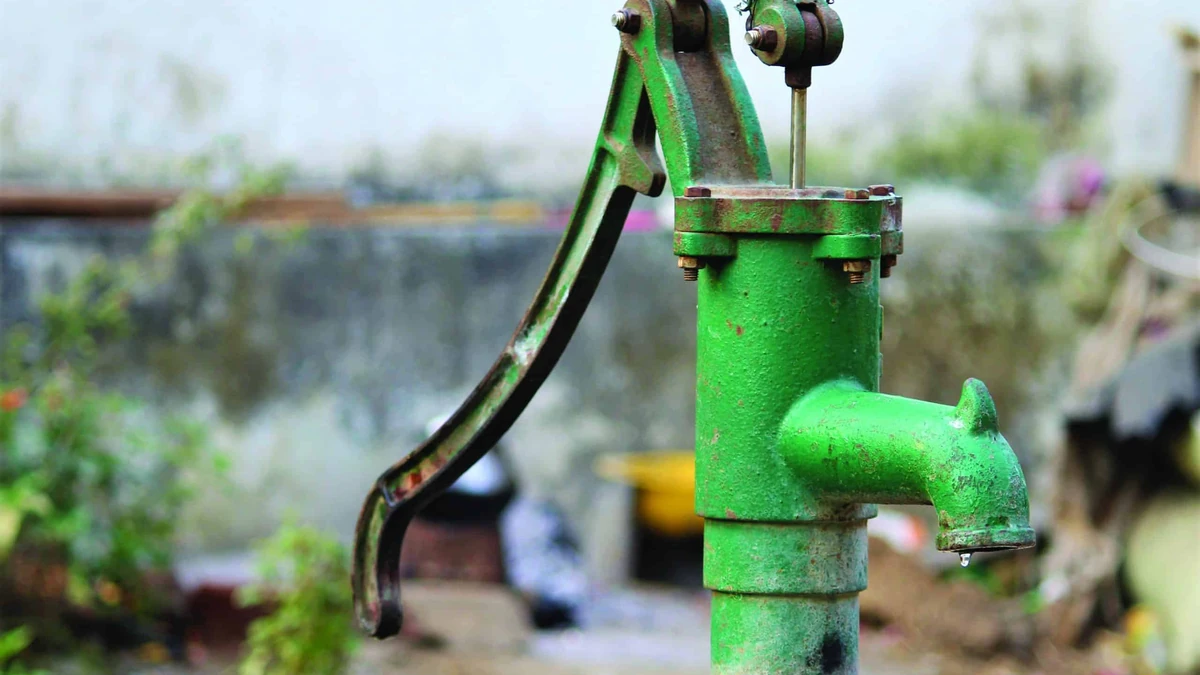
"Green hand pump": a generic term, insufficient for making a purchase.
Neither a specific color nor a traditional shape defines a product. The cited 25-foot lift height must be confirmed in relation to the specific configuration and the dynamic water level. Cisterns and wells present different risks and access requirements; technical functionality does not guarantee that the water is safe for drinking.
Cast iron and aluminum do not guarantee durability, ease of repair, or suitability for contact with potable water. Identify the individual components and their relevant certifications. Examine the seals, assembly, and parts rather than assuming that a traditional appearance equates to reliability.
Check pricing at Lehmans.
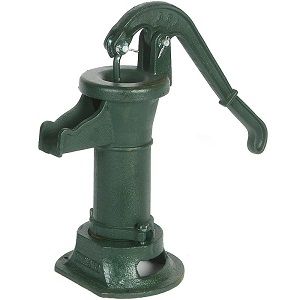
A 1¼-inch connection and a maximum flow rate of five gallons per minute do not indicate the effective flow rate at any given depth. Always confirm the availability and cost of replacement parts. There is no single "standard" flow rate for a residence; factors such as usage patterns, the number of occupants, water pressure, and well capacity all play a role.
Check on Lehmans.
Bison shallow-well pumps: distinguish between specific models and their respective winterization requirements.
For any specific model under consideration, verify the performance specifications against your actual operating conditions and the equipment being used. The manufacturer distinguishes between suction-style (shallow-well) pumps and deep-well systems; the product line should not be characterized as a "one-size-fits-all" solution for every application.
Check prices on Amazon.
Installing a backup pump alongside an existing system requires adequate space, as well as mechanical and sanitary compatibility. A Bison shallow-well pump can freeze if not properly winterized—it is not inherently frost-proof. Suitability for use depends on the specific product specifications and local conditions. Do not assume that the presence of stainless steel or brass fittings guarantees the absence of lead or regulatory compliance; always verify with the appropriate documentation.
Review the warranty and maintenance requirements specific to the model and your region. While a comprehensive manual assists with installation, it does not necessarily make the process simple. The right choice depends on your specific needs, pumping capacity requirements, and total costs; a brand’s reputation alone is not sufficient to declare a particular option the "best" choice.
Bison Deep Well: configuration based on water level and pump head
For its "Standard Deep Well" model, Bison offers a standard configuration for static water levels of up to 250 feet, and a "Heavy Duty" option capable of reaching up to 300 feet under specified conditions. These are the manufacturer’s specifications, not the result of testing by PrépaCivile. A deep-well pump should not be selected based solely on the total depth of the borehole or the reputation of a high-end brand.
The deeper the static water level, the more difficult it becomes to pump; therefore, if you intend to draw water from a depth of 200 feet or more, be prepared to put some muscle into the process.
Check pricing at Lehmans.

A system can be designed to operate without priming and can be configured to provide pressurized water using the appropriate accessories. It is not "virtually unbreakable," nor is it necessarily capable of supplying any type of storage tank. Always verify pressure ratings, fittings, check valves, and local regulations before connecting the system to a building. A standard garden hose does not automatically constitute a safe or appropriate water supply line.
Freeze protection depends on proper draining and installation as described in the manufacturer’s manual; it does not imply an "all-weather" guarantee. Long sections of piping may require mechanical lifting equipment. Always refer to the original documentation—do not replace a missing manual with a recreated PDF, and do not assume that procedures from a different version of the product apply to your specific unit.
A suitable hand pump can serve as a backup resource; however, it is not a definitive indicator of preparedness, nor is it a mandatory requirement for everyone living off-grid.
Check on Lehmans.
Double-action pump: deep-well model to be identified
Depending on the internal mechanism, a double-action pump—which operates on both the upstroke and downstroke—may affect the consistency of the water flow. The item is neither among the most popular nor is it universally easy to use. Identifying the necessary head, cylinder, and accessories requires considering the specific performance requirements and the operator’s capabilities.
Check pricing at Lehmans.
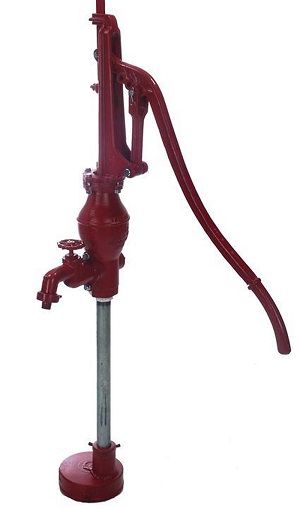
Adapting the unit for use with a wind turbine or at varying depths requires components that are explicitly compatible, as well as an appropriate design. A theoretical possibility does not constitute authorization to combine such equipment. Consult the manufacturer and the installer before modifying any drive mechanism or operating system.
Although less expensive than the Bison pump, this model requires additional parts before it is ready for installation. These include a pump cylinder, piping, and a pump rod; consequently, the total cost may end up being roughly the same as that of the premium stainless-steel model from Bison.
Agricultural profitability depends on usage, capacity, costs, and maintenance; it is not determined by assumed versatility. Livestock farming or continuous operations may require a flow rate and level of oversight that manual pumping cannot realistically provide.
Check on Lehmans.
Windmill pump head: check the complete system.
A single unit may have various configurations, but a surface-mounted head cannot simply be converted into a deep-well system. The cylinder, rods, and piping define the function. Without an exact model and schematic, do not compare its reach to that of a "Bison" pump, nor assume that the unit arrives ready for immediate installation into the well.
Check pricing at Lehmans.
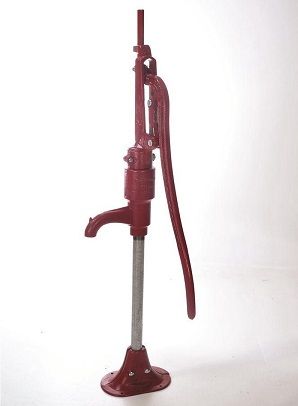
Adding a foot valve alone will not enable a surface suction pump to increase its suction depth from twenty to one hundred feet. A deep-well configuration requires specific mechanisms and components to be installed underwater.
Always verify that the package contents match the requested model and depth specifications. A pump head, a cylinder, and a length of pipe may not be sufficient for your specific site. Do not gauge the durability of a system solely based on the materials listed; also consider the consumable parts and the intended operating conditions.
Although designed as a standalone hand pump, opting for the slightly more expensive 6-inch offset well cap allows you to install this hand pump alongside your existing electric pump for emergency use.
This product is not guaranteed for all-weather use, nor is it fully freeze-resistant. Always check the requirements for draining, frost depth, maintenance, and the specific limitations of each model. Improper winterization can damage components and prevent access when the pump is needed most. provide for a reserve or another reliable source of supply.
Check on Lehmans.
Why do you need a backup hand pump?
If you rely on a private system for all your washing, cooking, and drinking water, it means you are also dependent on electricity.
A solar-powered system depends on its design, storage capacity, energy availability, and consumption levels. A cloudy month does not automatically lead to a water shortage. Assessing these actual dependencies helps in choosing an appropriate backup—whether manual or otherwise—rather than assuming a system failure based solely on the weather.
A hand pump can reduce electrical dependency in a specific setup, though it does not safeguard the water supply against every possible disaster. It remains dependent on the well itself, the water level, the physical capabilities of the user, the integrity of the system, and the quality of the water. It is better to plan for a reserve supply and alternative assistance in case the pump becomes unusable, rather than viewing it as an infallible, all-encompassing solution.
The most common type of hand pump is a manual suction pump, which uses suction to draw water from a well.
The practical suction lift is limited and varies based on the equipment, altitude, system losses, and the water level during pumping; twenty-two feet is not a universal constant. For deep wells, a specialized pumping mechanism is placed below the water level to lift the water to the surface. Sizing must account for actual operating conditions, not just a static measurement taken while the system is at rest.
Suction pumps tend to be less expensive than hand pumps designed for deep wells, and they are also easier and cheaper to install.
Most submersible deep-well pumps have heavy components that require professional installation.
What you need to know when buying a hand-operated pump
The following information is crucial for purchasing the right pump for your needs:
Usage
Do you intend to use your hand-operated well pump as a backup for a motorized well pump, or do you plan to use it as your primary or sole water source?
Pump flow rate
Evaluate your daily volume requirements, the physical effort involved, frequency of use, and specific applications, in relation to the well’s available flow rate. Five gallons per minute is not a universal requirement for a household; also, be sure to specify whether you are referring to U.S. or Imperial gallons. If the pump is intended for livestock or high-demand activities, manual pumping may be unsuitable, regardless of the stated maximum flow rate.
Well depth
You should know the total depth, static water level, drawdown during pumping, casing details, and the presence of any obstacles or existing pipes. A static water level alone does not guarantee that the pump will function when the water level drops. Have the configuration and safety margins confirmed by the supplier or a qualified installer; do not attempt to open or probe a well yourself, especially with an unclean object.
The terms "shallow" and "deep" can be used inconsistently in product listings. Rather than assuming that many sellers misclassify their products, verify the actual design and the required lift height. No accessory or well-depth figure can overcome the physical limitations of surface-suction pumping.
Do hand pumps require priming?
Priming requirements depend on the mechanism; a suction pump and a submerged-cylinder pump operate differently. Do not assume that most products require priming, nor that an entire brand’s product line is either self-priming or non-self-priming. Consult the manual for your specific system, and check sanitary requirements if water needs to be added.
Even if your chosen pump requires priming, it is not a significant issue and only takes a few minutes.
How do you prime a pitcher pump?
For a pitcher pump that requires priming, follow the instructions in the manual regarding the volume of water, the method, and the required wait time, using water of appropriate quality. Filling the pump up to the spout or waiting five minutes are not universal instructions. Do not operate the pump while dry, and do not force any seals without fully understanding the system's configuration. A problem may also stem from an air leak or the water level, requiring a proper diagnosis.
What are the drawbacks of manual pumping?
Even a high-end pump requires significant muscular effort to draw water; you must therefore be prepared to invest the necessary time and energy.
A pump extracts water; it does not make it potable. Water drawn directly from a well may bypass standard treatment processes. Have the water analyzed, select a treatment method based on the contaminants present, and ensure appropriate installation and maintenance. A household filter does not eliminate all risks, nor does it make it safe to drink brackish or contaminated water.
These systems require monitoring of their components and the condition of the well. Commercial-grade quality or a warranty does not negate the need for maintenance or the eventual exhaustion of consumable parts. Keep track of product references and contact information, and perform inspections after any work or significant events—do not assume that repairs can always be carried out on-site.
At what depth will a hand pump function?
The accessible depth depends on the entire system and the actual water level. The Bison pump mentioned, for example, offers various head and cylinder configurations. Request the specific data for your setup rather than assuming compatibility based solely on a general pump category.
Can a hand pump operate in freezing temperatures?
Protection against freezing depends on the specific model, installation, drainage, and usage. Even a "high-quality" pump will not function in all weather conditions without proper precautions. Review the exclusions, and ensure you have an alternative water source available if the device cannot be used or maintained during the winter.
Is it worth buying a budget-friendly hand pump?
While it may be tempting to opt for a cheaper model, such units often require regular maintenance—making them both time-consuming and more expensive in the long run.
It makes more sense to invest in a high-quality pump that comes with a decent warranty, rather than wasting time installing an inferior model that you end up having to drain, prime, and repair instead of actually using.
Stainless steel alone does not guarantee reliability, and modifying a budget model will not automatically extend its lifespan. The components, seals, and certifications must all be appropriate for the intended use. Before purchasing, consider the total cost, the level of service required, and your actual needs—and avoid any improvised upgrades that could compromise safety or void the warranty.
Conclusion
As a backup solution for times when your electric or solar-powered pumps are out of commission, a hand pump is second to none.
This feedback does not constitute a test by PrépaCivile, nor does it guarantee ease of installation for other owners. The physical effort required may be challenging—especially for those experiencing pain or limited mobility—and should not be viewed as a desirable form of exercise during an emergency. Test the equipment for its intended use and arrange for assistance if necessary.
Taste is merely a sensory perception and does not confirm that water is safe to drink. Brackish or otherwise substandard water may require additional treatment or an alternative source. The act of manual pumping does not, in itself, alter the water’s composition, nor does it make it superior to mountain water—which is also not inherently safe.
Before selecting an option, gather all relevant information: well measurements, product manuals, specific needs, water analysis results, and the total cost of installation. The eight historical references provided are intended to help frame the right questions; they do not constitute a current purchasing guide, as each model has yet to be fully evaluated. An emergency pump should be part of a broader plan that also accounts for water reserves, emergency contacts, and operational limitations.
Documents for assessing your configuration
- Bison: Original manuals for each model.
- Bison: Limitations regarding shallow-well systems and freezing conditions.
- Lehman: Cincinnati Gem product sheet.
- Quebec: Well water quality.
Related resources
Equipment to compare for your needs
Some links below are affiliate links: we may receive a commission at no additional cost to you. Products are examples by function, to choose according to your needs; buying the entire selection is unnecessary.