
In this article
- In brief
- 1. Why bleach in an emergency
- 2. What bleach treats, and what it does not
- 3. How bleach disinfects water
- 4. Is it safe for your health?
- 5. Choosing the right bleach
- 6. Step-by-step method
- 7. Adjusting the dose to the concentration you have
- 8. Points to watch
- 9. Storing treated water and bleach
- 10. Summary
- Frequently asked questions
- Further reading
- Sources
Boiling is the most widely recognized way to make water safe, but it requires a source of energy. Boil-water advisories, however, often come during power outages, floods or water main breaks, exactly when heating large amounts of water becomes difficult. Household bleach is then a practical, inexpensive and well-documented option, as long as you know the right doses and its limits.
This guide explains how bleach disinfects water, how to choose the right product, the recommended doses by concentration, the step-by-step method, the mistakes to avoid and the situations that call for another method. Keep it handy, or print the dose table for your kit.
In brief
In brief. Use regular, unscented household bleach with no additives, a known concentration and less than a year old. For clear water, use about 2 drops per litre and 6 drops per 4 litres with 8.25% bleach, or 8 drops per 4 litres with 5–6% bleach. Double the dose if the water is cloudy or very cold, stir and wait 30 minutes: the water should keep a slight chlorine smell. Bleach does not remove chemicals and works poorly against some parasites such as Cryptosporidium: when in doubt, boil or filter.
1. Why bleach in an emergency
Municipal water systems depend on treatment plants, pumps and pipes. A long outage, a flood, a main break or contamination can mean tap water temporarily no longer meets drinking-water standards. Authorities then issue a boil-water or do-not-consume advisory.
Boiling at a rolling boil for at least one minute remains the most reliable method against micro-organisms. But it requires a stove and fuel, which quickly becomes a burden for a family that needs several litres a day. Bleach is a complementary method that uses no energy at all: a few drops, a short wait, and the water can be used.
In a preparedness plan, ideally have at least two different methods: for example boiling and chlorination, or a portable filter and purification tablets. That way, if one method is unavailable or unsuited to the situation, the other takes over.
2. What bleach treats, and what it does not
The sodium hypochlorite in bleach is effective against most bacteria and viruses found in water, and against some parasites such as Giardia, provided the dose and contact time are respected. It does, however, have important limits:
- Some parasites resist: Cryptosporidium in particular is barely affected by chlorine. For surface water (lakes, rivers), prefer boiling or a filter with pores of one micron or smaller, possibly combined with chlorination.
- Chemical contaminants are not removed: pesticides, heavy metals, hydrocarbons, fuel or industrial products stay in the water. Water that may have been affected by this type of pollution, for example after a flood near an industrial area, should not be drunk without guidance from the authorities.
- Cloudy water reduces effectiveness: suspended particles shield micro-organisms from the chlorine. Let the water settle and pre-filter it first.
For an overview of other methods, see our guide to drinking water treatment methods.
3. How bleach disinfects water
Household bleach is a solution of sodium hypochlorite, usually between 3% and 8.25% in products sold in Canada. Once diluted in water, it mainly forms hypochlorous acid, a strong oxidizer that penetrates micro-organisms and damages their membranes, proteins and genetic material. That oxidizing effect is what inactivates them.
The process takes time, which is why you wait at least 30 minutes before drinking. Effectiveness also drops when water is very cold, very cloudy or rich in organic matter: part of the chlorine is “used up” before it can act on germs. The slight chlorine smell that remains after the wait shows there is still free chlorine, so the dose was sufficient.
4. Is it safe for your health?
Concentrated bleach is corrosive: swallowed undiluted, it can burn the mouth, throat and stomach. Purification doses, however, are very small. When dosed correctly, treated water contains residual chlorine comparable to tap water in many municipalities.
In an emergency, the real danger is often the opposite: drinking contaminated water exposes you to waterborne illnesses such as gastroenteritis, which can be serious for infants, older adults, pregnant people and anyone with a weakened immune system. Properly chlorinated water is far better than untreated water.
For preparing infant formula, follow your public health guidance: during a boil-water advisory, boiled water or suitable bottled water is generally recommended.
5. Choosing the right bleach
Not every bleach sold at the grocery store is suitable for treating water. Two criteria matter.
A regular product with no additives. Use bleach whose only active ingredient is sodium hypochlorite, with no scent, no thickener (“splash-less” or gel) and no other additive. Those ingredients can be harmful if swallowed. Read the label: some products state they must not be used to disinfect drinking water.
A known, recent concentration. Doses depend on the percentage of sodium hypochlorite printed on the label. Bleach breaks down over time, especially with heat and light: a bottle more than a year old, or of unknown age, may have lost some of its strength. To learn more, read our article on whether bleach expires.
6. Step-by-step method
Step 1: check the product
Make sure the bleach is regular, unscented and additive-free, and note its concentration. The doses below apply to 5–6% and 8.25% products, the most common.
Step 2: get a measuring tool ready
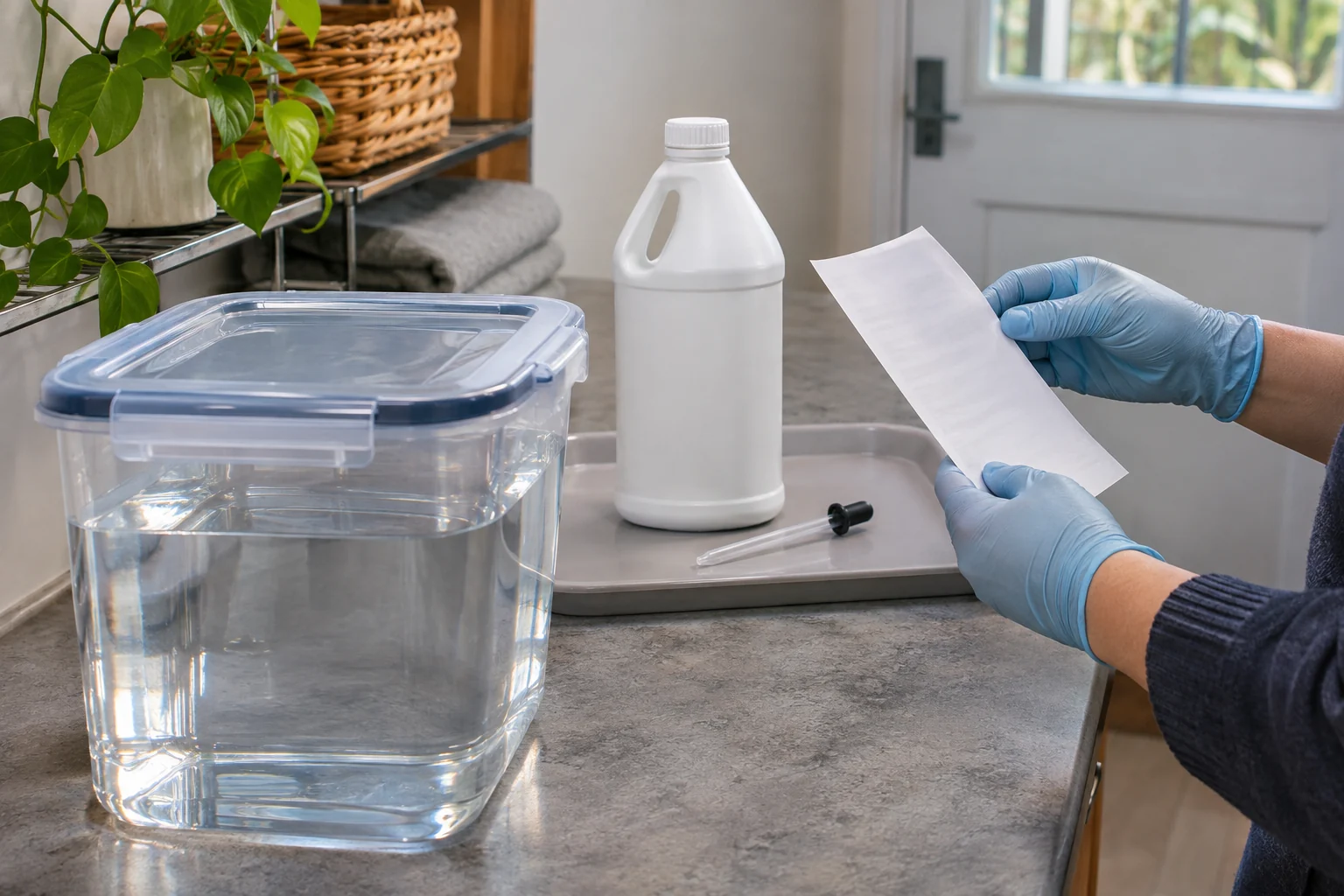
A clean dropper is the most accurate tool for small volumes; a measuring spoon works for larger ones. Keep them with your bleach and use them only for this purpose. Too little chlorine does not disinfect; too much makes the water unpleasant and can irritate.
Step 3: clarify the water if it is cloudy
Let the water stand so particles settle, then pour the clear part through a clean cloth, a coffee filter or a camping filter. If the water is still cloudy after this step, double the chlorine dose.
Step 4: add bleach according to the volume
| Volume of clear water | 5–6% bleach | 8.25% bleach |
|---|---|---|
| 1 litre | 2 drops | 2 drops |
| 4 litres (about 1 gallon) | 8 drops | 6 drops |
| 8 litres (about 2 gallons) | 16 drops (¼ tsp) | 12 drops (⅛ tsp) |
| 15 litres (about 4 gallons) | ⅓ tsp | ¼ tsp |
| 30 litres (about 8 gallons) | ⅔ tsp | ½ tsp |
For cloudy, coloured or very cold water, double these amounts. Stir well after adding.
Step 5: wait at least 30 minutes
Let the water stand for at least 30 minutes, protected from dust. After that, it should have a slight chlorine smell. If it does not, add the same dose again and wait another 15 minutes. If the chlorine smell is too strong, leave the water open to the air for a few hours, or pour it back and forth between clean containers.
7. Adjusting the dose to the concentration you have
If your bleach shows a different concentration, adjust the dose:
- 5–6%: the most common concentration in grocery stores. Follow the “5–6%” column.
- 8.25%: also widely available. It takes a little less product: follow the “8.25%” column.
- Unknown or lower concentration (around 3–4%): to be safe, use about 10 drops per 4 litres, or another method if possible.
- Concentrated industrial products (10% and up): hard to dose precisely and less stable. Avoid them for drinking water if you have anything else.
The simplest approach is to prepare ahead: buy a bottle of regular bleach, date it and stick a label on it with the matching doses. You will have nothing to calculate the day the water is cut off.
8. Points to watch
Disinfect caps and container mouths too
Cap threads and the outside of containers can hold drops of untreated water. After treatment, pour a little treated water over the mouth and cap, or wipe them with a clean cloth dampened with chlorinated water, before drinking.
Use clean containers
Treat and store water in clean, food-grade containers reserved for water. Properly treated water can be recontaminated by a dirty bucket, a doubtful ladle or unwashed hands.
Remember the chemical limit
No amount of bleach makes water safe if it is contaminated with fuel, industrial products or polluted floodwater. When in doubt, use bottled water and follow your municipality’s instructions.
Never mix bleach with other products
Mixed with ammonia, vinegar or some cleaners, bleach releases toxic gases. Store it separately, out of reach of children, in its original container.
9. Storing treated water and bleach
Treated water kept in a clean, closed container away from light keeps for several months. To be safe, write the treatment date on each container and renew your supply about every six months. Once a container is opened, use the water quickly.
Bleach itself keeps best somewhere cool, dark and tightly closed. Replace your reserve bottle every year: it is inexpensive and keeps your doses reliable.
10. Summary
Household bleach is a reliable, accessible and inexpensive purification tool for emergencies, on three conditions: use a regular product without additives, know its concentration and respect the recognized doses and contact time. It has two clear limits: it does not remove chemical contaminants and it works poorly against some parasites such as Cryptosporidium. That is why it fits best in a plan that also includes boiling or a filter.
Printing or copying the dose table and keeping it with your water supply is one of the simplest and most useful steps to be ready the day a boil-water advisory is issued.
Frequently asked questions
Does bleach-treated water taste bad?
A slight chlorine smell and taste are normal and show the treatment worked. If the taste is too strong, leave the water open to the air for a few hours or pour it back and forth between two clean containers. No smell at all after 30 minutes, on the other hand, suggests the dose may have been too low.
Can I treat lake or stream water with bleach?
Yes, but carefully. Let it settle, pre-filter it and double the dose if the water is cloudy or cold. Because chlorine works poorly against Cryptosporidium, it is better to boil surface water or use a suitable filter, with or without chlorination.
How long does treated water stay drinkable?
Kept in a clean, closed container away from light, it keeps for several months. To be safe, date your containers and renew the water about every six months. Once opened, use it quickly.
Can I treat collected rainwater?
Yes, with the same doses as for cloudy water, after pre-filtering. Be careful, though: rainwater running off a roof can carry chemical contaminants that chlorine does not remove. Discard the first water after a long dry spell.
What other methods should I plan for?
Boiling, chlorine dioxide purification tablets, portable filters and UV purifiers. No single method covers every case: combining at least two is the most robust approach.
Further reading
- Does bleach expire? Shelf life and storage
- Drinking water treatment methods
- Alternatives to bleach for water treatment and disinfection
- Calculating an emergency water supply
Sources
- Government of Canada, guidance on drinking water in emergencies and during boil-water advisories.
- U.S. Environmental Protection Agency (EPA), Emergency Disinfection of Drinking Water.
- Centers for Disease Control and Prevention (CDC), household water treatment.
- HealthLinkBC, Disinfecting Drinking Water.