
In this article
- How does bleach degrade?
- Reading the manufacturing date on the bottle
- How to store bleach correctly
- Can expired bleach be used?
- Factors contributing to degradation and observed rates
- Storing bleach for emergency preparedness
- Summary
- Frequently Asked Questions
- Additional checks
- Equipment to compare for your needs
Certain types of bleach can be used for disinfection purposes, as specified on their labels and in public health guidelines. Treating drinking water, disinfecting surfaces, and sanitizing equipment do not necessarily require the same product or the same dilution ratio. Hypochlorite can lose its potency over time and depending on storage conditions; therefore, it is better to check the product details and the date rather than relying on a bottle that has been sitting forgotten somewhere.
Understanding how and why bleach loses its potency allows you to incorporate it intelligently into an emergency supply—ensuring you neither waste it nor, more importantly, mistakenly rely on it when you actually need it.
How does bleach degrade?
A date does not cause a product to change instantly, but its usage and storage limits must be respected. A drop in hypochlorite concentration can reduce its effectiveness. This does not mean an old bottle is harmless: its contents may still be irritating or reactive, and the conditions under which it was stored—or the possibility of contamination—remain unknown.
The decomposition of hypochlorite is more complex than a simple conversion into salt water; depending on the conditions, various by-products may form. Consequently, an aged liquid should not be assumed to be chemically safe. Continue to follow the precautions listed on the label and never mix it with other products, even if its odor seems faint.
Shelf life: follow the manufacturer’s guidance for the specific product. For example, Clorox indicates a shelf life of up to one year for its disinfecting bleach, provided it is stored correctly; however, this does not necessarily apply to all brands. Factors such as heat, chemical formulation, the type of container, and the intended use all influence this assessment. Storing items in a cool place does not justify extending their shelf life at home.
This degradation is continuous and irreversible. It begins as soon as the product is manufactured and accelerates depending on storage conditions. A bottle purchased at a grocery store has generally already spent several weeks or months in storage by the time it reaches your own pantry.
Reading the manufacturing date on the bottle
Date markings and codes vary by manufacturer. A production code can often be used to determine a date, provided you follow the method specified by the brand. Do not assume that the same reading method applies to every bottle, or that the absence of a visible date allows you to simply estimate a timeframe; contact the manufacturer if the code remains unclear.
Example of a code: manufacturer-specific method (must be verified)
Facility code
The code may identify a specific production site and batch, which is useful for inquiries to the manufacturer or in the event of a product recall. Do not remove it from the packaging; in this example, only the portion of the code representing the date is used.
Year of manufacture
The last two digits of the year. For example: 24 = 2024.
Day of the year
The day number can range up to 366 in a leap year. The 42nd day corresponds to February 11th; before converting any code, ensure that you have confirmed the correct format.
Concrete example — Code A921042
- A9 → facility code (to be ignored)
- 21 → year 2021
- 042 → 42nd day of the year = February 11, 2021
This example serves only to determine a hypothetical date of manufacture. It does not guarantee efficacy until August 11, 2021, or February 11, 2022. The actual condition, status, and limitations of the product must be respected; a bottle as old as the one in this example should not be used for current disinfection purposes.
The date helps with stock rotation, but it is neither a measure of concentration nor proof of efficacy. Retain the label and adhere to the prescribed storage conditions. If a product has been stored improperly or its age is unknown, do not attempt to compensate for this uncertainty by arbitrarily increasing the dosage used for surfaces or drinking water.
How to store bleach correctly
Four factors accelerate the degradation of bleach: heat, light, air, and contamination. Controlling these four factors helps maximize the period during which the product remains reliable for use.
Keep cool
Adhere to the temperature range specified on the product, and keep it away from heat sources and direct sunlight. Cellars or basements may also present risks such as freezing, humidity, flooding, or access by children; therefore, they are not necessarily ideal storage locations.
Avoid exposure to light
Bleach bottles are generally opaque, which naturally limits exposure to light. Nevertheless, it is still recommended to store them away from direct light, especially for long-term storage.
Do not transfer to another container.
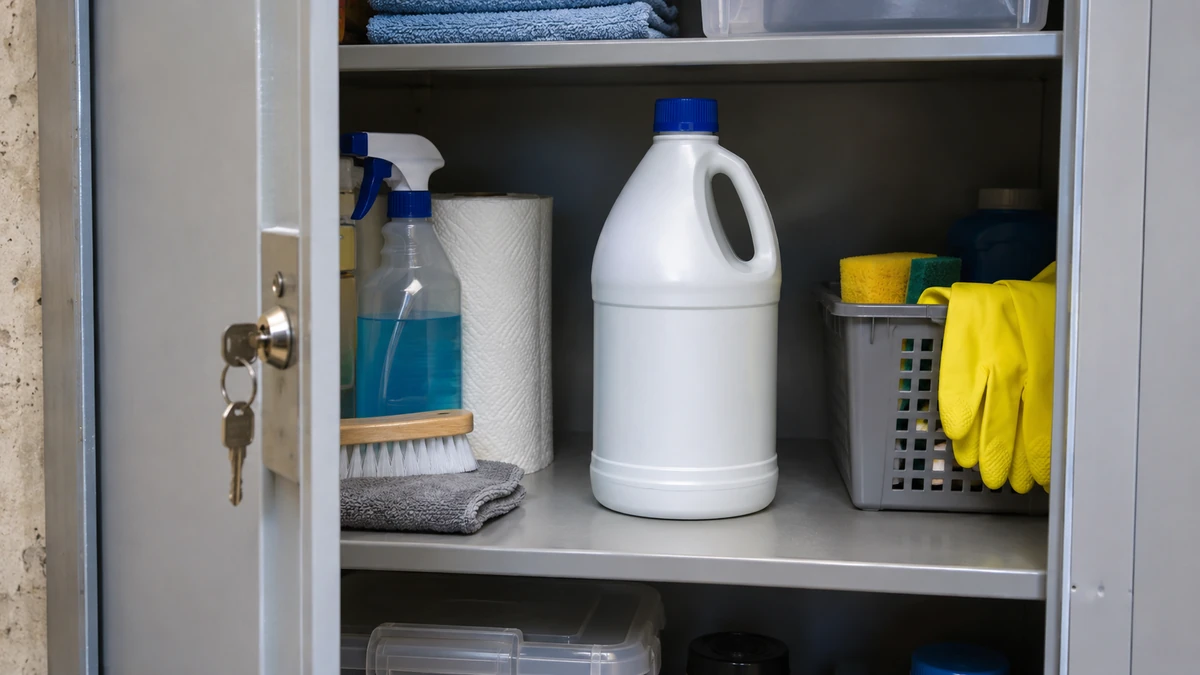
Keep the product in its original container with the label attached, closed according to the instructions, and out of reach of children. Transferring the product to another container can lead to confusion or chemical incompatibility; never use a beverage bottle for this purpose. The cap and bottle must be appropriate for the product; never replace the original closure or ventilation system with a different one.
Store separately from other products.
Never mix with any other cleaner or disinfectant. Acids—including vinegar—and ammonia-based products, in particular, can cause the release of dangerous substances. Ensure storage is organized according to compatibility guidelines; a loss of product effectiveness is not the only risk. Also, review the required protective measures and ventilation conditions for use.
Is freezing an option?
Freezing should not be considered chemically neutral. The product’s formulation, container, stability, and concentration can all be affected; follow the manufacturer’s instructions if the product has frozen. Do not intentionally place the product in a food freezer to extend its shelf life.
- The container, its condition, and its closure influence chemical interactions and risks; there is no guarantee that freezing will improve the product's shelf life.
- The separation of components during a freeze-thaw cycle can alter the effective concentration of the product.
- The freezing point depends on the formulation and concentration. This calculation does not justify freezing the bottle, nor does it allow for assumptions regarding its concentration after thawing.
Conclusion on freezing: Freezing is not recommended as a method for storing bleach in the context of civilian emergency preparedness. Due to uncertainties regarding the resulting concentration and the lack of long-term studies on this practice, it cannot be relied upon for a product intended for disinfection or water purification.
Can expired bleach be used?
The answer depends entirely on the intended use.
Potential cleaning use: only if permitted by the manufacturer and the condition of the product.
A product that is too old for disinfection may still be suitable for cleaning tasks as indicated on its label—though, by definition, this is not without risk. Verify surface compatibility, ensure proper protective measures, and maintain adequate ventilation. Do not mix the product, smell it at close range, or dispose of it without following specific guidelines; adhere to local disposal regulations if the product is no longer suitable for use.
Disinfection and water purification ✗
Bleach with an unknown residual concentration must not be used to disinfect surfaces in sensitive sanitary environments, nor to purify water intended for consumption. The amount of active hypochlorite remaining may be insufficient to guarantee the elimination of pathogens.
Practical rule: neither the date nor the odor is a reliable measure of concentration. A testing method must be appropriate for the specific product and its intended use; an unsuitable test cannot validate a water treatment process. For household use, it is better to follow the manufacturer’s specified conditions, expiration dates, and renewal instructions, rather than attempting to calculate a dosage adjustment to compensate for the product’s age. Furthermore, rotating your stock does not guarantee efficacy if the product has been stored improperly.
Learn more: Purifying water with bleach — dosages and methods
Factors contributing to degradation and observed rates
Stability studies must be interpreted in the context of their specific concentration, container type, and measurement conditions. They do not automatically extend the validity period indicated on the label of a household-sized bottle.
The "20% per year" figure: a simplification that requires nuance
It is often claimed that bleach degrades at a rate of approximately 20% per year after the first 6 months. While this figure is widely circulated, its origin is not clearly documented, and it does not accurately reflect reality in every scenario.
The following figures vary in terms of their level of verification and their specific scope of application:
- In 1982, Fabian and Walker conducted a six-month study on dilutions of a 1% solution, stored in amber glass bottles that were opened periodically for sampling. Their calculations projected an annual loss of 5.24% and a chemical stability of approximately 23 months under these conditions. This does not constitute a validated disinfection protocol for any specific pathogen, nor does it justify keeping any household-prepared dilution for two years. Furthermore, the container type and the concentrations used differ from those of standard household bleach.
- Retaining the original reference allows for the examination of the specific protocol and its limitations, rather than relying on a potentially inaccurate summary applied to a household product.
- The Castle Chemicals document—cited as indicating a 7% to 10% loss after 120 days—could no longer be retrieved from its original source. Consequently, this result is not used to calculate dosage or shelf life. The reference remains traceable—with this noted limitation—but no new PDF has been created to replace the original.
Initial concentration and rate of degradation
Stability is influenced by factors such as concentration, pH, temperature, light exposure, and the presence of impurities. The example of a 12.5% solution declining to 5% over one year should not be generalized without a clearly defined protocol. A higher concentration does not automatically equate to a longer-lasting product, nor does it necessarily make a product suitable for household use.
Select a product specifically suited to the intended protocol, ensuring it has a clearly stated concentration and an up-to-date instruction leaflet. A 5–6% solution is not the only format recognized by regulatory authorities, and concentrated solutions should never be diluted without following specific, verified guidelines. Water treatment and surface disinfection require different dosage levels; the percentages are not interchangeable.
Diluted bleach: a very short shelf life
For household dilutions prepared at home, standard guidelines recommend preparing the solution fresh as needed—often on a daily basis—rather than storing it for long periods. This is not a chemical law stating that any solution at any concentration becomes inactive after 24 hours; rather, commercial formulations and controlled studies have their own specific parameters. Follow the instructions on the product label, and do not keep an unlabeled mixture for future use.
Storing bleach for emergency preparedness
Like other stockpiled supplies, bleach requires careful management of dates and storage conditions. Even items like Mylar bags or oxygen absorbers do not guarantee a 10- to 25-year shelf life for every type of product. Evaluate actual usage and storage conditions rather than assuming that the lifespan indicated on packaging applies to the entire contents.
Rotation as a core strategy
Purchase quantities appropriate for your needs, note the date of receipt (without obscuring the manufacturer’s production code), and check the brand’s specific guidelines. Use products while they are still effective, and plan for replacement before you find yourself relying on a bottle of questionable quality. A rotation cycle of six to twelve months can serve as a useful inventory control measure—though it is not a guarantee for improperly stored products, nor is there a single expiration timeframe that applies to all formulations.
For households that do not use bleach on a daily basis, rotation entails a planned replacement schedule—for instance, at the change of each season—regardless of how much (if any) has actually been used.
Quantity to store
Calculate the required quantity based on actual usage, product instructions, the surfaces to be treated, and the specific product itself—rather than simply storing large volumes of a substance just because it could theoretically treat a vast amount of water. Treating water for drinking purposes requires precise concentrations and specific conditions. A smaller, well-tailored, and regularly replenished stock may be easier to manage than a large quantity that sits and ages, while still meeting the specific needs of your situation.
Ensuring access to safe water through various appropriate solutions can reduce reliance on a single method. Purification tablets, filters, and boiling all have their limitations: none can address every type of chemical contamination, and their microbiological effectiveness depends on specific conditions. Always verify the source and the manufacturer’s instructions; if a risk cannot be effectively mitigated, seek an alternative water source. Redundancy does not mean accumulating products that are incompatible with one another.
Additional Resources
- Bleach and water purification: dosages and methods
- Alternatives to bleach for purification and disinfection
- How much water should you store for an emergency?
- Emergency preparedness with infants
Summary
Household bleach is an effective and economical disinfectant for emergency preparedness; however, it carries a limitation not found in other stockpiled supplies: it degrades over time and may lose its effectiveness long before it is ever used.
Key takeaway: the manufacturer’s specified dates and conditions dictate how a particular product should be used. A decrease in concentration does not mean the contents have become harmless. A product code is not a chemical measurement, and the findings of a scientific study do not extend the shelf life of a standard household bottle. Always prepare dilutions according to the manufacturer’s instructions; do not attempt to create your own long-term storage formulas or increase the dosage to compensate for the product’s age. Never use a solution of uncertain concentration for treating drinking water or for critical disinfection tasks.
Regularly rotating your stock—combined with having alternative purification methods on hand—is the most robust approach to incorporating bleach into an emergency preparedness plan without becoming overly dependent on it.
Frequently Asked Questions
Which concentration of bleach should be chosen for emergency preparedness?
Select the concentration and formulation specifically required by your chosen protocol or product instructions. Do not assume that all bleach products with a concentration between 5% and 6% are suitable for treating drinking water. Fragrances, thickening agents, and other additives may render a product unsuitable for such use. Highly concentrated solutions require their own specific handling protocols; the lack of an alternative product does not justify improvising a dilution.
How can I determine if my bleach is still effective without using testing equipment?
Without proper testing, neither the smell nor the appearance of the bleach can be used to accurately gauge its concentration or effectiveness. Do not smell the product at close range to check its condition. The date, formulation, and known storage conditions can help in deciding whether to replace it, though these factors alone do not guarantee its safety or effectiveness. If a specific concentration is required, use only a method validated for that context, or seek expert advice.
Can bleach be stored in a container other than the original one?
Always keep the product in its original packaging, along with the accompanying instructions. The fact that a container is made of HDPE (high-density polyethylene) does not guarantee that the specific container, its closure, and its intended use are compatible. Transferring bleach to another container can lead to confusion, leaks, or contamination. Never use food-grade containers, and do not remove the original labeling. If the packaging is damaged, follow the manufacturer’s recommendations or consult local waste disposal services rather than attempting to devise an alternative storage solution.
Is expired bleach dangerous?
Depending on its concentration and condition, aged bleach may remain irritating, corrosive, or reactive; it does not simply turn into harmless salt water. Risks include not only reduced effectiveness but also hazards related to handling or mixing the product with other substances. Continue to observe all safety precautions, and never test the product by applying it to your skin or tasting it. If the product is no longer usable, seek guidance on proper disposal.
How often should a supply of bleach be replaced?
Adhere to the product’s stated shelf life, and replace it if it has been stored improperly, if the container was opened in a way that compromised its integrity, or if the label has become illegible. Even if stored in a cool cellar, you should not extend the shelf life beyond the period specified in the manufacturer’s instructions—for example, by keeping it for 18 or 24 months when the instructions indicate a shorter duration. Setting a seasonal reminder can be a helpful way to check dates and the condition of the packaging, though this does not replace the manufacturer’s specific recommendations.
What are the alternatives to bleach for emergency water purification?
Purification tablets, filters, UV treatment, and boiling can address certain water-related risks, though each has limitations regarding lifespan, battery life, turbidity, maintenance requirements, and the types of contaminants they can remove. Not all purification tablets have a four-to-five-year shelf life. Boiling addresses certain microbiological risks but does not remove salt or chemical pollutants. It is important to distinguish between a safe water reserve and emergency treatment methods; always consult the instructions for the specific model you are using.
Purifying water with bleach: dosages and method
Understand the conditions and limitations associated with any water treatment protocol, including the specific product and concentration required. Do not apply dosage guidelines intended for surface disinfection to water meant for drinking.
Alternatives to bleach for purification and disinfection
Purification tablets, filters, and UV treatment: complementary options to ensure you are not reliant on a single product.
How much water should you store for an emergency?
Calculating requirements, selecting appropriate containers, and rotating stored supplies: the foundations of reliable water self-sufficiency.
Additional checks
Equipment to compare for your needs
Some links below are affiliate links: we may receive a commission at no additional cost to you. Products are examples by function, to choose according to your needs; buying the entire selection is unnecessary.