
In this article
What happens to your wastewater during a long outage, or in an isolated home with no sewer? Being off the power grid and being off the sewer system are two different situations: a compliant septic system may, for example, depend on an electric pump. This guide explains how to understand your system, what to do during an outage, and what you need to know about pit latrines, composting toilets and septic systems in Quebec.
At a glance
- Find out now which parts of your system depend on electricity (pump, alarm, treatment unit).
- In Quebec, any system for an isolated dwelling is governed by regulation Q-2, r. 22 and requires a municipal permit: no latrine or pit can be improvised.
- Never enter a septic tank or excavation: gases can kill within moments.
Understanding your system and its dependencies
A flush toilet uses water, in amounts that vary by model. Treatment, municipal or on-site, combines physical, biological and sometimes chemical processes depending on the system. Reducing some uses helps, but not every sewer system is polluting, nor every home system green by definition: poorly treated discharge threatens health and the environment.
| Situation | What can happen | What to plan |
|---|---|---|
| Connected to the municipal sewer, power outage | Pumping stations may be affected during a long outage | Follow municipal instructions; limit water use if asked |
| Septic system with a pump | The pump or treatment unit stops; risk of backup | Know the system, its alarm and its capacity; limit water use during the outage |
| Gravity septic system | Works without power, but well water may run out if the well pump is electric | Plan water for flushing (bucket) and drinking water separately |
| Isolated home with no system | No compliant solution in place | Consult the municipality and a professional before any project |
An electromagnetic pulse is not needed to ask these questions, and it would not automatically make all plumbing useless. Ordinary outages are enough.
During an outage or water cut
If the sewer or septic system works but water is short: you can flush by pouring a bucket of non-potable water into the bowl. Keep drinking water for drinking and cooking.
If wastewater backs up or the municipality asks you to stop discharging water: stop using the toilet. An emergency toilet (a bucket lined with two strong bags, with an absorbent such as cat litter) lets you collect waste temporarily. Close the bags tightly, keep them away from living areas, and follow your municipality's instructions for disposal.
Hygiene: wash your hands with soap and water, or an alcohol-based sanitizer of at least 60%, after each use.
Important: temporary emergency collection does not authorize building a permanent system in the yard or burying waste. Public health and water protection rules apply even without a sewer.
Option 1: pit latrines
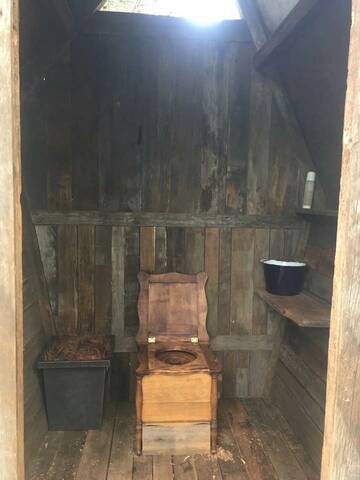
A pit latrine collects waste in an excavation, with a structure on top. It does not treat all the home's wastewater and is not made safe by having a slab and a shelter. Stability, access, fall risks, the water table, insects and pit management must be studied. This guide presents the questions to ask; it does not provide a construction plan.
A property's visible slope does not tell you how water moves underground: placing a latrine "downhill" from a well or stream does not prevent contamination. Geology, the water table, seasonal flows and regulatory distances must be characterized. Very permeable, fractured or karst soil can impose major constraints. Outdoor use also raises issues of cold, lighting and safety, especially at night or for a child or someone with reduced mobility.
Points to have checked
In Quebec, check the regulation on isolated dwellings (Q-2, r. 22) and the municipal permit: rules for a campsite or another country do not apply to a residence.
Location: it must meet the rules and site characterization, not just the uphill-downhill distinction.
Water table and bedrock: soil type, bedrock and water-table height, which varies by season, determine what is possible.
Flooding: being above the "usual" water level proves neither absence of risk nor compliance; check flood zones.
Water sources: the old rule of 30 m (100 ft) from a well does not apply to every system or property, and the clay-versus-sand comparison oversimplified how contaminants move.
Cover and access: a lid and insect protection are needed but do not remove biological risks; prevent falls and keep children out.
Dimensions: the old figures of 1.5 m (5 ft) deep and 1.2 m (4 ft) wide are not a validated design. Never enter an unsecured excavation.
End of use: the old advice to cover the pit with soil once it is full to 50 cm (20 in) from the top is not an approved closure method; follow the applicable instructions.
Safety around pits
Gases and lack of oxygen: a pit can contain flammable or toxic gases and lack oxygen, to the point of being deadly. Do not smoke, keep flames away and never enter a septic tank or similar space. A faint or absent smell does not prove the air is breathable. If someone falls in or loses consciousness, call 911 without going down to rescue them: improvised entries often cause several victims. See the CNESST guidance on confined spaces.
Products: never mix bleach, acids or detergents into waste. Lime, peat and hay are not safe solutions everywhere: lime is corrosive and its dust irritating. An absorbent is not a disinfectant. Only use the products specified for the approved system.
Option 2: composting toilets
A composting toilet is a device whose characteristics must be checked. A bucket that receives excrement and sawdust is first of all a collection system: emptying it into a garden composter does not necessarily destroy pathogens and does not make the result usable on crops. Temperature, duration, moisture and the destination of the material must be controlled.
Separating urine from solids can be part of the design, but urine is not sterile and must be managed according to local rules. A separating seat does not handle the building's other wastewater (kitchen, shower) either. Even without flush water, the device needs maintenance and supplies; cold, moisture and frequency of use change how it performs.
Commercial models may have a fan, separator or agitator, without guaranteeing no odour or complete breakdown. Some need electricity, and all require cleaning and emptying. A manufacturer's description does not prove compliance with the rules for a Quebec home: check the exact model, its documentation and its eligibility for your building.
Option 3: a septic system designed for the site
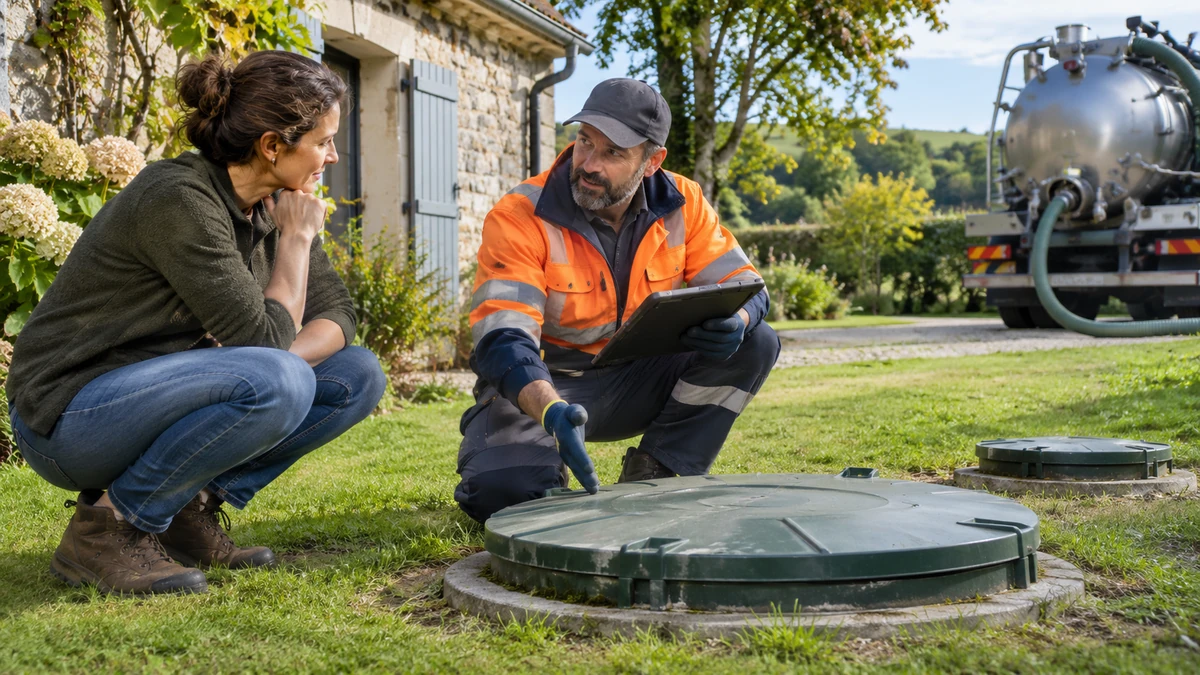
An on-site septic system can serve a building that is not connected, if the property allows it. In Quebec, the permit and required documents must be obtained before work begins, with a competent professional for site assessment and design, including to modify an existing system.
The design takes into account the number of bedrooms, soil, slopes, water table and site constraints. The tank is only one part of the system: the treatment that follows must suit the site, and a conventional leach field does not work everywhere. An improvised tank or buried barrels are not solutions. Excavation work also carries hazards (buried utilities, collapse).
Maintenance: keep the plans, manual and the emptying schedule required by your municipality. Have the work done by competent people and keep the lids secured. A backup, odour or alarm calls for an inspection: do not pour in drain cleaner or additives to avoid a necessary service call.
Comparing the options
| Option | Electricity | Maintenance | Authorization in Quebec |
|---|---|---|---|
| Pit latrine | No | Pit management, insects, safety | Governed by Q-2, r. 22 and the municipal permit; often restricted |
| Composting toilet | Depends on the model | Supplies, emptying, destination of material | To be checked for the model and building; does not handle greywater |
| Septic system | Depends on the system (pump, treatment) | Periodic emptying, inspection | Permit and professional assessment required |
Compare initial cost, energy, supplies, emptying, winter use and building rules. Self-sufficiency is described component by component: if a solution cannot be authorized on your property, choose another rather than lowering the requirements.
Frequently asked questions
Can I dig a temporary latrine during an emergency?
Not without authorization: an improvised latrine can contaminate a well or stream. In an emergency, a temporary collection toilet (double-bagged bucket and absorbent) and your municipality's instructions are the right approach.
Does my septic system work during an outage?
A fully gravity-fed system keeps working, but if yours has a pump or electric treatment unit, it stops. Learn about your system and its reserve capacity, and limit water use during the outage to avoid a backup.
Your experience
Experience helps us understand real constraints: winter maintenance, access for emptying, energy use, handling an outage or permit procedures. To share yours, describe the context and limitations, without proposing unauthorized discharges, burial or construction, and without private information. Use the "Contribute to this article" form; your account will be reviewed before possible inclusion.
Checks in Quebec
- Légis Québec: Regulation respecting waste water disposal systems for isolated dwellings (Q-2, r. 22)
- Quebec Ministry of the Environment: wastewater for isolated dwellings (in French)
- Ville de Québec: example of a septic system procedure (in French) (check your own municipality's procedure)
- CNESST: confined space hazards (in French)
Conditions vary by territory and building. This guide is not a permit, a quote or a certificate of compliance.
Equipment to compare for your needs
Some links below are affiliate links: we may receive a commission at no additional cost to you. Products are examples by function, to choose according to your needs; buying the entire selection is unnecessary.