
In this article
- In brief
- What is an emergency grab bag for?
- The rule of threes applied to the grab bag
- Protecting your airways
- Clothing and shelter in the first hours
- Water and food: immediate needs
- Essential documents
- Useful equipment to include
- Adapting the bag to your household
- Where to keep the bag and how to keep it ready
- Summary: suggested contents
- Frequently asked questions
A fire, a gas leak, a sudden flood: some situations require leaving home within minutes, sometimes in the middle of the night. A well-prepared emergency grab bag gets you through those first critical hours without improvising under stress, and without wasting precious time looking for your papers or medication.
In brief
In brief. A grab bag is a small bag you can pick up in under 30 seconds for a quick, local evacuation: house fire, water damage, gas alert. It holds the essentials for the first few hours: seasonal clothing, copies of documents, cash, medication, water and a snack, a light, a power bank, a whistle and a mask. It does not replace smoke alarms or the 72-hour go bag: it complements them.
What is an emergency grab bag for?
An emergency grab bag is designed for local, temporary situations: a house fire, water damage, a burst pipe, a gas alert, a precautionary building evacuation. The basic assumption is that outside resources remain available: a hotel, a relative’s home, insurance, emergency services, stores.
It is not a survival evacuation bag. It contains no camping gear, water filtration or multi-day rations. If the situation calls for extended self-reliance away from any infrastructure, a 72-hour go bag meets different needs. The grab bag covers the first hours, sometimes the first days, of an unplanned departure from home.
| Grab bag | 72-hour go bag | Home kit | |
|---|---|---|---|
| Scenario | Leaving within minutes, local incident | Regional evacuation, services disrupted | Sheltering at home, outage |
| Time covered | A few hours to 1 or 2 days | At least 72 hours of self-reliance | Several days to two weeks |
| Key contents | Documents, cash, clothing, medication | Water, food, shelter, lighting, radio | Water and food supplies, safe backup heat |
| Weight | Light, one bag per household | One bag per person | Bins or a shelf |
The rule of threes applied to the grab bag
The rule of threes is a common memory aid in preparedness. It recalls rough survival thresholds in extreme conditions: 3 minutes without breathable air, 3 hours without shelter in bad weather, 3 days without water, 3 weeks without food. Applied to a home evacuation, it helps put priorities back in order: get out of the smoke alive first, protect yourself from the cold next, and only then worry about water and food.
Protecting your airways
In a house fire, smoke inhalation is one of the main causes of death, often before the flames even reach the occupants. Smoke contains fine particles and toxic gases, including carbon monoxide. A fire can make a home uninhabitable in a few minutes.
An N95-type respirator can reduce exposure to soot particles, but it offers no protection against toxic gases such as carbon monoxide. It is a backup item, not a solution. Real protection starts well before the evacuation, with early detection:
- working smoke alarms on every floor, in hallways and near bedrooms;
- carbon monoxide detectors if you have a fuel-burning appliance, an attached garage or a fireplace;
- a portable fire extinguisher within reach in the kitchen, ideally on every floor;
- an escape ladder if bedrooms are on the second floor or higher.
This equipment is not part of the bag, but it directly determines whether you can get out in time. A perfectly packed bag does not make up for the lack of an alarm. In any fire, the absolute priority is to get out immediately: no item justifies delaying your exit or going back inside. If the bag is not on your way out, leave it. See a residential fire: getting out, gathering and calling for help.
Clothing and shelter in the first hours
A night-time evacuation during a Quebec winter quickly raises a very practical problem: protection from the cold. Ending up outside in pyjamas at -15 °C (5 °F) creates immediate vulnerability, even if help arrives quickly.
Seasonal spare clothing
Pack one complete set per person: underwear, pants, a warm sweater, socks. In winter, add a hat, gloves and a thermal layer. A pair of closed shoes or boots by the door, next to the bag, saves you from going out barefoot into snow or debris. Update the clothing whenever the season changes and as children grow.
Money and means of payment
During an evacuation, banking services may be temporarily unavailable: terminals down, a card left in a wallet inside. Keep in the bag:
- a cash reserve in small bills, enough for one or two nights of lodging and a few meals. The amount depends on the size of your household and the cost of living in your area;
- a credit or debit card set aside for emergencies, not used day to day.
Home insurance
Many homeowner and tenant insurance policies cover additional living expenses (lodging, meals) after an incident that makes the home uninhabitable. In practice, reimbursement often comes later: having the means to pay up front avoids getting stuck. Keep a printed copy of your policy and your insurer’s claims number, without relying only on online access. For the next steps, see the disaster recovery checklist.
Water and food: immediate needs
When evacuating your home to temporary lodging, water and food needs are short-term: restaurants, convenience stores and hotels usually remain open. The goal is simply not to depend on them in the first hour.
- Water: one bottle of about 500 mL to 1 L (17 to 34 oz) per person is enough for the trip and the first hours.
- Food: one non-perishable snack per person (granola bar, nuts, crackers) keeps hunger, especially in children, from adding to the stress. No need for full rations.
Essential documents
Losing your documents in a disaster leads to long, costly paperwork. Organized copies in the bag let you quickly reach your insurer, access services and prove your identity. Originals should be kept in a fire-resistant, waterproof box at home, or in a safe place elsewhere. See the emergency binder and protecting your documents.
- home or tenant insurance policy and auto policy, with contact numbers;
- property deeds, lease or titles;
- copies of ID: driver’s licence, passports, health insurance cards;
- a photo or written inventory of valuables, very useful for claims;
- an encrypted USB key with scanned documents, family photos and important backups;
- key phone numbers written on paper: insurer, relatives, doctor, pharmacy, employer.
A backup on a secure cloud service complements physical copies without replacing them: access to the internet or your devices may be compromised in the first hours. The challenge of gathering your emergency documents walks you through it step by step.
Useful equipment to include
A few simple tools can make a real difference in a quick evacuation:
- A sturdy LED flashlight: for moving in darkness or light smoke and signalling your presence. One per adult if possible, with checked batteries or a rechargeable model.
- A charged power bank and cable: better than a plain charger, since it does not need a wall outlet. The phone is often the first coordination tool.
- A multi-tool or small pry bar: useful for opening a jammed door or clearing a path, depending on your type of home.
- A whistle: light and effective for signalling your presence to rescuers in a partly damaged building.
- One N95 respirator per person: for minimal protection against particles, keeping its limits against gases in mind.
- A small first aid kit: bandages, gauze, gloves, scissors, pain relievers.
- A spare set of keys for the house and car.
Adapting the bag to your household
A grab bag is not a one-size-fits-all kit. Some items depend directly on your situation:
- Families with children: clothing for each child, a toy or comfort item, common medication, a copy of health records. For toddlers: diapers, formula, wipes, suitable food.
- People with medical needs: a few days of essential prescription medication, the list of prescriptions, contact details for the doctor and pharmacy, spare glasses, a medical alert bracelet or card if relevant. See long-term medications and continuity with your pharmacist.
- Pets: a leash, a soft folding carrier, a portion of food and veterinary records. Some emergency shelters do not accept animals: knowing your options ahead of time reduces stress. See evacuating with pets.
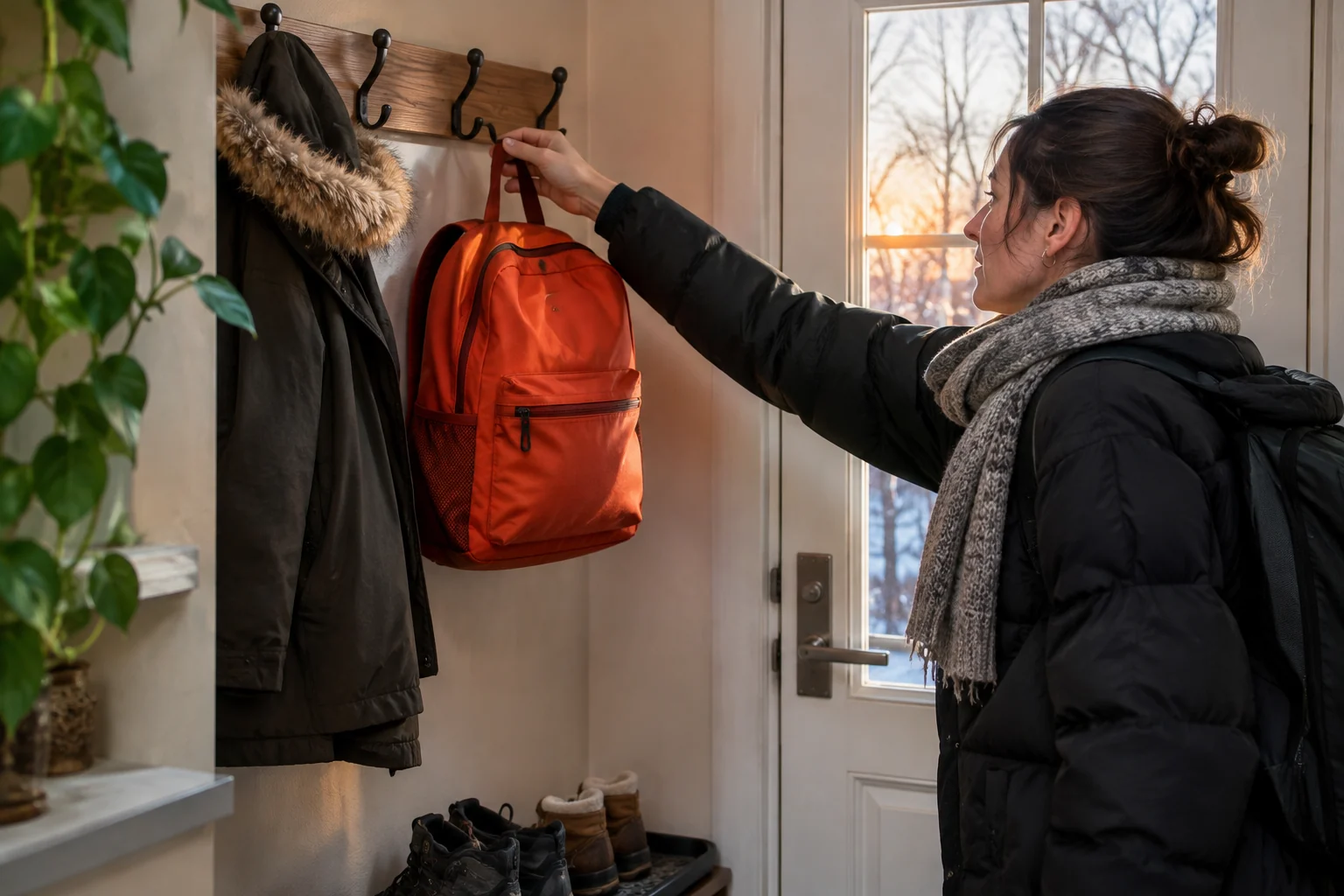
- Grab it and goThe bag is on the way out. If it isn’t, leave it.
- Stay protectedWarm clothes, shoes, light, water, snack, calls to loved ones.
- Find lodgingCash, emergency card, insurance policy, medication.
- Get back on your feetDocument copies, inventory of belongings, useful numbers.
Where to keep the bag and how to keep it ready
A grab bag is only worth something if it is accessible and up to date.
- Location: near the main exit, in an easy-to-reach closet, or in the main bedroom if your home has several floors. The goal is to grab it in under 30 seconds, without a detour.
- Review twice a year: do it when you test your smoke alarms and the clocks change. Replace clothes that no longer fit, check expiry dates, recharge the power bank, update documents.
- One bag per household: a single well-prepared bag is enough for most homes, as long as documents and cash are kept together and every adult knows where it is.
Preparing a grab bag takes a few hours at first and a few minutes of review each year. It is one of the simplest, most concrete steps in preparedness. The PrépaCivile tools can help you build your kits, and the preparedness review shows what you still have to do.
Summary: suggested contents
This list is a starting point, to adapt to the makeup and needs of your household.
| Category | Contents |
|---|---|
| Clothing | One complete seasonal set per person, closed shoes by the door |
| Money | Cash in small bills, a card set aside for emergencies |
| Documents | Copies of insurance, ID, deeds, inventory of belongings, encrypted USB key, numbers on paper |
| Water and food | One bottle of water and one non-perishable snack per person |
| Light and power | LED flashlight with checked batteries, charged power bank, cable |
| Health | Prescription medication (a few days), compact kit, one N95 respirator per person |
| Tools | Whistle, multi-tool or small pry bar, spare keys |
| Household-specific | Baby supplies, comfort item, glasses, leash and pet food |
To go further, see preparing for what: essentials before scenarios and where to start with preparedness.
Frequently asked questions
What is the difference between a grab bag and a go bag?
A grab bag is designed for temporary, local evacuations such as a fire or water damage, when outside resources remain available. A 72-hour go bag is meant for situations where you need to be self-reliant for longer, away from usual services.
How much cash should go in the bag?
There is no universal amount. The goal is to cover one or two nights of lodging and a few meals for the whole household. Adjust it to the cost of living in your area and the size of your family.
How often should you check the contents?
Twice a year is enough for most households. A good reminder: when you test your smoke alarms and the clocks change. Check dates, clothing, the power bank charge and documents.
Is an N95 respirator enough to evacuate during a fire?
No. It filters some of the fine particles in smoke, but does not protect against toxic gases such as carbon monoxide. It can help during a very short passage through light smoke, but the priority is still to get out as fast as possible, staying low.