
In this article
Many people come to emergency preparedness the same way: without really knowing what they’re looking for, with nothing but a sense of urgency. No cold sweats at night, but a persistent feeling, often tied to the birth of a child or a family responsibility: “I need to prepare.” Prepare for what? They don’t know yet. They only know they feel the need to do something to protect their loved ones.
The thought keeps coming back like a familiar face whose name you can’t place. Months go by, worries change, but the idea stays. Many people then start with a topic that speaks to them, such as home security, and through reading and buying discover other areas: water, food, power, first aid. They read dozens of articles, watch hours of videos, and sometimes feel even more pressed, but still with no clear direction.
This article is for people at that stage. It brings together what works, what works less well, and a simple direction to get started.
In short
In short. Preparing isn’t crazy: it’s giving yourself resources (skills, supplies, gear, relationships) to get through hard times with as little damage as possible. Start from the basic needs (water, food, shelter, safety, care), set a first goal of two weeks, gradually buy what you already use, then broaden out. Don’t try to have everything now, and don’t tie your efforts to a date or a specific threat.
What every beginner should know
You’re not crazy
Preparedness covers a thousand topics, but it all boils down to this: the goal is to keep you and your loved ones alive and well. You’re preparing for the bad things that can happen in a lifetime. Your preparations are all the resources (skills, supplies, gear, relationships) that will let you get through them with as few consequences as possible. Wanting to make it through a crisis isn’t crazy, and neither is having a plan for bad days. Authorities themselves ask every household to be able to manage on its own for at least 72 hours.
Start by naming what worries you
At first, people think about many threats at once: economic crisis, snowstorms, social unrest, pandemics, climate change, shortages, cyberattacks, massive outages… Naming what worries you can help with planning. But the goal isn’t to focus on a single threat: as we explain in essential needs before scenarios, the same preparations serve in almost every situation.
A good way to start is to look at the real risks where you live: spring flooding, ice storms, wildfires, heat waves, prolonged outages. The Government of Canada’s Get Prepared website, your province’s and municipality’s emergency management information, or Géorisques in France are good starting points.
How to start
- Name and assessLocal risks, family needs, inventory of what you have.
- 72 hoursWater, food, lights, radio, first aid kit, family plan.
- Two weeksRotating reserve, safe heating, documents, cash.
- BroadenSkills, power, home security, mutual aid network.
Understand what everyone needs
Every human being needs the same fundamental things: water, food, shelter and warmth, safety, and care when injured or ill. Can you live without water? Only a few days. Without shelter? It depends: in a Quebec winter, not for long. Food is what you can go without the longest, but lacking regular intake quickly hurts your health, morale and ability to solve other problems.
Read as much as you can about preparedness, and get different viewpoints before making big purchases. You need these basics whether the crisis comes from a storm, an economic downturn or a massive outage. Disruptions can be brief or long; these basic needs are how you measure your level of preparedness.
Set a first goal: two weeks
Before buying anything, think about what your family needs and choose a time frame. Start small: authorities ask for at least 72 hours; a good next goal is two weeks. For 14 days, what would you need:
- without running water?
- without being able to go grocery shopping?
- without electricity, heating or air conditioning?
- without being able to reach emergency services quickly?
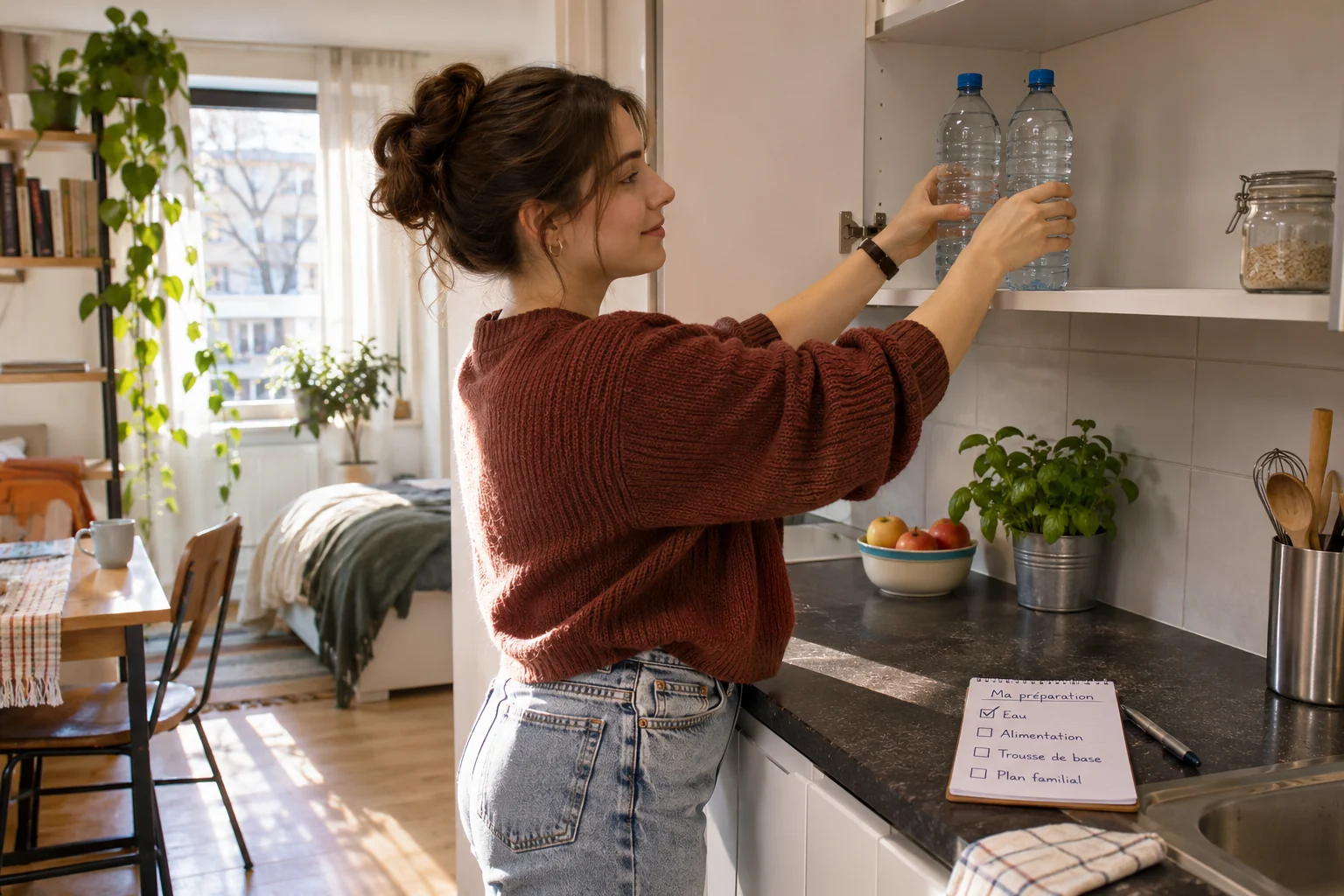
Food and water are the simplest. How much food would your family need, plus anyone who might drop by, if you had to stay home for 14 days? Choose foods that don’t need refrigeration and that your family already eats. For water, plan on about 4 litres per person per day: the Government of Canada recommends at least 2 litres of drinking water per person per day plus water for cooking and hygiene, and FEMA in the United States about one gallon. For a family of four, two weeks comes to about 224 litres.
Shelter and safety depend more on where you live, and often cost more than water and food: safe backup heating in winter, reinforced doors, lighting, alarms. For home security, see our guide to home security and hygiene.
Acquire supplies, gear and skills
You should now have a short list of what you need for two weeks. How much of it do you already have? Do you have stored water? Food-grade containers? Water if the power goes out, for example if you’re on a well? Do you know how to disinfect questionable water with unscented bleach, following the doses recommended by health authorities? A rain barrel, with filtration and disinfection, can supplement your reserve.
Take care of food and water first, because they’re the simplest. Once you have two weeks of supplies, move on to the other areas: first aid and medication, lighting and power, heating, communication, documents, home security, fuel. See our step-by-step preparedness plan, which details each of these steps.
Don’t forget skills, which weigh nothing and never expire: a first aid course (Red Cross, St. John Ambulance, PSC1 in France), knowing how to shut off your home’s water and power, cooking without electricity, canning, repairing, finding your way.
Reassess and adjust
If you’ve followed this plan, you have the basics for two weeks. Congratulations: you’re better prepared than many households, and you can be proud of it. You may feel you’ve only scratched the surface, and that’s normal. Some people then aim for a month, three months or more; others stop at two weeks and simply maintain their supplies. Both approaches are valid.
Looking back, most prepared people give the same advice: don’t dive headfirst into every purchase that comes to mind. Build a reserve of pantry foods first, before buying expensive freeze-dried meals. Think seriously about what you really need and what you can afford, and progress evenly across all areas rather than betting everything on one. You don’t need to have it all now.
Stay relaxed but focused
At first, you can get absorbed by the idea of becoming “the prepared person.” You see dozens of warnings of imminent disaster, only to wake up the next day and find the world still turning. That will happen to you too, but it’s no reason to give up. It’s precisely why you shouldn’t tie your efforts to a date or a specific threat. People who prepared solely for the “end of the world” predicted for December 2012 were probably disappointed; you won’t be, because your preparation is already useful at the next outage or the next storm.
Preparedness is a way of life that helps you through events you don’t always see coming. By moving forward now, slowly, at the pace your means allow, you give your family more security and peace of mind. And you may be able to help others and give them hope when they’re short on it. If worry starts taking up too much room, remember that preparedness should calm you, not make you anxious; see our article on fear and preparedness.
A starter list for two weeks
To move from intention to action, here’s a basic list to adapt to your household. Check off what you already have; the rest becomes your shopping list, spread over several weeks:
- Water: about 4 litres per person per day, in dated food-grade containers, and unscented bleach to disinfect if needed.
- Food: canned goods, pasta, rice, cereal, peanut butter, powdered or shelf-stable milk, snacks, and a manual can opener.
- Cooking: a camp stove and its fuel, to be used outdoors only.
- Lighting and power: headlamps or lanterns, spare batteries, power banks, a battery or hand-crank radio.
- Warmth: sleeping bags or warm blankets, layered clothing; a carbon monoxide alarm.
- Health: a first aid kit, a few weeks of regular medication (check with your pharmacist), hygiene products, toilet paper.
- Documents and money: copies of important papers in a waterproof pouch, some cash in small bills.
- Plan: meeting points, an out-of-area contact, a paper list of phone numbers.
Keep everything in one place the whole family knows, and put a review date in your calendar, for example when the clocks change.
The most common beginner mistakes
- Buying everything at once, often expensive specialized gear, before covering water and food.
- Storing food nobody eats, which will end up expired.
- Forgetting to rotate supplies and watch expiry dates.
- Neglecting special needs: medication, a baby, pets, older relatives, allergies.
- Preparing alone, without talking to your family or getting to know your neighbours.
- Trusting any source without checking medical, electrical or legal advice.
To go further, start with the “Step-by-step preparedness plan” series, then share the journey: find someone to come along, a relative, a neighbour, a friend. Together, we get through whatever the future holds better. See also our article on finding a mutual aid network near you.
Frequently asked questions
Where do you start when you know nothing?
With water and food for 72 hours, then two weeks, using foods you already eat. Then first aid, lighting, heating and a family plan.
How much water do you need for two weeks?
About 4 litres per person per day, so about 56 litres per person for 14 days, or 224 litres for a family of four.
Should you buy freeze-dried meals?
Not at first. Start with a rotating reserve of pantry foods; freeze-dried meals can come later, for the long term or the go-bag.
How long does it take to prepare for two weeks?
It depends on your budget and time. By adding a few items to each grocery trip and setting aside a weekend for water, the plan and basic gear, many families get there in two to three months without straining their budget. Consistency matters more than speed.