
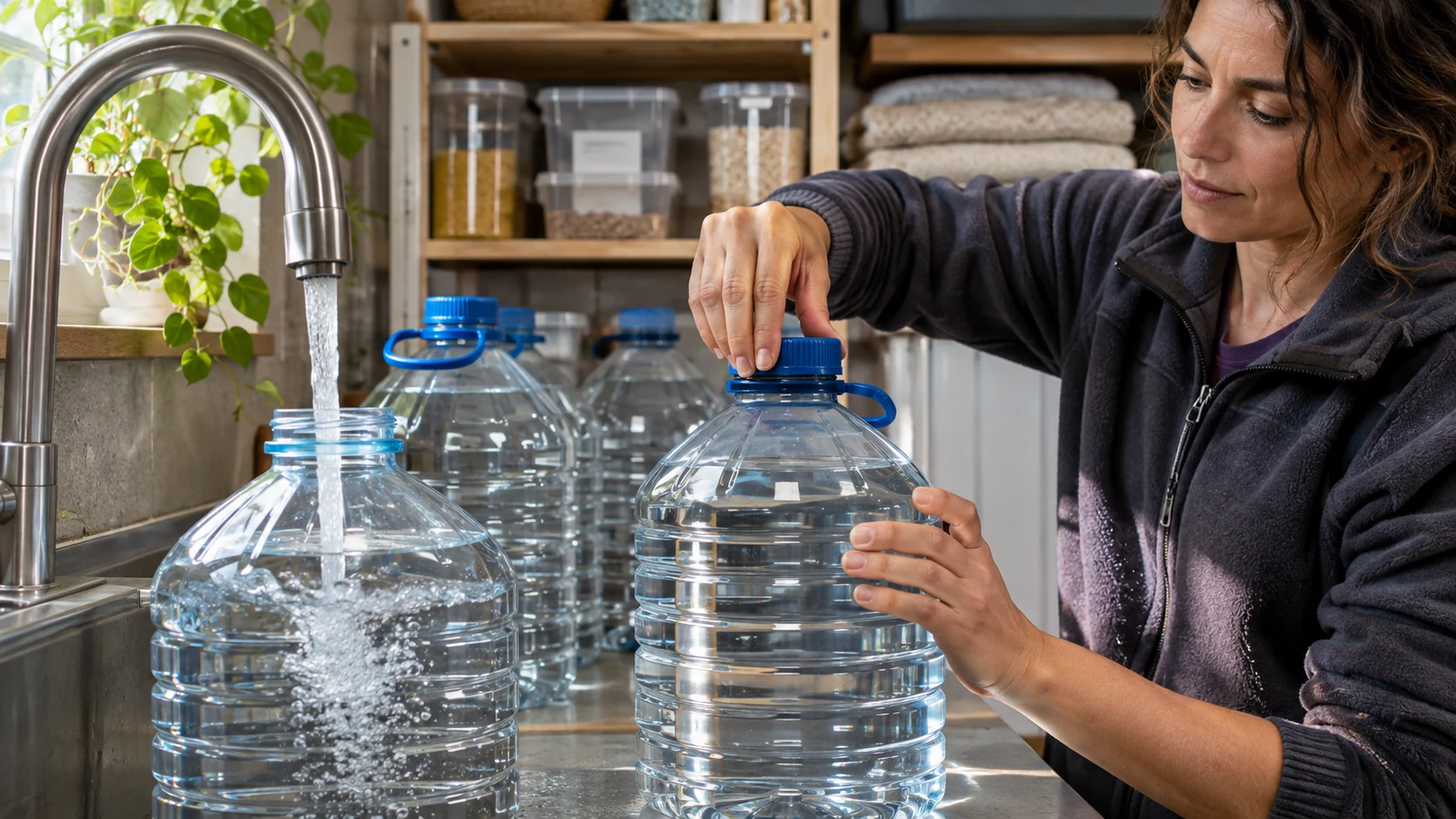
Friends often ask me where to start preparing for emergencies. The topic can feel intimidating at first: when you think about the dozens of things to plan for yourself and your family, the first list of "needs" quickly fills a whole page. Some people give up before they begin, for lack of money or method. Yet many preparedness items cost little, and knowing where to start should never be an obstacle.
This guide is the first part of a step-by-step plan, designed for someone starting from scratch who wants a simple model to follow, one step at a time. It focuses mainly on sheltering in place (staying safely at home during a disruption) rather than evacuation, which is covered in other guides. Part 2 covers the food reserve and personal safety.
In brief
In brief. Step 1: prepare for disruptions rather than a single event, and rank your needs with the rule of three (air, shelter, water, food). Step 2: build a water reserve, starting with the 72 hours recommended by authorities, then aiming for one to two weeks. Plan on about 4 liters per person per day for drinking, cooking and minimal hygiene, more in hot weather, during exertion or for pets.
Step 1: setting your priorities
Before buying anything, it helps to understand why you are preparing. For some people, the motivation comes from a concrete threat: a region exposed to floods, wildfires or ice storms. For others, it is simple common sense, the feeling that our societies rely on just-in-time supply chains and that the slightest disruption can empty shelves within hours.
There is no shortage of examples. During Hurricane Katrina in 2005 and Hurricane Sandy in 2012, fuel shortages, emptied grocery stores and power outages upended the lives of millions of people in under 24 hours, and some families could only return home after months or even years. The media often amplified reports of looting; research has mostly shown strong mutual aid among neighbors, but also the limits of emergency services in the first days.
You do not live near the ocean? Disruptions take many other forms:
- a sharp rise in fuel prices that reduces how often deliveries arrive;
- a port or rail strike that delays freight for weeks, like the British Columbia ports strike in 2023;
- an ice storm or extended outage, like in Quebec and Ontario in 1998;
- riots after a sporting event, which have already happened in several Canadian cities;
- lockdown orders or travel restrictions, as during the COVID-19 pandemic;
- a job loss or illness that suddenly cuts household income.
The message is simple: there should not be just one reason to prepare. The probability that a specific event affects you is low, but the probability that something disrupts your life is much higher. So think less about the event itself and more about the potential for disruption and what you would need to live safely through it. Our guide on cascading disasters explores this logic.
The rule of three
A simple benchmark helps rank priorities. It is called the rule of three: a person can survive about 3 minutes without air, 3 hours without shelter in extreme conditions, 3 days without water and 3 weeks without food. Some add 3 months without human contact, as a reminder of how important social ties are. These are orders of magnitude, not medical thresholds: age, health, heat or cold change them a lot. But they show the order in which to address your needs.
| Need | Order of magnitude | Preparedness priority |
|---|---|---|
| Air | About 3 minutes | Smoke and carbon monoxide alarms, first aid, masks |
| Shelter and warmth | About 3 hours in extreme conditions | Safe home, safe backup heating, clothing, blankets |
| Water | About 3 days | Water reserve and purification methods |
| Food | About 3 weeks | Food reserve and a way to cook |
| Social ties | Variable | Communication plan, neighbors, mutual aid |
Orders of magnitude, not medical thresholds: age, health, heat or cold change them a lot.
- AirSmoke and carbon monoxide alarms, first aid, masks.
- Shelter and warmthIn extreme conditions: safe home, safe backup heating, clothing, blankets.
- WaterWater reserve and purification methods.
- FoodFood reserve and a way to cook.
- Social tiesCommunication plan, neighbors, mutual aid.
Source: a common preparedness benchmark, presented in this article.
Step 2: water
Assuming you can breathe and have shelter, the next priority is water. It is the easiest thing to store before a disaster, yet most households do not have enough when something happens. An "ordinary" disaster is not always measured in hours: after a tornado, hurricane, flood or earthquake, services can take days or even weeks to return to normal. Tap water can also become unsafe to drink, with a boil-water or do-not-consume advisory.
How much water to store?
Official recommendations vary by country. The Government of Canada recommends at least 2 liters of drinking water per person per day, plus water for cooking and hygiene, for at least 72 hours. In the United States, FEMA recommends about one gallon, nearly 4 liters, per person per day. In Europe, French, Belgian and Swiss authorities also recommend a reserve for at least a few days in the emergency kit. A practical, easy-to-remember benchmark is therefore about 4 liters per person per day, adjusted for heat, physical activity, age, pregnancy, breastfeeding and health.
The recommended 72 hours are a minimum. To be well prepared, many specialists advise gradually aiming for one to two weeks, or more if you live in a remote area or one prone to long outages.
| Household | 3 days | 7 days | 14 days |
|---|---|---|---|
| 1 person | 12 L | 28 L | 56 L |
| 2 people | 24 L | 56 L | 112 L |
| 4 people | 48 L | 112 L | 224 L |
| Add per average dog | 12 L | 28 L | 56 L |
| Add per average cat | 3 L | 7 L | 14 L |
These amounts, based on 4 liters per person per day, are indicative. For pets, the Government of Canada suggests about 4 liters per day for an average dog and 1 liter per day for an average cat as a benchmark; adjust for your animal’s size, the heat and its activity. Our tool for calculating your emergency water supply lets you fine-tune for your household.
In liters, at 4 L per person per day
- 1 person56 L
- 2 people112 L
- 4 people224 L
Source: table in this article.
How to store water
For most people, the main challenge is space. With a large basement, storing a few hundred liters is easy; in an apartment, you often have a single closet. A few options:
- Store-bought bottles: convenient, sealed, easy to spread around the home; respect the date shown and rotate them.
- Food-grade 10- to 20-liter containers: less bulky than many small bottles and easy to carry. Use only containers designed for drinking water, clean, opaque or stored away from light.
- 200-liter barrels: worthwhile if you have space, but heavy and hard to move; plan for a pump or spigot.
- Tap water you store yourself: in cleaned and sanitized food-grade containers, replaced about every six months.
- Rainwater harvesting: one or two barrels connected to the gutters provide water for washing, flushing and the garden; it must be filtered and disinfected before drinking. See our rainwater harvesting guide.
Store water in a cool, dark place, away from chemicals and fuel, and protected from freezing. Write the fill date on each container.
Plan a way to purify as well
A reserve always runs out eventually. Plan at least two ways to make doubtful water safe: boiling, a portable filter, tablets or unscented bleach at the recommended doses. Our drinking water treatment sheet covers these methods. Also remember the simple reflex of filling all your clean containers as soon as an alert is announced.
Adapting to special needs
The benchmark of 4 liters per person per day is an average. Some household members have higher or different needs:
- Infants: powdered formula requires safe water; keep bottled water set aside for this use or ready-to-feed formula, and follow your health authority's guidance for preparing bottles.
- Pregnant or breastfeeding women: fluid needs increase.
- Older adults and people who are ill: the sense of thirst can be reduced; some treatments increase needs or, on the contrary, impose restrictions. Ask your doctor or pharmacist.
- Pets: plan about 4 liters a day for an average dog and 1 liter for an average cat (Government of Canada benchmarks), more in hot weather.
- Heat: during a heat wave combined with an outage, needs can double.
Common water reserve mistakes
- Reusing milk or juice containers, which are hard to clean and encourage bacteria.
- Storing containers in the sun, near chemicals, or in a garage where they may freeze and burst.
- Keeping everything in one place: spread part of the reserve between the home, the vehicle and the evacuation bag.
- Forgetting to rotate: without a written date, a reserve ages without anyone noticing.
- Relying on a single source, such as the water heater, with no backup purification method.
Your checklist for this step
- Think about likely disruptions in your area and note your priorities using the rule of three.
- Check that your smoke and carbon monoxide alarms work.
- Calculate your water needs for 3 days, then for 7 and 14 days.
- Build the 72-hour reserve this month, then increase it gradually.
- Choose two purification methods and learn to use them.
- Put replacement dates in your calendar.
The key is simply to have water stored for you and your family: it is easy, inexpensive and requires almost no preparation. In part 2, we will cover the food reserve and personal safety; for an overview, see our citizen preparedness guide.
Frequently asked questions
How long does stored water keep?
Commercially bottled water keeps until the date shown if stored cool and out of the light. Tap water you store yourself in clean containers should be replaced about every six months.
Can you drink water from the water heater in an emergency?
The water heater holds a useful reserve, but the water may contain sediment: let it cool, turn off the electricity or gas before draining, and filter or disinfect it before drinking.
Why 4 liters a day if you only drink 2?
Because you also need water to cook, wash your hands, do minimal washing and take some medications. In hot weather or during exertion, needs rise further.