
In this article
- Why collect rainwater?
- Can you drink rainwater?
- Components of a collection system
- Above-ground or underground systems
- Costs
- Legality and regulation
- Common uses for rainwater
- Recommended products to get started
- FAQ — Rainwater harvesting
- Sources and References
- Related resources
- Equipment to compare for your needs
Rainwater harvesting is gaining popularity among an increasing number of households in Quebec, France, Belgium, and elsewhere in the French-speaking world. Motivations vary depending on the situation: reducing municipal water consumption, independently watering a garden, living a more eco-friendly lifestyle, or maintaining a reserve in the event of a utility outage or prolonged drought.
Before installing your first rain barrel or underground cistern, there are several key factors to understand: the actual benefits, technical limitations, regional legal requirements, costs, and the components that make up a functional system. This guide covers all these aspects to help you make an informed decision.
Why collect rainwater?
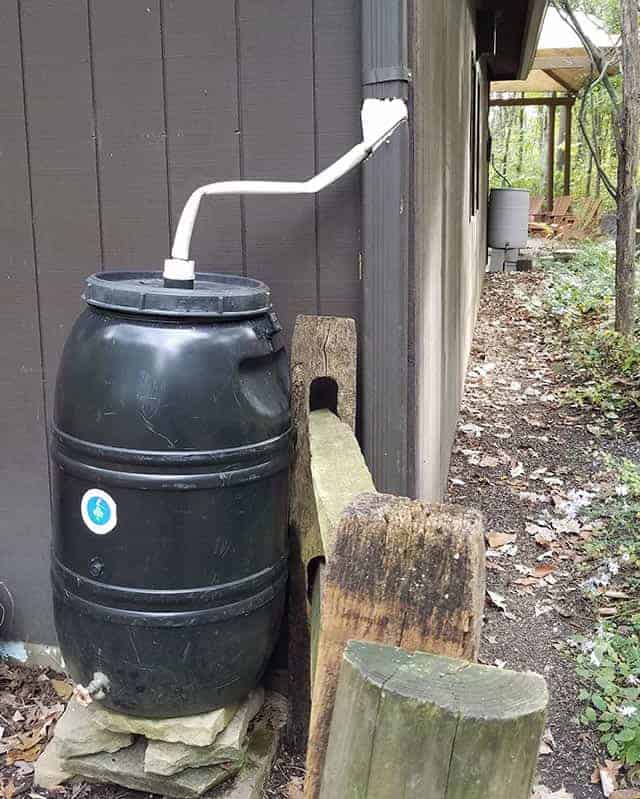
Even in regions where municipal water is inexpensive, rainwater harvesting offers tangible benefits, depending on how you intend to use the water.
Practical benefits
- Autonomy—provides a usable reserve during droughts, watering restrictions, or municipal water supply outages.
- Daily utility—can be used for watering plants, washing vehicles, filling swimming pools, or flushing toilets.
- Reduced runoff—helps prevent the overloading of storm drainage systems during heavy rainfall.
Context in French-speaking regions
- Quebec—many municipalities offer subsidies for the installation of rain barrels.
- France—some regions encourage domestic use for watering gardens and flushing toilets.
- Belgium—rainwater harvesting has been mandatory for certain new construction projects for several years.
Can you drink rainwater?
Do not consider water from a rain barrel to be potable (safe to drink). Rain can carry atmospheric contaminants, and once it lands on a roof, it may pick up microbes and other substances. Any treatment intended to make the water safe for human use requires laboratory testing, a system specifically designed to remove those contaminants, and a supportive legal framework. a hiking filter is not sufficient to demonstrate this.
What a treatment system must actually control
- Mechanical filtration (sedimentation, sand filters, or activated carbon filters)
- Treatment must target identified hazards: UV or chemical disinfection addresses certain microbes; membranes or filter media target particular contaminants. Reverse osmosis is not simply disinfection, and none of these labels alone establishes drinking-water safety.
- Regular maintenance of roofs, gutters, and filters
- Closed storage tanks, protected against insects, light, and algae
Without treatment
Without adequate treatment, rainwater must be reserved for non-potable uses: irrigation, outdoor cleaning, or flushing toilets. Confusing collected (untreated) rainwater with treated rainwater is the primary source of error in poorly designed domestic systems.
Components of a collection system

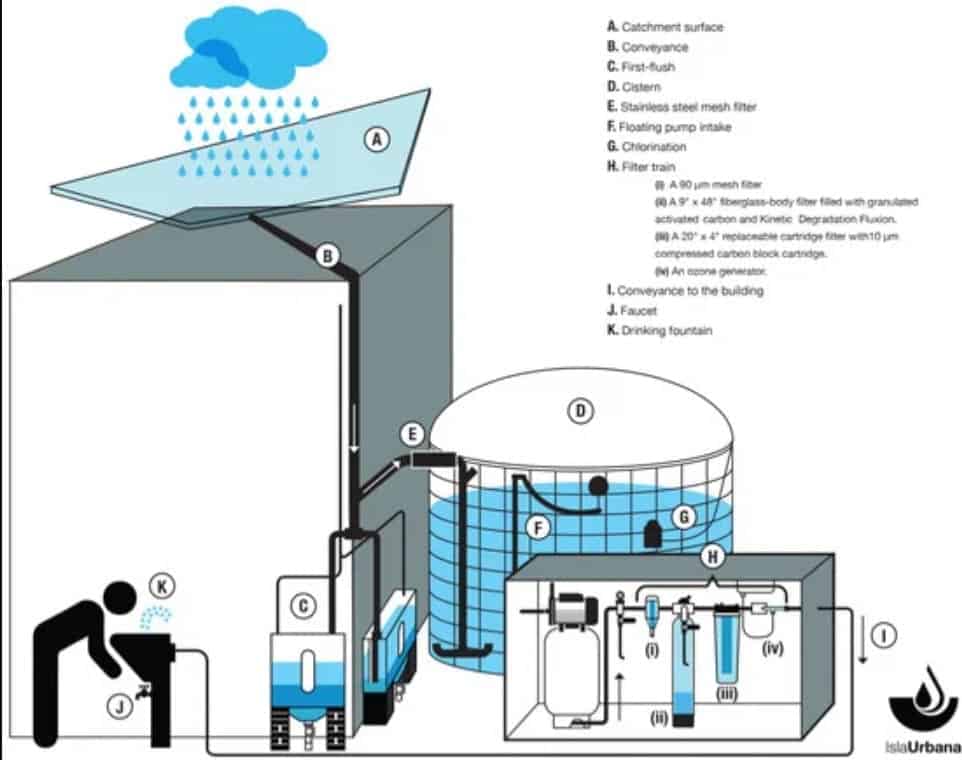
Regardless of its level of sophistication, every rainwater harvesting system relies on the same six basic components.
1
Catchment surface
The roof is the most common catchment surface. Its surface area and material directly determine the volume collected and the initial quality of the water. Metal or tile roofs are generally preferred over asphalt roofs.
2
Transport
Gutters and downspouts channel water toward the filtration system and then into the storage tank. The condition of the gutters is a frequently overlooked factor affecting water quality—clogged gutters introduce organic debris into the system.
3
Pre-treatment and filters
Nets, grilles, and leaf filters trap coarse debris before it enters the tank. Installing a grille or mesh screen at every entry point is the most effective measure for preventing mosquito breeding.
4
Storage tank
Options include a barrel, an above-ground tank, or an underground cistern, depending on the required volume and budget. Tanks must be opaque (to limit algae growth), enclosed, and ventilated.
5
Outlet points
Faucet, overflow, and bottom drain. An overflow is essential for discharging excess water during heavy rainfall and protecting the building's foundations.
6
Pump
Necessary for indoor use or in cases where gravity-fed flow is insufficient. A submersible pump is the most common solution for underground cisterns.
Above-ground or underground systems

Above-ground system
- Low installation cost
- Installation and maintenance can be performed without specialized skills
- Modular: barrels can be connected in series to increase capacity
- Susceptible to freezing—must be drained before winter in Quebec
- Susceptible to UV degradation—choose materials with UV-resistant treatment
- Visual impact depends on placement
Underground system
- Invisible and secure against theft
- More stable temperature if the tank is properly buried; pipes, the pump, and accessories must also be designed to withstand freezing and site-specific ground conditions.
- Large capacity possible (several thousand litres)
- High installation and excavation costs
- Building permit may be required, depending on the municipality
- Pump required for water extraction
Costs
The following price ranges are for reference only and will vary based on the supplier, region, and selected options.
Equipment and installation
- 200-litre rain barrel—budget should be determined based on a local quote; costs vary depending on capacity, materials, delivery, excavation, freeze protection, and maintenance. Canadian dollars and euros are not interchangeable.
- Above-ground tank (500 litres) — budget to be determined via a local quote: costs vary based on capacity, materials, delivery, excavation, frost protection, and maintenance. Canadian dollars and euros are not interchangeable.
- Underground cistern (1,000 litres) — budget to be determined via a local quote: costs vary based on capacity, materials, delivery, excavation, frost protection, and maintenance. Canadian dollars and euros are not interchangeable.
- Pump — budget to be determined via a local quote: costs vary based on capacity, materials, delivery, excavation, frost protection, and maintenance. Canadian dollars and euros are not interchangeable.
- Filters and pre-treatment — budget to be determined via a local quote: costs vary based on capacity, materials, delivery, excavation, frost protection, and maintenance. Canadian dollars and euros are not interchangeable.
Financial viability
Rainwater harvesting is rarely cost-effective in the short term in areas where municipal water is inexpensive. Viability improves in regions where water is costly or subject to restrictions, or when the system is integrated during the initial construction phase (resulting in lower installation costs). The primary value lies in self-sufficiency and resilience, rather than in direct savings on utility bills.
In Quebec, many municipalities offer subsidies for the purchase of a rain barrel—some cities even distribute them directly at a reduced price during environmental awareness events. Check with your local municipality before making a purchase.
Legality and regulation
Rainwater harvesting is legal in the vast majority of French-speaking countries, but the conditions for its use vary by jurisdiction.
Quebec / Canada
Generally legal and unrestricted for outdoor use. Use for potable (drinking) water is regulated and requires a certified filtration system. Some provinces require mosquito-proofing for open systems. Municipal regulations vary—it is recommended to check local requirements before any underground installation.
France
Reserve collected rainwater for permitted non-potable uses only. For drinking, cooking, and brushing your teeth, use a supply of potable water. Filtration followed by disinfection does not guarantee the removal of chemical contaminants from a roof. In France, the use of collected rainwater for food-related purposes or personal hygiene is prohibited in standard domestic settings.
Belgium
Rainwater harvesting has been mandatory for new construction for several years. It is primarily used for non-potable purposes (flushing toilets, irrigation, and—with appropriate treatment—laundry). Requirements vary by region (Wallonia, Flanders, Brussels).
Common uses for rainwater
Outdoor uses (untreated)
- Watering lawns and vegetable gardens
- Cleaning cars, patios, and walkways
- Filling a swimming pool or garden pond
- Washing outdoor tools and equipment
Indoor and emergency uses
- Flushing toilets (requires a dedicated plumbing setup)
- Doing laundry (requires a filter suited to the water hardness)
- Emergency reserve for municipal water outages or droughts
- Reserve collected rainwater for permitted non-potable uses only. For drinking, cooking, and brushing your teeth, use a supply of potable water. Filtration followed by disinfection does not guarantee the removal of chemical contaminants from a roof. In France, the use of collected rainwater for food-related purposes or personal hygiene is prohibited in standard domestic settings.
Recommended products to get started
Collection
200-liter rain barrel
An accessible entry point for starting a rainwater harvesting system. Suitable for watering a medium-sized garden.
Filtration
Gutter filtration kit
Traps leaves, debris, and insects before they enter the tank—an essential component of any well-designed system.
Pressure
Submersible pump
Necessary for indoor use or in situations where gravity alone does not provide sufficient pressure.
Potable use
Domestic water filter
Reserve collected rainwater for permitted non-potable uses only. For drinking, cooking, and brushing your teeth, use a supply of potable water. Filtration followed by disinfection does not guarantee the removal of chemical contaminants from a roof. In France, the use of collected rainwater for food-related purposes or personal hygiene is prohibited in standard domestic settings.
FAQ — Rainwater harvesting
Is it financially cost-effective?
Rarely cost-effective in the short term in regions where municipal water is inexpensive. Profitability improves in contexts where water is costly, subject to seasonal restrictions, or when the system is integrated into the building’s construction. The primary argument is not economic—it is about autonomy and resilience in the face of utility grid disruptions.
Can I connect my system to my home?
Yes, but this is generally reserved for underground cisterns equipped with a pump and certified filtration. In all cases, a strict physical separation between the municipal potable water supply and the rainwater system is mandatory to prevent cross-contamination. Local regulations govern such connections; it is recommended to check with your municipality or a certified plumber.
Do I need to filter water, even for the garden?
A simple leaf screen is sufficient for outdoor irrigation—plants tolerate minor impurities in rainwater well. For any indoor use (toilets, laundry, potable use), comprehensive filtration tailored to the specific application is essential. As a rule of thumb: the closer the use is to direct human contact, the more rigorous the filtration must be.
How much water can your roof collect?
The basic formula: catchment area (m²) × precipitation (mm) × efficiency coefficient (typically 0.8 to 0.9 for a pitched roof). For example, a 120 m² roof in a region receiving 800 mm of annual rainfall can theoretically capture up to 86,400 liters per year—an average of approximately 240 liters per day. The rainwater harvesting calculator available on this site allows you to accurately estimate your collection potential based on local parameters.
Access the rainwater harvesting calculator
Storage
Choosing your rainwater barrels
Capacity, materials, taps, and series connections: selection criteria for a barrel suited to your specific needs.
Purification
9 methods for water purification
Reserve collected rainwater for permitted non-potable uses only. For drinking, cooking, and brushing your teeth, use a supply of potable water. Filtration followed by disinfection does not guarantee the removal of chemical contaminants from a roof. In France, the use of collected rainwater for food-related purposes or personal hygiene is prohibited in standard domestic settings.
Runtime
How much water should you store for emergencies?
Calculating water requirements per person—from a 72-hour supply to enough for several weeks.
Sources and References
Local guidelines and product manuals take precedence for your specific situation. References consulted for this update include:
- Health Canada — Water and Food in Emergencies
- CDC — Rainwater Collection and Health
- Service-Public.fr — Rainwater Harvesting in France
Related resources
Equipment to compare for your needs
Some links below are affiliate links: we may receive a commission at no additional cost to you. Products are examples by function, to choose according to your needs; buying the entire selection is unnecessary.