
In this article
- A realistic calculation by use
- How many days of self-sufficiency to aim for?
- Reducing your consumption in an emergency
- A practical trial to calibrate your supply
- Pets
- If your supply runs short: backup sources
- Frequently asked questions
- Summary
- Sources and verification references
- Equipment to compare for your needs
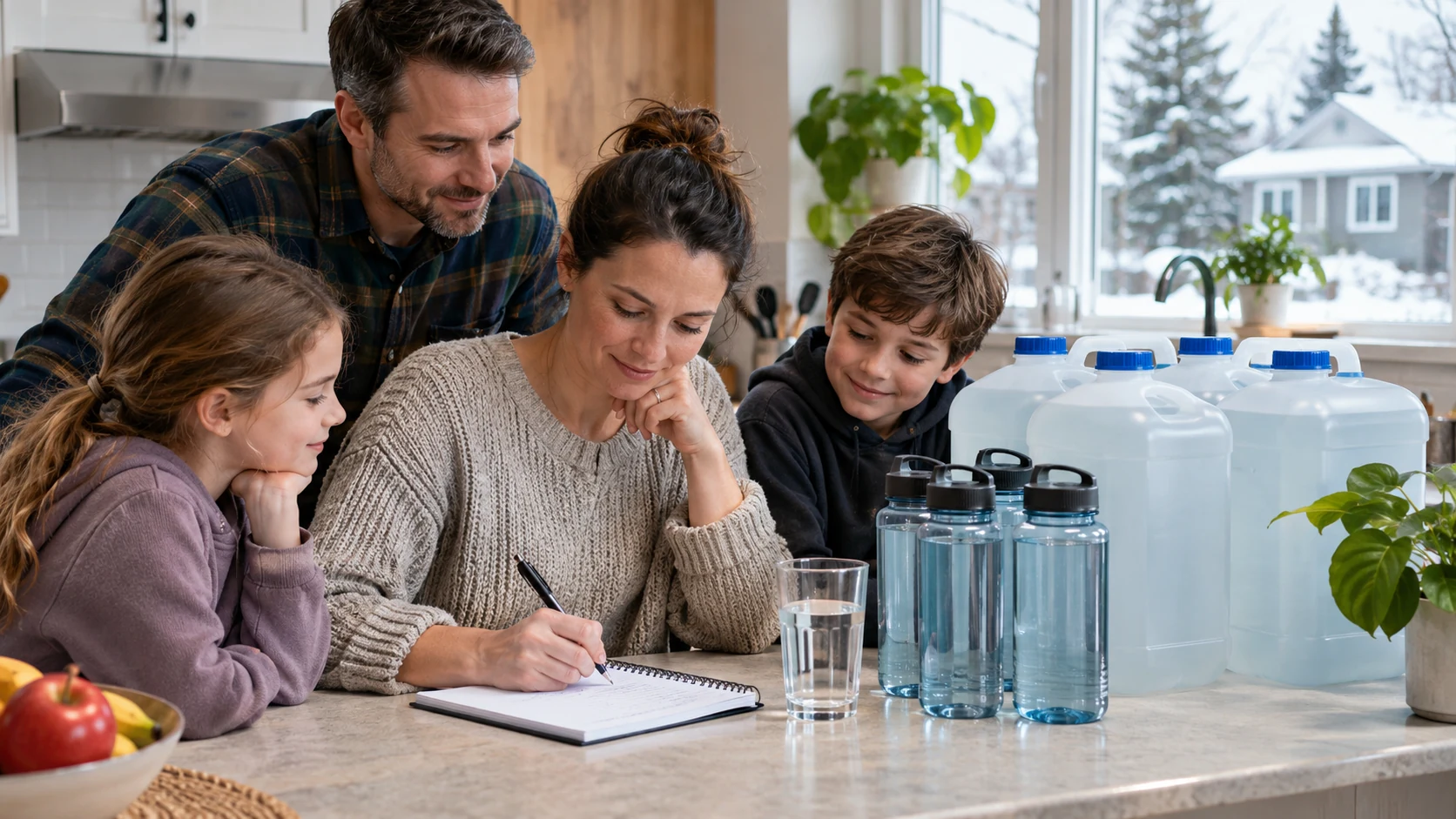
Water is the first thing to plan in an emergency supply. But figures vary from one source to another, units change (litres, gallons, ounces) and official recommendations are minimums. This article offers a realistic calculation, use by use, suited to the daily life of a Quebec household, and a simple way to check your own needs.
At a glance
- Official baseline: 2 litres per person per day for drinking, plus 2 litres for cooking and washing, for a total of 4 litres, for at least 72 hours.
- For a household of four, that means 48 litres for 3 days and 224 litres for 2 weeks, not counting toilet flushing.
- The best calculation is your own: a three-day trial using only your stored water reveals your real needs.
Reference figure: the Government of Quebec and the Canadian Red Cross cite 2 litres (about ½ US gallon) per person per day as the minimum for drinking. Health Canada adds 2 litres for food preparation and hygiene, for a total of 4 litres. In practice, with cooking and basic hygiene, a household uses more like 4 to 8 litres (1 to 2 US gallons) per person per day, depending on its habits.
This minimum supply covers neither a normal shower, nor laundry, nor toilet flushing. Increase it for heat, physical activity and special needs (infants, sick people, pets). To do the calculation directly, use our water storage calculator.
A realistic calculation by use
The official 2 litres per person per day covers drinking only, under favourable conditions. The 4-litre benchmark covers drinking and other essential needs. The following table details a water-saving scenario; toilet flushing is counted separately, since it can use non-potable water. Household volumes are planning assumptions, to be measured in your own home.
| Use | Minimum | Realistic | Notes |
|---|---|---|---|
| Drinking (active adult) | 2 L (½ US gal) | 2 to 3 L (½ to ¾ US gal) | More in heat or with physical activity |
| Cooking (hot meals) | 0.5 L (⅛ US gal) | 1 to 2 L (¼ to ½ US gal) | Rice, pasta and legumes need a lot of water |
| Handwashing | 0.5 L (⅛ US gal) | 1 L (¼ US gal) | Hand sanitizer reduces this need |
| Basic washing | 1 L (¼ US gal) | 2 to 3 L (½ to ¾ US gal) | Wet wipes greatly reduce this need |
| Toilet flush (once a day) | 4 L (1 US gal) | 4 to 6 L (1 to 1½ US gal) | Non-potable water possible; a bucket toilet eliminates this need |
| Total per person per day | 8 L, including 4 L for flushing | 10 to 15 L, including 4 to 6 L for flushing | Depending on habits and water-saving measures |
For a household of 4, based on 4 litres per person per day:
| Level | Calculation | Drinking water | To add |
|---|---|---|---|
| 72 hours | 4 × 4 L × 3 days | 48 L (about 12.7 US gal) | Non-potable supply for toilets, special needs |
| 2 weeks | 4 × 4 L × 14 days | 224 L (about 59 US gal) | To adapt to the household's space and risks |
| 30 days | 4 × 4 L × 30 days | 480 L (about 127 US gal) | Additional household needs not included |
These estimates assume the water-saving measures described below. Without them, volumes would be much higher. Also think about weight: one litre of water weighs one kilo, so 48 litres is about 48 kg (106 lb) without containers.
How many days of self-sufficiency to aim for?
Authorities recommend being ready to manage on your own for at least 72 hours: that is often how long emergency services need to mobilize and reach everyone. Past crises show that this can be too short.
Historical benchmarks in Quebec
January 1998 ice storm: hundreds of thousands of households lost power for days, some for weeks. In Montreal, one of the city's two filtration plants shut down: residents had to ration water and a boil-water notice was posted. See Ice storms in Quebec: preparing for outages.
Water main breaks: every year in Quebec, boil-water advisories affect entire neighbourhoods, lasting from a few days to several weeks depending on the cause.
Abroad, the March 2011 earthquake and tsunami in Japan, a country known for the quality of its infrastructure, cut off water to about 2.25 million households at the height of the crisis. Restoration took weeks: in northern Miyagi prefecture, repairs could not begin for two weeks because there was no electricity.
Households without running water, in millions, by time after the earthquake
- At the peak2.25 M
- After 1 week1.2 M
- After 2 weeks0.6 M
- After 3 weeks0.31 M
Source: Kuwata and Okamoto, Kobe University, 15th World Conference on Earthquake Engineering (2012), based on data from Japan's Ministry of Health.
A major break in the system can therefore last well beyond 72 hours. To choose a longer goal, look at the risks in your area, your municipality's advisories and the real options for water distribution, without simply transposing another region's restoration time to your home.
Step-by-step goals: start with a 72-hour supply, then extend it to 2 weeks, then to 30 days if your situation warrants it. Each level reached is a real improvement: there is no need to build it all at once.
Reducing your consumption in an emergency
The better you save water, the less you need to store. These methods are learned and tested before an emergency, not during one.
Food
Ready-to-eat foods for short emergencies: canned goods, cereals, bars. Dry rice and legumes, excellent for the long term, use a lot of water and energy to cook.
Dishes: keep the menu simple and wash according to Health Canada's guidance, with drinking water and a disinfectant used at the concentration on its label. A vague formula like "a few drops per litre" is not a procedure for sanitizing utensils.
Hygiene
Hand sanitizer with at least 60% alcohol, as recommended by the Public Health Agency of Canada: it greatly reduces the water needed for handwashing, without replacing soap when hands are visibly dirty.
Wet wipes: they allow decent personal hygiene without drawing on your supply.
Greywater reuse: water used to wash hands or rinse vegetables can be collected in a bucket and reused to flush the toilet.
Toilets
Flushing with greywater: pouring collected water directly into the bowl greatly reduces consumption.
Waterless emergency toilets: a double-bucket system or a composting toilet eliminates this use. See Off-grid sanitation: comparing toilets.
Laundry
For a short emergency, putting off laundry is the simplest solution.
For a long emergency, washing in a bucket with a washboard uses less water than washing in basins.
A practical trial to calibrate your supply
Tables give estimates, but the only way to know your household's real needs is to measure them. The trial consists of living for 2 to 3 days using only water stored in advance, without turning on the taps.
Duration: at least 3 days. Below that, results are not very representative: habits only show up after the first 24 hours.
Timing: a long weekend or a period spent mostly at home. If you go out, bring your containers and keep count.
Measurement: transfer water into graduated containers before using it, and note volumes as you go.
Backup equipment: use the opportunity to test lamps, communication tools and meal preparation. Simulate the outage without cutting the main power: never interrupt medical equipment, safety heating, alarms or building protection systems.
Review: compare your measured consumption with the table above and adjust your supply.
Habits, meals and plumbing make needs vary a great deal from one household to another: no average before or after the trial can be guaranteed for everyone. That is exactly what the trial teaches you.
Pets
Animals' water needs are proportional to their weight. A common estimate: divide the animal's weight in kilos by 2 to get its approximate daily consumption in decilitres. A 20 kg (44 lb) dog thus drinks about 1 litre per day.
These needs vary with species, activity and temperature: plan a 30 to 50% margin in heat or with exertion, and ask your veterinarian for advice for a sick or older animal. See also Pets: preparing for care and evacuation.
If your supply runs short: backup sources
If your supply turns out to be too small, several backup sources exist, provided you treat the water before drinking it.
Rainwater: barrels placed under downspouts quickly collect large volumes. Water running off roofs contains contaminants and must be treated. See Harvesting rainwater: yield, storage and uses.
Water heater: a residential water heater generally holds 100 to 300 litres (about 26 to 80 US gallons) of usable water, an often-forgotten supply. First turn off the heater's electricity or gas, close the cold-water inlet so contaminated water from the system cannot get in, let it cool and draw water from the drain valve.
Natural sources: rivers, streams and lakes, only as a last resort, and always treated before drinking.
Treatment reminder: no water from a natural source, rain collection or secondary system should be drunk without treatment first. See Emergency water treatment: methods and equipment.
Frequently asked questions
Are the recommended 2 litres per day enough?
For drinking, under normal conditions, yes: it is a minimum. But it covers neither cooking, nor hygiene, nor heat or exertion. Plan at least 4 litres per person per day, plus a non-potable supply for toilets.
I live in an apartment: where do I put all that water?
Start with the 72-hour level (48 litres for four people), split into 4- to 20-litre containers that fit easily in a closet or under a bed. Add known backup sources (water heater) and find out where your municipality's distribution points are. Larger storage is planned according to the weight the floor, and you, can bear.
Does stored water expire?
Commercial bottled water keeps according to the date and conditions on the label; water you put in containers yourself should be replaced regularly (the US CDC recommends every six months). See Does bottled water expire?
Summary
The amount of water to store depends on the size of the household, its habits, the water-saving measures adopted and the length of self-sufficiency you are aiming for. The official 2 litres per person per day is a minimum for drinking, not a complete preparedness goal.
The practical goal: start with a 72-hour supply, test it in real conditions, then extend it toward 2 weeks, then 30 days if your situation warrants it. Each level reached concretely improves your household's resilience.
To go further:
- Personalized water storage calculator
- Water storage: five common misconceptions
- Complete your household's preparedness review
- Back to the Water category
Sources and verification references
Local instructions and product instructions take precedence for your situation. References consulted for this update:
- Health Canada: keeping food and drinking water safe in an emergency
- CDC (United States): rainwater collection and health
- The Canadian Encyclopedia: the Great Ice Storm of 1998
- Kuwata and Okamoto (2012): water outages after the 2011 earthquake in Japan
Equipment to compare for your needs
Some links below are affiliate links: we may receive a commission at no additional cost to you. Products are examples by function, to choose according to your needs; buying the entire selection is unnecessary.