
In this article
A pet is one of the people and resources whose care the home must organize. An emergency can disrupt your food, treatment, transportation or accommodation. The objective is to predict these dependencies, without judging the animal according to its usefulness or assigning it an autonomous survival capacity.
A responsibility to prepare now
The situations below are a practical grid, not an official gravity classification. They examine day-to-day resources, service interruptions, evacuation and prolonged disruptions. The plan must be adapted to the species, age, behaviour and health status with the appropriate professionals.
Recent photography, up-to-date identification, veterinarian contact details, treatments, handling habits and instructions must be accessible to responsible adults. Identify a person who can help if you are hospitalized or absent and confirm your agreement.
1. Personal difficulty: preserve usual care
Loss of income or illness can make shopping and travel difficult. Plan for a reasonable supply of the usual foods, taking into account their conservation, your budget and the needs of the animal. Make a rotation rather than a massive purchase. A 72-hour marker is a starting point; an additional reserve can be built gradually if conditions permit.
Don’t change rations just to diversify the stock. Transitions, therapeutic foods and restrictions require veterinary advice. For medicines, agree on the quantity, renewal and storage with the veterinarian or pharmacist concerned; no universal duration is prescribed here.
Identify local temporary help and welcome solutions before you need them. Note who can buy the products, transport the animal or contact the clinic.
2. Breakdown or storm: maintain water, temperature and routines
Include the water of the animals in the plan of the household, with the bowls and resources necessary for cleaning. Needs change by species, size, heat, activity, diet, and health; check them for your pet rather than using the only amount intended for a person.
Prepare a hospitality solution if the accommodation becomes too hot, too cold or dangerous. For a refrigerated product or care equipment, have the continuity solution defined in advance. Improvised cooling can freeze or overheat a treatment.
- Routine ration and distribution equipment.
- Water, bowls, bags, bedding and hygiene resources adapted.
- Treatments and instructions of the professional.
- Cover, familiar object and simple routines.
- Contacts and usable means of transport.
Keep animals away from fumes, fuel, cables and emergency equipment. Under stress, even a pet can react differently.
3. Evacuation: carry and accommodate
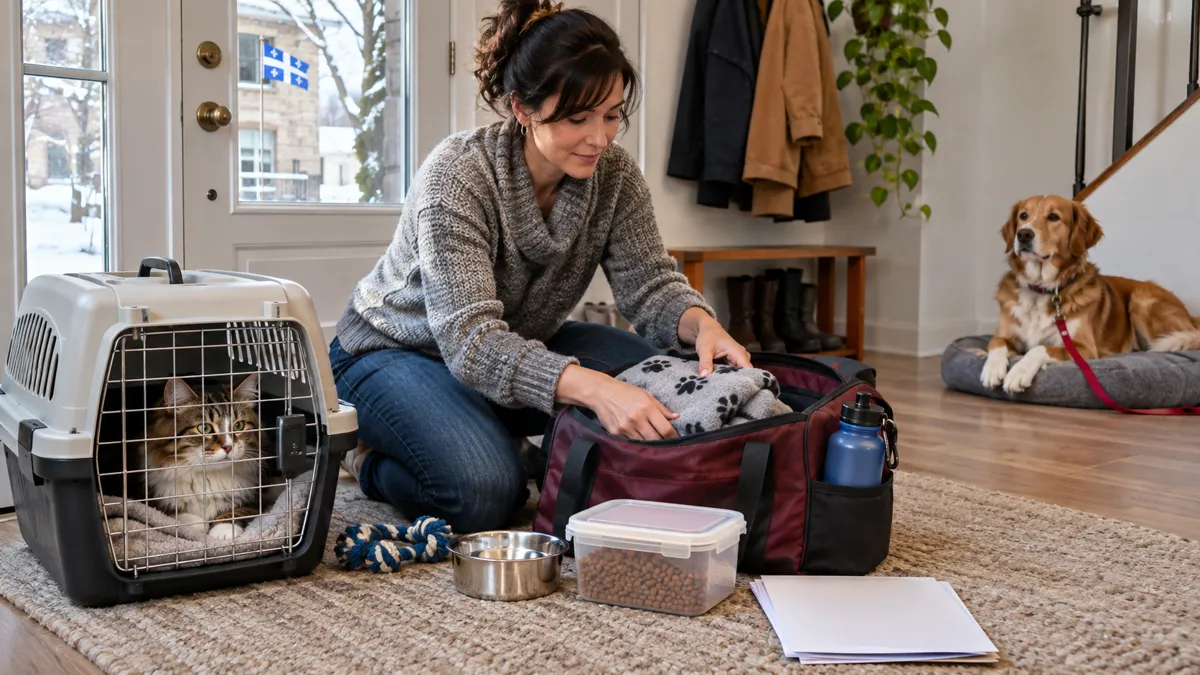
Prepare a suitable crate for the cat or small animal and a leash or harness suitable for the dog. Gradually habituate the animal with a positive approach. Do not assume that a frightened animal will return to the recall or accept an unknown container on the day of departure.
Confirm the rules of the destination: hotels, relatives, clinics or pensions. The reception conditions differ and service animals must be taken into account according to the applicable framework. Do not assume that all centres accept pets.
Distribute the material among adults. Do not add a load on the back of the animal without validation adapted to its health and condition. Keep copies of his documents and a legible contact on the carrier, without unnecessarily displaying sensitive information.
Also prepare a departure without you: location of the animal, authorized access, instructions, equipment and destination. A trusted person must know what they are able to do without putting themselves in danger. During an evacuation, take your animals where possible and follow the instructions of the responsible services.
4. Prolonged Disturbance: Seek resources and relays
A supply disruption does not allow the improvisation of a sustainable ration based on leftovers. In particular, a cat has its own nutritional needs that simply “very meaty” foods do not guarantee. A list of meats or vegetables is not a balanced ration. Do not rely on a cat’s hunting or waste to feed an animal.
Ask the veterinarian what substitutions are possible and for how long. Organize purchases with relatives, help services or available suppliers. A sick, very young, elderly or therapeutic animal requires special attention.
If you can no longer provide care, contact professionals or host organizations early. The plan focuses on protection and care solutions, without abandonment, self-medication or improvised irreversible decisions.
Behaviour and well-being
Routines, short exercises, and familiar objects can support adaptation. They do not guarantee the absence of fear. Respect the limits of the animal, separate species or individuals if necessary and seek competent accompaniment for persistent difficulties. An animal does not have to ensure the defense or survival of the group.
Periodically check the plan: adjusted equipment, up-to-date coordinates, available food and treatments, no one always agrees. Repeat the transport in a calm context rather than simulating a frightening catastrophe.
Checklist
- Identification, photography, file and up-to-date contact information.
- Regular supply and water counted in the reserve.
- Care continuity defined with a professional.
- Transporter or harness adapted, accessible and tried.
- Confirmed destination and alternative.
- Relay identified in case of absence of the main guard.
- Guidelines shared between responsible adults.
Source of preparation
Government of Canada - Emergency Preparedness for Pets and Service AnimalsThe advice on this page does not replace a veterinary consultation for a ration, treatment or behavior problem.