
In this article
Rainwater harvesting can complement some household uses and reduce dependence on a single source. The volume collected depends on rain, surface area and losses. However, the quantity available does not demonstrate its sanitary quality: clear water from a roof is not automatically drinkable.
Calculate theoretical yield
One millimeter of rain per square meter represents one liter of water before losses. The planning formula is therefore: rain in millimeters multiplied by collection area in square meters, then by a coefficient of yield. For a roof, the area considered is the horizontal projection of the area actually connected.
With 25 millimeters of rain, 100 square meters connected and an illustrative yield of 75%, the calculation gives 1,875 liters. This scenario does not announce the next rain and does not validate a sizing. A misdirected gutter, overflow, scattered first waters and limited tank capacity can reduce the volume actually conserved.
Size storage for demand and dry periods
A large yield during a downpour does not necessarily cover several weeks without rain. Compare the volumes requested, the frequency of rain, space and storage capacity. Check the resistance of the support: a filled tank represents a significant load that should not be placed on an unrated structure.
Start with a clearly defined use, for example part of the allowed watering. A simple, maintained and understood system is more useful than a complex network whose connections and overflow are not controlled. The PREPACITIVE calculator allows you to explore scenarios, without replacing a professional design.
Examine the catchment and inlets
The roof can bring dust, waste, debris and materials-related substances. The strainers and first water separation devices can reduce some inputs, but do not constitute a potabilization chain. Also check the products used to clean or treat the roof.
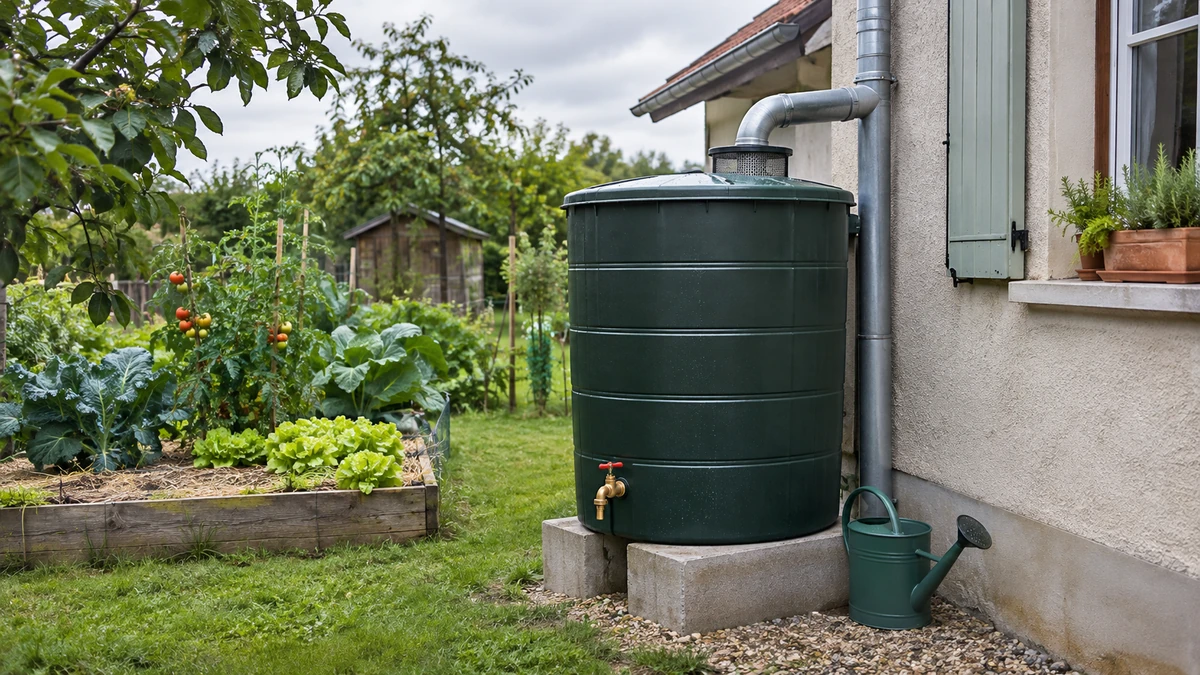
A tank must be properly closed, protected from insects and accessible for maintenance. Its overflow must be directed without creating infiltration, erosion or nuisance in the neighbor. Secure accesses to avoid falls and accidents, especially with children.
Distinguish outdoor collection from building plumbing
A watering barrel and an installation connected to domestic appliances do not meet the same technical requirements. In Quebec, the evolution of the Plumbing chapter introduces non-potable rainwater recovery systems. This does not mean that all connections and uses are free.
Have the current rules, municipal requirements, separation of networks, identification and protection against water return checked. A facility must not contaminate the drinking system. In France or elsewhere, consult the local framework; Quebec provisions do not automatically apply.
Do not improvise drinking-water treatment
A canvas or field container can collect water, but its cleanliness and composition matter. A filter of artisanal sand, a simple decantation or a passage in coal do not allow to affirm that the water is potable. Boiling does not remove all chemical contaminants.
To drink, first prepare a safe reserve and instructions to follow if the network is affected. If a project is really about drinking water, it requires an assessment of the resource, an adapted treatment chain, maintenance and controls. Do not use taste or transparency as proof of safety.
Maintain the system and prepare for winter
Inspect connections, mosquito nets, supports and overflows. Clean according to the instructions and record the interventions. A visible odor or contamination requires suspending the use concerned and looking for the cause, not masking the problem with a random product addition.
In Quebec, frost can damage components. Schedule the indicated drain or decommissioning for the exact system. A winter installation requires a suitable design; wrapping a barrel is not enough to guarantee its operation or safety.
References: RBQ , entry into force of the Plumbing Chapter · NRC , Quebec Construction Code, Plumbing.