
In this article
Emergency preparedness enjoys broad agreement on one point: it’s better to be ready than caught off guard. But as soon as you get into the details (why prepare, for which scenario, with what means), opinions quickly diverge. That’s exactly where the real thinking happens, and also where many beginners get lost.
In short
In short. Nobody disputes the idea of preparing; the disagreements are about scenarios. Rather than picking an enemy, first cover four needs that come up in every crisis: water, food, shelter and warmth, and safety (with basic care). Then assess the real risks where you live, build gradually, and stay critical of advice, wherever it comes from.
Easy agreement and real disagreements
Few people dispute the general idea of preparing. Common sense is enough: keep supplies, plan for the unexpected, reduce your immediate dependence on services. Nobody seriously argues against being ready for an ice storm or a prolonged power outage.
Disagreements arise when you get to the “why.” As soon as you name a specific scenario (an economic crisis, a cyberattack on infrastructure, prolonged social unrest), reactions diverge. Some find the scenario plausible, others think it’s exaggerated. And in both camps there’s often more conviction than nuance.
Yet the credibility of a preparedness effort doesn’t depend on the scenario chosen to justify it. It depends on the quality and relevance of what’s put in place. A family with water, food, a safe heat source and a plan is better prepared, whatever story motivated them.
Who is qualified to give preparedness advice?
The question comes up regularly in preparedness communities, especially around divisive topics such as firearms, resource management or social-crisis scenarios. The discussion often turns into a contest of legitimacy: who has the right to speak, based on what experience or training?
Reality is more nuanced. Someone with military experience has valuable expertise in certain areas: stress management, logistics, physical security. A doctor, nurse or paramedic brings a different perspective on emergency care and health risks. A farmer knows more about producing food in hard conditions. An engineer can better anticipate infrastructure failures. An emergency management professional knows municipal plans and how responders organize.
None of these profiles covers the whole spectrum. Emergency preparedness is a cross-cutting field, and claiming a single expertise is enough oversimplifies a subject that isn’t simple.
Note. There is no universal certification in emergency preparedness. The value of advice lies in its consistency, verifiability and applicability in a given context, not just in the title of the person giving it. On medical, legal, electrical or financial matters, always check with an official source or a professional.
People who have lived through real crises (armed conflict, major natural disasters, local economic collapse) bring a kind of knowledge that neither books nor forums can replace. Their accounts deserve to be taken seriously, even when they contradict the usual theoretical approaches.
Conversely, citizens with no specialized training but a rigorous approach, able to analyze the real risks around them and respond in a structured way, often achieve excellent results. Humility and rigour often make up for the lack of a specialized degree.
The single-scenario trap
One of the most common mistakes is focusing on a single scenario (often the one that sparked your interest in the first place) and organizing all your efforts around it. The problem is fundamental: real crises rarely take the shape we imagined. We develop this idea in our article on preparing for situations rather than a single event.
| Scenario-based preparedness | Needs-based preparedness | |
|---|---|---|
| Starting point | A specific event you fear | The household’s needs: water, food, shelter, safety, health |
| Resources and plans | Designed for that scenario | Useful across a wide range of situations |
| If a different crisis hits | Preparation unsuited or incomplete | The foundation still holds; you adapt it |
| Effect on motivation | Disappointment if the event doesn’t happen | Visible usefulness every day |
That doesn’t mean the scenario doesn’t matter. Depending on whether you live on the coast, in a northern region, near a river or in a dense urban area, the most likely risks differ. Context remains useful, but it should enrich a solid foundation, not replace it.
What everyone can agree on
- WaterDrinking, cooking, basic hygiene.
- FoodSupplies suited to the household, cooking without power.
- Shelter and warmthA livable home, safe heating, a CO alarm.
- Safety and healthProtection, first aid, medication, radio.
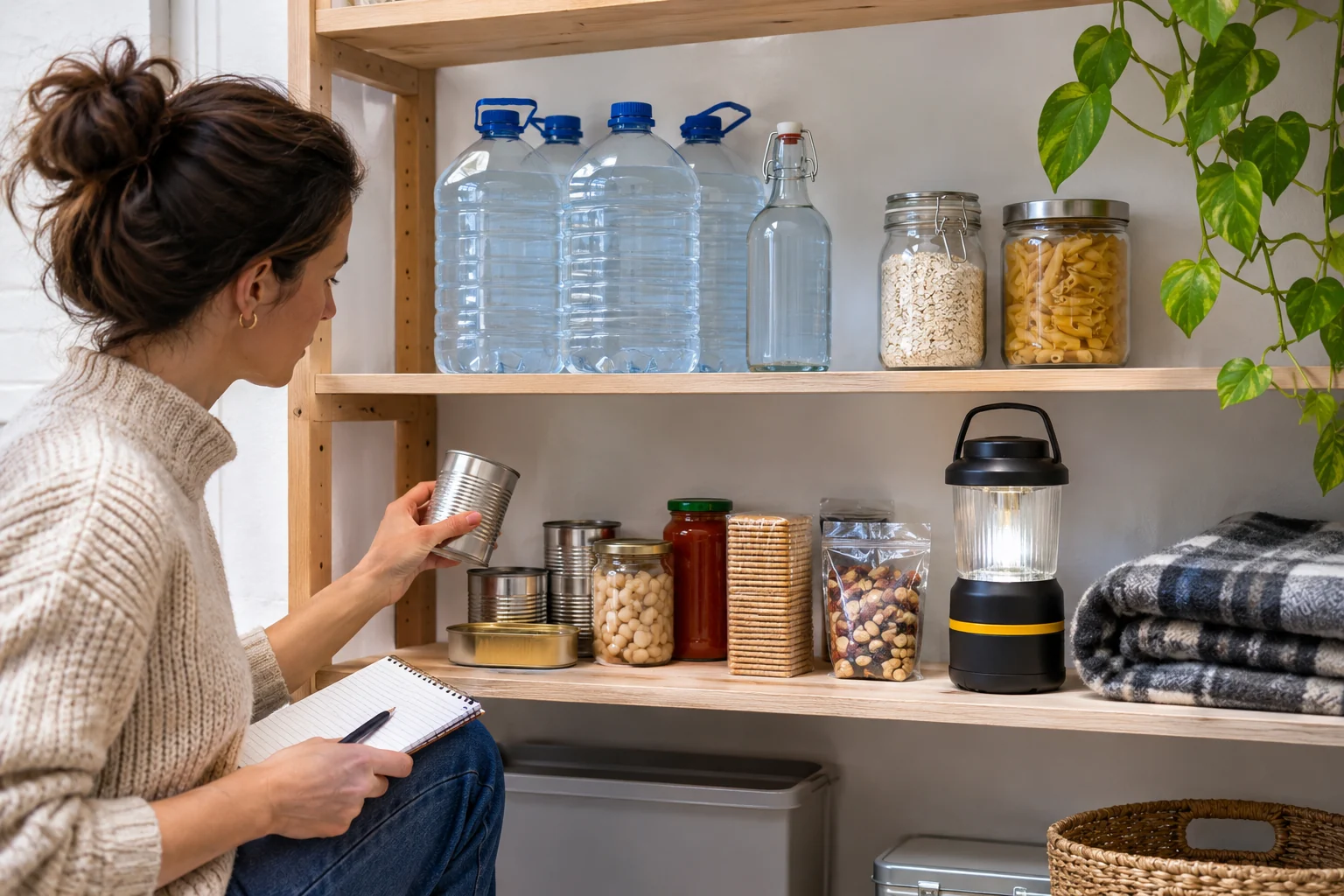
Whatever scenario comes up, certain human needs aren’t up for debate. They’re present in every degraded situation, whatever the cause:
- Water: safe water for drinking, cooking and basic hygiene. Canadian authorities recommend at least 2 litres of drinking water per person per day, plus water for cooking and hygiene, for at least 72 hours.
- Food: supplies that maintain adequate intake, suited to the household’s constraints (cooking without power, storage, special diets, allergies, babies).
- Shelter and warmth: keeping the home livable, which is especially critical in cold regions like Quebec, with safe backup heating and a carbon monoxide alarm.
- Safety and health: protecting household members, having a first aid kit and essential medication, staying informed with a radio and avoiding decisions made in a panic.
When these four dimensions are adequately covered, the exact nature of the crisis becomes secondary for the first hours or days. That’s the time it takes for responders and community resources to organize, or to make informed decisions about what comes next.
Different contexts, different preparations
Preparedness isn’t a one-size-fits-all model. Someone living alone in a downtown apartment doesn’t face the same constraints as a family settled in a rural area: their resources, likely risks and room to manoeuvre differ. A household with young children, an older person, a pet or someone with special care needs also has to adjust its priorities.
Legal frameworks also vary from country to country. In Quebec and Canada, the rules governing, for example, firearms, fuel storage or rainwater collection differ significantly from those in the United States, and France has its own rules. Preparedness resources produced in the United States are often useful for general principles, but how they apply here should always be checked against legal, climate and cultural differences.
The value of diverse viewpoints
A preparedness community limited to a single school of thought grows poorer. Disagreements, when handled with rigour and good faith, sharpen analysis and reveal blind spots. A minority opinion isn’t necessarily wrong, and a dominant one isn’t necessarily right.
The best preparedness resources generally don’t offer a single right answer. They present several perspectives, explain the reasoning and let readers form their own views based on their actual situation. That calls for some humility from those who share content and some critical thinking from those who read it. Preparedness is a personal and family undertaking; it benefits from community exchange and mutual aid, but the final decisions belong to each household.
Where to start, in practice
If you’re just starting out, or want to consolidate what you already have, the most solid starting point is the same: make sure your household’s essential needs can be met on its own for a reasonable period.
- Assess your real vulnerabilities. What are the most likely risks in your region and immediate surroundings: winter storms, prolonged outages, flooding, wildfires, heat waves, supply disruptions? Check official resources: the Government of Canada’s Get Prepared website, your province’s and municipality’s emergency management information (flood zone maps, municipal emergency plan), or Géorisques in France.
- Cover the essentials first. Water, food, warmth, basic first aid and a radio: these are useful whatever causes the disruption.
- Build gradually. Preparedness isn’t a weekend project. A steady, measured approach lasts longer than a big push followed by giving up. See our method for setting preparedness goals.
- Adapt to your context. Your home, your region, who lives with you and your budget determine what’s truly a priority for you.
- Stay informed without locking into a scenario. Keeping an eye on real risks is useful, but keep your approach flexible enough that your preparations serve in many kinds of situations.
Emergency preparedness isn’t about foreseeing everything. It’s about reducing vulnerability and keeping the ability to make informed decisions when conditions deteriorate, whatever the cause.
Final thoughts
There’s no certification in preparedness, no universal method, no scenario that applies to everyone. What exists is a set of solid principles that work across a wide range of situations, and a personal approach that benefits from being informed, nuanced and regularly reassessed.
Disagreements over scenarios or methods are part of the landscape. They’re more useful than people think, as long as they don’t become obstacles to action. What ultimately matters is the household’s real resilience: its ability to get through a hard period with as little disruption as possible, whatever form it takes. The best resources are those that help each reader make informed decisions for themselves and their loved ones.
Frequently asked questions
Do you need to pick a scenario to start preparing?
No. Start with essential needs, then adjust to the real risks where you live. A scenario can motivate, but it shouldn’t dictate your whole preparation.
Whose preparedness advice can you trust?
Advice that’s consistent, verifiable and suited to your context. For health, legal, electrical or financial matters, check with an official source or a professional.
Does American advice apply in Quebec or France?
The general principles often do; the legal, climate and practical aspects don’t always. Always check local rules.