
In this article
Setting preparedness goals is one of the simplest and most effective ways to make steady progress. Without a clear direction, it is easy to scatter your efforts, pile up gear with no coherent plan, or drift toward side topics. This guide offers a concrete method for structuring your citizen preparedness priorities, with examples by area and a sample twelve-month calendar.
In brief
In brief. Take stock of your gaps and your real risks, choose three to five specific, measurable goals, separate short-term from long-term, work on one skill at a time, involve your household and plan a mid-point review. Direction matters more than perfection.
Why goals rather than resolutions
New Year's resolutions have a well-known lifespan. Preparedness goals work differently, as long as you approach them with method. A resolution is often vague, emotionally charged and quickly abandoned. A preparedness goal is concrete, dated, measurable and tied to an overall resilience logic. You are not trying to do everything at once: you are trying to make regular progress on a few well-chosen areas.
Another advantage of yearly goals is that they let you take stock. What was accomplished? What was postponed, and why? Which areas deserve a fresh look? This cycle of planning and review is a useful discipline in itself, turning worry about crises into visible progress.
Core principle: a preparedness goal does not aim for perfection. It aims for measurable progress in areas that genuinely improve personal and family resilience.
How to structure your goals
Before you write a list, ask yourself a few questions:
- Where is my preparedness weakest?
- What are the most realistic risks in my geographic and family context: ice storms, floods, heat waves, wildfires, extended outages, job loss?
- What did I plan last year without doing it, and why?
- Which goals can be reached quickly, and which require several months of effort?
To identify your risks, check official resources for your area: your province's or country's emergency management website, your municipality's emergency plan, or national hazard maps (such as Géorisques in France or FEMA's resources in the United States). Then split your goals into two categories.
- Short-term goals: achievable within a few weeks or the first months. They build motivation and quick results. Examples: signing up for a course, buying and testing a specific piece of gear, checking your emergency kit.
- Long-term goals: they require sustained effort over several months and regular checkpoints. Examples: mastering a complex skill, setting up a backup power source, reorganizing your supplies.
For a goal to be truly useful, phrase it precisely. The SMART method helps turn a vague intention into a verifiable action:
| Vague intention | Specific, measurable goal |
|---|---|
| "Be more ready for outages" | "By March 31, gather 3 days of water and food for the household and test an evening without electricity" |
| "Learn first aid" | "Take a recognized first aid course before summer and renew it according to the certificate's validity period" |
| "Communicate better in a crisis" | "Write a family communication plan and run an out-of-area contact drill by June" |
| "Start a garden" | "Grow three easy vegetables this season and record the yields" |
Example goals by area
The examples below cover several areas of preparedness. They are not prescriptions, but ideas to help you define your own priorities.
Skills and training
Developing practical skills is often the most neglected area. People accumulate gear and forget that skill is the most portable, durable asset, and the one you cannot lose. A few examples:
- First aid: take a recognized course (Red Cross, St. John Ambulance, Heart & Stroke in Canada; American Red Cross in the United States; PSC1 in France; first aid courses in Belgium and Switzerland), then a module on controlling severe bleeding such as Stop the Bleed. If you spend time in remote areas, a wilderness or remote first aid course is especially useful. Check that the provider is recognized in your jurisdiction.
- Personal safety: a structured self-defense or practical martial arts class, in person with a qualified instructor, builds confidence, reflexes and the ability to de-escalate or escape a situation, which theory and videos alone cannot provide.
- Basic skills: lighting a fire safely, purifying water, navigating with a map and compass, repairing, sewing, cooking without electricity.
The informal "one skill a month" rule is a good framework to avoid scattering your efforts: focus on a single skill, practice it, then move on to the next. Learning sticks better and progress becomes visible. Our guide to learning a skill in six steps covers this approach.
Energy and communication
Energy self-reliance is an area where progress can be gradual and very concrete:
- Small solar system: powering a shed, cabin or light devices first is an accessible starting point. This first project teaches the basics (sizing, batteries, charge controllers) before you consider something bigger. Any connection to your home's electrical panel or to the grid must be done by a qualified electrician and comply with the applicable code. See our guide to building solar power in stages.
- Amateur radio: independent communication is often underestimated. Earning your amateur radio certificate (issued in Canada by Innovation, Science and Economic Development Canada, in the United States by the FCC, in France by the ANFR, and by national authorities elsewhere), understanding the frequencies used locally in emergencies and testing your equipment with a local club are structuring goals that can span several months. A hand-crank or battery emergency radio remains the minimum for receiving alerts: see our advice on choosing an emergency radio.
Food and preservation
- Home canning: adding home preserving to your routine is an accessible, gradual goal. Learn food safety basics first: acidic foods (fruit, jams, pickles) can be processed in a boiling water bath, but low-acid foods (vegetables, meat, legumes) require a pressure canner to eliminate the risk of botulism. Follow tested recipes from recognized sources.
- Garden and compost: gradually expanding a growing area, adding fruit trees over several years, starting to compost. These goals span several seasons and benefit from advance planning.
- Stock rotation: setting up a "first in, first out" system so your supplies never expire. See our ten rules for stock rotation.
Mobility and logistics
- A reliable vehicle: the goal is not necessarily to buy an expensive new vehicle. Restoring a reliable one, understanding its basic mechanics and equipping it for your region's conditions is a long-term project that builds skills useful well beyond evacuation.
- Organization and inventory: each year is a chance to reassess what you own, get rid of what is useless and organize the rest better. A regular inventory reveals gaps before they become problems.
Health and fitness
Fitness is an often-forgotten resilience factor. No gear makes up for limited mobility or poor endurance in a degraded situation.
- Include regular physical activity: walking, hiking, cycling, swimming, team sports.
- Combine training with outdoor activities that also build practical skills: orienteering, navigation, overnight camping.
- Adapt your goals to your actual condition and age, without trying to match past performance, while maintaining functional capacity. Ask a health professional for advice if you are returning to activity after a long break.
- Review your essential medications and a reasonable reserve with your doctor or pharmacist.
Preparing together as a family
Individual preparedness has its limits. Involving your loved ones, with goals suited to their interests and abilities, strengthens the household's collective resilience:
- Identify the skills each person can develop according to their interests: gardening, cooking, first aid, navigation, mechanics.
- Plan shared activities that combine preparedness and fun: outdoor outings, hikes, camping weekends.
- Discuss family priorities openly rather than imposing an approach that does not fit the group's realities.
Preparedness that rests on a single person is fragile. Spreading skills and responsibilities increases the household's ability to handle the unexpected, as our article on essential skills for every family member explains.
Prioritizing without scattering
The most common mistake is trying to do everything at once, which leads to half-reached goals, unused gear and fading motivation. A few principles:
- Limit the number of goals: three to five realistic goals beat fifteen theoretical ones.
- Separate urgent from important: some gaps are critical (water, medications, communication plan) and come first; other goals can wait.
- Schedule review points: mid-year is a good time to assess, adjust and understand what got in the way.
- Accept partial completion: a goal 70% reached that produced real progress is worth more than one abandoned after three weeks.
- Respect your budget: spread purchases over the year and favor skills, which are often free. See our habits for saving money on preparedness.
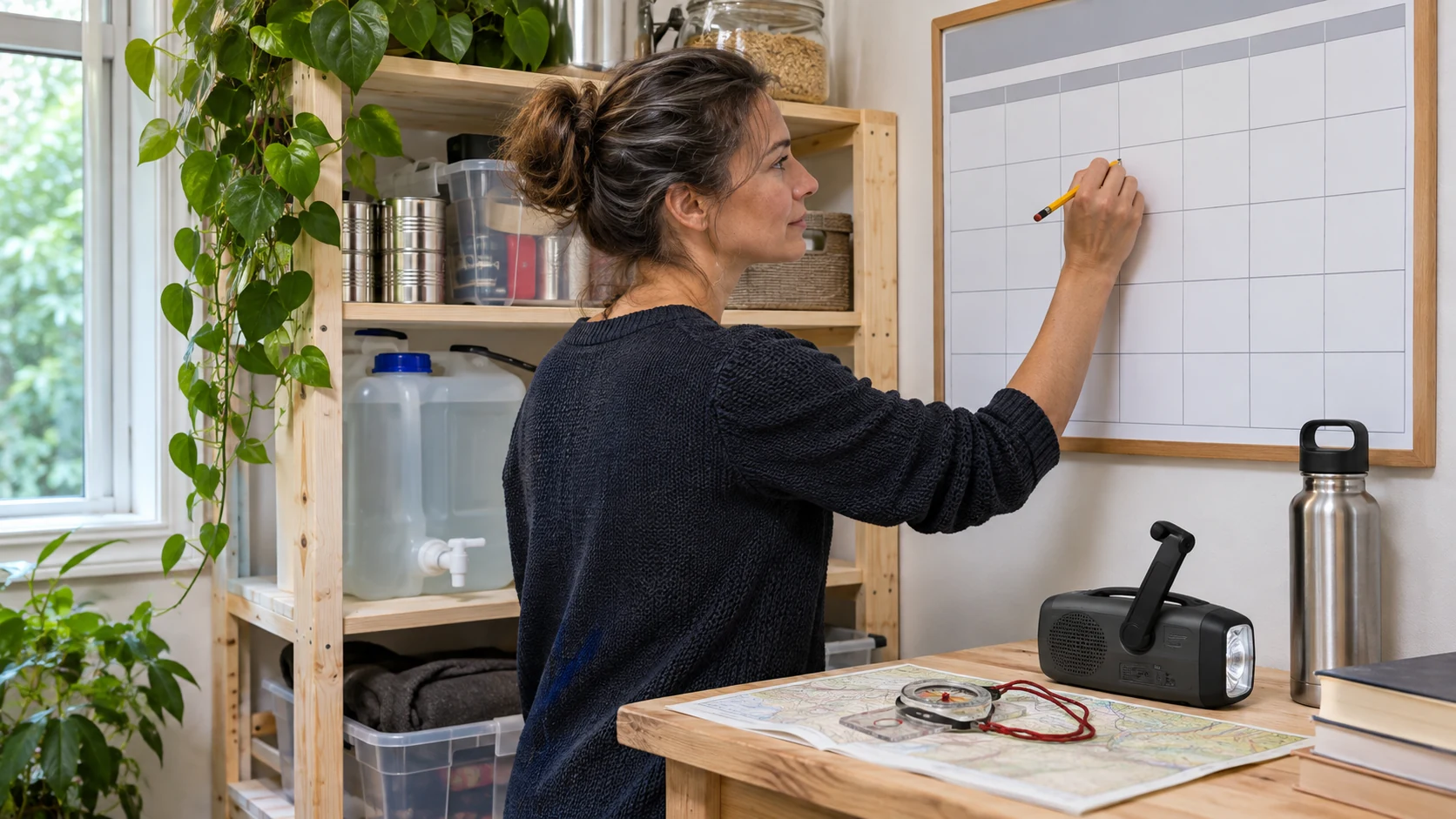
Sample twelve-month calendar
| Period | Priority area | Possible actions |
|---|---|---|
| January to March | Household basics | Assessment, 72-hour reserve, communication plan, power outage drill |
| April to June | Skills | First aid course, first garden, kit review |
| July to September | Mobility and outdoors | Family hike or camping trip, evacuation bag review, mid-year check-in |
| October to December | Winter readiness and review | Winter gear, safe backup heating, inventory, next year's goals |
Adapt this calendar to your hemisphere, climate and your region's seasonal risks: hurricane season, wildfire season, spring floods or heat waves.
Where to start
- Take stock: where are you weakest? Water, food, energy, communication, skills, health, mobility?
- Choose three priority areas: the ones that, once improved, will have the greatest effect on your resilience. Do not try to cover everything in one year.
- Define concrete actions: for each area, one specific, dated action: a course, a piece of gear to buy and test, a skill to practice.
The value of a goal is not measured only by whether it is achieved. Asking the right questions, identifying your gaps and committing to a concrete direction, even imperfectly, is already a form of resilience. The examples here are ideas, not templates: every family, geographic and financial situation is different. The most useful preparedness is the kind that fits into your life for the long term, not the kind that demands a heroic effort for three weeks before being abandoned. For an overview, see our citizen preparedness guide.
Frequently asked questions
How many preparedness goals should you set each year?
Three to five specific goals are enough for most households. A few goals achieved beat a long list abandoned.
Which area should you start with?
Vital needs and critical gaps: water, medications, food for a few days, lighting, a communication plan. More ambitious projects come next.
What if you do not reach your goals?
Review without guilt: identify what got in the way (time, budget, motivation), scale back if needed and carry the goal forward. Partial progress counts.