
In this article
There are many skills to learn in citizen preparedness. In a personal account, I described what I had acquired through four years of serious practice: some gardening basics, two ways to start a fire, experience with target shooting, and better arrangements for storing and rotating food and water. My projects also included Morse code, other fire-starting methods and improving accuracy with a crossbow.
These examples describe an individual learning path. Shooting and crossbows are not prerequisites for household preparedness. Specialized activities require appropriate settings, supervision and checking local rules. Your own priorities may begin with more ordinary needs: first aid, cooking, small repairs, water management and household communication.
The range of possibilities can feel overwhelming. The familiar idea of learning to fish rather than depending entirely on someone else illustrates the value of practical ability, without removing the value of mutual support. The following six steps offer a way to acquire skills gradually.
Step one: list the skills you want to learn
History can suggest questions about present needs. Accounts of the world wars in France and Canada, rationing, and the practical knowledge of the coureurs des bois offer examples to examine. They do not predict how a modern emergency would unfold: infrastructure, healthcare, laws and available resources have changed.
Make a list of skills you could realistically develop, then rank them according to your household’s needs and local hazards. Do not choose only what seems easy or entertaining. Identify the gap a skill would address and whether training is needed before you can practise it safely.
Prioritization helps avoid accumulating unfinished projects. It is easy to announce “I will learn this so that I can do that,” only to remain at the same point years later. Finding a suitable person to learn from can be difficult, but owning equipment or software is not enough either.
Underused language software, an unplayed guitar or renovation supplies waiting to be installed are familiar examples. Giving one learning goal priority at a time can avoid unnecessary purchases and make the next action clearer.
Step two: assess videos carefully
Platforms such as YouTube offer videos on subjects including fishing, archery, starting fires, building shelters and tying knots. Many are free. Their creators have different production resources, and an unpolished image does not itself establish whether the content is accurate.
Visual quality is therefore an insufficient test of a demonstration. Consider the instructor’s experience, the limits of the method, safety arrangements and consistency with reliable references. A simple video may help introduce a knot or identify a question to ask during a course. It does not guarantee competence or replace necessary supervision, especially in first aid or another activity involving risk.
Step three: take structured training
Even if online learning is not your preference, some structured courses can deepen a subject: vegetable growing, storing food and water, camping, shelters or specialized activities. Check the content, qualifications, cost and current conditions of each course. A free tutorial is not automatically reliable or relevant to your circumstances.
Choose resources and organizations that address the actual need, taking account of your budget and opportunities to practise.
Libraries, municipalities, associations and educational institutions can also offer activities. In Québec, CEGEPs and universities are possibilities to explore; elsewhere, look for the equivalent local institutions. Check current offerings and schedules with the organizers.
My own experience included Krav Maga and pistol shooting among other activities. Associations may offer workshops in food preservation, gardening, soap making or candle making. A library talk about food storage and preservation, or a camping course, can provide an accessible starting point. These are examples of fields to investigate, not a guarantee that a particular activity is available in your town.
For children, day camps and scouting organizations may offer age-appropriate learning with suitable supervision. Check the activities, safety arrangements and the child’s needs. A parent who is new to camping can also learn gradually alongside a child without pretending to know everything already.
Step four: practise regularly
After discovering a skill, practise it in a safe setting. Repetition can reveal mistakes, forgotten stages and difficulties using equipment. Keep a list of acquired abilities and schedule several refreshers during the year rather than relying on one session.
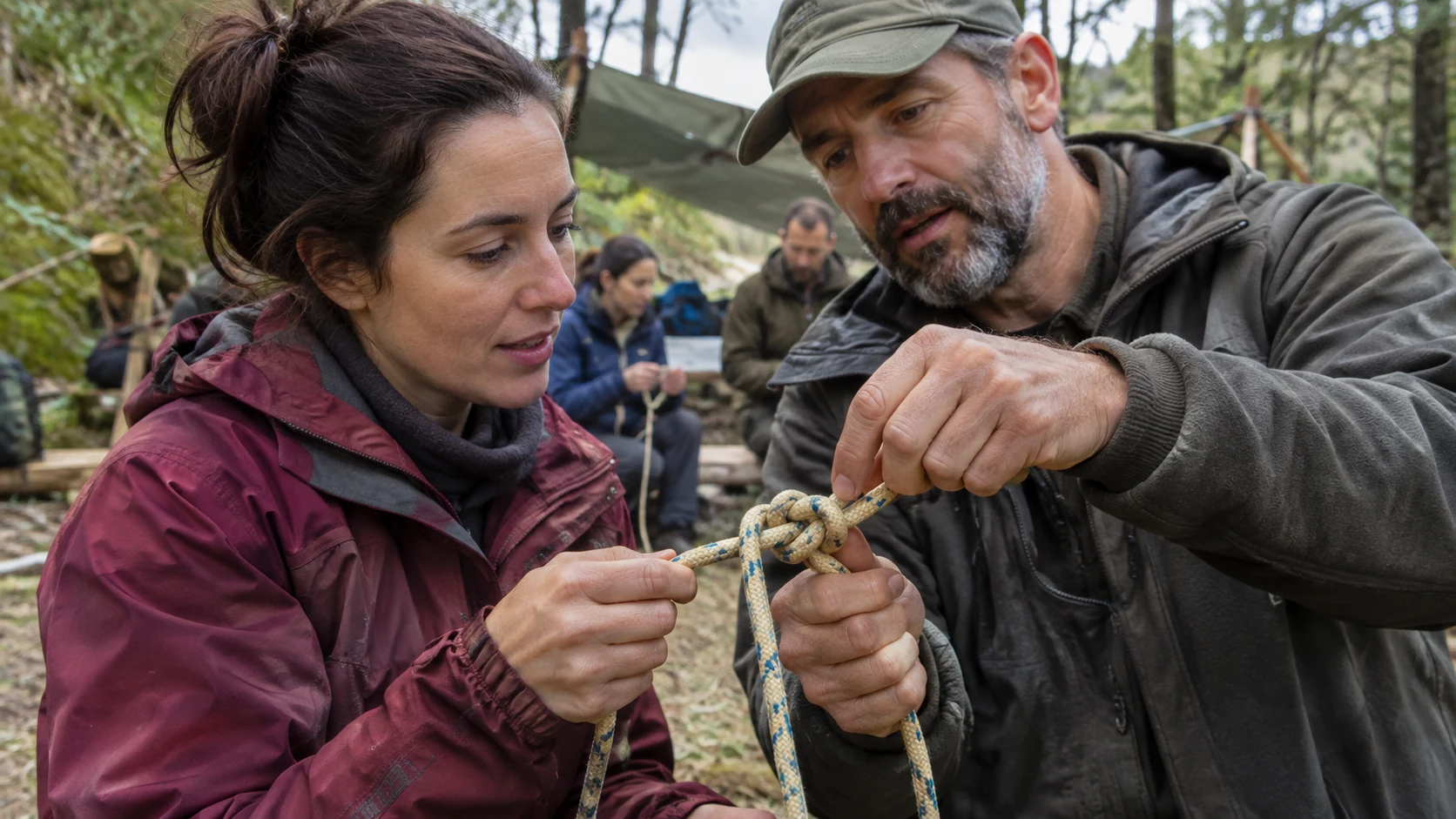
For example, pitch your tent to check that you can set it up efficiently without rushing, practise knots, or arrange a supervised session for a specialized activity. Fire-lighting practice belongs only in an appropriate, permitted location and must respect fire restrictions. The shooting activities mentioned in the personal account require a suitable setting; they are not exercises to transfer to a domestic yard.
Some simple tasks, such as a knot for a non-critical purpose, can be revisited at home during spare time. Successfully demonstrating something once does not establish competence for safety, rescue or supporting a load.
Step five: broaden and update your knowledge
Available time during the day can support gradual learning. In my personal example, this involved about an hour of commuting, some time before colleagues arrived and an hour at the gym. Podcasts and audiobooks provided opportunities to revisit a familiar subject, discover another field or identify an improvement.
Adapt this idea to your present life. Listening is optional and must remain compatible with the main task. When driving, attention to the road takes priority: do not operate a screen or search for content while moving. Audio material can introduce an idea to verify later; it cannot replace practice or careful study of a procedure.
Return regularly to your original list. Read other books, identify related subjects and reconsider your priorities. This review helps maintain interest in the next step while avoiding too many simultaneous projects.
Step six: explain what you have learned
Teaching someone else can provide an opportunity to organize your ideas and check what you understand. A frequently repeated claim needs correction, however: retention percentages attributed to Edgar Dale—for example, remembering 10% of what we read or 70–90% of what we teach—are not established universal findings. His Cone of Experience became associated with a misleading retention chart. No such numerical guarantee is used here.
Explaining a task makes you describe its stages. A learner’s questions can reveal gaps in their understanding and yours. Revisiting the difficulty, checking the answer and seeking feedback can deepen understanding. That does not make a beginner a qualified instructor in a sensitive field.
With children, an appropriate game can make learning enjoyable: finding a contact in the household plan, recognizing equipment or repeating a short, announced exercise. Protect their safety and confidence. The aim is a useful ability, not anxiety about disasters.
What would you like to learn now? Choose a skill, a realistic way to begin and a time to practise and review it.
References and your next action
- Subramony, Molenda, Betrus and Thalheimer (2014): The Mythical Retention Chart and the Corruption of Dale’s Cone of Experience.
- Government of Canada: make an emergency plan around household needs.
Record one priority skill and a practice date in your household plan.