
In this article
- 1. Apply "first in, first out"
- 2. Inspect containers at each rotation
- 3. Watch for signs of infestation
- 4. Keep an up-to-date inventory
- 5. Cook with the supply regularly
- 6. Date items when you add them
- 7. Group items by category
- 8. Label the shelves
- 9. Store heavy items low
- 10. Move items nearing their date in time
- Recap
- Frequently asked questions
- Read next
- Sources and verification references
- Equipment to compare for your needs
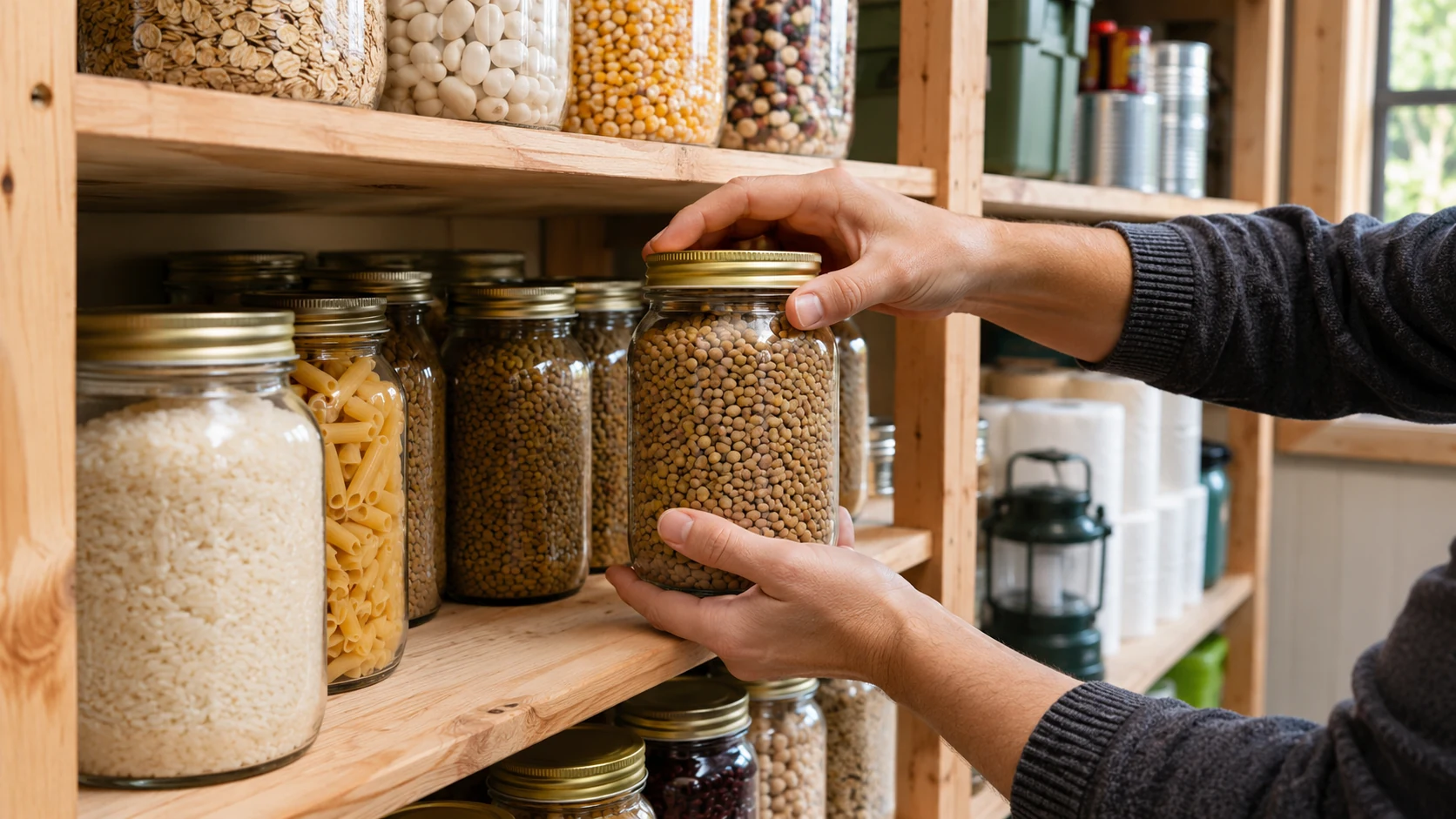
Building a food supply is one thing; keeping it useful is another. A supply forgotten for months collects expired cans, damaged containers and insects, at the very moment you need it. Maintenance does not take much time, but it does take method. Here are ten practical rules, from organizing your shelves to working the supply into everyday cooking.
At a glance
- First in, first out: new purchases go to the back, you take from the front.
- Only store what your household already eats, and cook with the supply every week.
- A monthly check and an up-to-date inventory prevent most losses.
1. Apply "first in, first out"
Rotation follows a principle borrowed from food logistics: eat the oldest items first, and put new ones behind or underneath. This principle, called FIFO, keeps items from sitting at the back of a shelf while the newest ones get eaten.
Choose a rotation direction for each shelf (left to right, or front to back) and stick to it.
With each addition, place new items behind or underneath.
Always take from the "out" side.
A small note on the shelf reminds other household members of the direction.
For large quantities of cans: sloped gravity-feed shelves automate rotation. You load from the back and cans roll forward as they are used. They are sold in stores, or can be built with boards and strips of wood.
2. Inspect containers at each rotation
Each rotation is a chance to inspect what is stored. Some signs call for immediate disposal.
Cans: warning signs
- Bulging lid or bottom: a possible sign of botulism, throw out without opening
- Seepage at the seam: the seal is lost
- Deep rust (not just on the surface): weakened can
- Deep dent on a seam or rim
Other containers: warning signs
- Bag punctured, torn or chewed
- Moisture or condensation inside a container: product too moist to start with, failed seal or temperature swings
- Unusual smell when opened
- Abnormal colour or texture for a familiar product
Botulism: it cannot be detected by smell or taste. The rule has no exceptions: any bulging can is thrown out without being opened or tasted. See Canned food shelf life.
3. Watch for signs of infestation
No supply is safe from pests. Mice, ants, cockroaches and pantry insects (weevils, pantry moths) get in through openings a few millimetres wide, and an unnoticed infestation can wipe out months of effort.
What to watch for: droppings (thin and elongated for mice, tiny and black for cockroaches), chewed packaging, live or dead insects, clumps or silky threads in flour or grain (pantry moths), a musky smell (mice).
Prevention: move bulk goods (flour, rice, legumes) into rigid airtight HDPE or glass containers; leave nothing open; clean shelves; check the seals on the room's doors, windows and vents.
Bay leaves: a few leaves in grain containers may discourage some insects, but the effect is modest; they are only an add-on.
To deal with an infestation, see Pantry weevils and Food supplies and rodents.
4. Keep an up-to-date inventory
A supply whose contents you do not know loses much of its value: you cannot tell what is missing, what is nearing its date or what was taken without being replaced.
| Method | Advantage | Limitation |
|---|---|---|
| Posted paper list | Simple, usable without electricity | Updated by hand |
| Spreadsheet | Sort by date, calculate self-sufficiency | Depends on a device |
| Pantry app | Barcode scanning, date reminders | Depends on a phone and sometimes the internet |
Whatever the method, update it with every movement. A reliable inventory lets you spot what is nearing its date, see gaps before they become a problem, avoid duplicate purchases, track what gets "borrowed" from the supply and estimate the household's real self-sufficiency, in days or weeks.
5. Cook with the supply regularly
An emergency supply is not meant to sit untouched until the big day. That approach produces food nobody eats, expired dates and products foreign to the household's habits. The most effective method: draw on the supply for ordinary meals and replace what you used at the next shopping trip. The supply rotates on its own.
Only store what your household actually eats: in a crisis, preferences do not fundamentally change.
Use sales to stock up on products you already eat, not to discover new ones.
Plan at least one recipe a week with shelf-stable foods (legumes, canned goods, grains).
The acceptability test: food your household has never eaten will be hard to accept under stress. Before adding it to the supply, try it in normal times: you will know whether people like it and how to prepare it, instead of finding out in an emergency. For example, see bread without baker's yeast.
6. Date items when you add them
Printed dates are often tiny and badly placed. Rewriting the date in large print with a permanent marker takes a few seconds and simplifies everything.
Use a thick marker, readable even in low light.
Write on the side that faces out once the item is shelved.
For cans, the month and year are enough.
For repackaged bulk goods, note the repackaging date and the target shelf life.
| Product | Quality benchmark |
|---|---|
| High-acid canned goods (tomatoes, fruit) | 12 to 18 months (USDA) |
| Low-acid canned goods (vegetables, meat, fish, soups) | 2 to 5 years (USDA); often safe beyond that if the can is intact |
| White rice in an airtight container | Several years; much longer in a metallized bag with an absorber |
| Dry legumes | Several years; they take longer to cook as they age |
| White flour | A few months in the pantry; longer in the fridge or freezer |
| Cooking oil | According to the date and type; goes rancid with heat and light |
| Salt, sugar, honey | Very long if kept dry |
7. Group items by category
A supply organized by category cuts search time, makes inventory easier and makes restocking intuitive for the whole household, not just the person who usually handles it.
- grains and starches (rice, pasta, flour, oats);
- legumes (beans, lentils, chickpeas);
- canned vegetables, fruit, meat and fish;
- tomato products;
- condiments, spices and salt;
- oils and fats;
- sweet products (honey, sugar);
- hygiene and health products.
The grocery store model: organize the supply like a small grocery store, with a fixed spot for each category. Anyone can find or put away an item without help, and rotation errors decrease. Emergency and everyday: if the supply sits next to the everyday pantry, separate them physically; ideally, the long-term supply is in a cool, dark place away from kitchen traffic.
8. Label the shelves
Labels make the organization visible: everyone in the household can restock without hesitation, and inventory takes a glance. An empty space under a label instantly shows what is missing. A piece of tape written on with a marker is enough: consistency matters more than looks.
9. Store heavy items low
Heavy items (large cans, bags of 5 kg or more, jugs): bottom shelf, below waist height.
Medium items: between waist and chest, the most accessible shelves.
Light or rarely used items: up high.
Never anything heavy and unstable above head height.
Stability: a 30-day supply for a family of four can weigh several dozen kilos. Anchor shelving to the wall or choose units sturdy enough, and check their load rating before filling them.
10. Move items nearing their date in time
The last stage of an item's life in the supply is its move to the kitchen before its date. You avoid waste and the supply keeps rotating.
As soon as an item is 3 to 6 months from its date, move it to the everyday pantry and plan it into meals.
At each check, review dates that are coming up.
Replace right away: add the replacement to the shopping list when you move the item. The gap between taking and restocking is the main cause of erosion in an otherwise well-kept supply.
Recap
With each addition
- Date the item with a marker
- Place it behind or under existing items
- Update the inventory
- Store it in its category's spot
Every month
- Inspect containers (bulging, seepage, damage)
- Look for signs of infestation
- Spot upcoming dates
- Compare the supply to the inventory
- Move items out and restock
Frequently asked questions
How often should I check my supply?
Once a month is a reasonable minimum for most households: you catch problems before they get worse. A leaking can found after a month is a minor problem; after a year, it may have damaged its neighbours and attracted pests. For a large supply (more than 30 days), checking every two weeks is better for items with shorter shelf lives.
Is a can that just passed its date still good?
The date on a commercial can is generally a best-quality date, not a safety date. An intact, well-stored can usually remains safe long afterwards, with slightly lower texture or nutritional value. Inspect the can (no deep dent, rust or swelling) and the contents when opened (normal smell and appearance). At the slightest doubt, do not eat it.
How do I protect rice and flour from insects?
By combining several layers: rigid airtight containers (food-grade HDPE or glass with a seal), since original bags do not stop insects; oxygen absorbers, which keep eggs from hatching; cool storage (ideally below 18°C); and freezing new purchases for at least 4 days. Bay leaves are only an add-on.
Should the supply stay at a fixed level or change with the seasons?
Both. A base level, for example 30 days, serves as a floor. Seasonal adjustments anticipate risky periods: in Quebec, fall is the right time to build up the supply before winter, which concentrates prolonged power outages and difficult roads. Some households choose, for example, to aim for 45 to 60 days in winter.
What about a small home with no dedicated space?
Fit the supply into existing space: under beds (flat airtight boxes), in little-used furniture, on top of cabinets, on high wall shelves. Rotation matters even more, because out of sight is out of mind.
Read next
Planning for a crisis lasting weeks
Organizing needs when the situation lasts beyond the first few days.
Rainwater harvesting
The same principles of rotation and maintenance apply to water supplies.
Bread without baker's yeast
Using the supply's flour and grains in everyday cooking.
Sources and verification references
Local instructions and product instructions take precedence for your situation. References consulted for this update:
Equipment to compare for your needs
Some links below are affiliate links: we may receive a commission at no additional cost to you. Products are examples by function, to choose according to your needs; buying the entire selection is unnecessary.