
In this article
You open a container of rice or flour and find small brown insects in it: unpleasant, but far more common than you might think. Weevils are among the most frequent insects in food supplies, and finding them does not mean the whole pantry is lost. Here is how to assess the situation calmly, what to throw out, what can be protected and how to keep it from happening again.
At a glance
- Weevils usually arrive with the products, as invisible eggs: it is not a sign of poor hygiene.
- Throw out visibly infested food, isolate it quickly and inspect the rest; nearby containers that are well sealed and clean can be kept.
- The best prevention: freeze new grain purchases for at least 4 days at −18°C, then store them in airtight containers.
What weevils are and why they appear
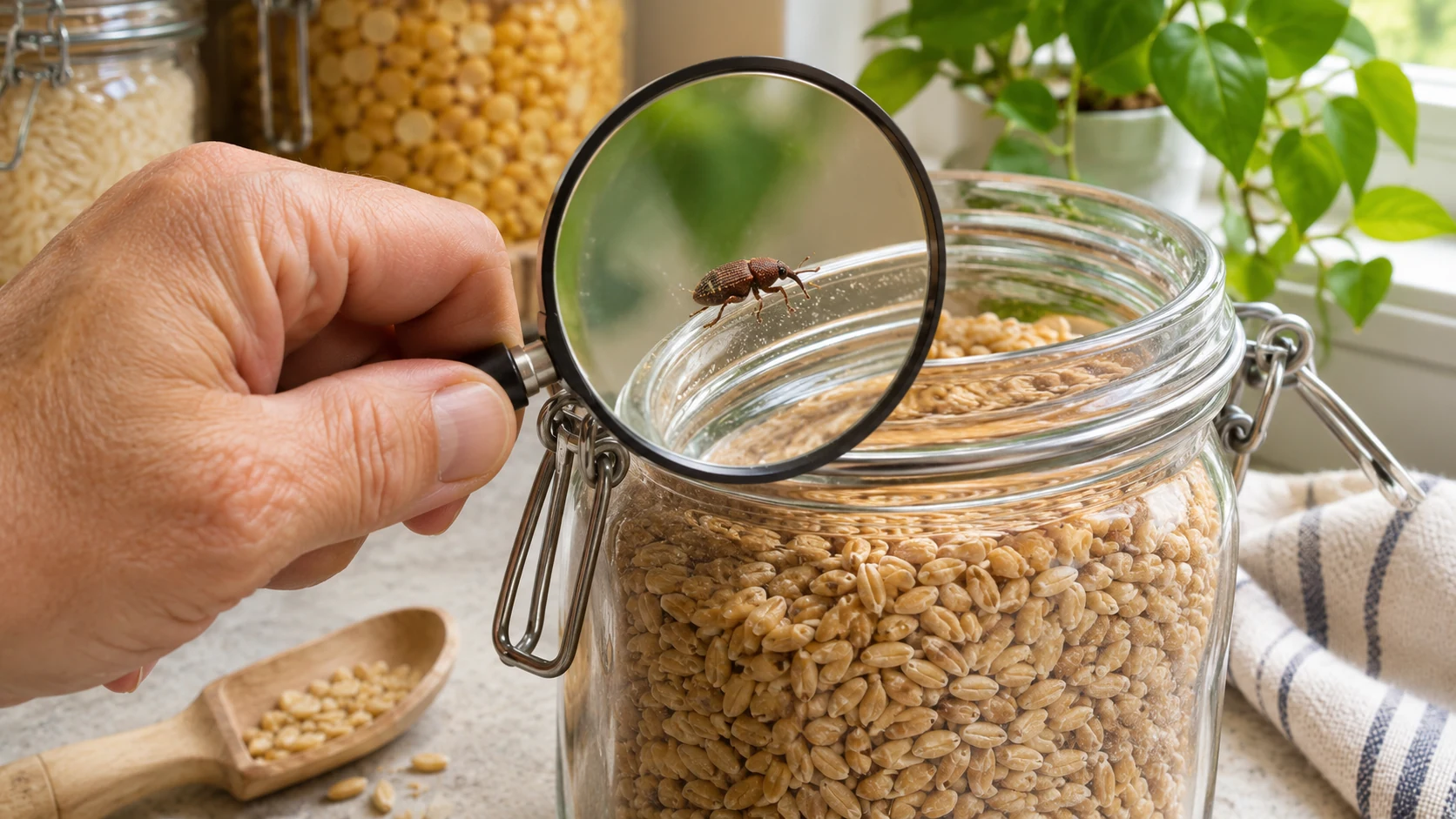
Weevils are small beetles. In stored food, the most common are the granary weevil (Sitophilus granarius) and the rice weevil (Sitophilus oryzae). They are a few millimetres long, dark brown to black, and recognizable by their elongated "snout," the rostrum.
Their life cycle is tied to grains and starches: the female bores a hole in a grain, lays an egg inside, then seals it. The larva grows inside the grain, feeding on it, and emerges as an adult a few weeks later.
Why they appear in new products: in most cases, weevils do not come from outside. They were already in the product when you bought it, as invisible eggs laid in the field or during processing. They hatch when conditions allow: warmth, humidity and storage time. It is not a sign of poor hygiene, but a reality of long-term storage.
The foods most often affected:
- rice (white, brown, wild);
- wheat, corn and other grain flours;
- dry beans and other legumes;
- whole grains (wheat, spelt, barley);
- dry pasta;
- semolina and couscous.
Is it dangerous to your health?
Insects do not make food toxic, but they signal an infestation and reduced quality: droppings, insect fragments, damaged grains, and sometimes moisture or mould that come with the problem. The University of Minnesota recommends throwing out visibly infested food, then inspecting the rest of the pantry: these insects contaminate far more food than they eat. Cooking does not fix mould or allergens.
People often point out that insects are eaten in many parts of the world. That is true, but those are insects raised and prepared for food, not a batch of infested flour with its droppings.
In a prolonged shortage: some people choose to sort and thoroughly cook a very lightly affected batch rather than throw it out. It is a choice to make knowingly. Without exception, discard any batch that is damp, mouldy, rancid or smells off, and keep people with allergies in mind. Isolate the container as soon as you find the problem, to keep adults from reaching nearby packages.
Handling an infestation without throwing everything out
Throw out visibly infested food, but not automatically the whole pantry.
Isolate the infested container, closed in a bag, and take it out of the kitchen.
Inspect all nearby dry goods, especially those in their original packaging.
Clean the shelves: vacuum corners and cracks, then throw out the vacuum bag.
Treat clean but questionable products with cold (see below).
Transfer clean products to airtight containers and keep an eye on them for a few weeks.
Option 1: floating out the adults? Not a good idea
Soaking brings some adults to the surface, but it removes neither larvae hidden in the grains, nor droppings, nor other contamination. It is not a way to make a batch safe. And a wet batch must never go back into dry storage.
Option 2: killing eggs and larvae with cold or heat
Cold: freezing
Put the food in an airtight bag and freeze it at −18°C (0°F) for at least 4 days, longer for a large volume. Cold kills eggs, larvae and adults. Let it return to room temperature before opening the bag, to avoid condensation.
Heat: oven
For a suspect product that is not visibly infested, the University of Minnesota describes a thin layer in the oven at 54°C (130°F) for at least 30 minutes. The heat must reach the whole mass. This does not sterilize the food or save a mouldy batch; for flour, freezing is gentler.
Option 3: hiding the insects in a recipe? No
Grinding an infested batch or mixing it into a dough does not fix the quality problem. Do not transform a visibly infested batch to make it look acceptable: get rid of it, and focus on protecting the clean food.
What about non-food uses?
You sometimes read that infested food can be used as bird feed, homemade play dough, an ant repellent or filling for a heating pad. These uses are not recommended: they can spread the infestation, attract other pests or needlessly expose people or animals to mouldy food. Instead, dispose of the batch in a tightly closed bag, in the outdoor garbage.
Preventing future infestations
Prevention rests on four simple principles that, applied consistently, greatly reduce the risk.
Airtight containers
Original bags (paper, thin plastic) do not stop weevils. Transferring food to rigid airtight containers (glass, hard plastic, metal) is the most effective measure. Metallized bags with oxygen absorbers remove the conditions insects need to develop.
Freeze before storing
Freezing new purchases of grains and legumes for at least 4 days before adding them to your supply kills eggs present at purchase. It is the simplest, most reliable prevention.
Cool and dry
Weevils thrive mainly between 25 and 30°C (77 and 86°F), with high humidity. A cool, dry place, such as a sound basement, greatly slows their breeding, even if eggs are present.
Rotation
First in, first out: using the oldest products first shortens storage time, and therefore the risk. A supply that rotates is a healthier supply.
Myths and facts
"Bay leaves keep weevils away." A modest, unreliable effect: they do not kill eggs already present. An add-on, not protection.
"Rice turns into maggots." No: the larvae come from eggs already in the grains.
"Weevils are a sign of a dirty kitchen." No: they usually arrive with the product.
More resources on long-term storage
- Long-term flour storage
- Long-term rice storage
- Dry beans: comparing five storage methods
- Oxygen absorbers for food storage
- Complete guide to Mylar bags
- Food supplies and rodents: containers and prevention
Summary
Finding weevils calls for a proportionate response: discard infested food, keep nearby containers that are still clean and well sealed, then clean and monitor. Cold or heat treatments kill insects but do not restore spoiled food.
Prevention remains far more effective than dealing with it afterwards: airtight containers and freezing new purchases are two simple habits that clearly improve the life and quality of your supplies. A well-managed supply rotates, is inspected regularly and is kept in good conditions.
Frequently asked questions
How can I tell if my supplies are infested?
The most common signs: small brown insects in the container, a fine greyish powder at the bottom (remains of chewed grains), grains with holes or hollowed out, and an unusual rancid or dusty smell. Early on, infestation is hard to see: inspect your containers regularly, preferably in daylight.
How long should food be frozen to kill weevils?
At least 4 days at −18°C, according to the University of Minnesota. Some sources advise 7 days for large quantities, whose centre takes longer to cool. Let it return to room temperature in the closed bag before opening, to avoid condensation.
Do weevils attack foods other than grains?
They are adapted to grains and dry legumes. They do not attack sealed canned goods, sugar, oils, or properly sealed freeze-dried or dehydrated foods. An infestation in an open container can still spread to poorly closed packages nearby: hence the importance of isolating it quickly.
Should I throw out my whole supply if one container is infested?
No, if you act quickly. Isolate the affected container and inspect the others. Those that are airtight with no sign of infestation can generally be kept: weevils mainly travel through original packaging, not from one airtight container to another. Take the opportunity to do a full inventory of your supply.
Read next
Food supplies and rodents
Choosing containers and habits that also protect against mice.
Complete guide to Mylar bags
The reference method for long-term airtight storage that keeps insects out.
Long-term rice storage
Containers, conditions and shelf lives to protect your rice supply.
Sources and verification references
Local instructions and product instructions take precedence for your situation. References consulted for this update:
Equipment to compare for your needs
Some links below are affiliate links: we may receive a commission at no additional cost to you. Products are examples by function, to choose according to your needs; buying the entire selection is unnecessary.