
In this article
- What is an oxygen absorber?
- The four types of compatible containers
- How many absorbers should you use?
- Which foods can be stored with absorbers?
- The botulism risk
- Storing unused absorbers
- Absorbers compared with other methods
- Frequently asked questions
- Further reading
- Equipment to compare based on your needs
Even dry foods like beans and rice slowly deteriorate when exposed to oxygen: oxidation destroys nutrients, turns fats rancid and encourages mould. For storage over several years, oxygen absorbers are the simplest, cheapest and most effective solution at home. This guide explains how they work, compatible containers, how to calculate the right amount, foods to exclude, the botulism risk and how they compare with other methods.
In short
- An oxygen absorber only works in a fully airtight container: a sealed Mylar bag, a Mason jar, a bucket with a gasket lid or a sealed #10 can.
- Use them only for dry foods (under 10% moisture) that are low in fat.
- Never with moist foods: without oxygen, the bacteria that cause botulism can grow.
- Work quickly: once the package is open, absorbers saturate within a few hours in open air.
- Keep packets out of children's reach; if swallowed in Quebec, call the Centre antipoison du Québec at 1-800-463-5060.
A note on shelf life
The long shelf lives quoted for some dry foods are planning estimates, not safety guarantees for home packaging. The food must be suitable, dry enough and properly packed. Oxygen absorbers don't dry food and don't destroy all bacteria: discard any product that's mouldy, damp or suspicious. Rotate your supplies and follow the manufacturer's instructions.
What is an oxygen absorber?
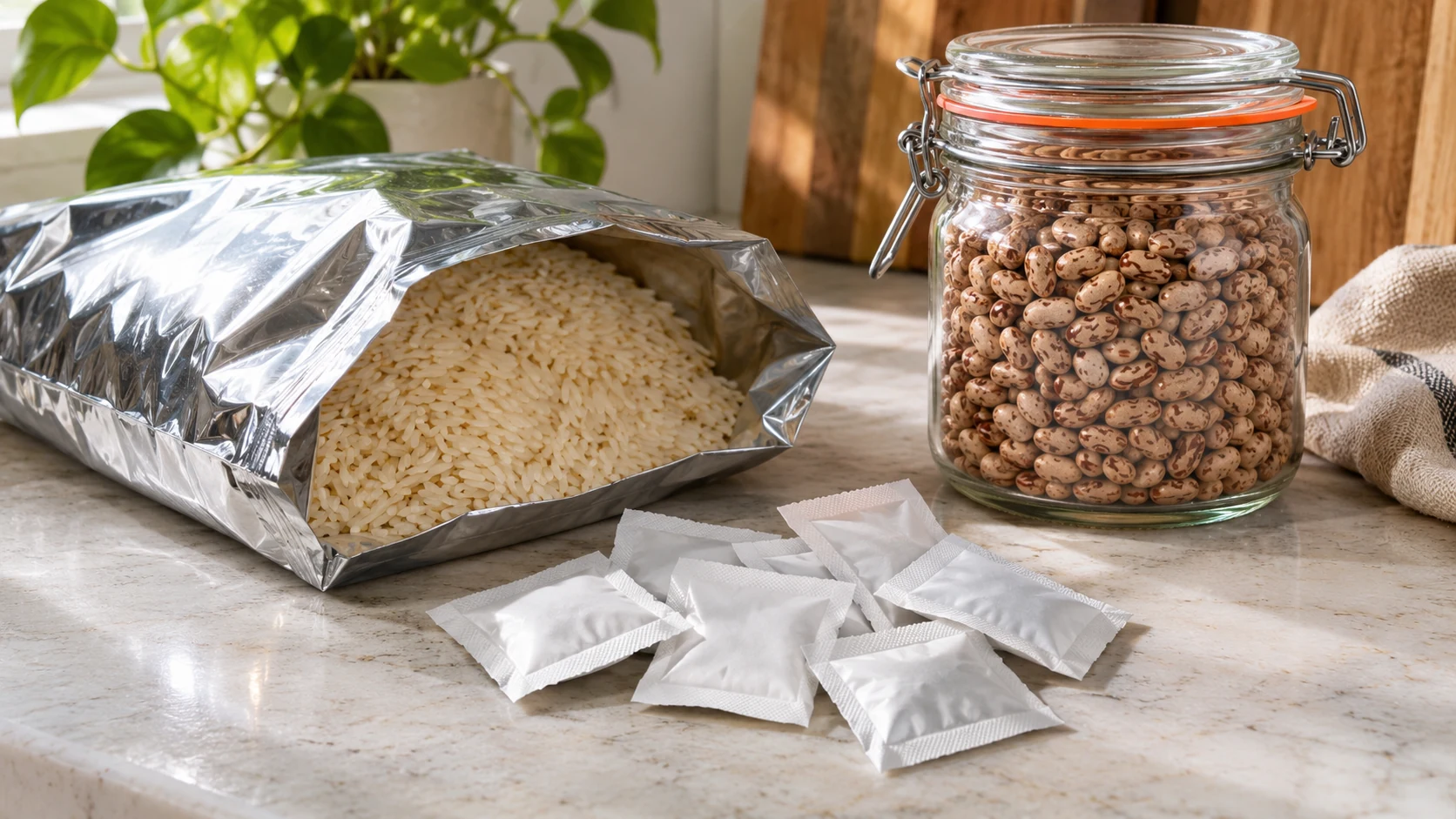
An oxygen absorber (often abbreviated OA) is a small packet containing iron powder. Placed in an airtight container, it chemically binds oxygen: the iron "rusts" and the oxygen concentration in the container drops below 0.01%.
Good to know: air is made up of about 78% nitrogen, 21% oxygen and 1% other gases. Absorbers only remove oxygen; nitrogen stays in the container, with no effect on the food. That's why a bag never empties completely of air, but shrinks a little.
Oxygen absorbers help to:
- prevent deterioration from oxidation;
- slow the growth of moulds and bacteria that need oxygen (but not anaerobic bacteria, such as the one that causes botulism);
- preserve the flavour and colour of food over the long term;
- protect vitamins sensitive to oxidation;
- eliminate most insects: deprived of oxygen, insects and their larvae don't survive, which keeps an infestation from developing in the container.
The four types of compatible containers
An oxygen absorber only works in a fully airtight container. If the container lets air through, the absorber is useless.
| Container | Strengths | Limitations | Best for |
|---|---|---|---|
| Mylar bag | Blocks air, moisture and light; economical | Sealing takes practice; contents not visible | Large long-term supplies |
| Mason jar | Simple, rodent-proof, easy rotation | Fragile glass; lets light through | Small quantities |
| Bucket with a screw-on gasket lid | Large quantities, impact-resistant | Re-exposed each time it's opened; gasket lid costs more | Supplies opened rarely |
| Sealed #10 can | Very sturdy, blocks light | Can sealer is expensive | Long-term portions |
1. Mylar bags
Mylar is a metallized multilayer material that's impermeable to air and moisture. It's the go-to option for long-term storage: economical, durable and available in several sizes. You fill the bag with dry food, add the absorbers, then heat-seal it. The bags can then be stored in buckets for extra protection against impacts and rodents.
Advantages
- Protects from light.
- Practically indestructible once stored in a bucket.
- The cheapest long-term option.
- Available in several sizes.
Drawbacks
- Sealing takes a bit of practice.
- You can't see the contents without opening the bag.
For the full procedure, read our guide to Mylar bags for food storage.
2. Mason jars
Mason jars (two-piece lids) are great for small quantities. Add the absorber to the jar filled with dry food and screw on the lid. As the absorber does its job, the lid is pulled inward: a sign that the jar is airtight.
Advantages
- Very easy to use.
- Rodent-proof.
- Easy stock rotation.
Drawbacks
- Fragile (glass).
- Limited volume per jar.
- Doesn't protect from light: store them somewhere dark.
3. Food-grade buckets
Food-grade buckets let you store large quantities. Be careful: most ordinary HDPE buckets let a little air in through the lid, which is fine for short-term storage but not long-term. Screw-on gasket lids (Gamma Seal-type) form a real barrier and are recommended for storage beyond a year. Even better: put the food in a sealed Mylar bag inside the bucket.
Each time you open it
Opening a bucket exposes the food to air. If you close it again, add new absorbers. Buckets are therefore less suited to supplies you rotate often, and better for long-term supplies that are rarely opened.
Advantages
- Large quantities in a single container.
- Durable and impact-resistant.
Drawbacks
- Most ordinary buckets aren't airtight.
- Re-exposed to oxygen each time they're opened.
- Gasket lids cost more.
4. #10 cans
This is the format many emergency food manufacturers use (about 3 litres, a little under a US gallon). You can use it at home with a can sealer, a specialized and expensive piece of equipment. The process is simple: fill the can with dry food, add the absorbers, seal. The seal is fully airtight and the cans resist impacts.
Advantages
- Extremely sturdy packaging.
- Protects from light and impacts.
- Small portions make rotation easier.
Drawbacks
- Expensive can sealer.
- Limited volume per can.
How many absorbers should you use?
In a container filled with food, the oxygen to remove is in two places: in the spaces between pieces of food, and inside some porous foods themselves, such as dry beans. For effective long-term storage, the absorbers' capacity must cover both.
When in doubt
Using a few more absorbers than needed won't harm the food. They're inexpensive: better to use one too many than to run short and compromise months of storage.
Precise calculation: the water test
This test measures the proportion of air in any dry food:
Pour 1 cup (250 ml) of the dry food into a large measuring cup.
Add 2 cups (500 ml) of water.
Read the final volume: it will be less than 3 cups, because the water filled the air spaces.
Calculate: 3 cups minus the volume you read = volume of air. Example: 3 − 2.5 = 0.5 cup of air, or 50% of the food's volume.
Apply this proportion to the container's total volume to get the volume of air, then multiply by 21% (the share of oxygen in air) to find the volume of oxygen to absorb.
Full example
A 1 US gallon (3,785 cm³) Mylar bag filled with a food containing 50% air: 3,785 × 50% = about 1,893 cm³ of air. Then 1,893 × 21% = about 398 cm³ of oxygen to absorb. Choose absorbers with a total capacity of 400 to 500 cm³ (capacity is listed in "cc", meaning cm³ or millilitres of oxygen).
Beans and legumes: these foods also contain air inside the seed. For an accurate test, soak them at least 6 hours before measuring. They generally need more absorbers than standard charts suggest. See also Dry beans: comparing storage methods.
Which foods can be stored with absorbers?
Almost all dry, low-fat foods are suitable:
- flours and whole grains;
- pasta and cereals (see Long-term rice storage);
- dry beans and legumes;
- powdered milk and powdered cheese;
- freeze-dried foods;
- thoroughly dry spices.
Home-dehydrated foods
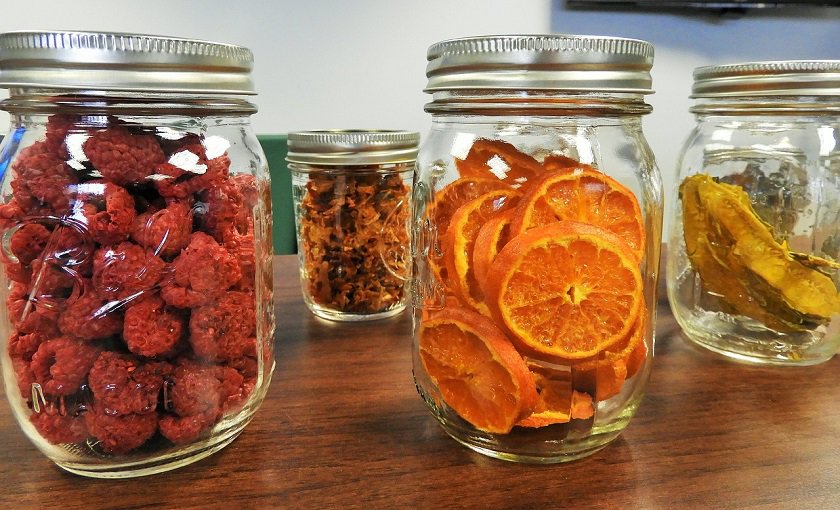
Fruits and vegetables dehydrated at home are only suitable if they're dry enough: they should snap when bent, or shatter under the pressure of a spoon for round shapes. Too much residual moisture creates a botulism risk (see below). For the full method, see our food dehydration guide.
Nuts and seeds
Absorbers extend the shelf life of nuts and seeds, but their high oil content means they inevitably go rancid: expect about 2 years at most with absorbers, less without. Low temperature and humidity remain the most important factor. Granola, also high in oil, isn't suited to long-term storage.
Foods never to store with absorbers
- Salt: it hardens like a rock in an airtight container with an absorber, and doesn't need one to keep.
- Sugar: same result; brown sugar also contains too much moisture. See Storing sugar.
- Moist foods: any food over 10% moisture must not be stored with absorbers, because of the botulism risk.
- Baking soda, baking powder, pancake mixes, yeast: a chemical reaction could make leavening agents ineffective.
The botulism risk
The bacterium Clostridium botulinum is anaerobic: it thrives precisely in environments without oxygen, and produces a very dangerous toxin. According to Utah State University, it needs a moisture level of about 35% or more to grow. For a good safety margin, specialized guides recommend storing only foods with less than 10% moisture with absorbers.
Correction
This article stated that cooking "eliminates this risk in practice". That's misleading. The U.S. CDC does say the toxin is destroyed by heating to 85 °C (185 °F) for at least 5 minutes, but cooking must never be used to "rescue" a doubtful food. Never taste a suspicious food. Throw out, without eating, any container that's bulging, leaking, smells bad or whose contents look abnormal. If symptoms appear after eating a suspicious food (blurred vision, trouble swallowing or speaking, weakness), call 911 or, in Quebec, Info-Santé 811.
This risk shouldn't discourage you from using absorbers: it only concerns foods that aren't dry enough. Standard dry products (beans, rice, flour) and properly dehydrated foods don't have this problem.
Dehydration guidelines before storage
For fruits and vegetables you dehydrate yourself, here are pretreatment and drying guidelines. Times vary with the dehydrator, slice thickness and room humidity: always check the final texture.
| Food | Pretreatment (blanching) | Drying (hours) |
|---|---|---|
| Apples | Anti-browning dip | 6 to 12 |
| Apricots | Anti-browning dip | 24 to 36 |
| Bananas | Anti-browning dip | 8 to 10 |
| Carrots | Blanch 3 to 4 minutes | 3.5 to 5 |
| Cherries | Anti-browning dip | 24 to 36 |
| Corn | Not needed | 6 to 8 |
| Figs | Not needed | 6 to 12 |
| Garlic | Not needed | 6 to 8 |
| Grapes (seedless) | Not needed | 12 to 20 |
| Mushrooms | Not needed | 8 to 10 |
To find out how long they keep afterwards, read How long dried foods keep.
Storing unused absorbers
As soon as they leave their package, absorbers start taking oxygen from the air. After 2 to 4 hours in open air, they're saturated and unusable. So prepare everything in advance and put away the ones you don't use right away.
Original package, vacuum-sealed
The best option: close the original package and vacuum-seal it immediately.
A filled Mason jar
Put the absorbers in a Mason jar, fill the remaining space with marbles or another inert material to reduce the volume of air, then seal it tightly.
How to tell if an absorber is still active:
- the original package arrives vacuum-packed, a sign of freshness;
- the colour indicator, if there is one, is pink or red (no oxygen), not blue or purple (oxygen present);
- the packets feel soft, not hard or crunchy.
Some suppliers say their absorbers have a real capacity above the stated one. Count on a working window of 10 to 20 minutes after opening the package before their effectiveness starts to drop noticeably.
Absorbers compared with other methods
| Method | What it removes | Keep in mind |
|---|---|---|
| Oxygen absorber | Oxygen | Simple and effective in an airtight container |
| Desiccant (silica gel) | Moisture | Acts on something else; rarely combined with an absorber |
| Vacuum sealing | Part of the air | Bags are slightly permeable; 2 to 3 years at most |
| Nitrogen flushing | Oxygen, displaced by nitrogen | Excellent results, but specialized equipment |
Oxygen absorbers or desiccants?
These two products don't act on the same thing: absorbers take up oxygen, desiccants take up moisture. Absorbers need a little moisture to activate, so using them with a desiccant is generally not recommended. One exception: for home-dehydrated foods that still contain some moisture, a silica gel packet (not a stronger desiccant, which could keep the absorber from activating) can help. In that case, put the desiccant at the bottom of the container and the absorber on top.
Oxygen absorbers or vacuum sealing?
Vacuum sealing reduces the air in the package without removing it completely, and vacuum bags are slightly permeable to oxygen: they're not suited to storage beyond 2 to 3 years. Absorbers in an airtight container do better: they lower oxygen below 0.01% and keep it there.
Using an absorber in a vacuum-sealed bag is counterproductive: the vacuum removes the nitrogen (which the absorber doesn't take up), and the absorber that keeps taking up the remaining oxygen can create such a strong vacuum that sharp-edged foods like rice may puncture the bag.
Oxygen absorbers or nitrogen flushing?
Nitrogen flushing, used industrially for chips and some packaged products, fills the package with nitrogen to drive out the oxygen. It gives excellent results, but requires specialized equipment that's hard to use correctly at home. Absorbers give an equivalent result (the oxygen disappears and only nitrogen remains) with a much simpler method.
Frequently asked questions
Can oxygen absorbers be reused?
No. Once saturated (after 2 to 4 hours in open air, or after use in an airtight container), an absorber can't be regenerated at home. They're single-use products, inexpensive enough to replace every time.
How much time do I have after opening the package?
You generally have 10 to 20 minutes of working time after opening. After that, absorbers gradually saturate. Prepare all your containers and food before opening the package, work quickly and immediately reseal unused absorbers in their vacuum-sealed package or a well-filled Mason jar.
How can I tell if the absorbers worked in a Mason jar?
The most visible sign is the lid being pulled in: the centre of the flat lid is slightly concave and doesn't "click" when you press it, just like a successful canning job. If the lid is domed or clicks under pressure, the jar isn't airtight and the oxygen hasn't been removed.
Are absorbers dangerous if swallowed by accident?
They contain iron powder, of low toxicity in small amounts for a healthy adult. But the packets are a choking hazard for young children, and iron can be dangerous for them. Remove them before eating the food and keep them out of children's reach. If a child swallows one in Quebec, call the Centre antipoison du Québec at 1-800-463-5060; elsewhere in Canada, call your provincial poison centre.
Further reading
- The complete guide to Mylar bags for food storage: procedure, sizes and shelf lives.
- How long dried foods keep: fruit, vegetables, jerky and mushrooms.
- Freeze-dried or dehydrated: comparing uses and storage
Sources and verification references
Local instructions and product instructions take precedence for your situation. Reference consulted: Utah State University: food storage and low-oxygen packaging.
Equipment to compare based on your needs
Some links below are affiliate links: we may receive a commission at no additional cost to you. Products are examples by function, to choose according to your needs; buying the entire selection is unnecessary.