
In this article
Dry beans provide protein, fibre and variety in a food reserve. Their usefulness also depends on the water, energy and preparation time required. Storage should keep them dry and sound without turning a commercial or experimental shelf life into a universal guarantee of several decades.
Understand deterioration
Humidity, heat, pests and compromised packaging can affect the lot. Over time, the culinary quality can also decrease: older beans sometimes become more difficult to soften. The absence of visible mold does not prove that all storage conditions have been correct.
Keep the bean type, origin and date. Do not mix batches without tracking. Choose volumes that are compatible with the recipes of the household and keep a ready-to-eat portion for situations where cooking would be difficult. Bulky dry stock is not a complete answer to loss of cooking facilities.
1. Airtight food containers
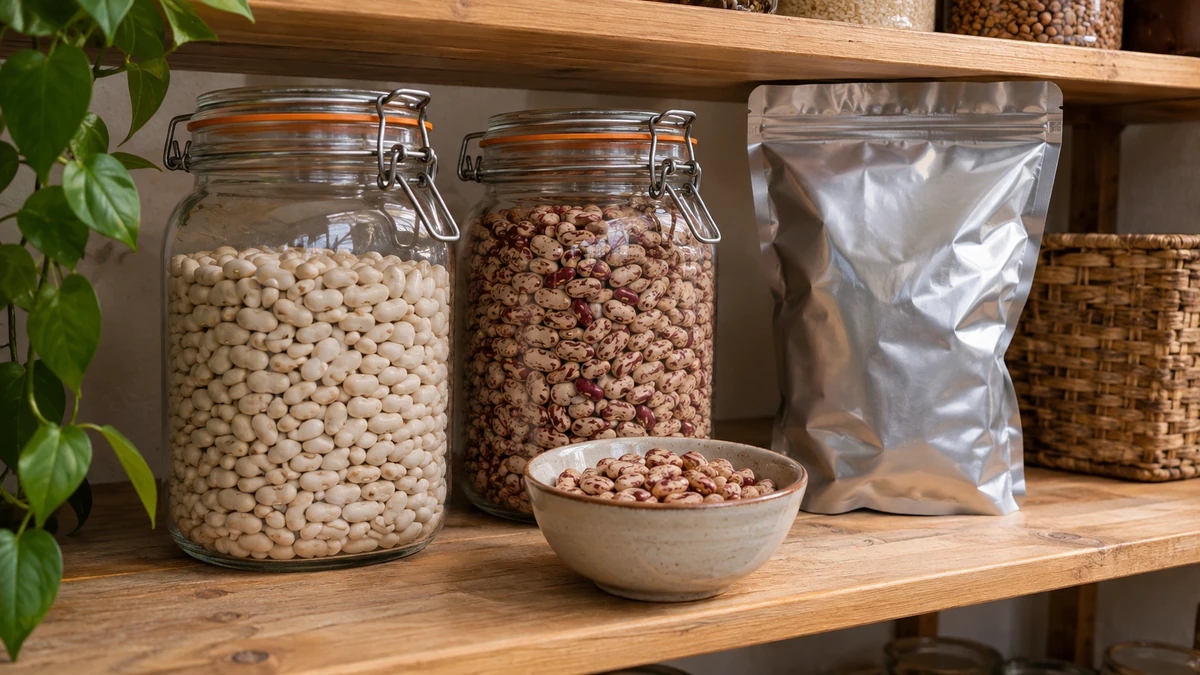
A clean, dry and tightly closed container protects better than a badly closed bag. It must be suitable for food contact and load. Small containers limit repeated openings and facilitate inspection. Check the seals, look for cracks and protect against odours.
This method is suitable for regular rotation. It does not remove the insects already present and does not make a wet product safe. If you notice an infestation or degradation, isolate the lot and decide on an appropriate response; do not mask the problem by transferring the grains to another container.
2. Freezer storage
Cold can be part of a storage or pest-management plan by an appropriate method. It requires space and power. A short freeze should not be presented as a universal treatment of all insect stages.
Especially prevent condensation when returning to room temperature. A dry product can regain moisture if the packaging is opened too early in humid air. Organize the manipulations and follow the recommendations of the chosen method rather than a randomly chosen number of hours.
3. Vacuum sealing
Vacuum reduces air in proper packaging, but does not sterilize the food. The quality of the bag, the closure and the risk of perforation count. Packaging that has taken up air must be inspected; the equipment does not compensate for poor storage conditions.
Provide portion packaging and protection against mechanical damage. The cost of the consumables and the place of the machine must be compared to the real gain in your rotation. A more complex technique is not automatically more useful for a small stock used quickly.
4. Containers with oxygen absorbers
The absorbers require a sufficiently dry product, a really tight container and an appropriate sizing. They are not suitable for all foods. Follow the instructions of the supplier and a reliable storage method; a sachet does not correct excess moisture.
Label clearly and avoid bags arriving in prepared portions. Keep them out of the reach of children. The presence of an absorber does not allow to deduce a precise duration without knowing the product, the packaging and the conditions.
5. Mylar-type barrier bags
A barrier bag can be combined with a protective container and, when the method provides, with an absorber. The quality of the heat seal is essential. Check the instructions, dimensions and the absence of perforation. The outer bucket protects physically, but is not necessarily itself an oxygen-tight barrier.
Prepare beans safely
Follow reliable cooking instructions for the variety. Health Canada highlights the risk of lectins in undercooked dry kidney beans and advises not to cook them using only a slow cooker. Commercially canned kidney beans have already undergone the necessary processing; they offer a different option for a reserve without long cooking.
Try the stored batches, note the time and energy consumed, and then adjust the rotation. The best method is one that keeps food usable and that you can follow properly.
Reference: Health Canada, lectins in dry legumes.
Equipment to assess for your needs
Canadian and French listings may differ in model, capacity or package. Check the exact item, instructions and suitability for your use. No price or stock availability is guaranteed.

Contenant Rubbermaid, plastique sans BPA, Brilliance Pantry stockage hermétique des aliments, stock ouvert, cassonade (7,8 tasses)
View on Amazon.ca
Rubbermaid Brilliance Lot de 4 boîtes de conservation alimentaire sans BPA avec couvercles, hermétiques, résistantes aux taches, passent au lave-vaisselle, gris
View on Amazon.frAffiliate links: PrépaCivile may earn a commission on qualifying purchases. Product names and images come from the Amazon listings reviewed. No prices or customer reviews are reproduced.