
In this article
Food supplies become more useful when they are part of ordinary meals. Soup is a simple way to combine stock, vegetables, protein and starch while checking what needs to be used, replaced or stored more clearly.
The historical article began with a culinary discovery: you can make soup with available ingredients without following a rigid recipe. We retain that idea, the variations and the detailed example. The aim is to develop a method your household can repeat, rather than buy foods it never cooks.
Start with a small inventory
Before taking out a pot, check the refrigerator, freezer and dry supplies. Choose a few ingredients that suit the preferences and allergies of the people eating the meal. Record what you use. This helps you adjust future purchases and place new products behind older ones.
Stock rotation is not a reason to salvage questionable food at any cost. A leak, insects, damaged packaging or uncertain storage requires a separate decision. Making soup does not automatically turn spoiled food into safe food.
In Canada, a best-before date mainly describes the quality of an unopened product stored correctly; it is not the same as an expiration date. This means neither an automatic ban the next day nor a universal one-year extension. Check the type of product and its instructions. Reference: CFIA, understanding food date labels.
Choose a stock you actually use
Vegetable, poultry or bone stock can provide a base. Cubes and concentrates make some meals easier; homemade or frozen stock also works when its preparation and storage are properly managed. Follow the product directions for dilution. Adding equal amounts of water and stock is not a rule for every concentrate.
Arrange containers by date and label homemade portions with the preparation date. A readable label avoids guessing what is inside a frozen container. Make an amount that suits the pot, the planned meals and the space available for cooling and storing portions.
Vary the protein without complicating preparation
Canned beans, lentils, tofu and properly stored cooked meat offer different options. Choose the protein before deciding on the cooking sequence: dried lentils need appropriate cooking, while cooked beans or tofu can be added according to the recipe.
Raw meat cannot be handled as if it were a cooked leftover. Use a recipe that accounts for cooking it and making the necessary checks. The time needed to soften vegetables does not, by itself, establish that every protein is ready. For dried legumes, follow the preparation instructions for the particular product.
During a power outage, the choice may also depend on available water and cooking energy. Trying a soup made with already-cooked ingredients beforehand lets you learn its taste, preparation and utensil requirements. That trial is more useful than an improvised estimate during an emergency.
Adjust the starch and vegetables
Grated potato can thicken the stock; pasta, rice or another starch changes both texture and liquid requirements. Avoid adding several large amounts of starch without checking the remaining capacity. They can absorb a substantial share of the liquid.
Carrots, beets, sweet potatoes, onions, squash, kale and celery appeared in the historical example. They are suggestions, not requirements. Check vegetables stored in a cellar or cool space before using them. Do not assume a storage practice will suit your home simply because it worked in another setting.
A detailed example to adapt
The historical version combined the ingredients below. We retain the amounts as a culinary starting point, without presenting old prices as current ones.
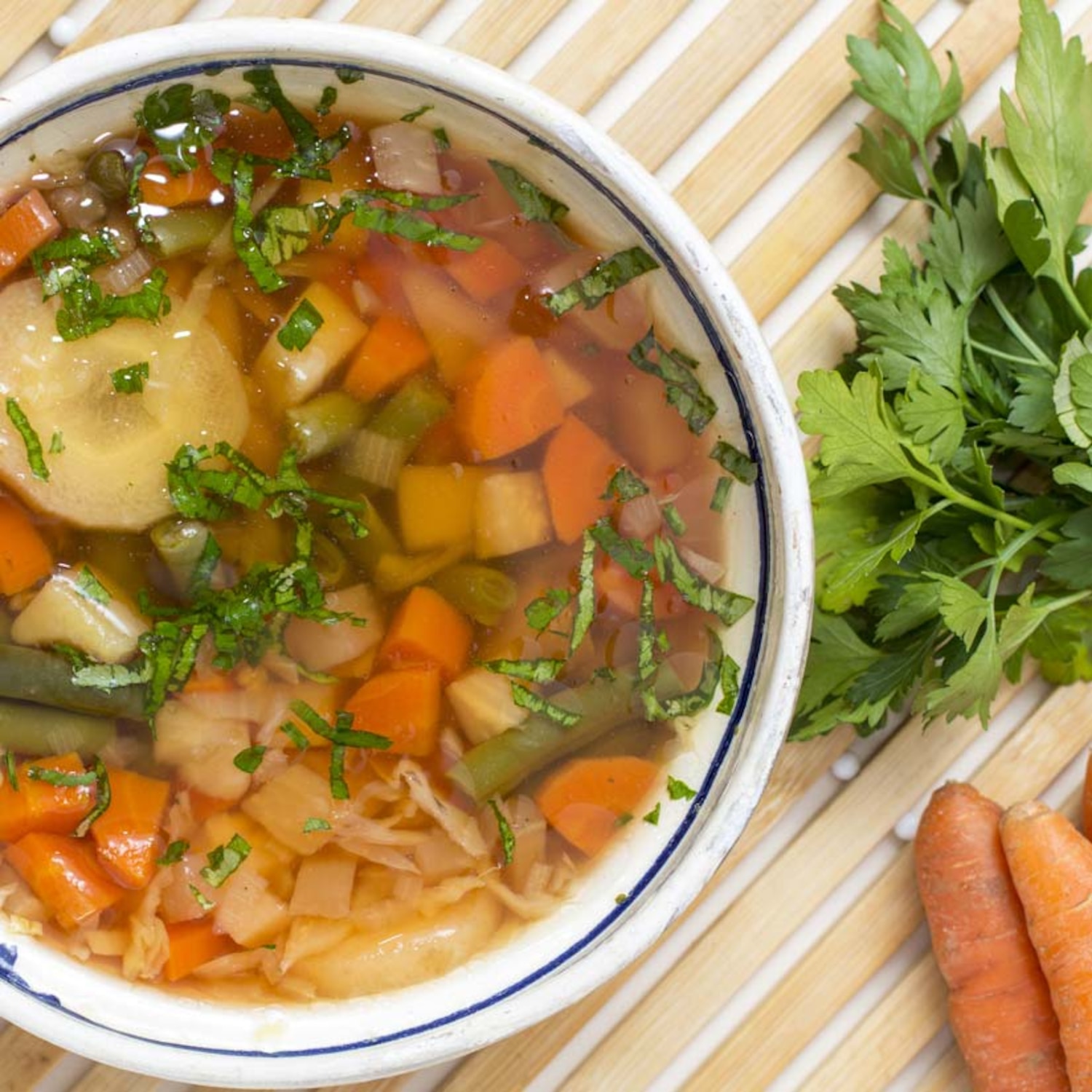
- 4 cups of ready-to-use stock and 4 cups of water, adjusted for the stock you choose;
- 1 carrot, 2 beets and 1 sweet potato;
- 2 onions and 3 cloves of garlic;
- dried basil and chilli flakes, to taste;
- ½ block of tofu, cubed, and 1 can of mixed beans;
- 1 cup of roasted butternut squash, previously prepared and stored appropriately;
- 6 large kale leaves with their tender stems, and 1 celery stalk.
Prepare and cut the vegetables, then plan when to add them according to cooking time. Leave enough room to stir without overflowing. The original example simmered for more than 30 minutes, until the vegetables were tender. Adjust that time for the pieces, ingredients and recipe you use. Adjust liquid and seasoning gradually.
The reported yield was approximately ten two-cup portions. Measure your own batch: evaporation, additions and vegetable size affect the result. A portion of soup is not automatically a complete meal for every person. Adjust the amount and accompanying foods to your needs.
Cool, store and reheat portions
Health Canada recommends cooling leftovers quickly in shallow containers, keeping cooked food at room temperature for no more than two hours, and eating refrigerated leftovers within two or three days or freezing them. Reheat to 74 °C and bring soup to a rolling boil while stirring. Smell and appearance cannot establish food safety. Full Health Canada guidance (French).
Set aside the containers you need before starting. Label the food, date and number of portions. Reheat the amount you intend to eat rather than the entire supply. A label can also identify allergens important to your household.
Measure what the habit changes
The historical cost of less than $6.50 depended partly on garden produce and purchases made at another time. It is not a current budget. To compare your variations, add up the ingredients actually used and divide by the number of portions obtained. Keep a separate line for garden produce if you also want to track its cost.
After the meal, record the ingredients people enjoyed, what remains and what needs replacing. A successful soup can then become a reference recipe for pantry rotation. The intended result is practical: familiar foods, realistic quantities and a meal the household knows how to make again.