
In this article
- What is Mylar?
- Mylar vs. Vacuum Sealing
- Which foods should be stored in Mylar bags?
- Risk of botulism
- Shelf life of foods stored in Mylar bags
- Oxygen absorbers: use and dosage
- Sealing methods
- Step-by-step instructions
- Choosing Your Mylar Bags
- Capacity by food type
- Frequently Asked Questions
- Sources and References
- Related resources
- Equipment to compare for your needs
Mylar bags have become the gold standard for long-term food storage among those preparing for emergencies. Non-porous, gas-impermeable, light-opaque, and puncture-resistant, it offers preservation conditions that are difficult to replicate with other materials available to the general public. When combined with oxygen absorbers, it enables a shelf life of several decades for dry, low-fat foods.
This guide covers the entire process: understanding Mylar and its benefits, choosing the right foods, using oxygen absorbers correctly, sealing the bags step-by-step, and selecting the appropriate equipment.
What is Mylar?
Mylar is the trade name for biaxially-oriented polyethylene terephthalate. Originally developed in the 1950s, this material is used in numerous industrial applications—thermal insulation, solar filters, technical blueprints, and even kites. For food preservation, its physical properties make it an especially suitable choice:
- Non-porous
- Gas-impermeable
- Reflects light (protects against photochemical degradation)
- Flexible and puncture-resistant
- Accessible and easy to use
Mylar vs. Vacuum Sealing
Vacuum sealing and Mylar bag storage are often confused. They are two distinct processes that yield different results.
Vacuum Sealing — Limitations
- Long-term leakage: the plastic bags used are porous at a microscopic level. Over time, air gradually seeps in.
- Residual oxygen: vacuum sealing removes most of the air, but not all of the oxygen.
- Light penetration: transparent bags allow for the photochemical degradation of food.
Mylar bags — advantages
- Complete seal: Mylar is impermeable.
- Near-total oxygen removal using absorbers — less than 0.01%.
- Total opacity: the aluminum layer blocks 100% of light.
Vacuum sealing can extend shelf life by 3 to 5 times, which is useful for regular stock rotation. For long-term storage exceeding 5 years, Mylar bags combined with oxygen absorbers are the best solution.
Which foods should be stored in Mylar bags?
The deciding criterion is simple: dry and low in fat. Any food containing moisture may begin to spoil inside an airtight, sealed bag. Any food high in fat will turn rancid within 3 to 12 months.
Foods suitable for long-term storage
- Professionally dehydrated fruits and vegetables
- White flour
- Cereals and whole grains
- Pasta
- Sugar
- Dried beans
- Powdered milk
- Spices
Foods with a limited shelf life (2 to 5 years in Mylar)
These foods can be stored in Mylar but require regular rotation:
- Whole wheat flour
- Pearl barley
- Brown rice
- Brown sugar
- Granola
- Dried meat (jerky)
- Nuts and seeds
- Dried eggs
- Ground grains (other than oats)
- Fresh or moist foods
- Home-dehydrated fruits and vegetables (unless they snap when bent—a sign that the moisture content is sufficiently low)
Risk of botulism
Botulism is a risk when storing moist foods in low-oxygen packaging. For dry goods intended for storage with an oxygen absorber, guidelines from Utah State University recommend a moisture content of approximately 10% or less. This benchmark does not replace product-specific measurements; no generic threshold (such as 35%) is sufficient to rule out the risk.
Warning sign: If a Mylar bag is bulging (a sign that bacteria are growing inside), do not consume its contents.
Botulinum toxin is destroyed by boiling for 10 minutes. Many foods intended for long-term storage (such as dried beans or grains) are cooked in water before consumption, which eliminates any potential contaminants. However, this does not justify consuming food from a bag that is bulging or shows signs of spoilage.
Shelf life of foods stored in Mylar bags
Three factors explain why it is difficult to provide exact shelf-life durations:
- Nutrients degrade before the food itself. Rice, for example, may remain safe to eat for 25 to 30 years, but its nutritional value begins to decline after 10 years.
- Data on the shelf life of items in Mylar is limited. There are few systematic, long-term studies; some cited timeframes are estimates based on the known properties of the material.
- Storage conditions have a major impact on shelf life. Every 5.6°C (10°F) increase in temperature cuts the shelf life in half. A cool, dry environment (between 10 and 15°C / 50 and 59°F) significantly extends the shelf life of stored goods.
| Food Type | Shelf Life (sealed Mylar bag + oxygen absorbers) |
|---|---|
| Hard whole grains (dried corn, buckwheat, red wheat, kamut, spelt) | 10 years or more |
| Soft whole grains (oats, quinoa, rye, barley) | 8 years or more |
| Professionally dehydrated vegetables | 10 to 20 years |
| Professionally dehydrated fruits * | 10 to 15 years |
| Home-dehydrated fruits and vegetables * | 2 to 5 years |
| Freeze-dried fruits and vegetables | 25 years |
| Legumes (beans, lentils, chickpeas, split peas) | 25 years or more |
| White rice | 10 to 30 years |
| Brown rice | 2 to 5 years |
| White flour | 10 to 15 years |
| Whole wheat flour | 10 years |
| Cornmeal | 5 to 10 years |
| Potato flakes | 30 years |
| Pasta | 20 to 30 years |
| Non-fat dry milk | 15 years |
| Powdered cheese | 10 to 15 years |
| Powdered eggs | 5 to 10 years |
| Nuts and seeds ** | 1 to 5 years |
| Granola | 1 year |
| Yeast | 3 to 5 years |
| TVP (textured vegetable protein) | 10 to 15 years |
| Baking soda / baking powder | 30 years |
| Sugar | Depending on product quality, packaging, and turnover |
| Honey | Depending on product quality, packaging, and turnover |
| Salt | Depending on product quality, packaging, and turnover |
* Home-dehydrated fruits and vegetables
Home-dried fruits and vegetables have varying levels of residual moisture. The fact that a piece snaps or breaks is not an accurate measure of its moisture content or water activity. Follow a validated method for each specific food item, and use appropriate packaging and storage durations; a desiccant cannot turn an insufficiently dried product into one that is safe for oxygen-free storage.
** Nuts and seeds
Nuts and seeds contain oils that become rancid over time. Mylar packaging extends their shelf life but does not eliminate the issue entirely. Most sources suggest a practical shelf life of about 2 years. Regular rotation is essential. The key is to keep the temperature low—cold conditions significantly slow down the process of becoming rancid.
Oxygen absorbers: use and dosage
Oxygen absorbers (OAs) are small packets containing iron. Once placed inside an airtight container, oxygen molecules bind to the iron particles. OAs can reduce the oxygen content within a container to less than 0.01%. Nitrogen—which makes up about 78% of the air—is not absorbed and remains in the bag. This is why a sealed Mylar bag containing an OA does not always have the "sucked-in" appearance of vacuum-packed goods; this is perfectly normal.
Benefits of oxygen absorbers
- Prevents food degradation caused by oxidation
- Inhibits the growth of mold and aerobic bacteria
- Preserves flavors and colors
- Protects vitamins that are sensitive to oxidation
- Eliminates pests—microscopic eggs present on dry foods cannot hatch without oxygen
Foods that should not be stored with oxygen absorbers
- Salt: hardens completely in the presence of an OA
- White sugar: also hardens; Brown sugar contains too much moisture.
- Moist foods: a moisture content greater than 10% creates a risk of botulism in an anaerobic (oxygen-free) environment.
Oxygen absorbers vs. nitrogen flushing
Nitrogen flushing is a technique used by some industrial manufacturers (it is what puffs up bags of potato chips). It involves displacing oxygen by injecting nitrogen before sealing the package. Without professional equipment, it is very difficult to ensure that no residual oxygen remains inside the packaging. Using oxygen absorbers is a much more accessible method that yields comparable results for home use.
Quantity of oxygen absorbers required
Oxygen is present in a bag in two places: in the spaces between the food items and within the food items themselves. The number of oxygen absorbers (OAs) required therefore depends on the type of food and the volume of the container. It is always better to use slightly more OAs than necessary—an excess has no negative impact on the food.
| Food Type | 1 quart (0.95 L) | 1 gallon (3.8 L) | 5 gallons (18.9 L) |
|---|---|---|---|
| Beans, lentils, split peas | 125–150 cc | 500–600 cc | 2,500–3,000 cc |
| Rice | 100 cc | 400 cc | 2,000 cc |
| Flour | 100 cc | 400 cc | 2,000 cc |
| Instant mixes and powders | 100 cc | 400 cc | 2,000 cc |
| Coffee beans | 100 cc | 400 cc | 2,000 cc |
| Pasta | 125 cc | 625 cc | 2,500 cc |
| Cereals | 125 cc | 625 cc | 2,500 cc |
| Instant potatoes | 125 cc | 625 cc | 2,500 cc |
| Whole grains (barley, corn, wheat, oats) | 125 cc | 625 cc | 2,500 cc |
Storing unused oxygen absorbers
As soon as the package is opened, oxygen absorbers (OAs) begin to absorb ambient oxygen. They reach their maximum capacity within 2 to 4 hours. Once the package is opened, work quickly. To store unused oxygen absorbers (OAs): reseal them in their original vacuum-sealed packaging, or place them in an airtight glass jar filled as full as possible (the less air in the jar, the better the OAs are preserved).
How to check if oxygen absorbers are still active
- They arrive in vacuum-sealed packaging
- The oxygen indicator is pink or red (not blue)
- The sachets are soft to the touch (not rigid)
Sealing methods
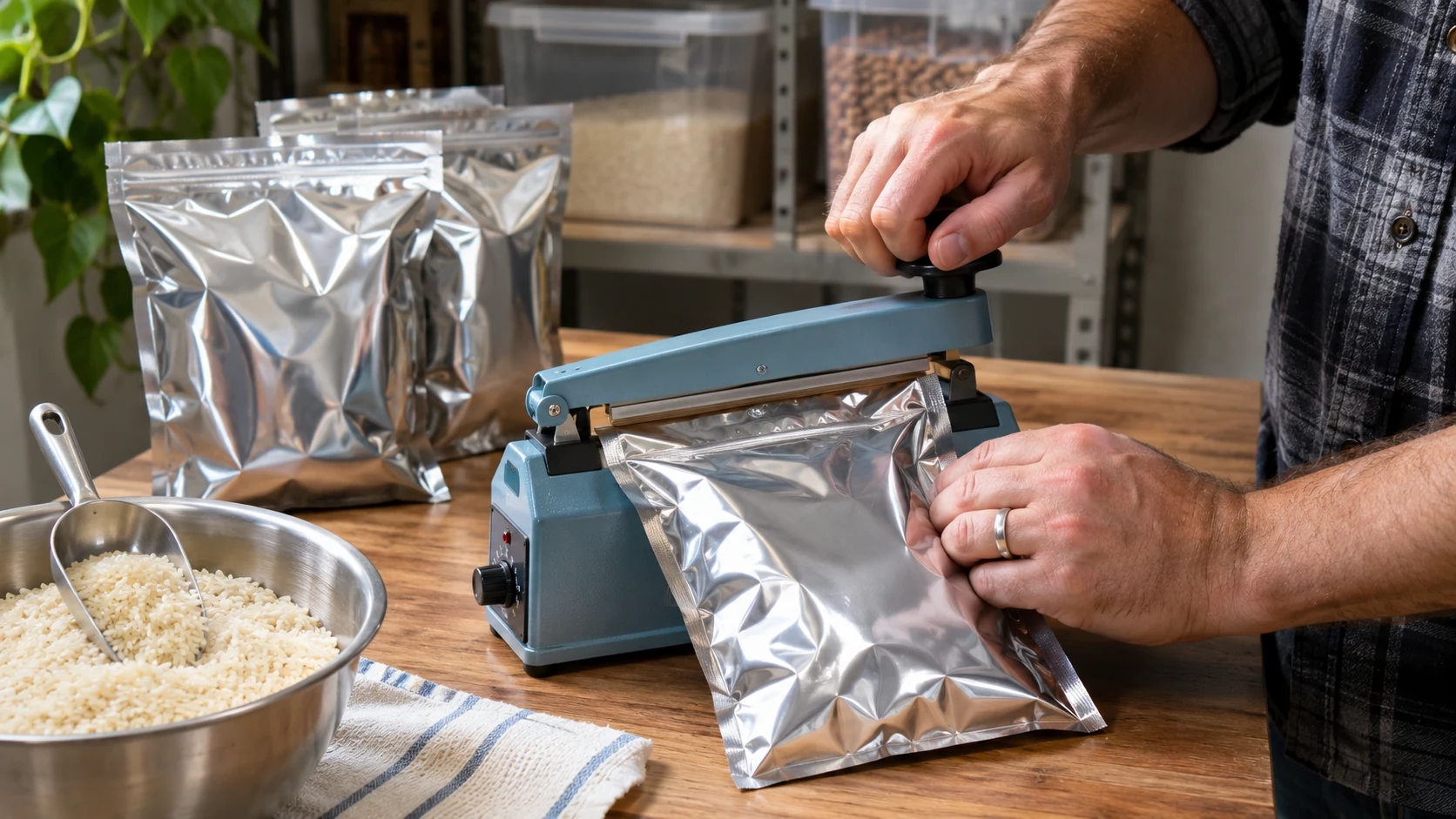
Mylar bags must be heat-sealed to create a durable, airtight seal. Bags with an integrated zip-lock closure must also be heat-sealed—the zip is merely for convenience and is not a substitute for heat-sealing. The required temperature is approximately 190 to 220°C (375 to 425°F). Thicker bags require higher temperatures.
1. Dual-heated (clamshell-style) heat sealer (recommended)
A handheld tool with two heated surfaces that press against both sides of the bag simultaneously. This makes it easier to seal the final 2–3 centimeters after the air has been removed. Optimal setting: approximately 210°C (410°F). This is the most practical method for regular home use.
2. Impulse sealer
Designed to seal a bag in a single pass. Less convenient for two-stage sealing (an initial partial seal followed by a final seal after adding oxygen absorbers), but affordable models work reasonably well with a bit of practice.
3. Hair straightener
An alternative option that does not require the purchase of specialized equipment. Choose a model with an adjustable temperature setting that can reach at least 220 °C (425 °F). The advantage over a standard household iron is the ability to keep the bag in an upright position during sealing, which prevents food particles from contaminating the seal area.
4. Standard household iron
Use a piece of wood covered with a towel as a work surface. Set the iron to its maximum temperature. The main challenge is having to work with the bag in a horizontal position, which may cause food particles to shift toward the sealing area. This technique requires some practice, but it is a viable method.
The following video illustrates the process using a clothes iron:
https://youtu.be/v_fpxrN3Tgg
Step-by-step instructions
Materials needed
- Food items to be stored
- Mylar bags
- Oxygen absorbers
- Storage buckets or containers
- Heat sealer (or clothes iron)
- Work gloves
- Wooden board covered with a towel (if using a clothes iron)
- Scoop or funnel
- Permanent marker for labeling
- Clear packing tape (to protect labels)
- Airtight jar or container (for unused oxygen absorbers)
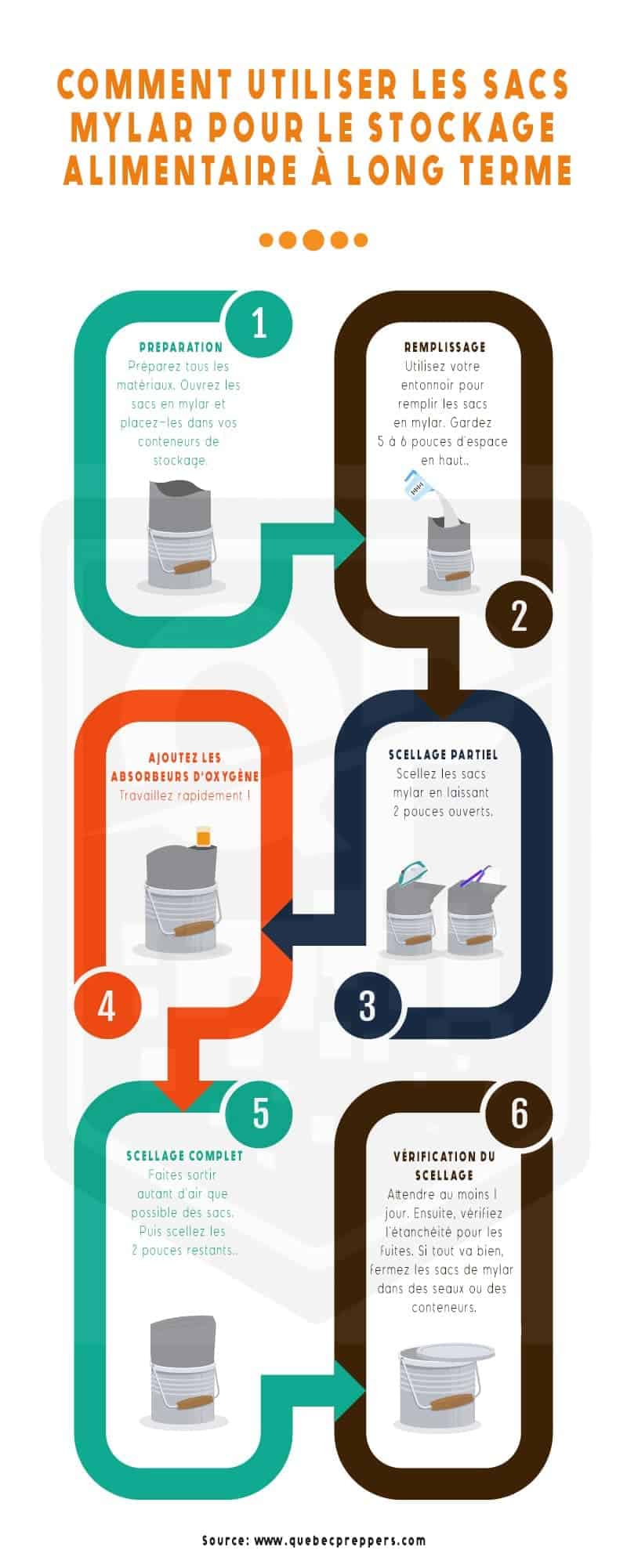
Step 1 — Preparation
Have everything set up before opening the oxygen absorbers. Once the oxygen absorbers are removed from their packaging, time is of the essence. Place the open Mylar bags into their respective buckets, line up the containers, and ensure the heat sealer is plugged in and heated up. Prepare the required number of oxygen absorbers for each bag (calculated in advance) before opening the packets.
Step 2 — Loading the food
Fill the bags using a scoop or a funnel. Shake the bag to settle the food. Leave 10 to 12 cm (4 to 5 in.) of space at the top of the bag—an overfilled bag is difficult to seal properly. Label each bag and its container with the contents and the date. Cover the label with clear adhesive tape to protect it from wear.
Caution when handling 7.5-mil bags: wear gloves. These thick bags have sharp edges that can cut your fingers during handling.
Step 3 — Partial sealing
Preheat the sealer. Seal the bag, leaving an opening of 3 to 5 cm (1 to 2 in.) along the side. Ensure that no food particles are in the sealing area, as this would compromise the integrity of the seal. Wear gloves during this step, as the bag will become hot.
Step 4 — Adding oxygen absorbers
Open the oxygen absorber (OA) packets and add them to the bags according to the specified quantities. Work quickly: the goal is to seal all the bags within 10 to 20 minutes. The longer the OAs are exposed to ambient air, the less residual capacity they will have to function effectively inside the bag.
Step 5 — Final Sealing
Press on the bag to expel any remaining air. Seal the final 3 to 5 cm. The seal should be placed as high up on the bag as possible to allow for extra space in case it needs to be reopened later.
Step 6 — Checking the Seal
Wait at least 24 hours. Visually inspect the seal and test its airtightness by pressing on the bag. If the oxygen absorbers (OAs) have worked correctly, the bag may appear partially compressed—however, since nitrogen (which is not absorbed) remains inside, the bag might also look full while still being perfectly sealed.
Step 7 — Closing the Containers
Once the seal is confirmed to be airtight, close the buckets or containers securely. Store them in a cool, dry place, away from light. For emergency food supplies, avoid areas prone to flooding. An ideal location would be a root cellar, an indoor pantry, or a basement with a stable temperature.
Summary Diagram
Choosing Your Mylar Bags
Size
Mylar bags are generally available in sizes ranging from 1 gallon (3.8 L) to 6 gallons (22.7 L). For reference, a one-gallon bag holds approximately 2.7 to 3.3 kg (6 to 7 lbs) of rice. A 5-gallon bag can hold approximately 11 to 17 kg (25 to 37 lb).
For family use, 1-gallon bags are generally more practical than larger sizes. If a 5-gallon bag is opened during an emergency, it is unlikely that the entire contents can be consumed before they begin to degrade. Smaller sizes also allow for better portion management across a variety of stored foods—for instance, 2.7 kg of dehydrated onions occupies a very different volume than 2.7 kg of rice.
Thickness
The most common thicknesses are 4.3 mil and 7.5 mil (1 mil = 0.0254 mm). 7.5-mil bags offer greater puncture resistance but are less flexible, which slightly limits the amount of food that can be packed into them. 4.3-mil bags are more pliable, allowing for tighter, more compact packing. Both types are suitable for stationary storage inside buckets. For situations involving frequent transport, 7.5-mil bags provide superior mechanical protection.
Bags with a Zipper Closure
A zipper closure makes handling easier both during and after the sealing process; it allows the bag to be closed temporarily—without the need for heat sealing—and helps keep food particles away from the area intended for the heat seal. It also remains useful after the bag has been opened, allowing it to be resealed between uses. Note, however, that a zipper closure is not a substitute for heat sealing.
Recommended Products
- 10 x 5-gallon Mylar bags
- 5 mil thickness
- 10 x 2,000 cc ShieldPro oxygen absorbers (absorb between 200% and 300% of their rated capacity)
- 50 x 1.8-liter Mylar bags
- 5 mil thickness
- 500 cc oxygen absorbers included, in sealed packs of 10
- Adjustable to 210°C (410°F) — optimal for Mylar
- Lightweight and easy to handle
- Locking mechanism for continuous sealing
- Adjustable temperature up to 230°C (450°F)
- 2.5 cm (1 in) sealing plate
- 2.4 m (8 ft) power cord
Capacity by food type
The following values are estimates — actual density varies based on particle size, settling, and how the bag is filled.
| Food Type | 1 gallon (3.8 L) | 5 gallons (18.9 L) |
|---|---|---|
| Rice | 2.3–3.3 kg (5–7.3 lb) | 11–17 kg (25–37 lb) |
| Whole-grain white wheat | 2.3–3.4 kg (5–7.5 lb) | 11–17 kg (25–38 lb) |
| Flour | 2.3 kg (5 lb) | 11–15 kg (25–33 lb) |
| Corn grits (polenta) | 2.3–2.7 kg (5–6 lb) | 15 kg (33 lb) |
| Beans (black, pinto, white, etc.) | 2.3–3.2 kg (5–7 lb) | 11–18 kg (25–40 lb) |
| Lentils | 3.2 kg (7 lb) | 16 kg (35–36 lb) |
| Macaroni | 1.8 kg (4 lb) | 9–9.5 kg (20–21 lb) |
| Potato flakes | 1.1 kg (2.5 lb) | 5.5–6 kg (12–13 lb) |
| Dried diced carrots | 1.5 kg (3.3 lb) | 7–7.5 kg (16–17 lb) |
| Powdered milk | 2.3–2.7 kg (5–6 lb) | 13–14 kg (29–30 lb) |
| Powdered eggs | 1.9 kg (4.2 lb) | 9–9.5 kg (20–21 lb) |
Frequently Asked Questions
Can a Mylar bag be reused after it has been opened?
Yes, provided the bag is in good condition (no punctures, no creases in the seal area) and the sealed edge was cut high enough to leave sufficient material for a new seal. In practice, 7.5-mil Mylar bags hold up better to reuse than 4.3-mil bags. A reused bag with a clean sealing area and a fresh oxygen absorber is perfectly suitable for medium-term storage.
Why isn’t the bag vacuum-sealed after it has been closed?
Air consists of approximately 78% nitrogen and 21% oxygen. Oxygen absorbers remove the oxygen, but not the nitrogen. The volume of nitrogen remaining in the bag explains why the “vacuum-packed” look—typical of true vacuum sealing—does not always occur. A bag that is not compressed can still be perfectly sealed and safe; verify the integrity of the seal physically rather than visually.
What storage temperature should be targeted to maximize shelf life?
A range of 10–15°C (50–59°F) is ideal for most dry foods. Every 5.6°C (10°F) increase in temperature reduces the shelf life by approximately half. An uninsulated garage, an attic, or any area subject to significant seasonal fluctuations is not an ideal location. A stable basement, a root cellar, or an indoor pantry are the best choices.
What bag size is best to start with?
For family use, 1-gallon (3.8 L) bags are generally the most practical size. They allow for storing manageable quantities, diversifying the types of food per bag, and limiting waste once a bag is opened. 5-gallon bags are better suited for items consumed in large, regular quantities—such as rice, beans, or flour—that can be used up quickly after opening. To start, prioritize medium-sized bags and ensure regular rotation.
Do salt and sugar require oxygen absorbers?
No. Salt will harden into a solid block if it comes into contact with an oxygen absorber (OA). White sugar will also harden, and brown sugar contains too much moisture to be stored with OAs. These two items should be stored in heat-sealed Mylar bags *without* oxygen absorbers—they are not susceptible to oxidation. Simply store salt and sugar in sealed Mylar bags, omitting the OA.
Long-Term Food Supply: A Comprehensive Method
Beyond Mylar: Building a sustainable, balanced, and rotating food supply to ensure self-sufficiency for periods ranging from several weeks to several months.
How to Dehydrate Food for Emergencies
Producing your own dehydrated food for Mylar storage—methods, equipment, and key considerations for effective home dehydration.
Food Storage Guide: 9 Effective Tips
The Fundamentals of Emergency Food Storage—rotation, optimal conditions, common pitfalls, and practical organization of your food reserves.
Sources and References
Local guidelines and product manuals take precedence for your specific situation. References consulted for this update include:
- Utah State University — Food Storage and Low-Oxygen Packaging
Related resources
Equipment to compare for your needs
Some links below are affiliate links: we may receive a commission at no additional cost to you. Products are examples by function, to choose according to your needs; buying the entire selection is unnecessary.