
In this article
Household preparedness rarely rests on a single person. When conditions deteriorate, whether because of an extended outage, an injury, a storm or a service interruption, the whole household must be able to keep essential functions going. This article offers a structured overview of the practical skills that each member of a family or group should be able to handle, according to their age and abilities.
In brief
In brief. Every vital household function, water, heating, cooking, first aid, communication, should be covered by at least two people. Take stock of everyone’s skills, identify functions that depend on one person, start with water, fire, first aid and heating, learn one skill a month as a family and write short procedure sheets. Children can learn a great deal, gradually and in a safe setting.
Why not concentrate skills in one person
In many families, tasks are naturally divided according to aptitudes, preferences or habits. This works well in normal times, but it can become a real weakness under stress or prolonged constraints.
If the person who usually handles heating is unavailable, through illness, absence or injury, and nobody else knows how the system works, the situation deteriorates quickly. The same applies to almost every vital function of a group: food, water, care, safety, communication.
Basic principle. Every critical function should be covered by at least two members of the group, not necessarily at the same level of expertise, but with enough skill to keep the essentials going. Emergency organizations apply this principle by cross-training their teams, so that one person being unavailable does not paralyse the whole.
The question of roles within the group
It helps to move beyond the idea that certain tasks “naturally” belong to certain group members, whether by gender, age or habit. A rigid division may seem efficient in normal times, but it creates blind spots when constraints change quickly. A few examples:
- if the person who cooks is unavailable for several weeks, who takes over cooking without electricity?
- if the person who usually splits the wood is injured in the middle of winter, who can do it?
- if both adults in the household are temporarily unable to act, do the teenagers know how to handle an immediate emergency?
These questions are not meant to create anxiety but to honestly identify dependencies within the group and address them gradually. Involving children in learning practical tasks is nothing dramatic: it is a normal passing-on of practical skills, like cooking, swimming or riding a bike, adapted to each child’s age.
Seventeen skills to share across the group
The list below covers the main categories of skills that let a group keep its basic functions running when conditions deteriorate. It is neither exhaustive nor a rigid program: each family adapts it to its context, environment and resources.
| Area | Skill | What it covers |
|---|---|---|
| Water | 1. Water supply and treatment | Finding alternative sources, knowing treatment methods (boiling, filtration, chemical disinfection) and the minimum quantities needed. |
| Fire and heating | 2. Making fire | Lighting and maintaining a fire safely, with several ignition methods. Accessible early on, with appropriate supervision. |
| 3. Managing heating | Understanding backup heating (wood stove, indoor-rated propane appliance, etc.), fuelling and adjusting it, recognizing a problem and checking carbon monoxide alarms. | |
| 4. Cutting and splitting wood | Using an axe, hatchet or saw efficiently and safely; familiarity with the tool reduces the risk of injury. | |
| 5. Cooking off-grid | Preparing meals without electricity: camp stove (outdoors or in a ventilated space depending on the appliance), campfire, wood stove, solar oven; managing rations. | |
| Food | 6. Preserving food | Canning with tested methods, lacto-fermentation, dehydration, dry storage; reducing waste. |
| 7. Gardening | Planning a vegetable garden, managing sowing, caring for soil; even a small garden or balcony contributes to self-reliance. | |
| 8. Fishing and hunting | Knowing the local legal framework (licences, seasons) and how to clean and prepare fish or game. | |
| 9. Identifying edible plants | Recognizing a few safe local species and the toxic ones; this requires serious, gradual training. | |
| Health | 10. First aid | Controlling bleeding, performing CPR, using a defibrillator, treating a burn, immobilizing a fracture, recognizing warning signs; ideally with certified training. |
| Maintenance and logistics | 11. Home repairs | Stopping a leak, shutting off water, gas and electricity, making temporary roof or window repairs, maintaining the stove or generator. |
| 12. Washing clothes by hand | Washing, rinsing and drying laundry without a machine: an often-overlooked task that quickly becomes important during a long outage. | |
| 13. Sewing and mending | Repairing clothing, equipment and tarps to extend their life. | |
| 14. Navigation and outdoor skills | Reading a map, setting up an emergency shelter, signalling, preventing hypothermia. | |
| 15. Managing backup power | Charging essential devices, using a generator only outdoors, away from openings, and handling fuel safely. | |
| Communication and safety | 16. Communicating | Knowing backup options (radio, text messages, out-of-area contact, two-way radios), getting reliable information and staying in touch with the group. |
| 17. Home safety | Preventing fires, using an extinguisher, securing entrances; where the law allows and if the household owns firearms, knowing how to store and handle them safely, in strict compliance with local regulations. |
To explore some of these areas further, see our guide to water treatment, our guide to lighting a fire, our article on starting a garden, the one on fermentation and our challenge on backup communications.
Involving children: not too early, not too late
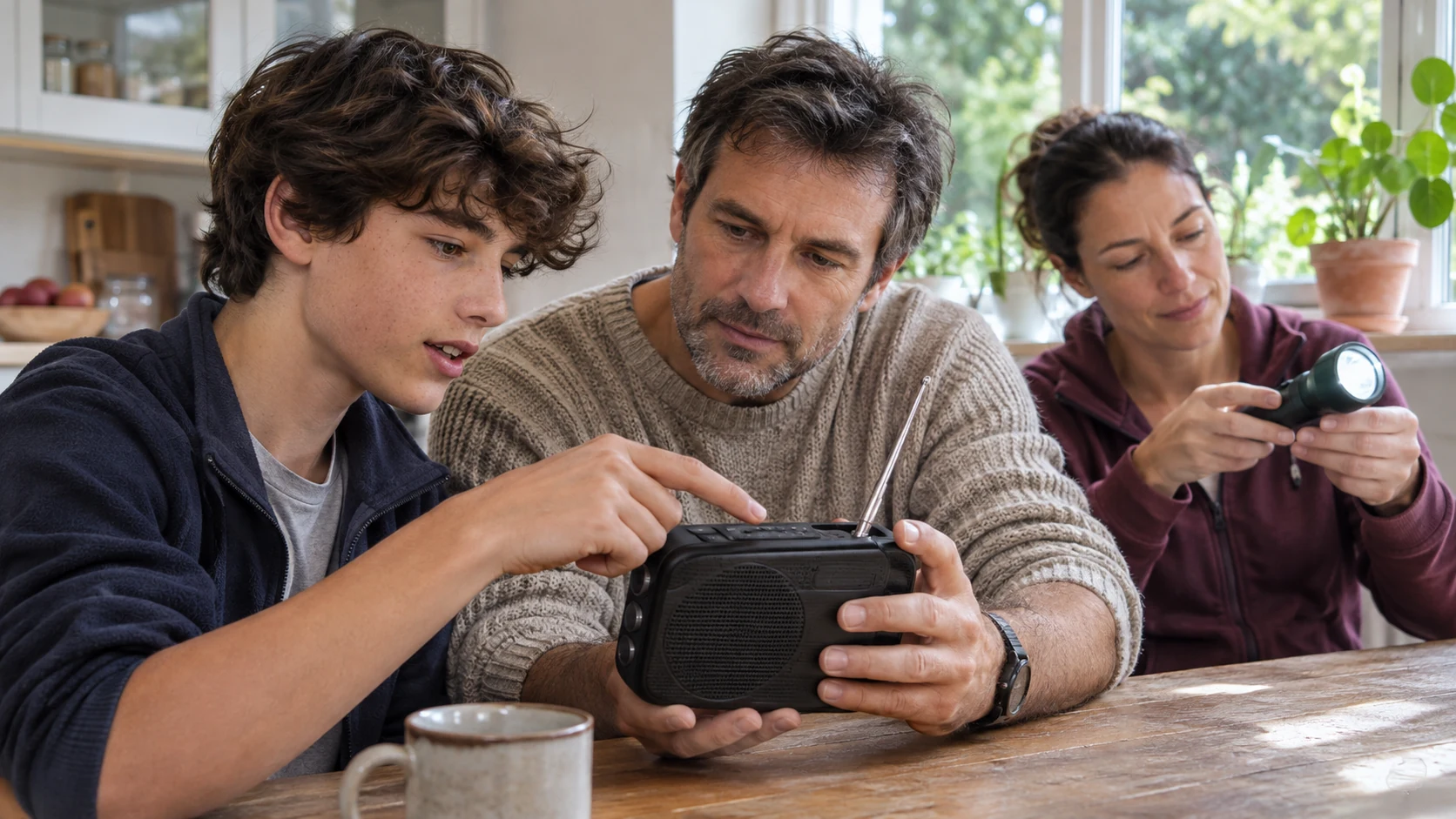
Children are often underestimated in household preparedness. In reality, practical skills can be passed on to them gradually from an early age, adapting complexity and responsibility to their development.
The aim is not to place a disproportionate burden on them, but to enable them to:
- know the basic actions in an immediate emergency, such as calling emergency services and giving their address;
- be comfortable with common household tools and equipment;
- understand the family’s procedures for a quick departure or an incident;
- contribute usefully to practical tasks suited to their age.
| Approximate age | Example skills |
|---|---|
| 4 to 6 years | Knowing their full name and address, knowing when and how to call emergency services, recognizing the fire alarm and the meeting place |
| 7 to 9 years | Packing their bag, keeping their flashlight in its place, helping refill water supplies, applying a simple bandage |
| 10 to 12 years | Feeding a stove with an adult, filtering water, following a simple route on a map, applying a pressure bandage |
| Teenagers | Taking a first aid course, cooking without electricity, shutting off water and electricity, looking after a younger sibling |
Learning in a calm, supervised setting builds confidence rather than anxiety. Familiarity with tools, axe, knife, stove, first aid kit, also reduces the risk of injury: a tool handled hesitantly is often more dangerous than one used with ease and respect for the basic rules. To learn more, see our guide to preparing children for emergencies.
Where to start: a priority-based approach
Faced with such a long list, it is easy to feel overwhelmed. The most effective approach is to progress in stages, based on the real impact of each skill in your situation. A simple method: identify the two or three most critical functions for your household (water, heating, first aid, food) and check whether at least two people can handle them independently. Close those gaps first before broadening out.
A few organizing principles
- Take an honest inventory of everyone’s current skills, without overestimating or underestimating.
- Identify at-risk functions: those that depend on one person, or that nobody is really comfortable with.
- Prioritize skills with high immediate impact: water, fire, first aid, heating.
- Plan gradual learning: one skill a month, as a family, in a hands-on way.
- Document essential procedures so they remain accessible even if the most experienced person is away.
| Function | Main person | Backup person | To learn or practise |
|---|---|---|---|
| Water | |||
| Heating | |||
| Off-grid cooking | |||
| First aid | |||
| Communication |
Filled in as a family, this small table immediately shows which functions have no backup. Our article on learning preparedness skills offers a method for making progress.
Points to watch
- Partial mastery has value. Being able to do something correctly in most situations is useful, even without being an expert.
- Documentation complements training. A procedure sheet placed near the stove, the generator or the first aid kit can make up for a gap under stress.
- The law applies at all times. Some skills, particularly those involving firearms, hunting, fishing or foraging, are regulated and vary by country, province, state or region. Check local requirements before training.
- Skills fade without practice. One-off learning is not enough: practise regularly so the actions remain available under pressure.
- Safety comes first. Axes, fires, stoves and generators carry risks: supervise learning and follow manufacturers’ instructions.
Summary
A well-prepared family or group is not one in which a single person has all the skills, but one in which critical functions can be covered by several members under varying conditions. This sharing of skills cannot be improvised: it is built gradually, through hands-on learning, regular practice and organization planned in advance.
The goal is neither perfection nor mastery of every skill listed here. It is everyday resilience: a group’s ability to keep its essential functions going even when conditions change, resources become scarce or a member is unavailable. For an overview, see our skills framework.
Frequently asked questions
How many skills should we aim for?
There is no ideal number. What matters is that each critical function in your household (water, heating, food, first aid, communication) has at least two people capable of handling it.
From what age can a child learn these skills?
From about four or five for the basics, such as knowing their address and how to call emergency services. More technical skills come gradually, always supervised and adapted to the child’s maturity.
Do we need to take paid courses?
Not necessarily. Many skills can be learned as a family, from neighbours or through community groups. For first aid, however, certified training is still strongly recommended.