
In this article
Fermentation transforms food with microorganisms under controlled conditions. It can diversify cooking and some forms of conservation. It does not automatically make all products stable without refrigeration and does not replace health rules, a proven recipe or a person’s health needs.
Choose a specific method
Lacto-fermentation of vegetables, yogurt, kefir, kombucha, miso, tempeh and natto are based on different ingredients, cultures and conditions. A brine rule for a vegetable does not allow all these foods to be prepared. Start with a single tested recipe, with quantities and material you can follow.
Salt can play an essential role in the selection of microorganisms from a fermentation. Do not decrease its amount to adapt the taste without a validated method. An approximate measure in spoons becomes particularly uncertain when the grain size changes. Respect the units and how to weigh indicated by the exact recipe.
Prepare equipment and ingredients
Use suitable, clean food containers with no cracks or damaged enamel. The weights, covers and exhaust systems must be suitable for the process. A closed container without a suitable device can build up pressure; do not transpose the assembly of another product.
Choose healthy vegetables and prepare them according to the recipe. A damaged raw material does not become safe because it ferments. Note the origin of the ingredients, the date, the masses and the temperature of the location. A small batch makes it possible to better observe and limit losses at the beginning.
Keep vegetable fermentation within a tested recipe
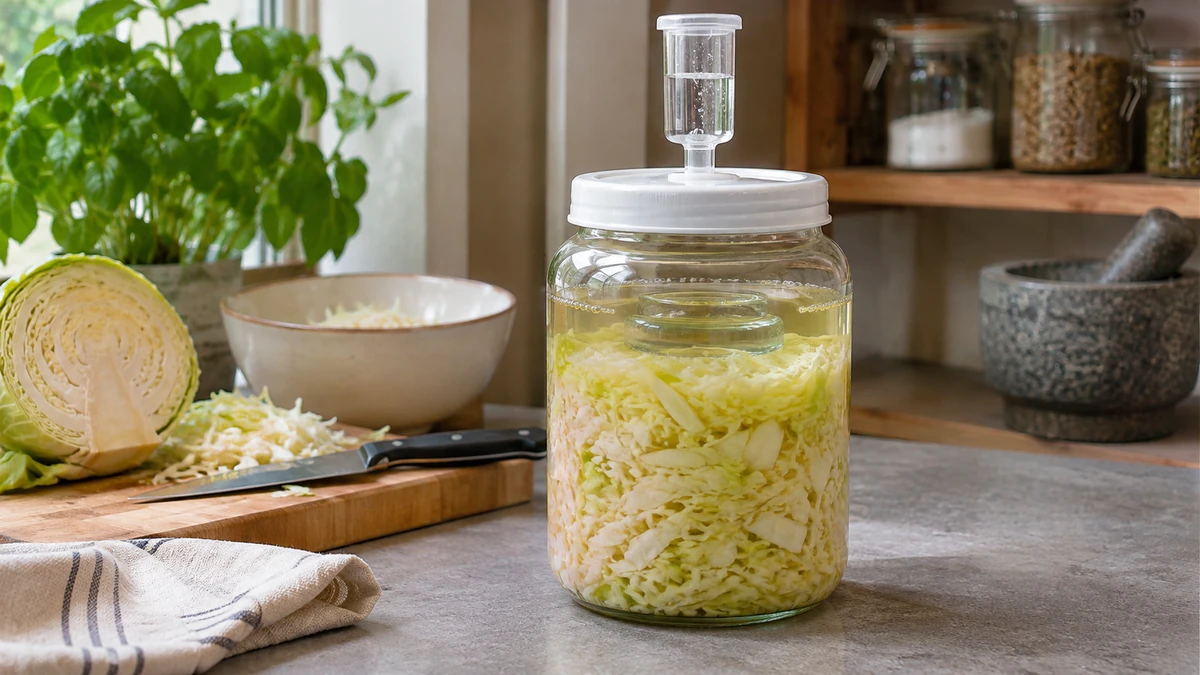
Sauerkraut and some in-brine vegetables are accessible examples when using a proven procedure. Liquid level, temperature, amount of salt and duration are part of a whole. The presence of bubbles alone does not demonstrate success or security.
Follow the expected signs and rejection instructions of the method. Do not taste a questionable lot to determine if it is safe. A pH measurement, when planned, requires appropriate equipment and use; it does not automatically validate all aspects of an improvised process.
Understand the source’s ten food categories
Sauerkraut, lacto-fermented vegetables and kimchi are three distinct tracks, with specific recipes. Kefir and yogurt use suitable cultures and, depending on the product, dairy ingredients. Fresh cheeses require sanitary control and conservation that should not be simplified into “sustainable fermented milk”.
Kombucha involves cultivation and acidification to be monitored. Miso, tempeh and natto are based on other microorganisms and processes. Their presence in a list of ten foods does not mean that they are all suitable for a beginner or that they can be stored as an industrial can.
Avoid general health promises
Fermentation can change the taste, digestibility and composition of a product. Not all fermented foods contain the same living microorganisms, especially after heating. Consumption does not guarantee to prevent an infection, treat a digestive disorder or compensate for an insufficient diet.
People with medical needs, reduced immunity or dietary restrictions should seek appropriate advice on the home products concerned. Salt, allergens, potential alcohol and manufacturing conditions matter. A “natural” qualifier does not address these issues.
Store correctly and include it in the food plan
Respect the conditions after fermentation: refrigeration, duration of use or additional treatment provided by the method. Don’t assume that a closed jar can stay on a shelf. Canning is another operation, which requires its own validated process.
For home preparation, also keep foods easy to use without ongoing fermentation. If electricity is lacking, a product requiring cold remains dependent on this function. The batch book, the labeling and a real rotation make it possible to learn without transforming a culinary experiment into a guarantee of autonomy.
Reference: National Center for Home Food Preservation, Fermentation Principles.