
In this article
Oats can be part of a food reserve if they match the habits of the household and can be prepared with the means available. Its preservation depends on the product, its packaging and real conditions. A decades-long promise does not automatically apply to any package transferred to another container.
Identify the product and instructions
Flakes, instant oats, cut grains, bran and flour are not interchangeable. Record the type, batch, date and instructions of the package. A flavoured product may contain other ingredients and require a different rotation.
Start with the duration and conditions indicated by the manufacturer. The date should not be deleted during a transfer. Avoid a 30-year-old universal grid that ignores fat, moisture, temperature and container closure.
Prioritize clean and appropriate storage
Choose a dry, cool and stable place away from chemicals and sources of contamination. Use a food contact container that is clean and suitable for the product. An old bucket of non-food product is not suitable.
Protect oats from pests and avoid adding moisture with a wet spoon. After opening, an airtight container can facilitate storage. The outer packaging must not prevent monitoring of stock conditions.
Label and organize the rotation
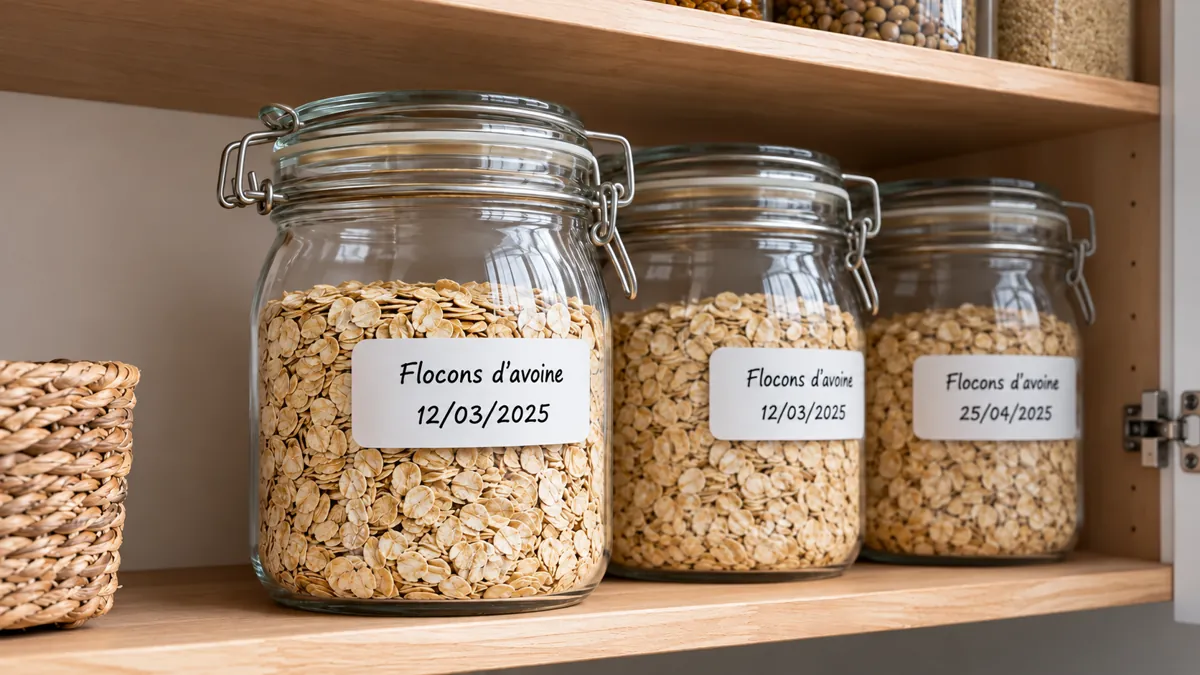
Write down the product, the batch and the useful dates. Place the products to be used first in an accessible way. Buy according to realistic consumption rather than reaching a volume presented as ideal.
A small reserve regularly used to check acceptance and preparation needs. If habits change, adjust the quantities. Rotation does not make a contaminated food safe, but limits forgetfulness and loss.
Understanding the limits of the vacuum
Removing air alone is not a suitable storage method for all foods. Products that require cold must continue to be stored according to their requirements. The absence of oxygen can change microbiological risks.
For very long-term specialized packaging, use a validated method for the food and its conditions. Do not infer that a Mylar bag, an absorber or a home closure will guarantee a certain duration or safety.
Do not improvise with chemicals
A household dehumidifier or calcium chloride intended for a room should not be added to a food container. The absence of apparent direct contact is not sufficient to qualify a product for this use.
Rice, coal and sachets recovered in a package are not a validated food method. Do not add a desiccant or absorber without checking its destination, instructions and the complete method. A preservative does not replace a food that is initially dry and healthy.
Check before consuming
Infiltration, contamination, pests, abnormal smell or doubt on conditions require proper assessment. Do not taste to prove that a product is safe and do not assume that a cooking corrects any deterioration.
Keep the lot information useful in case of a recall. If you cannot establish the conditions of conservation or the absence of contamination, seek advice from the competent services rather than relying on a theoretical duration.
Anticipate use during a breakdown
Check the water, the instructions and the necessary preparation. A reserve intended for a breakdown must also include suitable foods that do not all require cooking. Allergies and nutritional needs of the household must be respected.
Do not use a camping stove inside to make the reserve usable. Conservation and preparation are two related issues: a well-stored food must still be able to be served in safe conditions.
Sources and benchmarks
- Utah State University - Packaging and Conservation Boundaries
- Utah State University - Storage Conditions
- Utah State University - Food Storage GuideOriginal PDF · source language preserved
Two items for putting these ideas into practice
Identify containers, date batches and record food-storage conditions.
Affiliate links: as an Amazon Associate, PrépaCivile earns from qualifying purchases. These examples are optional. Check the model, package contents and terms. Use equipment you already own first.
Containers for organizing dry foods
Canada: 7.8-cup container; France: four-piece set. The offers differ in capacity and contents. Follow the stated food-storage uses.
Canada — Amazon.ca
 Contenant Rubbermaid, plastique sans BPA, Brilliance Pantry stockage hermétique des aliments, stock ouvert, cassonade (7,8 tasses)View on Amazon.ca
France — Amazon.fr
 Rubbermaid Brilliance Lot de 4 boîtes de conservation alimentaire sans BPA avec couvercles, hermétiques, résistantes aux taches, passent au lave-vaisselle, grisView on Amazon.fr
Notebook for household information
Canada: three-pack; France: individual notebook. Compare size and quantity.
Canada — Amazon.ca
 Rite in the Rain Lot de 3 cahiers à spirale résistants aux intempéries, 7,6 x 12,7 cm, couverture noire, motif universel (n° 735-3)View on Amazon.ca
France — Amazon.fr
 Rite in the Rain toutes saisons carnet a spiral , 7,6 x 12,7 cm Étanche NoirView on Amazon.fr